
Where Can I Buy Russian Oil Asset Reserve (ROAR) Crypto? Best Places to Buy ROAR in 2026


Quick Summary
If you are searching for where to buy Russian Oil Asset Reserve (ROAR) crypto, the simplest current answer is: ROAR is available on its public Solana-linked market pages. The official project site says ROAR is a speculative digital asset on the Solana blockchain, and it also says it is not backed by physical oil reserves or any government entity, which is an important detail before you buy.
At the moment, public market data shows ROAR as a small-cap, high-volatility token with a 1 billion token supply model and rapidly changing liquidity conditions. CoinGecko currently shows ROAR as a Solana ecosystem token with a market cap around $138,300 and 24-hour trading volume around $59,439.95, while the official project site emphasizes that the token is speculative rather than physically backed.
| Best buying route | Why it matters | What to check first |
|---|---|---|
| ROAR/USDT spot market | Clean central exchange route for trading ROAR against USDT | Make sure you are using the correct trading pair and account security settings |
| Public Solana liquidity | Useful for on-chain buyers who already use wallets and understand token verification | Confirm the exact contract address before swapping |
| Project official links | Helps you verify the token story, contract address, and risk disclosures | Check whether the token is described as speculative and not asset-backed |
What Is ROAR Crypto?
ROAR stands for Russian Oil Asset Reserve. The project’s official website describes it as a sovereign energy protocol on Solana, but it also clearly states that $ROAR is a speculative digital asset and not backed by physical oil reserves or any government entity. That makes the token’s name sound more traditional and commodity-like than its actual legal and financial status.
That distinction is the heart of the search intent behind “where can I buy ROAR crypto.” Most people are not only asking for a buy page. They are trying to understand whether ROAR is a real token, what kind of token it is, and whether the name means there is actual oil backing behind it. The answer from the current public record is more cautious than the branding suggests.
ROAR currently appears in public market data as a Solana ecosystem token with a 1 billion supply structure. CoinGecko shows the token among Solana ecosystem assets, and the official site lists a contract address on Solana, which strongly suggests that ROAR is meant to be traded within the Solana on-chain environment.

Where Can I Buy Russian Oil Asset Reserve (ROAR) Crypto?
As of April 2026, Russian Oil Asset Reserve (ROAR) is primarily traded through Solana-based decentralized exchanges (DEXs) rather than major centralized exchanges. Current public market data shows ROAR is listed across 2 exchanges and 5 active markets, with live price discovery and on-chain liquidity.
The most practical way to buy ROAR right now is through a Solana wallet connected to a DEX aggregator or Solana-native swap platform. Because ROAR is a small-cap token with fast-moving liquidity, buyers should always verify the official contract address before swapping. The project’s official website and CoinGecko both publish the Solana contract for verification.
ROAR Official Contract Address:
RoARruzbesVGAZgCzSoQCEdyVWytvzLbyNaxXBF7dnF
| Buying method | Best for | Key thing to check |
|---|---|---|
| Solana DEX aggregator | Most users | Exact ROAR contract |
| Solana-native DEX | Experienced on-chain traders | Slippage and liquidity |
| Waiting for CEX listings | Conservative users | Official listing announcements |
Current ROAR Market Overview
ROAR is still a very small asset in market-cap terms, and that is exactly why it can move so quickly. CoinGecko currently shows a market cap of about $138,300, a 24-hour volume around $59,439.95, and a top market route on decentralized exchanges. The site also shows an all-time high of $0.002573 and an all-time low of $0.000009032, which highlights how wide the token’s historical range has already been.
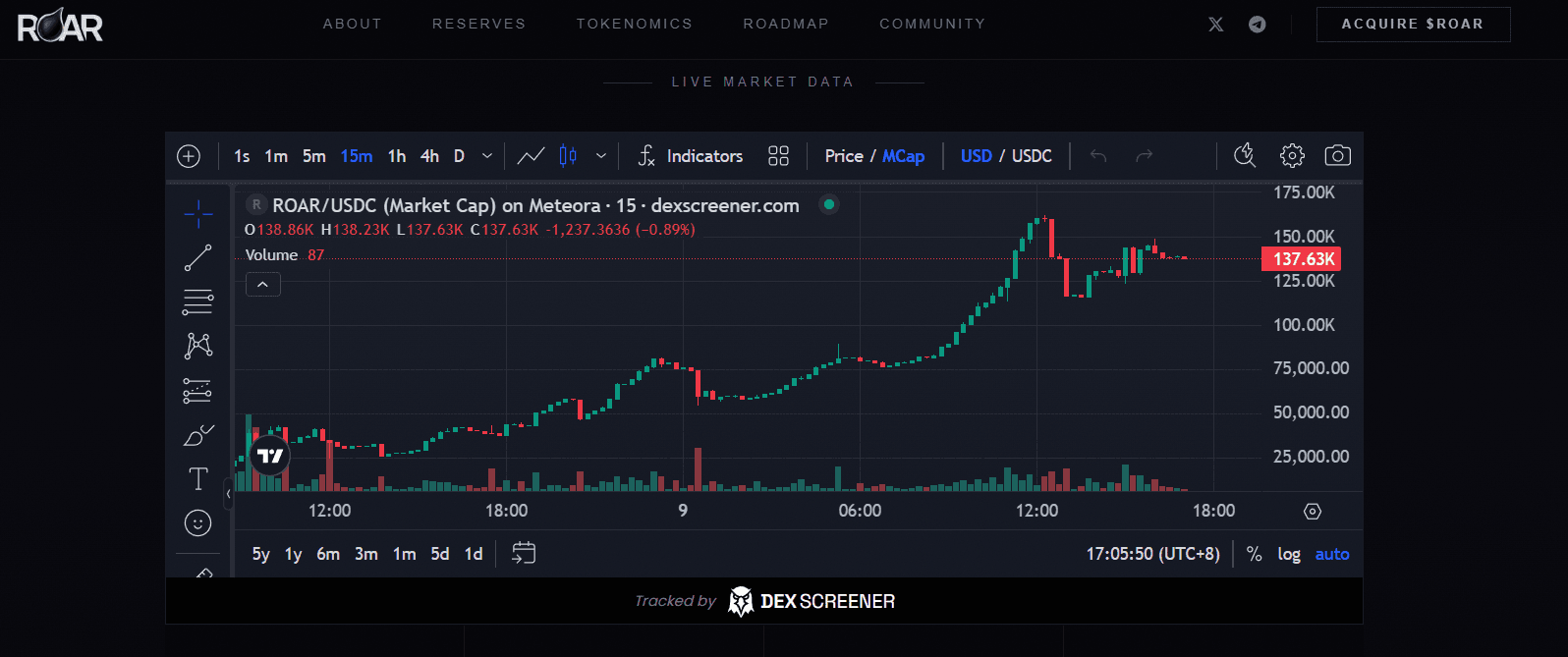
The official project site adds another important piece: it says the token has 1B holders / total supply language on the page, while also stating that ROAR is speculative and not backed by real oil reserves. That mix of language and disclaimer is one reason many users search for a plain answer before they buy.
Some live pages show much larger activity snapshots than CoinGecko’s current summary, which suggests that public data on ROAR can vary depending on the tracker and timing. That is not unusual for a very fast-moving token, but it does mean buyers should treat live numbers as snapshots rather than permanent truths.
| Metric | Latest public snapshot |
|---|---|
| Token name | Russian Oil Asset Reserve |
| Ticker | ROAR |
| Chain | Solana |
| Official site description | Speculative digital asset, not backed by physical oil reserves or government |
| CoinGecko market cap | About $138,300 |
| CoinGecko 24h volume | About $59,439.95 |
| CoinGecko ATH | $0.002573 |
| CoinGecko ATL | $0.000009032 |
How to Buy ROAR Safely
To buy Russian Oil Asset Reserve safely:
First, set up a Solana-compatible wallet.
Second, fund it with SOL or a supported stablecoin.
Third, copy the official ROAR contract address from a trusted source such as the project website or CoinGecko.
Fourth, connect your wallet to a DEX or aggregator and search using the contract address instead of just typing “ROAR.”
Finally, start with a small amount because ROAR is highly volatile.
CoinGecko currently shows ROAR as a Solana ecosystem token with a total supply close to 1 billion, and also flags that contract permissions may still allow changes, which increases risk.
Important Risk Note
Despite its name, ROAR is not backed by physical oil reserves or any government entity. The project’s own materials describe it as a speculative digital asset, meaning its value depends entirely on market demand rather than real-world commodity collateral.
That means buyers should treat ROAR as a high-risk narrative token, not as a commodity-backed reserve product.
How to Buy ROAR on-Chain
If you prefer on-chain trading, the public information suggests ROAR is primarily a Solana token with live liquidity somewhere in the Solana ecosystem. CoinGecko lists it in the Solana ecosystem category, and the official site exposes a Solana contract address for verification. That means a wallet-based buyer should always confirm the exact contract before swapping.
On-chain buying is attractive because it gives you direct control, but it also brings more responsibility. You need to verify the contract address, understand the token decimals, check slippage tolerance, and make sure you are interacting with the intended market pair. For a token like ROAR, that step is not optional. It is the difference between buying the real asset and buying something that just looks similar.
Is ROAR Backed by Real Oil?
The clearest answer from the current public sources is no confirmed public backing has been shown. The official ROAR website explicitly says the token is not backed by physical oil reserves or any government entity, even though it uses strong energy and sovereignty language in its branding.
That is a big deal because many people who search for “Russian Oil Asset Reserve” will naturally assume there is a reserve model behind the token. The current public record does not support that assumption. Instead, it points to a speculative Solana token that uses oil-themed storytelling as part of its market identity.
This is also why search intent matters so much. A buyer who only reads the ticker name may expect a commodity-style asset, but the disclaimer tells a different story. For SEO readers, this is the exact kind of information they need before they decide whether ROAR belongs in their portfolio at all.
Why ROAR Can Move So Fast
ROAR is the kind of token that can move quickly because its market structure is small, narrative-driven, and highly sentiment-sensitive. CoinGecko’s current market cap and trading volume place it firmly in micro-cap territory, which usually means price changes can be outsized when volume picks up.
The official site’s energy branding also helps create attention. When a token sounds like a reserve asset, traders may react to the story before they fully analyze the fundamentals. That can create short bursts of demand, especially if social chatter or momentum traders pile in at the same time.
That is why ROAR should be treated as a high-risk token rather than a slow, stable holding. The current public data does not support the idea of a deeply institutionalized reserve asset. It supports the idea of an energetic, speculative, Solana-based narrative token with a real market and real volatility.
What to Check Before You Buy ROAR
Before buying ROAR, the most important step is verifying the contract address listed on the official project site. The site publishes the address directly, which helps reduce the risk of buying the wrong token.
Next, confirm the route you are using. If you want a simpler exchange-style experience, the ROAR/USDT spot market is already live. If you want to use a wallet and on-chain liquidity, make sure you are comfortable with Solana token verification and slippage control.
Finally, compare live market snapshots instead of trusting a single number. CoinGecko currently shows one market view, while the project site shows a different emphasis on disclaimers and token identity. For a token as small and speculative as ROAR, that broader view is much safer than chasing a single price screenshot.
| Checklist item | Why it matters |
|---|---|
| Confirm ROAR contract address | Prevents wrong-token mistakes |
| Check the buy route | Determines whether you use Exchange or on-chain liquidity |
| Review the project disclaimer | Tells you whether the token is really asset-backed |
| Watch market cap and volume | Helps you judge liquidity and volatility |
| Use small position sizing | Reduces damage from sudden reversals |
Should You Buy ROAR?
ROAR is interesting, but it is not the kind of asset you buy casually. The token has real market presence, a live spot market on Exchange, and public on-chain identity, but the official project itself says it is speculative and not physically backed. That combination creates opportunity, but it also creates risk.
If you are a trader who understands micro-cap volatility, ROAR may be worth watching closely because it sits in a narrative that can attract attention fast. If you are looking for something straightforward, transparent, and low-stress, ROAR is probably not that. The current public record makes that pretty clear.
For readers who already trade speculative tokens, the most practical move is to use a route that is easy to access and easy to verify.
FAQ
What does ROAR stand for?
ROAR stands for Russian Oil Asset Reserve. That is the full name used by the project and by current market pages.
Where can I buy ROAR crypto?
As of April 2026, Russian Oil Asset Reserve (ROAR) is primarily traded through Solana-based decentralized exchanges (DEXs) rather than major centralized exchanges. Current public market data shows ROAR is listed across 2 exchanges and 5 active markets, with live price discovery and on-chain liquidity.
Is ROAR backed by real oil reserves?
No confirmed public evidence shows that ROAR is backed by physical oil reserves. In fact, the official project site says it is not backed by physical oil reserves or any government entity.
Is ROAR on Solana?
Yes. The official site describes ROAR as a Solana-based asset, and CoinGecko also categorizes it under the Solana ecosystem.
Is ROAR risky to trade?
Yes. ROAR is a small, speculative token with a volatile market profile, and the official site itself says it is a speculative digital asset. Its low market cap and shifting liquidity make it a high-risk trade.