
What Is a Gold-Backed Token? Tether Gold vs PAX Gold Explained

In the second half of 2025, gold briefly pushed past $4,500 per ounce, as a weaker U.S. dollar and shifting rate-cut expectations drove capital back into assets not tied to government credit. Inside the crypto market, one answer keeps surfacing: gold-backed tokens. Unlike physical bullion, ETFs, or paper gold, on-chain gold trades 24/7, settles instantly, and moves globally without banks, clearing houses, or geographic friction, turning gold into a liquid, crypto-native instrument.
By 2025, this trend has narrowed the spotlight to two names:PAX Gold (PAXG) and Tether Gold (XAUT). Searches around PAXG crypto, is PAX Gold safe, is PAX Gold a good investment, and Tether Gold vs PAX Gold have become some of the most frequent gold-related queries across both crypto traders and institutional desks. With gold prices surging and macro uncertainty lingering, choosing between these two gold-backed tokens is no longer theoretical — it is a practical portfolio decision.

What Is a Gold-Backed Token?
A gold-backed token is built around a simple promise: one token equals real, physical gold held in custody. Tokens are minted only when gold already exists in a professional vault, and their market price closely follows spot gold. The structure resembles a digital warehouse receipt. Instead of holding a certificate or relying on ETF mechanics, the investor holds a blockchain asset that represents ownership of bullion stored off-chain.
This design matters because it removes friction. Gold-backed tokens trade continuously, clear instantly, and can be transferred globally within minutes. In practice, gold starts behaving more like a liquid crypto asset — without losing its connection to real-world value. That efficiency explains why gold-backed tokens have moved from a niche product into a serious portfolio tool.

What Makes a Gold-Backed Token Work
At its core, a gold-backed token is a digital claim on physical gold. Tokens are issued only when real gold bars already exist in custody, and prices closely track the spot gold market. Instead of holding paper certificates or navigating ETF mechanics, traders hold a blockchain asset that represents bullion stored in professional vaults.
This structure changes how gold behaves. Settlement is instant. Trading is continuous. Transfers are global and bank-free. For traders used to crypto market speed, gold-backed tokens remove many of the frictions that have traditionally made gold awkward to use tactically.
PAX Gold (PAXG): How PAXG Crypto Is Structured
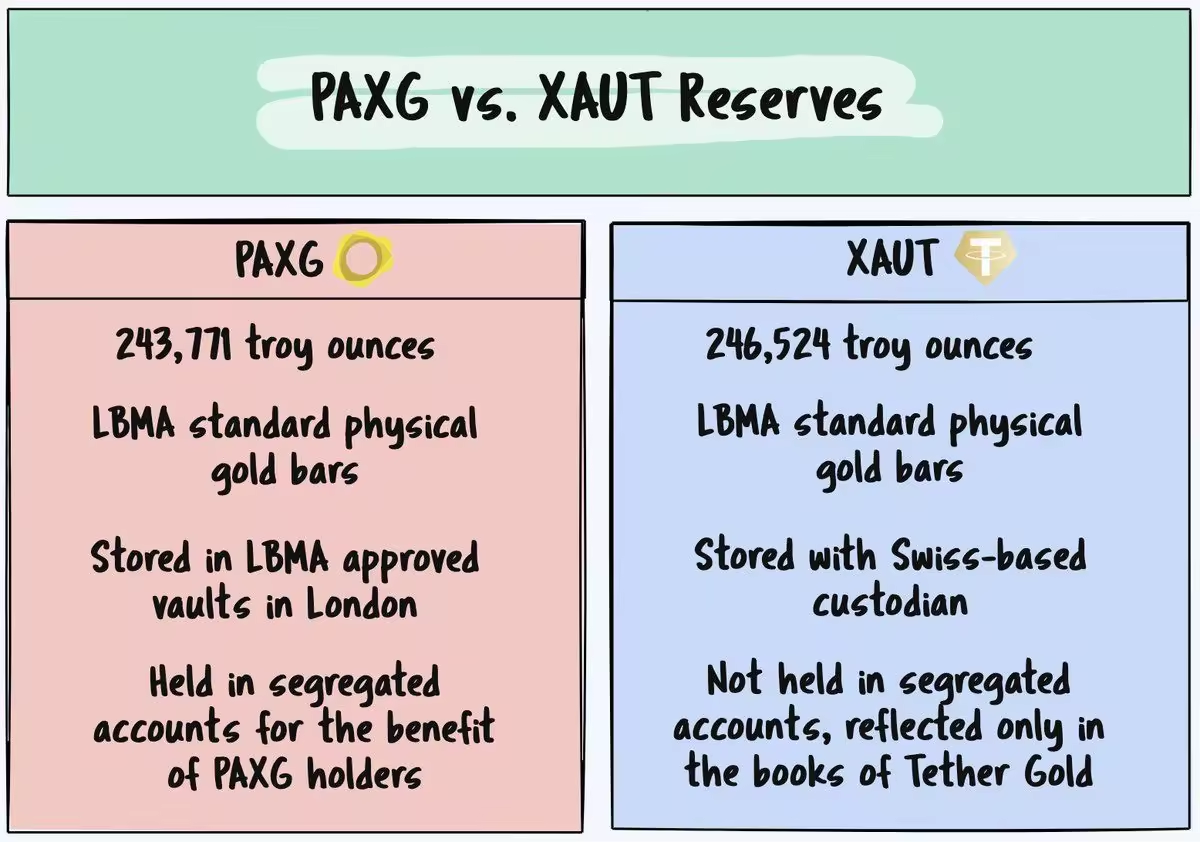
PAX Gold is widely treated as the reference standard for gold-backed tokens. Each PAXG token represents one fine troy ounce of gold, fully backed and stored in LBMA-accredited Brink’s vaults in London. The underlying bars are 400-ounce “Good Delivery” bars, the same format used by central banks and major bullion desks.
What separates PAXG crypto from many alternatives is direct allocation. Each token corresponds to specific gold bars with identifiable serial numbers. Holders are not exposed to pooled or unallocated gold; they have a clear claim on physical bullion. That structure directly addresses one of the most common questions in this market: is PAX Gold safe.
Issuance is handled by Paxos Trust Company, a New York State-chartered trust regulated by the NYDFS. In 2025, when U.S. authorities intensified scrutiny on stablecoins and asset-backed tokens, Paxos continued to be cited as a compliance benchmark. Full reserves, legal segregation of assets, and transparent audits kept PAX Gold on the right side of regulatory conversations. Monthly attestations by Withum confirm that the circulating PAXG supply is fully backed at all times.
Tether Gold vs PAX Gold: The Difference That Actually Matters
At a glance, Tether Gold and PAX Gold look nearly identical. Both represent one ounce of gold per token. Both aim to track spot prices closely. Both trade across major crypto platforms. The real decision rarely comes down to price mechanics.
The difference shows up in regulation and disclosure. PAX Gold operates inside a clearly defined U.S. regulatory framework, with frequent third-party attestations and segregated custody. Tether Gold, while backed by physical gold stored in Swiss vaults, offers less formal regulatory transparency. That gap may not matter to every user, but it becomes significant for institutions, funds, and compliance-driven traders.
Market behavior reflects this split. PAXG crypto appears more often in institutional research, regulated trading environments, and DeFi protocols that prioritize compliance. Tether Gold is more commonly favored by users already embedded in the broader Tether ecosystem, where familiarity and liquidity take precedence over regulatory clarity.
Is PAX Gold a Good Investment for Traders?
When people ask is PAX Gold a good investment, they are usually not looking for explosive upside. Gold has never been a growth asset, and PAXG doesn’t pretend to be one. Its value lies elsewhere.
PAX Gold tracks spot gold closely, with minimal long-term deviation. Short-term premiums or discounts can appear during periods of volatility or regional demand spikes, but arbitrage tends to close those gaps quickly. From a trader’s perspective, PAXG behaves exactly as digital gold should.
That makes PAXG crypto a risk-management instrument. During equity drawdowns, geopolitical stress, or currency weakness, rotating capital into PAX Gold provides gold exposure without exiting the crypto ecosystem. It also serves as a parking asset when holding fiat-backed stablecoins feels less attractive under inflation or policy uncertainty.
Seen through this lens, PAX Gold is not a speculative bet. It functions as infrastructure — a way to hold gold with the speed, liquidity, and accessibility crypto traders expect.
Is PAXG Safe Compared With Other Gold-Backed Tokens?
Safety in a gold-backed token comes down to three factors: custody, audits, and legal structure. PAXG scores strongly across all of them. The gold is stored in recognized vaults, ownership claims are legally enforceable, and supply is independently verified on a monthly basis. In insolvency scenarios, customer assets remain segregated from the issuer’s balance sheet.
That combination explains why “is PAXG safe” remains one of the most searched questions in this category, and why PAX Gold often serves as the benchmark in gold-backed token comparisons.
Trading PAX Gold on WEEX
For traders who actively trade gold-backed tokens rather than passively hold them, execution quality matters. WEEX provides an environment built for assets like PAXG, where liquidity depth, price accuracy, and risk control directly affect outcomes. With institutional-grade liquidity providers and advanced risk management systems, WEEX allows traders to access PAX Gold without the friction typically associated with physical gold or traditional commodity markets.
In fast-moving macro conditions, where gold reacts sharply to rate expectations or geopolitical headlines, the ability to trade PAXG with low latency becomes a functional advantage, not a marketing slogan.
Final Thoughts: Gold-Backed Tokens and the Role of PAX Gold
Gold-backed tokens represent a quiet shift in how traders interact with real-world assets. Instead of choosing between crypto volatility and traditional finance rigidity, assets like PAXG crypto sit in the middle.
Between Tether Gold vs PAX Gold, the choice usually reflects priorities. Traders who value regulatory clarity, audit transparency, and institutional credibility tend to favor PAX Gold. Those focused on ecosystem familiarity may choose differently.
For anyone asking is PAX Gold a good investment, the answer depends on intent. It is not designed to outperform growth assets. But as a hedge, a store of value, and a bridge between gold and crypto liquidity, PAX Gold has established itself as one of the most credible gold-backed tokens available in 2025.
You may also like

$龙虾 Airdrop on WEEX: Complete Guide to Lobster and Claim Free $龙虾
Explore the BNB Chain meme token's supply and community role, then learn how to join the 30,000 USDT WEEX campaign before June 30, 2026 at 17:00 UTC+8.
$ARX Airdrop on WEEX: Complete Guide to Arcium and Claim Free $ARX
Arcium tokenomics connect confidential-compute staking and governance with ARX utility, while the WEEX ARX campaign lets eligible users claim rewards from a 50,000 USDT pool before June 29, 2026 at 21:10 SGT.

$ARX Airdrop on WEEX: Complete Guide to Arcium and Claim Free $ARX
Arcium tokenomics connect confidential-compute staking and governance with ARX utility, while the WEEX ARX campaign lets eligible users claim rewards from a 50,000 USDT pool before June 29, 2026 at 21:10 SGT.
$RE Airdrop on WEEX: Complete Guide to Re Protocol and Claim Free $RE
Explore Re Protocol's insurance-capital ecosystem and $RE tokenomics, then learn how to join the WEEX 50,000 USDT $RE airdrop campaign before June 25, 2026 at 22:10 UTC+8.
$O Airdrop on WEEX: Complete Guide to o1.exchange and Claim Free $O
Explore $O tokenomics, the o1.exchange trading ecosystem, and how to join the WEEX 50,000 USDT reward campaign before June 25, 2026 at 00:00 (UTC+8).

$RE Airdrop on WEEX: Complete Guide to Re Protocol and Claim Free $RE
Explore Re Protocol's insurance-capital ecosystem and $RE tokenomics, then learn how to join the WEEX 50,000 USDT $RE airdrop campaign before June 25, 2026 at 22:10 UTC+8.

$O Airdrop on WEEX: Complete Guide to o1.exchange and Claim Free $O
Explore $O tokenomics, the o1.exchange trading ecosystem, and how to join the WEEX 50,000 USDT reward campaign before June 25, 2026 at 00:00 (UTC+8).
$ASTEROIDETH Airdrop on WEEX: Complete Guide to Asteroid Shiba and Claim Free $ASTEROIDETH
Learn the Asteroid Shiba story, Ethereum meme-token details, and how to claim free tokens in the WEEX 50,000 USDT ASTEROIDETH airdrop before June 23, 2026 at 17:10 UTC+8
$QAIT Airdrop on WEEX: Complete Guide to QAIT and Claim Free $QAIT
Learn QAIT tokenomics, SEALCOIN ecosystem utility, and how to claim free tokens in the WEEX 50,000 USDT QAIT airdrop before June 18, 2026.
$FUTUON Airdrop on WEEX: Complete Guide to Futu Holdings Tokenized Stock and Claim Free $FUTUON
Learn FUTUON tokenomics, Ondo's tokenized-stock ecosystem, and how to claim free FUTUON rewards through the WEEX 50,000 USDT airdrop before June 17, 2026 at 17:00 UTC+8.
$SLX Airdrop on WEEX: Complete Guide to Solstice and Claim Free $SLX
Explore Solstice tokenomics, the SLX utility model, and how new users can join the WEEX SLX airdrop for a share of the 50,000 USDT prize pool before June 15, 2026 at 23:00 UTC+8.
$THREE Airdrop on WEEX: Complete Guide to three.ws and Claim Free $THREE
Explore three.ws tokenomics, its 3D AI agent ecosystem, and how to claim free THREE campaign rewards through the WEEX 50,000 USDT airdrop before June 11, 2026 at 17:00 UTC+8.

How to Earn Crypto for Free in 2026: WEEX WXT Ecosystem Carnival Guide

$THREE Airdrop on WEEX: Complete Guide to three.ws and Claim Free $THREE
Explore three.ws tokenomics, its 3D AI agent ecosystem, and how to claim free THREE campaign rewards through the WEEX 50,000 USDT airdrop before June 11, 2026 at 17:00 UTC+8.
$CTR Airdrop on WEEX: Complete Guide to Citrea and Claim Free $CTR
Learn Citrea's Bitcoin application-layer ecosystem, $CTR tokenomics, and how to claim free CTR campaign rewards through the WEEX 50,000 USDT CTR airdrop before June 10, 2026 at 17:00 UTC+8.
$WLD Airdrop on WEEX: Complete Guide to Worldcoin and Claim Free $WLD
Worldcoin connects proof-of-human identity, World App, World Chain and WLD tokenomics; join WEEX before June 9, 2026 to claim from a 50,000 USDT WLD airdrop pool.

$OPG Airdrop on WEEX: Complete Guide to OpenGradient and Claim Free $OPG
Learn OpenGradient tokenomics, verifiable AI infrastructure, and how to claim free token rewards through the WEEX 50,000 USDT OPG airdrop before June 9, 2026 at 18:00 UTC+8.

WEEX Poker Party Reloaded: Draw Cards, Build Hands, and Share Daily USDT Prize Pools
WEEX is running Poker Party Reloaded, a card-based trading event where eligible users complete tasks, draw cards, build poker hands, and compete for daily USDT prize pools.
$龙虾 Airdrop on WEEX: Complete Guide to Lobster and Claim Free $龙虾
Explore the BNB Chain meme token's supply and community role, then learn how to join the 30,000 USDT WEEX campaign before June 30, 2026 at 17:00 UTC+8.
$ARX Airdrop on WEEX: Complete Guide to Arcium and Claim Free $ARX
Arcium tokenomics connect confidential-compute staking and governance with ARX utility, while the WEEX ARX campaign lets eligible users claim rewards from a 50,000 USDT pool before June 29, 2026 at 21:10 SGT.
$ARX Airdrop on WEEX: Complete Guide to Arcium and Claim Free $ARX
Arcium tokenomics connect confidential-compute staking and governance with ARX utility, while the WEEX ARX campaign lets eligible users claim rewards from a 50,000 USDT pool before June 29, 2026 at 21:10 SGT.
$RE Airdrop on WEEX: Complete Guide to Re Protocol and Claim Free $RE
Explore Re Protocol's insurance-capital ecosystem and $RE tokenomics, then learn how to join the WEEX 50,000 USDT $RE airdrop campaign before June 25, 2026 at 22:10 UTC+8.
$O Airdrop on WEEX: Complete Guide to o1.exchange and Claim Free $O
Explore $O tokenomics, the o1.exchange trading ecosystem, and how to join the WEEX 50,000 USDT reward campaign before June 25, 2026 at 00:00 (UTC+8).
$RE Airdrop on WEEX: Complete Guide to Re Protocol and Claim Free $RE
Explore Re Protocol's insurance-capital ecosystem and $RE tokenomics, then learn how to join the WEEX 50,000 USDT $RE airdrop campaign before June 25, 2026 at 22:10 UTC+8.


