Tokenization Boom 2026: Your DeFi Guide for RWA Profits

Key Takeaways
- Institutional Market Entry: Heavyweights like JPMorgan and BlackRock are massively driving the market in 2026 with their own products, ushering in a new era for digital assets.
- Regulatory Security: The full implementation of the MiCA regulation in the EU creates legal certainty for investors in the second quarter of 2026.
- Democratization of Asset Classes: Private credit and real estate are now liquid and tradable for retail investors through fractionalization.
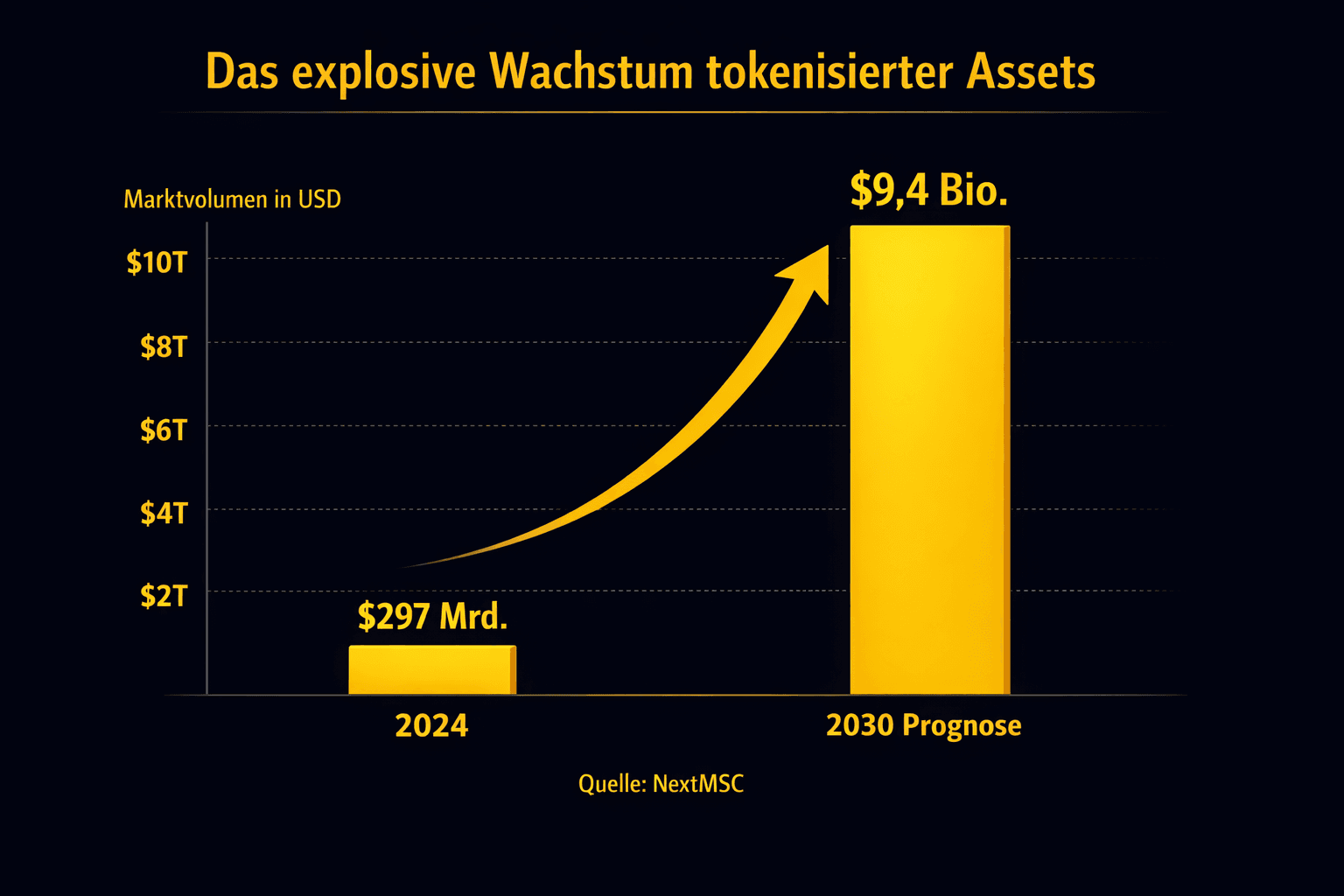
- Growth Forecast: Market analysts estimate the volume of tokenized assets to exceed 9 trillion dollars by 2030.
The year 2026 has begun, and the tokenization boom is manifesting in real-world applications.
Many investors are wondering how they can profit from real estate and government bonds directly on the blockchain without going through traditional banks.
The DeFi maturation process makes it possible to bring institutional yields directly into your own wallet. This article examines how this trend can be utilized strategically.
Why 2026 is the Year of Tokenization
The financial market is in a so-called tokenization supercycle. The data on this is clear: the market is growing exponentially. This is no longer just hype, but the construction of a new financial infrastructure.
Two primary factors are driving this development in 2026:
- Institutional Giants: In December 2025, JPMorgan launched "MONY," the first tokenized money market fund from a systemically important major bank on Ethereum. This signals to the market that the technology is ready for mass adoption.
- Regulatory Clarity: With the full implementation of MiCA in the European Union, there are clear rules of the game for issuers, which strengthens the confidence of institutional investors.
A decisive shift is taking place: Tokenized Real World Assets (RWA) are transforming from a niche experiment into a structural component of global financial markets.
Real-World Assets 2026: From Experiment to Mainstream
For investors, the question arises: What is actually tradable today? It is no longer just about digital artworks (NFTs), but about hard assets with generatable cash flow.
Tokenized Real Estate & Private Credit
In the past, real estate investments often required high five- to six-figure sums. Today, the fractionalization of ownership allows for entry with little capital. The sector for tokenized real estate has recorded 3-year growth of over 300 percent and is opening a new era for property investments.
Another growth market is private credit (corporate loans). Protocols like Centrifuge now manage over 1.3 billion dollars in Total Value Locked (TVL). They bring interest from the real economy into the DeFi ecosystem by enabling financing for small and medium-sized enterprises via the blockchain.
Commodities on the Blockchain
Gold and silver are no longer only relevant physically in a vault. The market for tokenized commodities has exceeded the 4 billion dollar mark. Tokens like PAXG or XAUT dominate this segment by about 80 percent. The decisive advantage for investors is the ability to trade around the clock as well as the possibility to use these assets as collateral in DeFi applications.
The DeFi Maturation Process: Institutions Take the Helm
Decentralized Finance (DeFi) has grown up. The phases of extremely volatile and often unsustainable yields have given way to an era where "real yield" – i.e., yield from genuine value creation – is the focus.
Market Shares of Blockchains
Ethereum maintains its position as the market leader. With a market share of around 65 percent, the Ethereum network acts as the central settlement layer for RWAs. Nevertheless, specialized solutions are catching up:
- Ethereum: Approx. 12.5 billion USD RWA volume.
- Polygon: Strong focus on institutional infrastructure projects.
- Avalanche: Growing in the area of tokenized financial instruments.
Graphic: Distribution of RWA market shares by blockchain (Visualized here: Pie chart - Ethereum 65%, Polygon 15%, Avalanche 12%, Others 8%)
Governance Evolution and Compliance
Leading protocols like Aave are adapting their governance models. The focus is shifting toward genuine profit sharing for token holders and away from pure speculation.
An important trend in 2026 is also "permissioned pools." These require a one-time verification (KYC) of the user, but in return allow access to regulated, institutional investment products.
Investment Opportunities for Retail Traders
To position yourself in the current market environment, the following three areas are particularly relevant:
- Tokenized US Treasury Bonds: Platforms like Ondo Finance offer access to short-term US Treasuries. These are considered a risk-free rate and are now available on-chain. Ondo has become the largest RWA operator with nearly 2 billion dollars in Assets Under Management.
- Infrastructure Investments: Instead of focusing only on individual assets, one can invest in the infrastructure. This includes tokens of blockchains or protocols like Pendle Finance, which enable the trading of interest rate derivatives on RWAs.
- Stablecoin Strategies: The market for stablecoins is growing to an estimated 500 billion dollars. Through protocols like Morpho, stablecoins (USDC/USDT) can be efficiently lent against real collateral.
Risks & Due Diligence
Despite the opportunities, there are significant risks that must be checked before any investment. The "SeC FiT PrO" framework (Security, Finance, Technology) from Galaxy Digital offers guidance for this.
- Smart Contract Risk: Unaudited contracts are susceptible to errors. Historical data shows that unaudited protocols lose value disproportionately during times of crisis.
- Liquidity Risk: Tokenized real estate often cannot be sold as quickly as liquid cryptocurrencies.
- Regulatory Risk: Even though MiCA offers security, tax frameworks can change.

Conclusion
The tokenization boom 2026 marks the fusion of the traditional financial world and blockchain technology. For traders, this means a greater selection and access to real yields, but it also requires a deeper understanding of the new mechanisms.
It is now important to understand the differences between pure crypto lending and RWA lending and to check which platforms operate in compliance within your own legal jurisdiction. Diversification remains the key to long-term portfolio preservation, even in the new token economy.
FAQ - Frequently Asked Questions
What exactly are Real World Assets (RWA)?
RWAs are digital tokens on a blockchain that legally and bindingly represent physical or traditional financial assets such as real estate, gold, or bonds.
Is DeFi safe for beginners in 2026?
Due to regulations like MiCA, the sector has become significantly safer, yet technical risks such as smart contract errors still persist.
How much starting capital is needed for RWA investments?
Through fractionalization, many platforms allow entry with amounts as low as 50 USDC or less.
Which blockchain is most important for RWAs?
Ethereum is the dominant platform with about 65 percent market share, followed by Polygon and Avalanche for specific applications.
Where can tokenized stocks be traded?
Specialized providers like Ondo Finance or Backed Finance offer these products, but usually require identity verification (KYC).
WEEX | Rising Star of Crypto Exchanges in the DACH Region
WEEX combines security, innovation, and community with features for beginners and professionals:
Security & Protection
- 1,000 BTC Protection Fund: Self-funded pool for rapid loss protection in exceptional cases
Trading & Earning
- Auto Earn: Daily automatic USDT earnings without effort
- Copy Trading: Follow elite traders automatically or apply as an elite trader for additional benefits
- WE-Launch: Early access to new projects – exclusive for WEEX users
Benefits & Rewards
- Promotions & Rewards: Trading competitions and special bonuses for active users
- Affiliate Program: Lifetime commissions from new users – details here
- VIP Benefits: Lowest fees, market insights, and personal support for high-volume traders
- WXT Token: Fee discounts, airdrops, and exclusive platform benefits
Discover current trends on WEEX Spot and start now: Register now
Disclaimer – Legal Notice from WEEX Exchange
WEEX and its affiliates offer services for the exchange of digital assets, including derivatives and margin trading, only where legal and for eligible users. All content is general information, not financial advice – seek independent advice before trading. Trading cryptocurrencies involves high risk and can lead to a total loss. By using WEEX services, you accept all associated risks and terms. Never invest more than you can afford to lose. Further information can be found in our Terms of Use and in the Risk Disclosure.