Polkadot Smart Contracts: PVM vs. EVM – The Complete Guide

Key Takeaways
- Dual Development Paths: Developers can choose between EVM compatibility (via Solidity and Revive) for easy porting or PVM (via Rust and ink!) for maximum performance.
- Cost Revolution: Smart contract transactions on the Polkadot Asset Hub cost an average of less than $0.01 due to the efficient weight model.
- Performance Boost: The RISC-V-based PolkaVM executes code 1.3 to 1.7 times faster than native code and eliminates the overhead of traditional virtual machines.
- Scalability: Through Elastic Scaling and parallel core utilization, over 100,000 transactions per second (TPS) are theoretically possible.
- Seamless Tooling: Established tools like Hardhat and MetaMask are fully supported, simplifying the entry for Ethereum developers.
Introduction
Imagine being able to use your existing Solidity applications, but with the speed and negligible costs of a modern Layer-0 architecture. Smart contracts on Polkadot have become a reality in 2026 and now offer developers two powerful paths: the familiar EVM route or the ultra-fast PolkaVM.
Since the major network upgrade at the end of 2025, the landscape has fundamentally changed. Developers are no longer forced to choose between security and scalability. In this guide, you will learn how to leverage both technologies, keep gas costs under a dollar, and why the RISC-V architecture is setting the new standard for Web3 applications.
A New Era: Smart Contracts Directly on the System
For a long time, smart contract development in the Polkadot ecosystem was almost exclusively limited to parachains like Moonbeam or Astar. With the successful migration to the Asset Hub, contracts can now be executed directly at the heart of the system.
This is a paradigm shift. The Asset Hub acts as a system parachain that is secured directly by the validators of the Relay Chain. This means bank-grade security combined with direct access to native assets like DOT, USDC, and USDT without the need for complex bridges.
The Technology Comparison: EVM vs. PolkaVM
The most important decision for architects and developers is the choice of the execution environment. Polkadot does not offer a "one-size-fits-all" solution for this, but rather two specialized paths. For deeper technical details, it is worth taking a look at the documentation on EVM vs PolkaVM.
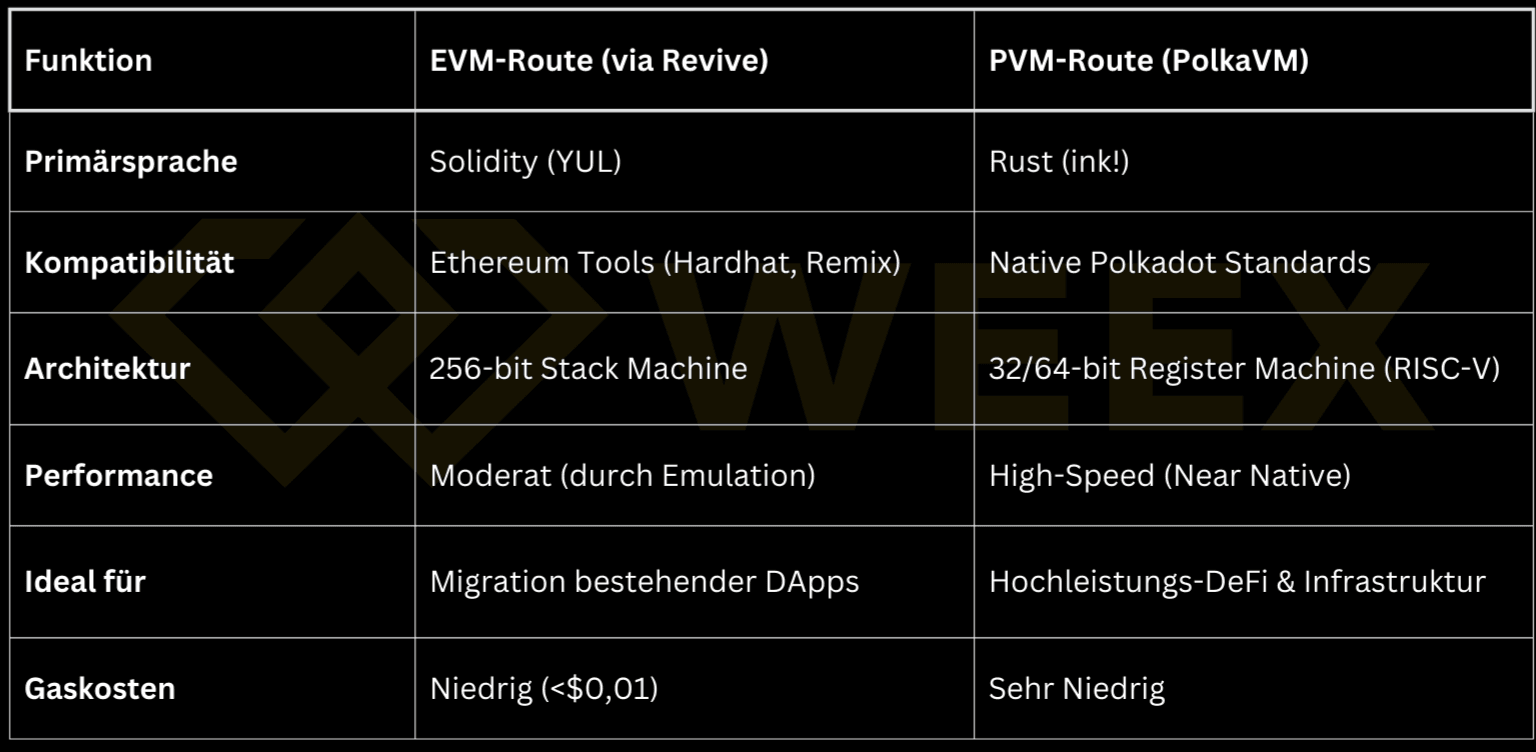
The decision depends heavily on project requirements. Those who want to quickly port an existing Uniswap instance choose the EVM route. Those building a high-frequency order book opt for the PVM.
Why RISC-V (PolkaVM) Is the Future
The core of the new performance is the PolkaVM. Unlike the classic Ethereum Virtual Machine, which interprets a specific 256-bit bytecode, the PolkaVM is based on the RISC-V architecture. This is the same instruction set found in modern hardware.
Technical benchmarks prove that PolkaVM code is only 1.3 to 1.7 times slower than natively compiled machine code. For comparison, the traditional EVM is often 10 to 100 times slower. For developers, this means that complex calculations that would be too expensive on Ethereum (such as cryptography or complex game logic) are easily possible on Polkadot.
Route 1: Solidity on Polkadot (The Migration Path)
For developers coming from the Ethereum world, the barrier is remarkably low. There is no need to learn a new programming language. Polkadot uses the innovative Revive Compiler for this purpose.
This compiler takes your existing Solidity code and translates it not into inefficient EVM bytecode, but into optimized PolkaVM code (YUL to RISC-V). The result is an application that behaves like an Ethereum smart contract but benefits from the performance of the PolkaVM.
The Setup with Hardhat
Integration into the existing workflow is seamless. Developers can continue using their familiar Hardhat environment by simply adjusting the configuration.
Example of a hardhat.config.js for the Asset Hub:
module.exports = { solidity: "0.8.20", networks: { polkadot_asset_hub: { url: "https://polkadot-asset-hub-rpc.polkadot.io", chainId: 1000, accounts: [PRIVATE_KEY] } }, // The Revive plugin is integrated here };
It is important to note that a current Node.js version (v22.5 or higher) is recommended for using the Revive compiler to avoid compatibility issues.
Route 2: Native Rust Contracts with ink! (The Performance Path)
If the goal is to get the absolute maximum out of the hardware, there is no way around ink!. This is a domain-specific language (DSL) for Rust, developed specifically for smart contracts.
The advantages of ink! over Solidity are significant:
- Security: The Rust compiler prevents entire classes of errors, such as memory access errors, during development.
- Efficiency: The compiled WebAssembly (WASM) artifacts are extremely compact, which saves storage fees on the blockchain.
- Ecosystem: Developers benefit from the entire Rust ecosystem and tools like
cargo.
Interested developers can take their first steps directly in the browser in the sandbox environment without needing local installations.
Interoperability through XCM
A smart contract on Polkadot is never isolated. Through the Cross-Consensus Messaging (XCM) protocol, every contract gains superpowers regarding interoperability.
Unlike isolated Layer-1 blockchains or fragmented Layer-2 solutions, a contract on the Asset Hub can:
- Receive tokens from other parachains.
- Call functions on foreign chains (remote execution).
- Transfer assets trustlessly and without central bridges.
A practical example would be a DeFi protocol on the Asset Hub that aggregates liquidity from a specialized DeFi chain while simultaneously retrieving identity data from an identity chain – all in a single, atomic transaction.
Cost Structure and the Weight Model
A common criticism of traditional blockchains is volatile transaction costs. Polkadot addresses this problem with a deterministic fee model based on "weight" instead of pure gas.
Fees are calculated based on two dimensions:
- Ref Time: The required computation time.
- Proof Size: The amount of data that must be processed and stored.
Current analyses show that complex smart contract interactions on the Asset Hub are on average significantly cheaper than on comparable networks, often well under a cent. This enables business models in the area of microtransactions and gaming that would not be economically feasible on Ethereum.

Conclusion
With the introduction of smart contracts on the Asset Hub and PolkaVM technology, Polkadot has not only closed the gap to Ethereum but has technically surpassed it in many areas. The freedom of choice between EVM convenience for quick migrations and PVM performance for demanding applications gives developers maximum flexibility.
With transaction costs near zero, the security of the Relay Chain, and scalability through Elastic Scaling, 2026 is the ideal time to enter the Polkadot ecosystem.
FAQ - Frequently Asked Questions
Can I adopt my existing Ethereum contracts without changes?
In most cases, yes. The Revive Compiler allows for the compilation of standard Solidity code. Only in the case of specific precompiles or complex low-level calls might minimal adjustments be necessary.
Do I need DOT tokens for transaction fees?
Yes, since the Asset Hub is a system chain of Polkadot, fees are paid in native DOT. Alternatively, stablecoins like USDC could be used for fees in the future, provided governance activates this.
Is ink! difficult to learn for Solidity developers?
Rust has a steeper learning curve than Solidity. The concepts of ownership and borrowing are initially unfamiliar, but they lead to safer and more stable code in the long term. The syntax of ink! itself, however, is very logically structured.
Does my MetaMask wallet work with Polkadot smart contracts?
Yes, thanks to the Ethereum compatibility layer and RPC adapters, users can continue to use their MetaMask to interact with Solidity contracts on Polkadot without having to install a Polkadot-native wallet.
What does Elastic Scaling mean for my DApp?
Elastic Scaling means that the network can automatically allocate additional compute cores during high load. Your application will therefore not become slow or prohibitively expensive just because the network is currently experiencing heavy usage.
WEEX | Rising Star of Crypto Exchanges in the DACH Region
WEEX combines security, innovation, and community with features for beginners and professionals:
Security & Protection
- 1,000 BTC Protection Fund: Self-funded reserve for rapid loss protection in exceptional cases
Trading & Earning
- Auto Earn: Daily automatic USDT earnings with no effort
- Copy Trading: Follow elite traders automatically or apply as an elite trader for additional benefits
- WE-Launch: Early access to new projects – exclusive to WEEX users
Benefits & Rewards
- Promotions & Rewards: Trading competitions and special bonuses for active users
- Affiliate Program: Lifetime commissions from new users – details here
- VIP Benefits: Lowest fees, market insights, and personal support for high-volume traders
- WXT Token: Fee discounts, airdrops, and exclusive platform benefits
Discover current trends on WEEX Spot and start now: Register now
Disclaimer – Legal Notice from WEEX Exchange
WEEX and its affiliates offer services for the exchange of digital assets, including derivatives and margin trading, only where legal and for eligible users. All content is general information, not financial advice – seek independent advice before trading. Trading cryptocurrencies involves high risk and can lead to a total loss. By using WEEX services, you accept all associated risks and terms. Never invest more than you can afford to lose. Further information can be found in our Terms of Use and in the Risk Disclosure.