
Is Chinese Digital Oil Fund (CDOF) a Good Investment? Key Risks Explained


KEY TAKEAWAYS
CDOF should be treated as a speculative oil-themed Solana token unless stronger asset-backing proof is available.
The project’s petroleum fund narrative does not automatically mean holders own oil, revenue rights, or redemption claims.
Low-liquidity tokens can move sharply in both directions, making entry and exit prices harder to control.
The biggest risks include unclear reserve proof, token impersonation, wallet concentration, thin liquidity, and weak utility.
A good investment decision should come from verifiable data, not from oil-themed branding or short-term chart momentum.
What is Chinese Digital Oil Fund (CDOF)?
Chinese Digital Oil Fund, or CDOF, presents itself as a Solana-based strategic petroleum fund concept with an on-chain registry tied to oil reserve-style reporting. Its public website describes categories such as crude grades, refined product inventories, and derivatives-market references, which gives the project a structured real-world asset tone.
That structure is worth noting, but it is not enough by itself. A crypto project can publish oil-related data, dashboards, or registry-style language without giving token holders legal ownership of barrels, storage assets, or oil revenue. For beginners, CDOF is better approached as an oil-themed crypto token first, and only treated as a verified asset-backed product if the project provides stronger documentation.
For WEEX users, the better question is not whether CDOF sounds like a serious oil product, but whether its liquidity, token structure, reserve claims, and project transparency are strong enough to justify the risk. Users researching new assets can start crypto trading on WEEX while applying a cautious due-diligence framework.
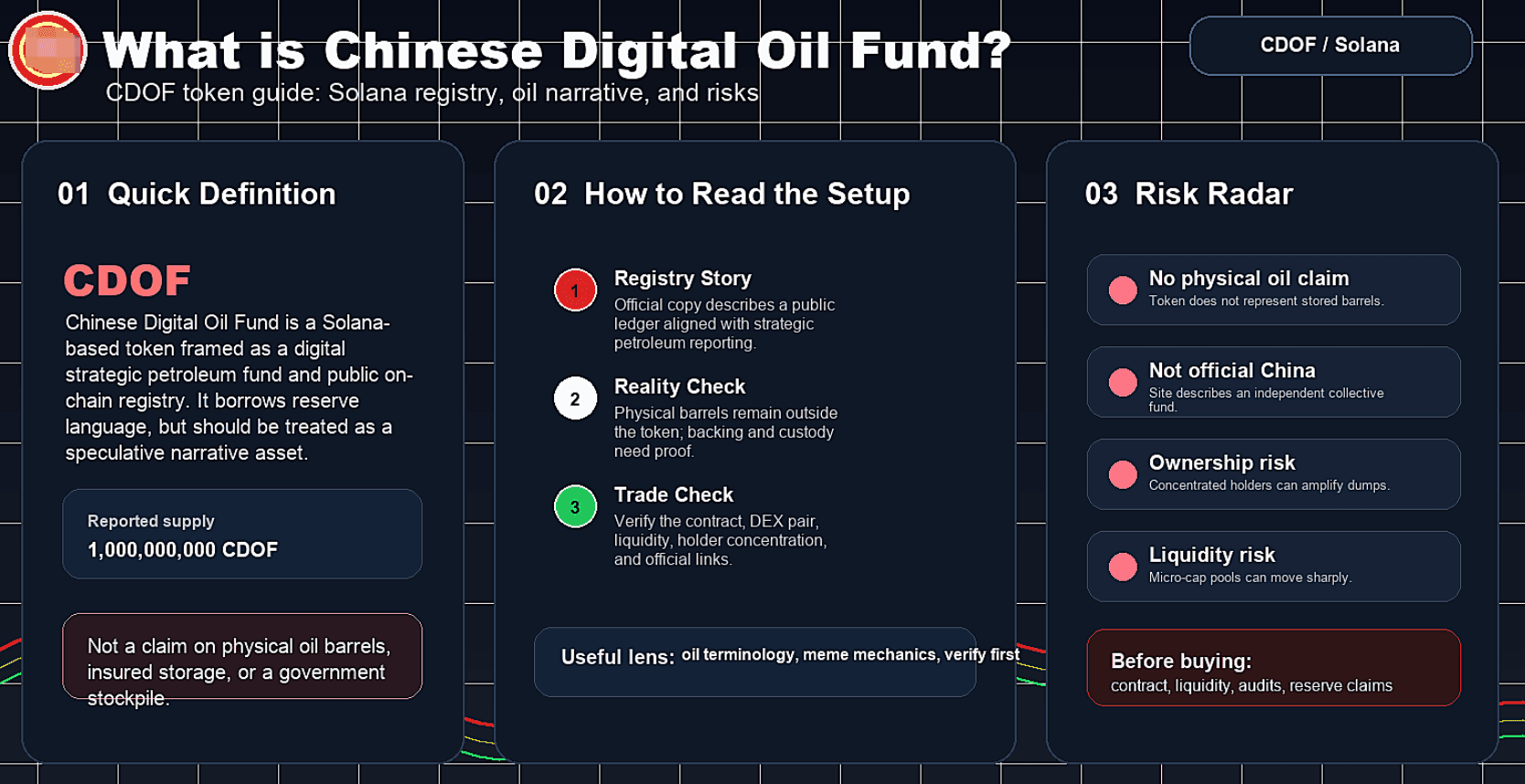
Is CDOF a good investment?
CDOF may be worth researching, but calling it a good investment would be too strong without clearer proof. The token sits in a high-risk category because its appeal depends heavily on narrative, market attention, and decentralized liquidity. That can create short-term trading opportunities, but it also means the token can reverse quickly if the story cools down.
A practical investor should ask a few direct questions. Can the token’s supply be verified on-chain? Is liquidity deep enough to exit? Are top wallets concentrated? Are oil-reserve claims backed by legal documents, audits, custody records, and redemption terms? If those answers are weak or missing, CDOF belongs in the speculative bucket.
The oil-reserve narrative is powerful, but risky
Oil is an easy story for traders to understand. It connects to inflation, geopolitics, national reserves, industrial demand, and macro risk. That makes oil-themed crypto tokens more readable than many abstract Web3 projects.
The danger is that a familiar theme can make a risky token feel safer than it is. CDOF’s oil-reserve language may sound institutional, but traders should not treat it like a regulated commodity fund. A real oil-backed product would usually show legal structure, custody arrangements, reserve verification, issuer details, and redemption mechanics. Without those, the token’s value is driven more by attention than by hard asset backing.
CDOF tokenomics: what traders should check
Tokenomics is not only about total supply. For a small Solana token, distribution and permissions often matter more. A token can have a clean supply number but still carry serious risk if a few wallets control most of the float or if token controls remain active.
WEEX users reviewing CDOF should check the token mint, liquidity pool, holder distribution, transaction history, and whether mint or freeze authority is still enabled. They should also confirm whether the active market address is a trading pair or the token mint itself. Confusing those two can lead to buying the wrong asset.
Liquidity risk can change the trade
Low-liquidity tokens often look exciting because percentage moves can be large. The same feature makes them dangerous. If a pool is thin, a modest buy can push price up quickly, but a modest sell can also drag price down hard.
For CDOF, liquidity should be checked before any price opinion. A chart can show a recent rally, but if the spread is wide or the pool depth is shallow, the displayed price may not be the price a trader can actually exit at. This is especially important for beginners who may focus on the token’s upside narrative while missing the mechanics of slippage.
Token impersonation and address confusion
CDOF also carries copycat risk. When a token name starts trending, similar tickers and fake contracts can appear. This is common in small-cap Solana markets because launching a token is relatively easy.
Users should never buy CDOF by searching the ticker alone. The safer process is to verify the official token mint through project channels and compare it with the swap interface before confirming any transaction. A pair address may identify a liquidity pool, while the token mint identifies the actual asset. That difference matters.
Is CDOF backed by real oil?
CDOF should not be treated as confirmed oil exposure unless the project provides stronger proof. A token can reference strategic petroleum reserves and public inventory reporting without giving holders a claim on physical reserves.
This distinction affects the investment case. If CDOF is mainly a narrative token, traders should evaluate attention, liquidity, and wallet behavior. If it were a verified oil-backed asset, the analysis would also include reserve quality, custody, redemption, and legal rights. Based on currently visible public information, the safer approach is to avoid assuming asset backing.
What could support CDOF’s market outlook?
A stronger CDOF outlook would need several things to improve together. Liquidity would need to deepen. Volume would need to stay active beyond a short hype cycle. Holder distribution would need to look healthier. The project would also need clearer communication around tokenomics, team structure, reserve claims, and security checks.
Narrative alone can move a token for a while, especially if oil-themed assets stay popular. But a healthier market setup needs more than a good story. Traders should watch whether new attention turns into better market structure or only short-lived price spikes.
What could weaken CDOF?
CDOF could weaken if oil-themed tokens lose attention, Solana meme liquidity rotates elsewhere, or large holders sell into rallies. Thin liquidity can make that process faster and harsher than beginners expect.
The token could also face trust pressure if users cannot verify reserve claims, token controls, audits, or team information. In a market where many projects use institutional-sounding names, missing proof becomes part of the risk. If the project’s documentation does not improve, traders may treat CDOF as a short-term meme trade rather than a serious portfolio asset.
Beginner framework before buying CDOF
A cautious framework starts with verification. Confirm the token mint, check the trading pair, review liquidity, inspect top wallets, and understand token permissions. Then read the project’s oil-related claims and ask what token holders actually receive.
After that, define the purpose of the trade. If the thesis is short-term narrative momentum, use small size and a clear exit plan. If the thesis is long-term asset backing, demand stronger proof before taking the idea seriously. Mixing those two theses is where many traders get into trouble.
Final thoughts
CDOF is not automatically a bad token, but it is not automatically a good investment either. It is an oil-themed Solana asset with a marketable narrative and several unresolved questions. That combination deserves research, not blind confidence.
For WEEX users, the disciplined view is straightforward: treat CDOF as speculative until the project proves more. The key signals to watch are liquidity, holder distribution, token controls, documentation quality, and whether the oil-reserve story becomes verifiable rather than just attractive.
FAQ
1. Is CDOF a good investment?
CDOF may be worth researching, but it should be treated as high risk. Its investment case depends on liquidity, token distribution, project transparency, and whether oil-reserve claims can be verified.
2. Is Chinese Digital Oil Fund backed by real oil?
Users should not assume CDOF is backed by real oil unless the project provides legal documents, reserve audits, custody records, and redemption terms. Oil-themed branding alone is not proof.
3. Why is CDOF risky?
CDOF is risky because it may have thin liquidity, unclear asset backing, copycat-token risk, possible holder concentration, and limited verified project information.
4. Can CDOF still rise if it is risky?
Yes. Speculative tokens can rise when attention, liquidity, and social momentum increase. That does not make them safer. Fast rallies can reverse quickly if volume fades or large wallets sell.
5. What should beginners check before buying CDOF?
Beginners should verify the token mint, trading pair, liquidity depth, top wallets, token permissions, and project documentation. A small test transaction is safer than rushing into a large swap.
6. Is CDOF an RWA token or a meme coin?
CDOF uses real world asset language, but it should not be treated as a verified RWA token unless asset backing is documented. Until then, it is safer to view it as a speculative oil-themed Solana token.
7. What would make CDOF more credible?
Clear tokenomics, independent audits, legal structure, reserve verification, custody details, transparent team information, and deeper liquidity would make the project easier to evaluate.
8. What else can WEEX users review?
Users researching the WEEX ecosystem can also review WEEX Token (WXT), the platform token of WEEX. New users may also check the WEEX welcome bonus, which can include trading bonuses, coupons, or task-based rewards tied to account setup, deposits, or trading activity.
DISCLAIMER: WEEX and affiliates provide digital asset exchange services, including derivatives and margin trading, onlywhere legal and for eligible users. All content is general information, not financial advice-seek independentadvice before trading. Cryptocurrency trading is high risk and may result in total loss. By using WEEX services you accept all related risks and terms. Never invest more than you can afford to lose. See our Terms of Use and Risk Disclosure for details.
You may also like
Inside HBF: How SanDisk's High Bandwidth Flash Loads LLMs Straight Onto Hardware
What is HBF (High Bandwidth Flash)? Inside SanDisk and SK hynix's new AI memory technology that loads LLMs directly on hardware to cut inference lag, with timeline, specs, and how it differs from HBM.
Missed NVDA? Why SNDK's $1,500+ Surge Could Be the Start of the AI Storage Supercycle
Missed NVDA? See why SanDisk (SNDK) stock surged past $1,500 toward $2,000 in 2026, the AI storage supercycle driving NAND prices, analyst price targets, and key risks before you trade.
Elon Musk Reclaims Trillionaire Status: What It Means for Tesla and SpaceX Stock
Both Tesla and SpaceX stocks rallied in tandem on June 29, lifting Elon Musk back above the trillionaire…
SPCX Stock 52-Week Range: What $147 to $225 Tells You About Investor Sentiment
SPCX Stock shows a 52-week range from $147.11 (June 23) to $225.64 (June 16). That is a dramatic…
SPCX Stock and Government Contracts: How Much of SpaceX’s Revenue Actually Comes From NASA
SPCX stock is a popular search for investors hunting SpaceX exposure. While SpaceX remains private, understanding its revenue…
SPCX Stock Net Loss Explained: Why SpaceX Lost $4.28 Billion Last Quarter
SpaceX reportedly posted a $4.28 billion net loss last quarter, a sharp jump from a $0.528 billion loss…
Is Tesla Stock a Buy Before Q2 Delivery Numbers?
Tesla stock is heading into Q2 delivery numbers with a raised bar—and that’s the real story. Two major…
SPCX Stock Insider Lockup: What Happens When Early Investors Can Finally Sell
SPCX Stock is approaching a key phase: the insider lockup window. This article explains how lockup expiration can…
Should You Buy Amazon Stock Now? AI Boom and 2026 Forecast
Explore Amazon Stock (AMZN) outlook for 2026 and beyond, including AI growth, AWS expansion, retail performance, and key risks shaping future market expectations.
USWR Crypto Price Analysis 2026: Can USWR Memecoin Reach $1?
USWR crypto price analysis 2026: Can this AI-water narrative memecoin sustain momentum? Get USWR price targets, tokenomics, and key risks before investing.
$AI Airdrop on WEEX: Complete Guide to Gensyn and Claim Free $AI
Learn Gensyn tokenomics, machine-intelligence network utility, and how to claim free tokens in the WEEX 50,000 USDT AI airdrop before July 7, 2026.
What is NuScale Power(SMR) Coin: Comprehensive Guide to SMR/USDT Perpetual Futures and Investment Insights
This guide explains what NuScale Power (SMR) “coin” means in crypto markets, how SMR/USDT futures work, and practical…
What is NuScale Power(SMR) Coin: everything you need to know and how to trade SMR/USDT futures
This guide explains what NuScale Power (SMR) means for crypto market participants, how SMR/USDT derivatives work, and how…
What is Arista Networks(ANET) Coin: a comprehensive guide for USDT-settled stock futures traders
Arista Networks (ANET) on WEEX refers to a USDT-settled stock futures market that tracks the price of Arista…
SPCX Stock and the Cathie Wood Sell-Off: Why ARK Invest Is Cutting Its Position
SPCX stock drew fresh attention after ARK Invest trimmed its position as the price slid from around $225…
SPCX Stock vs AST SpaceMobile: Is There a Better Way to Play Satellite Connectivity?
SPCX Stock and AST SpaceMobile represent two very different paths to bet on satellite connectivity. SPCX Stock is…
SPCX Stock and the Charter Communications Deal: What a Mobile Partnership Would Mean
SPCX stock jumped after reports that SpaceX and Charter Communications discussed a mobile partnership. This piece explains what…
What is Hela Wood(HWOOD) Coin? Everything you need to know about the GameFi resource token and where to buy
Hela Wood (HWOOD) is the in-game resource token of World of Hela, newly listed on WEEX with HWOOD/USDT…
Inside HBF: How SanDisk's High Bandwidth Flash Loads LLMs Straight Onto Hardware
What is HBF (High Bandwidth Flash)? Inside SanDisk and SK hynix's new AI memory technology that loads LLMs directly on hardware to cut inference lag, with timeline, specs, and how it differs from HBM.
Missed NVDA? Why SNDK's $1,500+ Surge Could Be the Start of the AI Storage Supercycle
Missed NVDA? See why SanDisk (SNDK) stock surged past $1,500 toward $2,000 in 2026, the AI storage supercycle driving NAND prices, analyst price targets, and key risks before you trade.
Elon Musk Reclaims Trillionaire Status: What It Means for Tesla and SpaceX Stock
Both Tesla and SpaceX stocks rallied in tandem on June 29, lifting Elon Musk back above the trillionaire…
SPCX Stock 52-Week Range: What $147 to $225 Tells You About Investor Sentiment
SPCX Stock shows a 52-week range from $147.11 (June 23) to $225.64 (June 16). That is a dramatic…
SPCX Stock and Government Contracts: How Much of SpaceX’s Revenue Actually Comes From NASA
SPCX stock is a popular search for investors hunting SpaceX exposure. While SpaceX remains private, understanding its revenue…
SPCX Stock Net Loss Explained: Why SpaceX Lost $4.28 Billion Last Quarter
SpaceX reportedly posted a $4.28 billion net loss last quarter, a sharp jump from a $0.528 billion loss…