
How much would $1,000 invested in SpaceX during its IPO be worth?
By: WEEX|2026/06/18 13:00:00
0
Share


Shares were priced at $135. As of June 18, 2026, SpaceX shares were trading at approximately $191.82. At this price, a $1,000 investment made during the IPO at $135 per share could have grown to approximately $1,421. The potential profit would have been approximately $421, or 42.1%, excluding commissions, taxes, and potential restrictions during share allocation.
At the same time, this result does not mean that every retail investor could easily purchase shares at $135. Demand significantly exceeded supply, and the actual allocation depended on the broker, jurisdiction, and terms of participation in the IPO.
A quick calculation of a $1,000 investment
SpaceX set its initial offering price at $135 per share. The company offered approximately 555.6 million shares and initially raised approximately $75 billion. After the underwriters exercised their additional option, the total amount increased to approximately $85.7 billion.
Assuming fractional shares are available, the calculation would look like this:
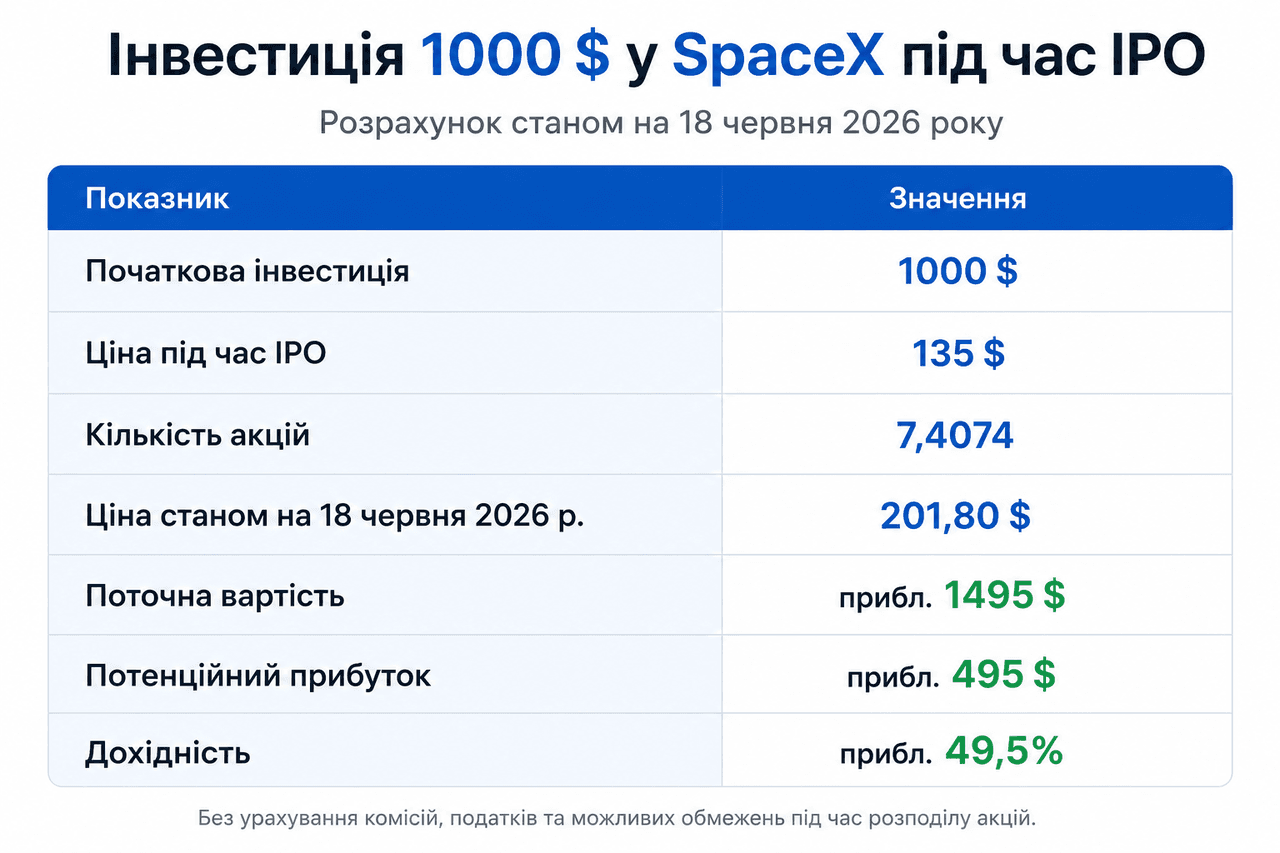
Formula: $1,000 ÷ $135 × $201.80 = approximately $1,494.81
This is a retrospective calculation based on the market price recorded on June 18, 2026. The share price changes throughout the trading session, so the result quickly loses its relevance.
Calculation without fractional shares
Not all brokers allow the purchase of fractional shares during an IPO. In such a case, you could have bought seven shares for $1,000:
- seven shares at $135 — $945;
- unused balance — $55;
- value of seven shares at $201.80 — $1,412.60;
- total amount including the balance — $1,467.60.
The potential profit would have been approximately $467.60, or 46.8% of the initial amount.
This example does not account for broker commissions, currency conversion, or taxes.
When did the SpaceX IPO take place?
SpaceX priced its shares at $135, and public trading under the ticker SPCX began on Nasdaq on June 12, 2026. On the very first day of trading, SpaceX shares started above the IPO price and rose by approximately 19% by the close.
The Ukrainian publication "Minfin" also reported that the company offered over 555 million shares at a fixed price of $135. Investor demand before the offering exceeded $250 billion, meaning it was nearly four times the initial supply volume. More details on the SpaceX IPO parameters.
High demand helped the shares rise after trading began, but it also limited the opportunities to obtain the desired number of shares at the IPO price.
Could an ordinary investor buy shares at $135?
The IPO price is not always available to everyone. Before public trading begins, shares are allocated among institutional and retail participants who have submitted applications through brokers.
Even if a broker provided access to the SpaceX IPO, it did not guarantee that the application would be fully filled. Due to significant excess demand, an investor could:
- receive fewer shares than ordered;
- receive no shares at all;
- purchase them only after trading began at a higher price;
- face restrictions regarding minimum balance or country of residence.
Therefore, the calculation based on $135 shows the result for an investor who actually received shares at the offering price. For a buyer who opened a position after the market opened, the result would be different.
How the result changes depending on the purchase price
The entry price is just as important as the subsequent performance of the shares.
The calculation assumes the availability of fractional shares and does not account for costs.
Why investors paid attention to SpaceX
SpaceX combines several areas that are usually valued separately: space launches, satellite communications, rocket manufacturing, and the development of transport systems for complex space missions.
The company was founded by Elon Musk in 2002. Its most famous products are the Falcon rockets, the Dragon spacecraft, the Starship system, and the Starlink satellite network.
Investor interest is supported by several factors:
- a significant share of the commercial launch market;
- rocket reusability technology;
- government and commercial contracts;
- regular revenue from Starlink;
- potential for new satellite and space services.
However, a strong market position does not mean that any valuation of the company is justified. After an IPO, investors must compare the share price with earnings, losses, capital expenditures, and realistic growth rates.
The role of Starlink in SpaceX's valuation
Starlink transforms SpaceX from a company primarily dependent on individual launches into a service provider with a recurring revenue model.
Users pay regularly for satellite internet, and businesses and government entities can enter into long-term contracts. This model potentially makes cash flows more predictable.
Regular revenue
Rocket launches depend on mission schedules, contracts, and payload readiness. Starlink subscriptions generate regular payments, although the costs of deploying and updating the satellite constellation remain significant.
Global market
Starlink operates where building ground infrastructure is expensive or technically complex. The potential audience includes private users, businesses, airlines, maritime carriers, and government agencies.
Dependence on regulators
Expanding the network requires permits for radio frequency use and the provision of telecommunications services in each jurisdiction. Therefore, the global scale is simultaneously an advantage and a source of regulatory risk.
Why SpaceX is compared to Tesla
Both companies are associated with Elon Musk, operate in capital-intensive industries, and build their business around technologies that are difficult to replicate quickly.
However, directly applying Tesla's history to SpaceX can be misleading.
Tesla went public with a significantly lower valuation. In contrast, SpaceX was valued at approximately $1.75–1.77 trillion at the time of its IPO. The higher the initial base, the greater the absolute business growth must be for a similar increase in share value.
The comparison also ignores differences in:
- revenue structure;
- capital expenditures;
- regulatory environment;
- government contracts;
- product development cycles;
- corporate governance.
Therefore, Tesla's historical growth cannot be used as a forecast for SPCX.
What can affect SpaceX shares
Starship results
Starship is one of SpaceX's most expensive and complex projects. Successful tests and regular commercial operation could expand the company's addressable market.
At the same time, accidents, technical delays, or budget overruns could worsen investor expectations.
Financial performance
After going public, the market will evaluate not only technological achievements but also:
- revenue growth rates;
- operating results;
- free cash flow;
- capital expenditures;
- debt load;
- Starlink profitability;
- costs for Starship and other long-term programs.
Even a promising company can lose value if its results do not meet the expectations built into the stock price.
Competition
SpaceX competes with private companies, government space programs, and satellite operators. Notable industry participants include Blue Origin, Rocket Lab, and a number of Chinese aerospace companies.
Technological advantage can last for years, but it is not permanent.
General market conditions
The price of SPCX is influenced by interest rates, capital availability, investor sentiment toward the technology sector, and economic expectations.
During a market downturn, even companies with stable businesses can decline along with broader indices.
Main risks of investing in SpaceX
High initial valuation
A valuation of approximately $1.77 trillion already assumes significant future earnings. If the growth rates of Starlink or Starship turn out to be lower than expected, the market may reprice the shares.
Volatility after the IPO
In the first few weeks after an offering, the price often reacts sharply to demand, news, and the actions of short-term traders. Gains of tens of percent can be followed by equally rapid declines.
Technological failures
Failed launches can lead to financial losses, mission delays, additional inspections, and reputational consequences.
Dependence on regulation
Space launches, satellite communications, and government contracts are regulated by numerous bodies. Changes in rules can affect timelines, costs, and access to specific markets.
Corporate governance
Investors should evaluate the voting structure, the level of founder control, agreements with related companies, and the rights of public shareholders.
Survivorship bias
Comparing SpaceX only to Amazon, Apple, or Tesla highlights successful examples and ignores companies whose shares lost a significant portion of their value after high-profile IPOs.
Past results of individual technology issuers do not determine the future performance of SPCX.
What is important for an investor from Ukraine to consider
Access to US stocks depends on broker rules, client verification, and the restrictions of a specific jurisdiction.
Before a transaction, you should check:
- whether the broker serves residents of Ukraine;
- whether it provides access specifically to Nasdaq stocks;
- what commissions it charges for the transaction and currency conversion;
- whether it supports fractional shares;
- how it handles tax documents;
- what rules apply to participating in an IPO;
- whether there are restrictions on transfers or the source of funds.
Tax consequences depend on the investor's status and the type of income received. For a personal calculation, it is advisable to consult a tax professional.
Separately, it is necessary to distinguish between real shares and instruments that only replicate their price. A token, perpetual contract, or other derivative may not grant ownership rights, voting rights, or dividends.
In WEEX materials about instruments related to SpaceX, it is noted that derivatives and pre-IPO products should be distinguished from real company shares. The terms of such instruments must be checked separately.
Does growth after an IPO mean shares are undervalued?
No. Growth in the first days indicates that demand exceeded the available supply at the offering price. It does not prove that the current market valuation is low or that the trend will continue.
To evaluate shares, you need to analyze at least three groups of indicators:
- financial results;
- growth rates of main business areas;
- the ratio of price to fundamental indicators.
In the case of SpaceX, the economics of Starlink, Starship costs, government contracts, and the company's ability to convert technological advantages into stable cash flow are of particular importance.
Scenarios for a $1,000 investment
The values below are not a forecast. They only show how the value of an investment would change if shares reach a certain price.
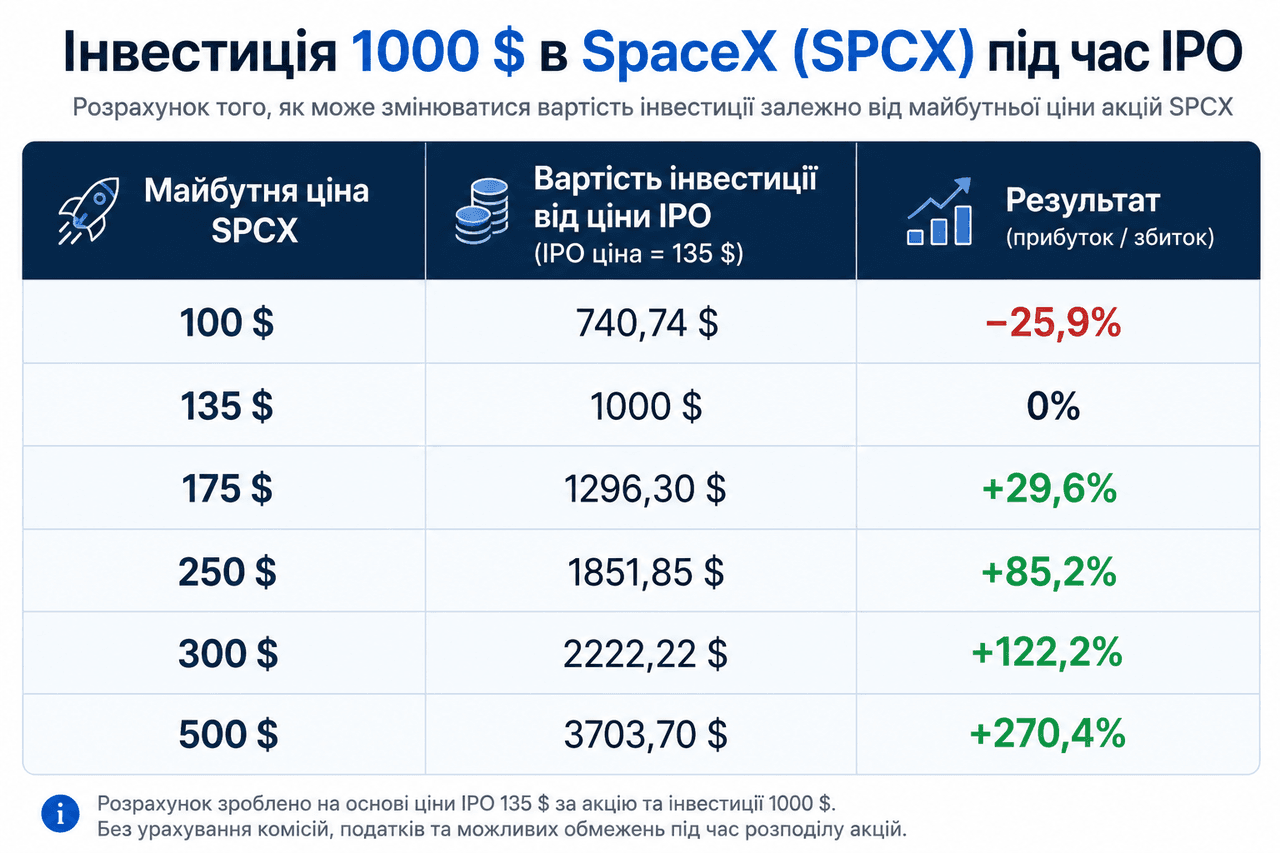
For an investment to grow from $1,000 to $5,000, the share price would have to rise to approximately $675. This would mean a fivefold increase in price from the IPO and a corresponding increase in market capitalization, assuming the number of shares remains unchanged.
Such a scenario is theoretically possible in the long term, but it should not be presented as an expected result without analyzing earnings, profitability, and share dilution.
Questions and answers
At what price did SpaceX hold its IPO?
The initial offering price was set at $135 per share. Public trading under the ticker SPCX began on Nasdaq on June 12, 2026.
How much would $1,000 invested in the SpaceX IPO be worth?
At an SPCX price of about $201.80, a notional investment of $1,000 at the IPO price would be worth approximately $1,495. The calculation is current for the quote recorded on June 18, 2026, and does not include costs.
Could all investors buy shares at $135?
No. Access to the IPO price depended on the broker and share allocation. Due to significant demand, applications could be partially filled or not filled at all.
Where are SpaceX shares traded?
Shares are traded on the Nasdaq exchange under the ticker SPCX.
Are SpaceX tokens real shares?
Not necessarily. A tokenized instrument or derivative may only replicate price changes and not grant shareholder rights. Before a transaction, you must check the legal structure of the product.
Can a $1,000 investment turn into $10,000?
For this to happen, the share price would have to increase tenfold from the IPO price — to approximately $1,350, excluding potential new issuances. This is a scenario-based calculation, not a forecast.
What is the main risk of SpaceX shares?
One of the key risks is the high valuation, which already accounts for significant future growth. Additional risks are related to technology, regulation, costs, and volatility.
Conclusion
A $1,000 investment in SpaceX at the IPO stage at a price of $135 could have been worth approximately $1,495 as of June 18, 2026. This corresponds to a paper profit of approximately $495, or 49.5%, assuming the purchase of fractional shares and no costs.
Such a result reflects strong demand in the first days of trading but does not provide a basis to automatically project this dynamic into the following months or years. SpaceX went public with a valuation of approximately $1.77 trillion, so further growth will depend on whether Starlink, the launch business, and Starship can justify the market's high expectations.
For those who want to understand the differences between shares, pre-IPO products, and derivative instruments more deeply, there are separate explanatory materials in the WEEX Cryptopedia. It is important to verify whether a specific product entails actual ownership of a share, as well as to consider commissions, liquidity, and regulatory restrictions.
DISCLAIMER
WEEX and its affiliates provide digital currency exchange services, including derivatives and margin trading, only where such activity is legal and exclusively to appropriate users. All content is provided for reference only and does not constitute financial advice — consult with a financial advisor before trading. Cryptocurrency trading is high-risk and can result in the loss of your entire investment. By using WEEX services, you accept all associated risks and terms. Always invest only the amount you can afford to lose. Details are available in our Terms of Use and Risk Warning.


Customer Support:@weikecs
Business Cooperation:@weikecs
Quant Trading & MM:bd@weex.com
VIP Program:support@weex.com
