
11 Facts About Whether AI Can Select Promising Cryptocurrencies Better Than Humans
By: WEEX|2026/06/18 13:30:00
0
Share


In 2026, artificial intelligence is increasingly used to analyze market data, blockchain transactions, news, and the sentiment of crypto market participants. At the same time, an algorithm's ability to process information quickly does not mean it can flawlessly predict the price of Bitcoin or find an asset that is guaranteed to rise.
This topic is important not only for traders. AI tools already offer token ratings, automated reports, trading signals, and ready-made portfolio construction scenarios. Because of this, users need to understand not only the capabilities of such systems but also the limits of their reliability.
This article will be useful for readers who want to figure out how artificial intelligence works for analyzing cryptocurrencies, what indicators it takes into account, and why its conclusions should not be taken as ready-made financial advice.
AI in this context is a collection of models and algorithms that analyze data, find statistical patterns, and form probable scenarios. It can speed up research but does not eliminate market uncertainty.
Fact 1. The concept of "best cryptocurrency" has no single mathematical definition
The result depends on the criteria that the user or developer sets for the model. One system may favor assets with large market capitalization and high liquidity. Another may prefer young tokens with rapid user growth but significantly higher risk.
The algorithm does not decide what is "best" on its own. It ranks assets according to a target function: potential return, volatility, liquidity, market momentum, or another specified indicator.
For example, a conservative model may filter out an illiquid token even if its price is rising rapidly. A more aggressive system, conversely, might place it at the top due to strong short-term dynamics.
That is why a cryptocurrency rating without a description of the methodology says little about the quality of the analysis.
Fact 2. The advantage of AI lies primarily in the scale and speed of information processing
The system can simultaneously analyze:
- price history;
- trading volumes;
- liquidity;
- market depth;
- on-chain transactions;
- activity of individual wallets;
- movement of funds to and from exchanges;
- developer activity;
- news;
- social media posts.
It would take a human hours or days to process such a massive amount of information. An algorithm can update assessments almost continuously.
However, a large amount of data does not guarantee a correct conclusion. The model may correctly see a change in an indicator but incorrectly explain its cause.
For example, a transfer of a significant amount of tokens to an exchange address could mean preparation for a sale. But it could also be an internal movement of funds, a change of custodial service, or a technical operation.
Fact 3. Even a complex model yields weak results if it works with incomplete or distorted data
The crypto market does not have one flawless source of information. Prices on different platforms can vary, on-chain analytics sometimes misclassify addresses, and trading volume statistics can contain artificial activity.
A separate problem is latency. If the system receives news or an on-chain signal later than other market participants, its conclusion may lose practical value before it even appears on the user's screen.
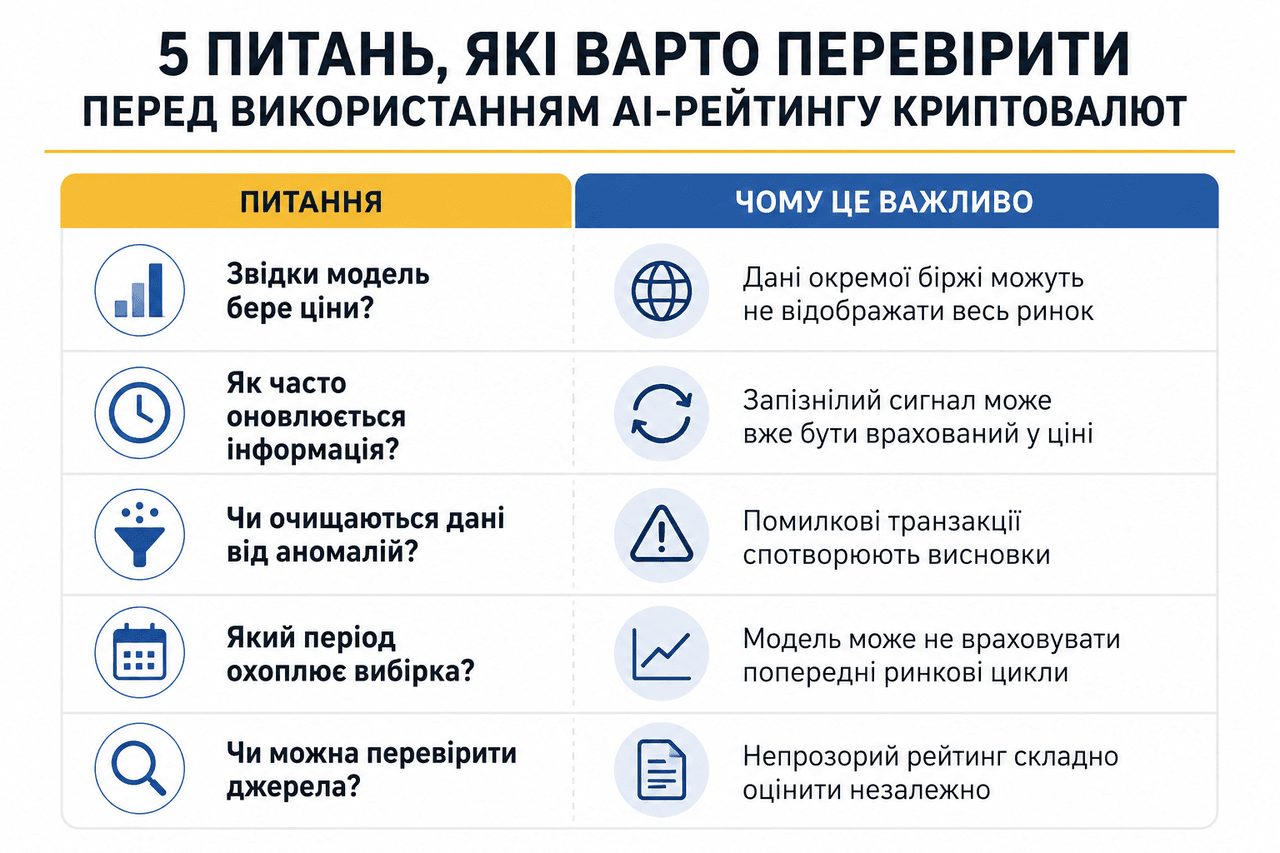
Before using an AI rating, you should check:
Fact 4. Blockchain shows transactions, but it does not always show why they were made
AI systems can track large transfers, token accumulation, activity of new addresses, and interaction with smart contracts. Such indicators help to see changes that are not yet reflected in standard financial reporting.
However, a blockchain address often does not contain verified information about the owner. Even if an address is linked to a fund, exchange, or large investor, its classification may be incorrect.
A practical example: a model records a withdrawal of Bitcoin from an exchange and interprets it as a sign of long-term accumulation. In reality, the exchange could have just moved funds between its own hot and cold wallets.
Therefore, an on-chain metric is a signal for further verification, not self-sufficient proof of a future price movement.
Fact 5. A large number of positive mentions does not necessarily indicate real interest in a project
Sentiment analysis algorithms process posts on X, Reddit, Telegram, blogs, and news outlets. They determine the frequency of mentions, the general tone of messages, and the speed at which a topic is spreading.
This allows for noticing an information impulse before it becomes obvious in the price chart. At the same time, crypto communities often face bots, coordinated advertising campaigns, fake reviews, and intentional spreading of panic.
A ready-made example — the launch of ChatGPT in 2022 increased attention to crypto assets related to the topic of artificial intelligence, even if individual projects had no direct connection to OpenAI. Researchers found a noticeable increase in attention and valuations of such assets after the service launched. This shows that an information trend can influence prices regardless of fundamental changes in the project itself.
Therefore, sentiment analysis should be compared with liquidity, on-chain activity, tokenomics, and actual product usage.
Fact 6. A large language model structures information well but can formulate a false conclusion in a convincing tone
ChatGPT and other language models can be used to:
- explain technical documentation;
- compare the tokenomics of several projects;
- compile a list of risks;
- prepare questions to verify a team;
- summarize a large text;
- build positive, base, and negative scenarios;
- explain the meaning of on-chain indicators.
At the same time, a language model can work with outdated information, misunderstand the context, or invent a source. Therefore, every statement about price, regulation, listing, audit, or partnership must be verified separately.
A useful prompt for a chatbot sounds like this:
Compare the tokenomics of two projects based on emission, token distribution, unlocking schedule, concentration in the largest wallets, and liquidity risks. Do not make a conclusion about which asset to buy. For each statement, indicate the source and date.
A dangerous prompt:
Name a cryptocurrency that will definitely rise next month.
In the second case, the user is asking for a result that no model can guarantee.
Fact 7. Automation and AI are not the same
A regular trading bot can work according to fixed rules. For example:
- buy after the intersection of two moving averages;
- sell after reaching a set loss level;
- place a grid of orders in a defined range;
- maintain a set asset ratio;
- perform arbitrage between platforms.
Such a bot does not necessarily learn or change its strategy on its own.
An AI component appears when the model classifies market conditions, analyzes text data, adapts parameters, or evaluates the probability of different scenarios.
AI trading bots can work around the clock and execute operations faster, but they remain vulnerable to code errors, hacks, strategy failures, and incorrect data. That is why testing and risk management are more important than the marketing label "AI".
For those who want to understand automated trading separately, the WEEX Cryptopedia has material on the capabilities and limitations of AI-based trading bots.
Fact 8. A model can show an almost perfect result in a test and lose funds in the real market
This often happens due to overfitting or over-optimization. The algorithm adjusts too precisely to past fluctuations and remembers random noise instead of a stable pattern.
A hypothetical example: a developer tests thousands of indicator combinations on data from the previous year. One combination shows an exceptionally high return. However, this could be a random coincidence that will not repeat on a new segment of the market.
Realistic testing must take into account:
- trading commissions;
- spread;
- execution latency;
- partial order execution;
- insufficient liquidity;
- volatility changes;
- downturn periods;
- technical failures.
A telling example is in our WEEX Cryptopedia: in one experiment, different large language models demonstrated very different results during trading, with some systems making a profit while others suffered significant losses. One contest does not prove the long-term superiority of a specific model, but it clearly shows how much the result depends on the methodology, market period, and risk control.
Fact 9. Models are weaker where there are not enough historical analogues
An algorithm can estimate how Bitcoin previously reacted to changes in liquidity, interest rates, or trading flows. But it does not know in advance about a future protocol hack, a sudden ban by regulatory authorities, the bankruptcy of a large company, or the loss of a stablecoin peg.
After news appears, a model can quickly analyze the market's reaction. However, this is not the same as predicting the event itself.
Especially dangerous are models that form one precise target price without:
- a range of probabilities;
- alternative scenarios;
- an error description;
- a list of conditions under which the forecast will lose relevance;
- data on previous errors.
A Bitcoin forecast using AI should be read as a conditional scenario: "under these circumstances, this result is likely," not as a prediction of the future.
Fact 10. AI does not feel fear or greed, but that does not make it completely objective
A human might buy an asset due to fear of missing out on growth, hold a losing position for too long, or change their strategy after a few unsuccessful trades.
An algorithm executes set rules more consistently. It does not get tired, does not panic because of a red candle, and can monitor many indicators simultaneously.
However, a model inherits other limitations:
- training data bias;
- developer errors;
- a flawed target function;
- incorrect assumptions;
- insufficient sample representativeness;
- non-transparent decision-making logic.
A more practical approach is the division of roles. The algorithm collects and organizes information, while the human verifies sources, evaluates context, and is responsible for the final decision.
Fact 11. Artificial intelligence is most useful as a research assistant, not as an autonomous capital manager
Instead of asking "which cryptocurrency to buy?", it is more appropriate to use AI to perform specific analytical tasks.
For example, a model can:
- compare token unlocking schedules;
- find supply concentration in the largest wallets;
- highlight contradictions in documentation;
- check if a claimed partnership matches official announcements;
- compare developer activity with marketing statements;
- model the consequences of a liquidity drop;
- compile a list of smart contract risks;
- prepare a portfolio stress-test scenario.
Example of tokenomics verification
Instead of asking to name the "most promising token," a user can ask the system to compare projects using the same scheme:
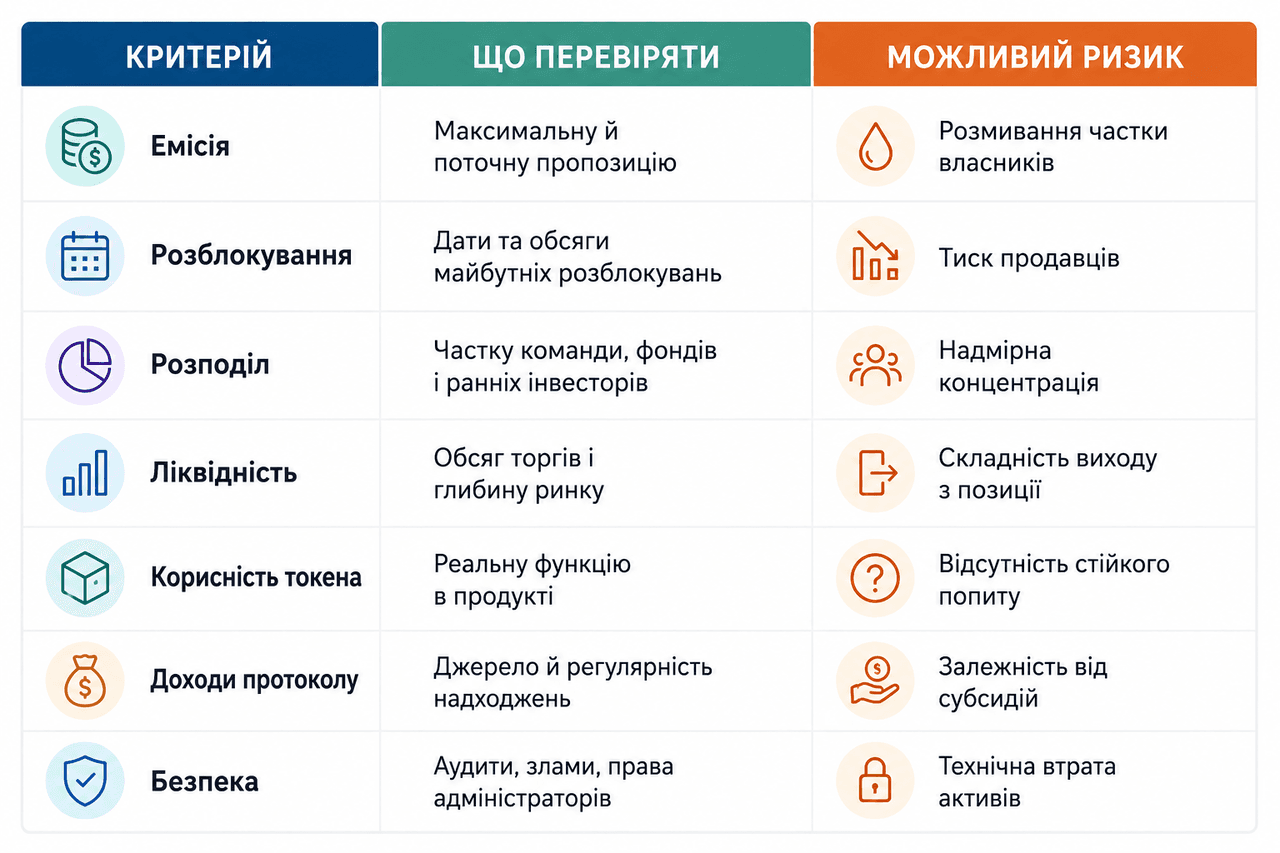
Such an approach does not provide a ready-made answer, but it helps to see weak points before making a decision.
Example of sentiment analysis
AI can detect that the number of token mentions per day has increased fivefold. Instead of an automatic conclusion that "demand is growing," you should check:
- how many messages were published by new accounts;
- whether they repeat the same text;
- whether real trading volume has increased;
- whether the number of unique on-chain users has grown;
- whether there is news that explains the interest;
- whether a mass token unlock is occurring.
This is how AI turns from a trading signal generator into a hypothesis verification tool.
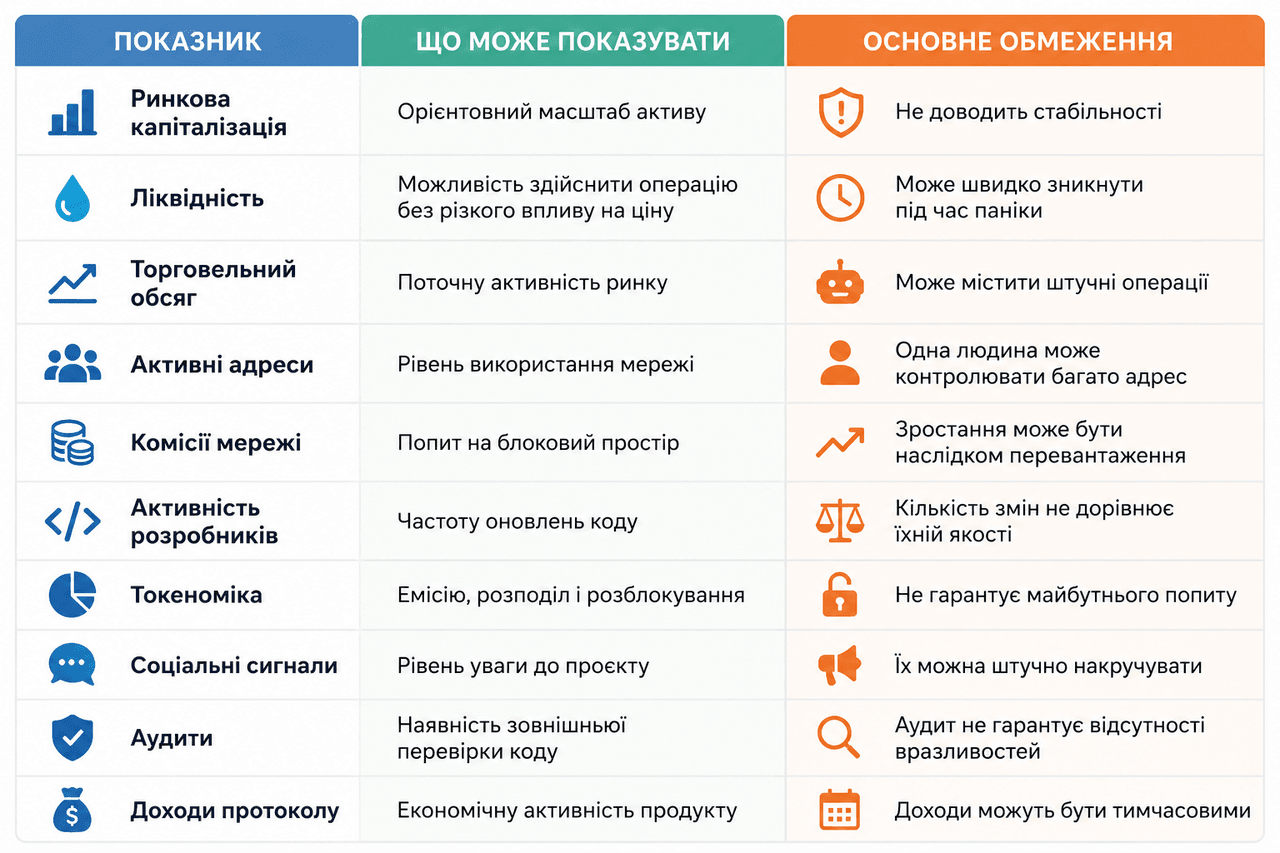
What indicators AI can use for selecting crypto assets
A single indicator almost never provides a sufficient picture. A more reliable model compares several groups of data.
Can AI predict Bitcoin price growth
AI can estimate probabilities, but it cannot guarantee a result.
For Bitcoin analysis, models can use:
- historical volatility;
- fund flows on exchanges;
- activity of long-term holders;
- ratio of realized profits and losses;
- liquidity in the derivatives market;
- funding rates;
- macroeconomic indicators;
- news background;
- search interest;
- behavior of large addresses.
The problem is that the relationships between these indicators change. A signal that worked in the previous cycle may become weaker after a change in market structure.
Therefore, a forecast should be evaluated based on five questions:
- What data was used?
- When was it updated?
- Over what period was the model tested?
- What was the error rate of previous forecasts?
- What could make the scenario irrelevant?
If the author of a forecast does not answer these questions, the precise figure itself does not have much analytical value.
How to use AI for analyzing cryptocurrencies more cautiously
It is advisable to use an AI tool as one of the layers of verification, not as the sole source of a decision.
A practical sequence could look like this:
1 Formulate a specific question.
2 Define evaluation criteria.
3 Ask the model to show sources.
4 Verify information against primary sources.
5 Compare the result with independent analytics.
6 Model a negative scenario.
7 Check liquidity and technical risks.
8 Do not give the model control over funds without restrictions.
Do not enter into a chatbot:
- a seed phrase;
- a private key;
- an exchange password;
- two-factor authentication backup codes;
- an API key with withdrawal rights;
- personal documents without an urgent need.
Frequently Asked Questions
Can AI find a promising cryptocurrency
AI can select assets based on specified indicators and find atypical changes in data. However, it cannot guarantee future growth. The result must be verified against primary sources, on-chain data, and information about liquidity.
Is AI better than a crypto analyst
In tasks where fast processing of large data sets is needed, an algorithm has an advantage. A human is better at evaluating ambiguous context, team accountability, regulatory consequences, and the quality of incomplete information. Combining both approaches is more practical.
Can ChatGPT choose a cryptocurrency for investment
ChatGPT can help compare projects, compile a list of risks, and explain indicators. Its answer should not be used as the sole basis for an investment decision.
Can you earn money using AI bots
An AI bot can automate a strategy, but automation does not guarantee profit. The result depends on market conditions, model quality, commissions, liquidity, settings, and risk control.
Can AI accurately predict the price of Bitcoin
No. It can estimate the probability of a scenario based on available data, but unexpected events and changes in market participant behavior can quickly make a forecast irrelevant.
Should you allow an AI agent to trade on its own
This creates additional technical and financial risks. Before granting access, you need to limit API permissions, prohibit fund withdrawals, and test the system without real capital or with a minimal amount.
Will AI replace crypto analysts
It is more likely that it will automate data collection, initial classification, and report preparation. Verifying sources, interpreting context, accountability, and risk control will remain important human functions.
Conclusion
Artificial intelligence can process market, text, and on-chain data faster than a human. It is capable of finding patterns, comparing tokenomics, tracking sentiment, and verifying analytical hypotheses.
However, AI does not define the "best cryptocurrency" independently of criteria and does not turn an uncertain market into a predictable system. Its conclusion depends on the quality of data, methodology, underlying assumptions, and market context.
The most sound approach is to use AI for gathering information, comparing indicators, and modeling scenarios. Final assessment requires separate verification of liquidity, tokenomics, security, regulatory restrictions, and potential loss size.
Read more about AI trading, trading tools, and risk management in the WEEX Cryptopedia.
DISCLAIMER
WEEX and its affiliates provide digital currency exchange services, including derivatives and margin trading, only where such activity is legal and exclusively to appropriate users. All content is provided for reference only and does not constitute financial advice—consult a financial advisor before trading. Cryptocurrency trading is high-risk and can result in the loss of your entire investment. By using WEEX services, you accept all associated risks and terms. Always invest only the amount you can afford to lose. Details are available in our Terms of Use and Risk Warning.



Customer Support:@weikecs
Business Cooperation:@weikecs
Quant Trading & MM:bd@weex.com
VIP Program:support@weex.com
