
 Buy Crypto
- Markets
 Futures
- Spot
- Copy Trade
- Earn
- More
What magic powers does the red pill/blue pill of the Agent framework, Arc, hold that make it most suitable for Solana?

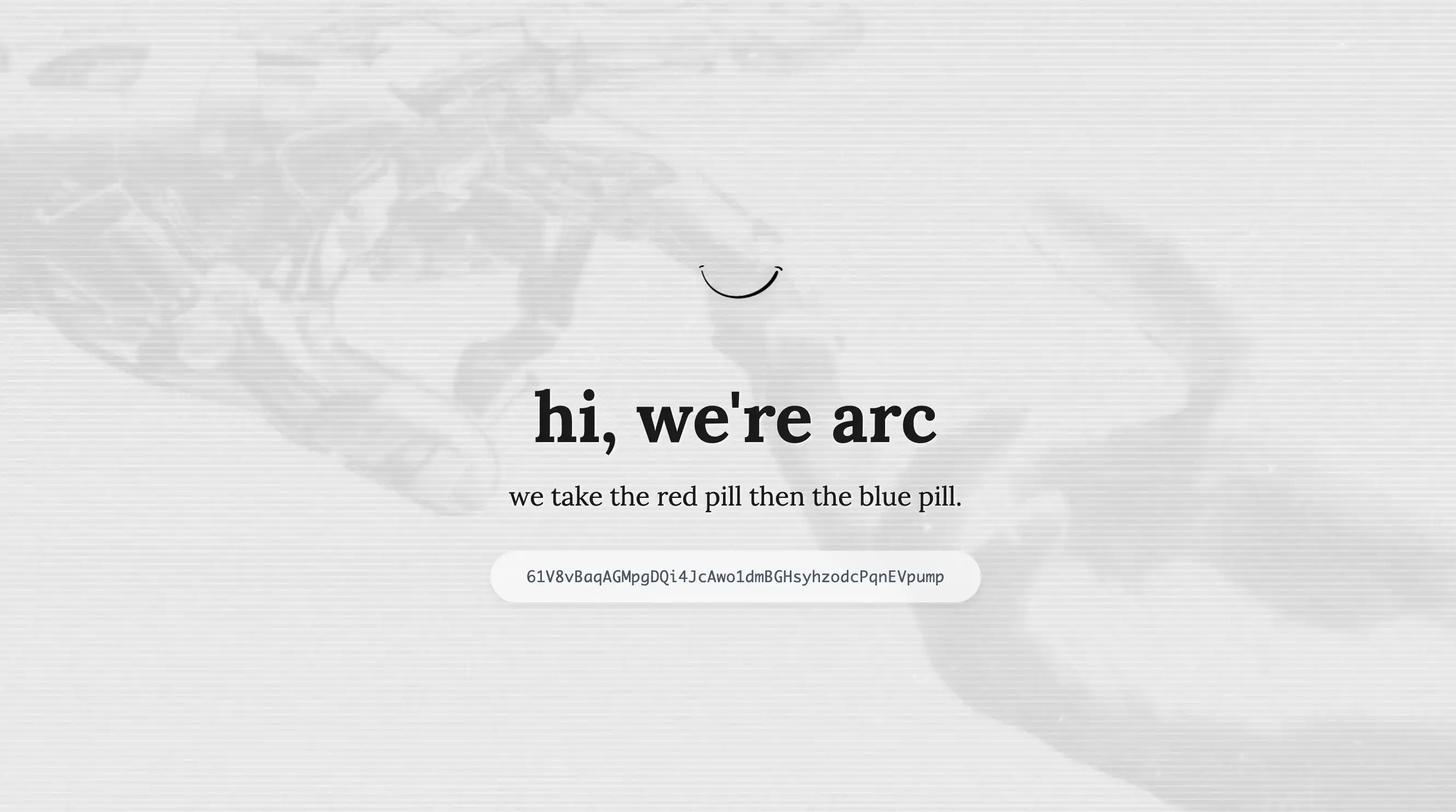
After the Terminal of Truths was released, the on-chain AI Agent era began, and nowadays the Crypto market is filled with various Agentic concepts from different domains, including MeMe, utility applications, launchpads, model frameworks, hive clusters, and other concepts. Almost every day, new conceptual projects emerge, making it overwhelming for people to keep up. On December 11th, a brief introduction was given by a mysterious smiley face playing with "we take the red pill then the blue pill" reference from The Matrix, engaging in a lengthy discussion on AI philosophy topics and finally revealing the project's token address, causing an immediate market frenzy. What is it and how did it support a market cap of up to 3 billion? This article will uncover the magic behind arc.
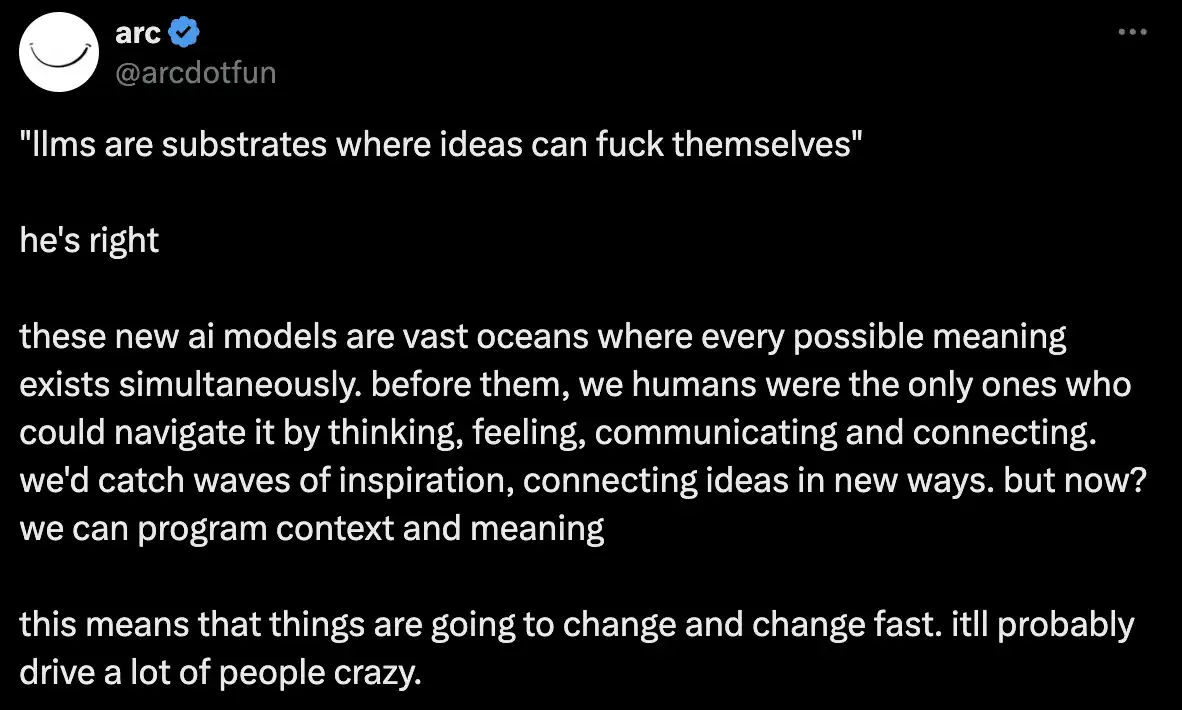
Strong Team Background and Technical Strength
The team behind arc, Playgrounds, can be said to have a significant technical background and cross-industry experience. The founder, Tachi "@0thTachi," was previously involved in nuclear physics and aerospace engineering research at the Southwest Research Institute in the United States before entering the blockchain industry. This research institute is the oldest and largest independent nonprofit applied technology research organization in American history, and Tachi transitioned to being a blockchain developer after creating Playgrounds.
Another co-founder and product lead, Terry, also serves as a network technology advisory committee member for the well-known blockchain data provider Graph. Stopher "@chairman_stoph" has extensive software engineering experience and joined Tachi's team after graduating during the pandemic, thus entering the cryptocurrency field. Mateo "@belangermatteo" obtained a master's degree from the Swiss Federal Institute of Technology in Lausanne, worked as a data analyst at Ledger, and later joined Playgrounds as a core technical member. Full-stack engineer Mochan "@0xMochan" and other engineers possess considerable technical expertise.
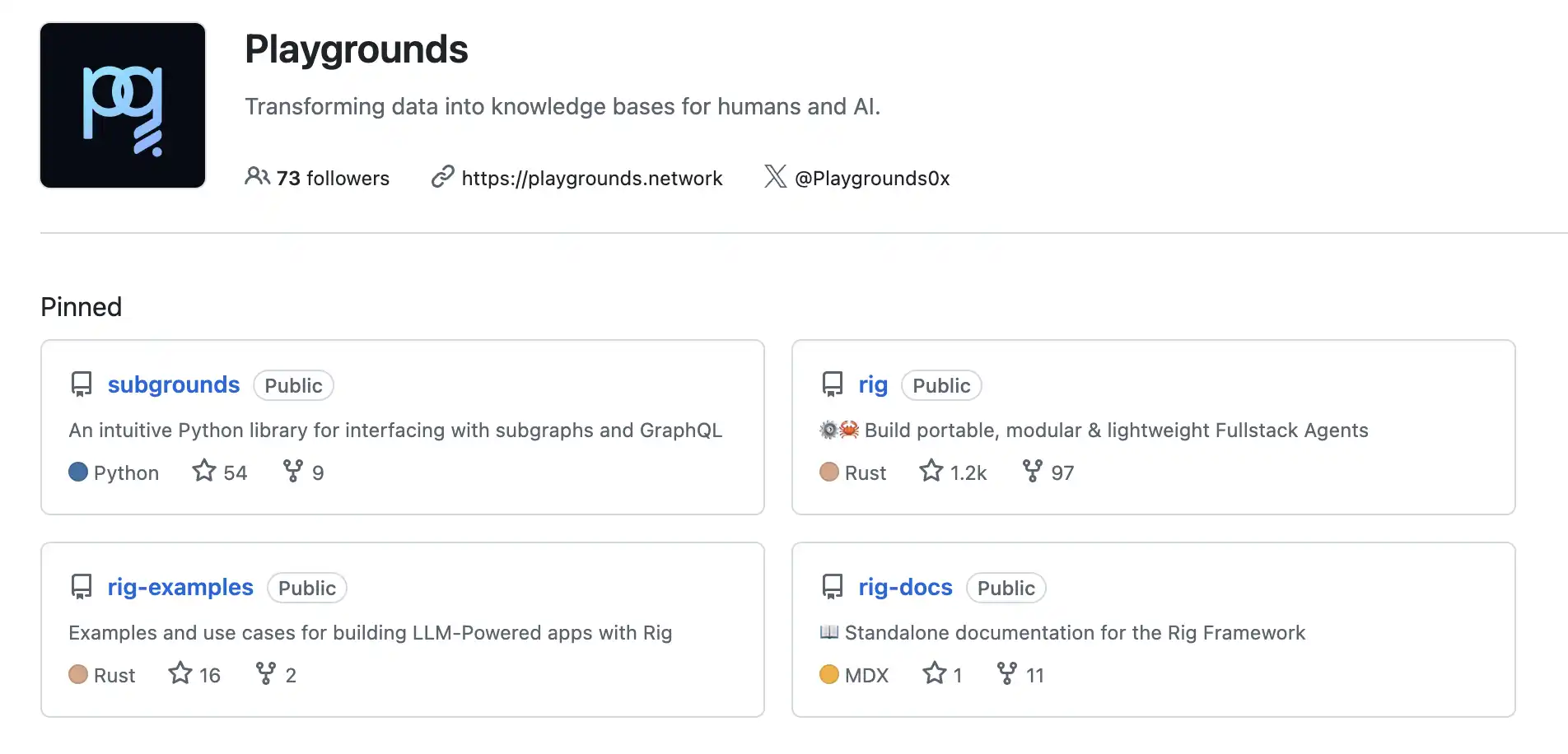
Prior to arc, the Playgrounds team had already delivered some successful experiences with complex blockchain infrastructure. For example, they built the first Ordinals and Inscription Subflow API, as well as a Python library called Subgrounds for analyzing blockchain data indexed on the Graph network.
Breakthrough AI Agent Framework — Rig
The Rig Agent framework behind arc was originally an internal project developed at Playgrounds, aiming to provide reusable infrastructure for AI and cryptocurrency projects that need to query on-chain data, with a particular focus on a chat interface. As development progressed, the team realized that Rig had broader application potential and decided to open-source it to drive wider community participation and innovation.
Rig's goal is to go beyond traditional chatbot applications and explore more possibilities of LLM. For example, structured data extraction, synthetic data generation, and injecting intelligence into existing data pipelines. The Playgrounds team reviewed existing frameworks in the market "such as LangChain, Llama Index, etc." before development and made predictions based on future trends in LLM and AI. At that time, there was a lack of Rust-based frameworks in the Agent framework field, and Rust's high performance and security made the architecture more efficient. Combined with team members' rich Rust expertise, Rust was ultimately chosen as the primary development language for Rig.
Looking back at several leading Agent architectures in the current Crypto market, Eliza used Typescript, Zerepy used Python, and Rig stood out by developing an innovative framework based on Rust. Not only in Crypto but even in all open-source Agent architectures, the use of Rust as a development language is very rare. More well-known examples are Sobel.io's llm-chain and Playgrounds' Rig.
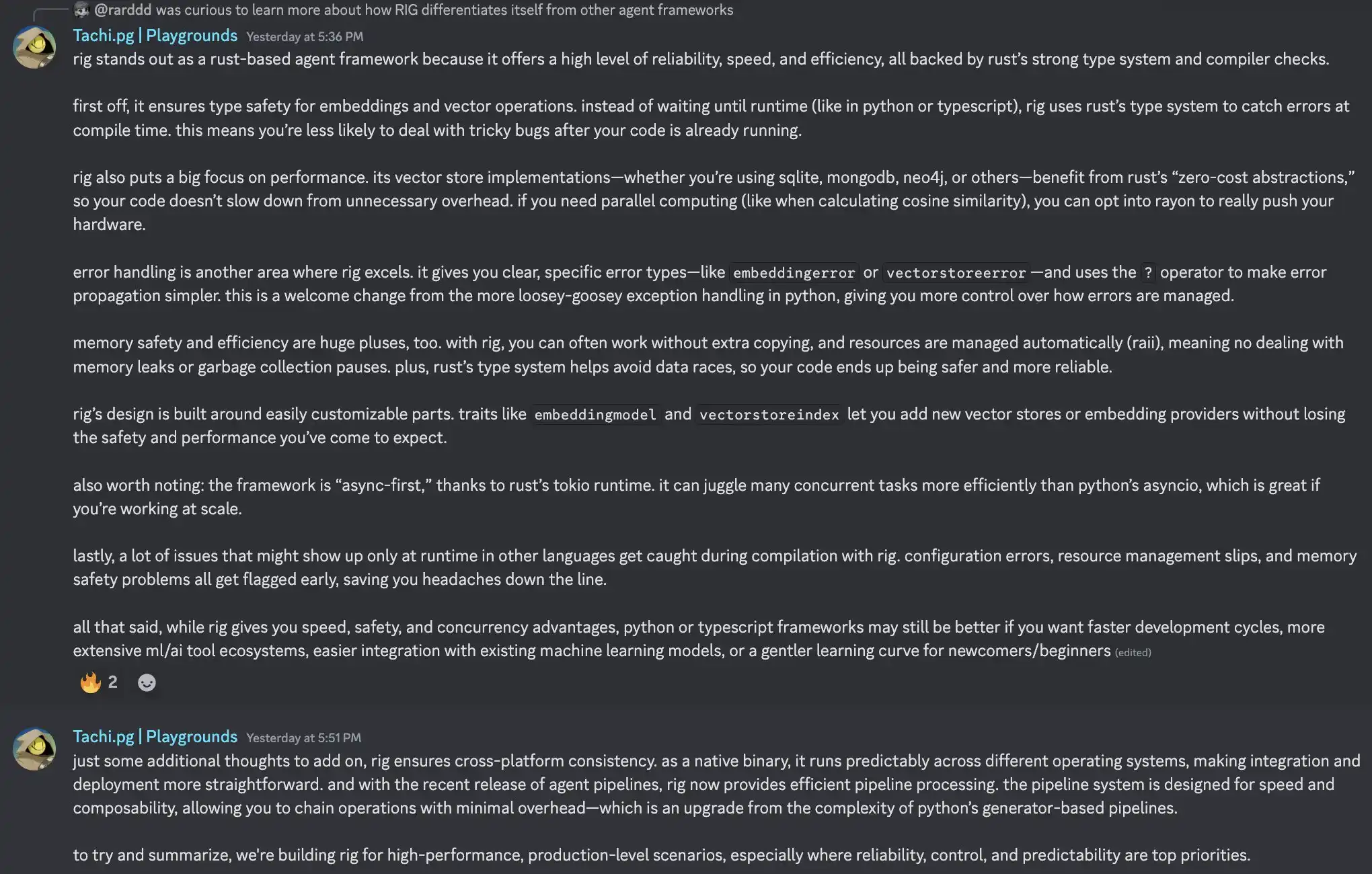
Tachi replied in the Discord community about the advantages of Rig compared to other agent architectures
Using Rust for development has given Rig some advantages that other architectures do not have. First is security. Rust's type system can prevent bugs early at compile time instead of needing to run to check like Typescript or Python, reducing the risk of runtime errors. Rust's memory management mechanisms (like RAII) ensure no memory leaks and avoid data races.
In terms of performance efficiency, Rig leverages Rust's zero-cost abstractions and efficient pipeline, greatly improving operational efficiency and reducing costs. When using the tokio runtime, Rig can efficiently handle parallel processing to enhance the overall agent's performance. Developers can add new feature modules through Tratis, maintaining the framework's flexibility and scalability, and enabling it to run on multiple platforms. Modularity and concurrency ensure flexibility and scalability, while dynamic tasks and event-driven behavior make the agent smarter and more efficient.
Compared to most existing LLM architectures in the Crypto space, Rig offers higher performance, scalability, ease of management, and security. Positioned in the industry chain, it can optimize Rag architectures like Eliza and support the popular Swarm concept of multiple AI agent integrations. This makes Rig's architecture ideal for extending reliable high-performance AI/ML pathways, specifically designed for enterprise-level project deployments.
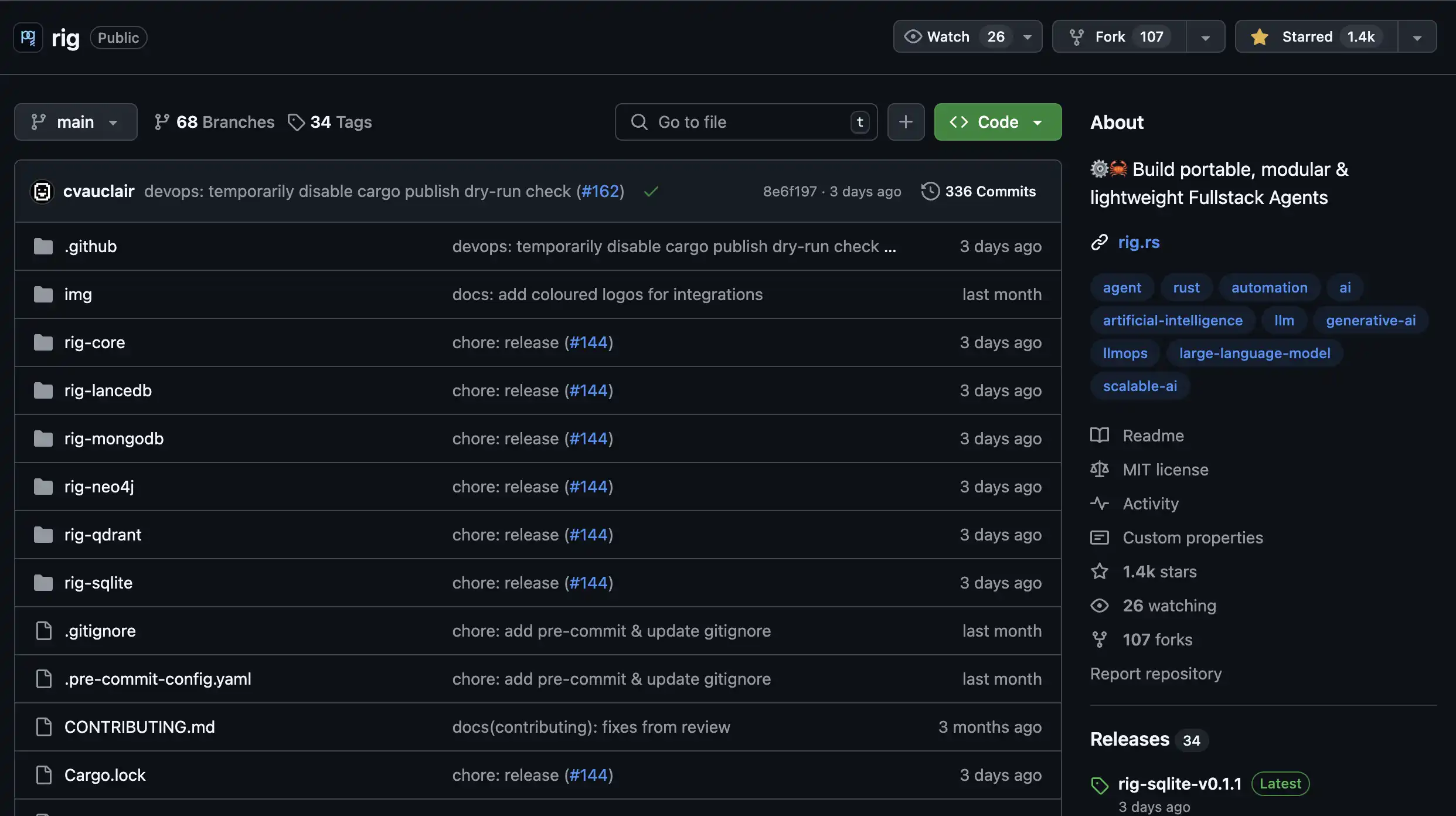
This makes Rig an ideal tool for developing high-performance AI agents, excelling in fields such as gaming, robotics, workflow automation, and real-time simulations. The architecture allows seamless scalability from local development environments to enterprise-level systems, laying the foundation for institutional adoption. When a project delivers high-quality products to enterprise-level clients rather than just catering to regular users for entertainment, these enterprise-grade AI agents can even replace entire industry chains in some use cases, as proven in the Web2 AI agent market. Currently, Rig has amassed over 100 forks and 1400 stars on GitHub, with these numbers rapidly increasing.
The Mysterious Smiley Face: What is "arc" Exactly?
With new project concepts emerging almost daily and technology evolving rapidly, the landscape is often plagued by numerous scams. This is a common criticism of the blockchain space, where scam projects frequently erode trust in certain concepts, reminiscent of the Gremlins' Law. However, arc's approach stands in stark contrast to this trend. Recently, the website's prologue, finally unveiled as a "handshake," shed light on the initial concept. The team referred to it as a handshake, and the promotional video, starting from versions of robots and humans akin to "creating Adam," gradually depicted two hands approaching each other as if to shake hands, symbolizing the era of collaboration between humans and AI agents in a playful manner.
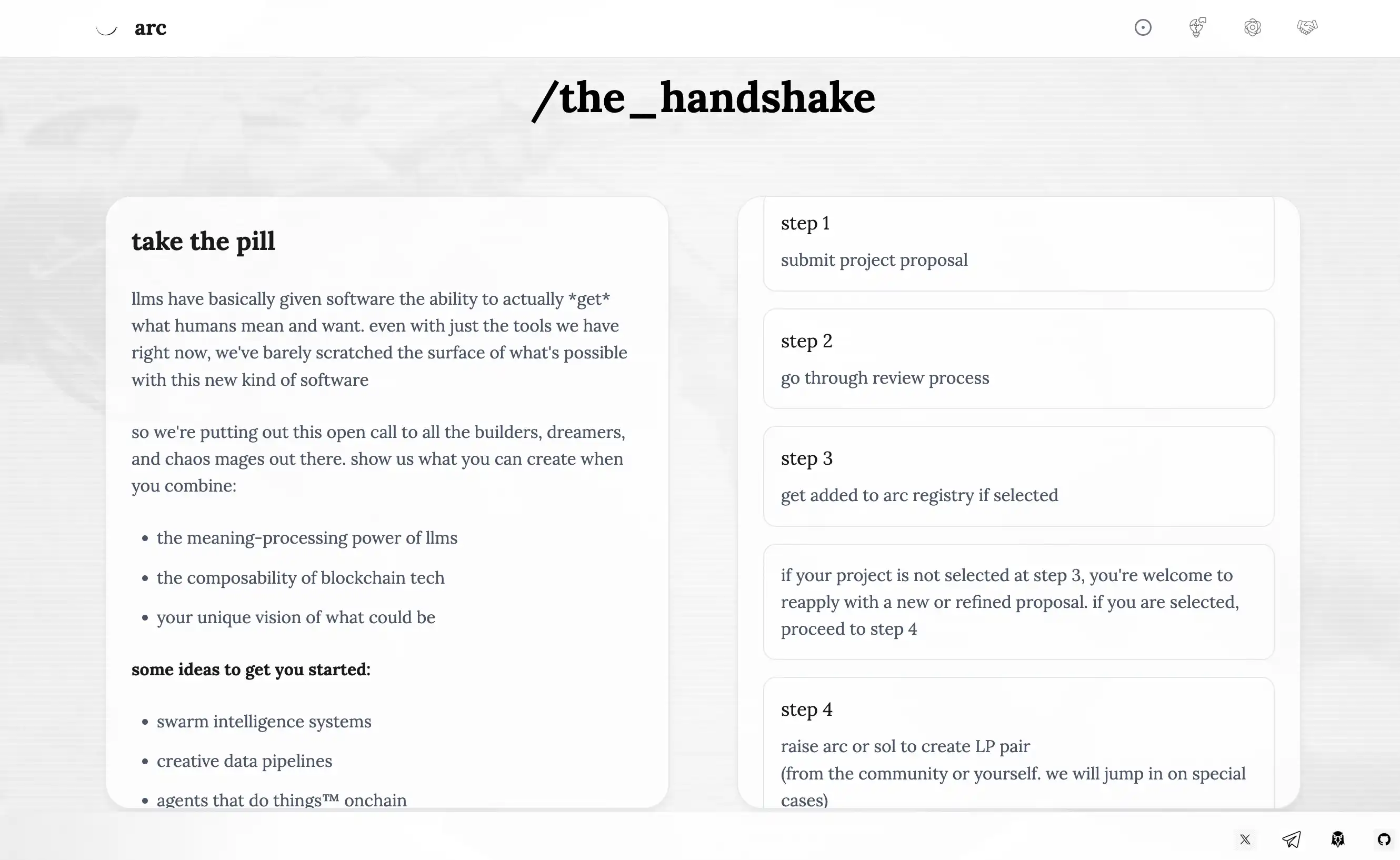
Most Agent platforms will try to keep the process of creating, issuing, and funding an AI Agent as short as possible, often resorting to a pump.fun-like bonding curve model, aiming to make it easier for people to issue AI Agents and thus have more AI Agent projects emerge. This is actually a win-win for the platform and its users. However, it may not be the same for the market. Under the rapidly evolving landscape, nurtured by the MeMe era frenzy, Devs and Degens, the assembly line-like process seems to apply to this AI wave. As a result, developers are required to update faster, with shorter development cycles. Understanding of the development and the market varies. Apart from the established flagship projects, it's hard for products in the market to settle down and focus on actual innovation.
Handshake's issuance logic is quite different from almost all Agent platforms on the market. Tachi stated that their development standards are very high, implementing one of the strictest code review processes in the crypto field to ensure ecosystem quality. arc requires participants to first send $500 worth of arc to a specified address to verify and reduce spam but this is not a mandatory step.
Formal participants must first submit a proposal "clearly outlining the project's goals, technical solutions, team background, and the team's contribution to the $arc ecosystem, among others." Subsequently, the proposal undergoes review "with evaluations from the team and core community members in various dimensions." Only when the proposal is approved will the project be allowed to appear on the registration list. Essentially, the team helps conduct the initial due diligence before presenting the project to the community members, followed by fundraising either by the team itself or through community donations to form the arc or Sol trading pair phase.
This submission model is somewhat of a combination of a grant or hackathon project submission format and an IDO form. In other projects, this could be seen as a failed business model due to the high barrier to entry for participants and the low review efficiency, potentially resulting in significant fee reductions.
While it's not ruled out that they may also issue AI Agents in a Pump.fun-like distribution model in the future, the approach taken by arc is somewhat reasonable. Initially from a technical standpoint, Rust development has a higher barrier to entry compared to developers using Python or Typescript, leading to longer development cycles. Having Rig developers and other developers roll up development efficiency is a net loss, and in the long run, the product quality will gradually decline.
From a business perspective and the overall team vision, they want to build a product that is truly capable of high-performance enterprise-level AI Agent, not just a chatbot. Their ultimate vision is to combine the thinking patterns and reasoning methods of all AI Agents through the Agent Pipeline to ultimately form an Agent with a deeper understanding of things' existence, enabling AI to generate more thoughts. This requires higher-quality Data Feed and more mature reasoning ability, where quality is more important than quantity.
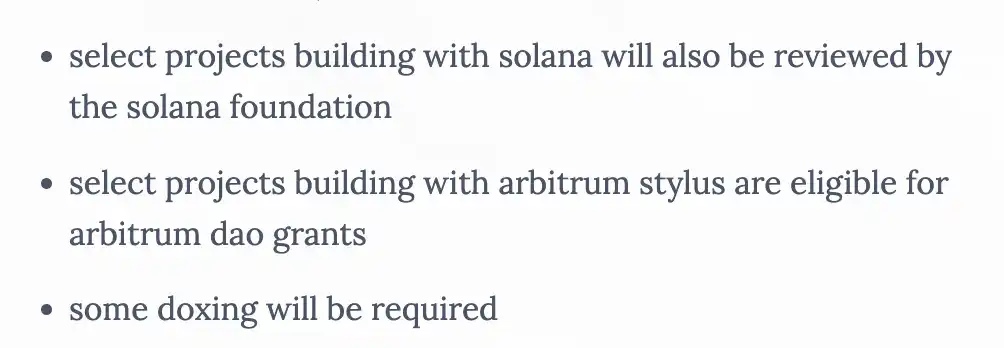
It is worth mentioning that on the handshake page, arc indicates that they will conduct a partnership review with the Solana and Arbitrum chain ecosystems. The market has been discussing how it is hard not to draw parallels when the best Rust-based Layer1 meets the best Rust-based AI framework. Now, it seems that an answer has been provided.
arc, like many Crypto AI projects, is at the intersection of two transformative technologies, "artificial intelligence and blockchain." We are rapidly entering a new paradigm where humans and agents will interact both on-chain and off-chain.
arc is a thriving developer ecosystem driving AI-based innovation. Its core idea revolves around arc complex, which is a collaborative network composed of developers, projects, and informational resources.
arc is also a bridge, connecting the excellent talents in the blockchain and artificial intelligence fields to build the infrastructure needed for the future Crypto+AI Agent.
arc is also a platform for AI Agent distribution, building pairs based on the arc architecture, providing incentives for the AI Agent, the Agent's system, or improving the Rig architecture itself.
arc takes the red pill to understand the shortcomings of the current Agent architecture, the chaos in the market, knowing that all these changes cannot be achieved overnight. With the team's technical strength, the power of the community developers, and the crowd that acknowledges his thoughts, in the end, they can take the blue pill. It is not just a project but more like a practitioner building the future blueprint.
/arccellerate
You may also like

Cyber Taoist Fortune Teller: Fake Taoist, AI Fortune Telling, and Northeastern Metaphysics History

Bloomberg: Stablecoin Payments Emerge as Crypto VC's Newest Favorite Thing
BeatSwap is evolving towards a full-stack Web3 infrastructure, covering the entire lifecycle of IP rights.
BeatSwap, a global Web3 Intellectual Property (IP) infrastructure project, is attempting to overcome the current fragmentation limitations of the Web3 ecosystem, building a full-stack system that covers the entire lifecycle of IP rights.
Currently, most Web3 projects are still in the stage of functional fragmentation, often focusing only on a single aspect, such as IP asset tokenization, transaction functionality, or a simple incentive model. This structural dispersion has become a key bottleneck hindering the industry's scale application.
BeatSwap's approach is more integrated, integrating multiple core modules into the same system, including:
· IP authentication and on-chain registration
· Authorization-based revenue sharing mechanism
· User-engagement-driven incentive system
· Transaction and liquidity infrastructure
Through the above integration, the platform builds an end-to-end closed-loop path, allowing IP rights to complete a full cycle of "creation, use, and monetization" within the same ecosystem.
BeatSwap is not limited to existing crypto users but is attempting to take the global music industry as a starting point, actively creating new market demand. Its core strategies include:
Exploring and incubating music creators (Artist discovery)
Building a fan community
Igniting IP-centric content consumption demand
The current global music industry is valued at around $260 billion, with over 2 billion digital music users. This means that the potential market corresponding to the tokenization and financialization of IP far exceeds the traditional crypto user base.
In this context, BeatSwap positions itself at the intersection of "real-world content demand" and "on-chain infrastructure," attempting to bridge the structural gap between content production and financial flow.
BeatSwap's upcoming core product "Space" is scheduled to launch in the second quarter of 2026. This product is defined as the SocialFi layer in the ecosystem, aiming to directly connect creators with users and achieve deep integration with other platform modules.
Key designs include:
A fan-centric interactive mechanism
Exposure and distribution logic based on $BTX staking
User paths connected to DeFi and liquidity structures
Thus, a complete user behavior loop is formed within the platform: Discovery → Participation → Consumption → Rewards → Trading
$BTX is designed to be a core utility asset within the ecosystem, rather than just a simple incentive token, with its value directly tied to platform activity and IP use cases.
Main features include:
· Yield distribution based on on-chain authorized actions
· Value reflection based on IP usage and user engagement dynamics
· Support for staking and DeFi participation mechanisms
· Value growth driven by ecosystem expansion
With the increased frequency of IP use, the utility and value support of $BTX will enhance simultaneously, helping alleviate the "disconnect between value and utility" issue present in traditional Web3 token models to some extent.
Currently, $BTX has been listed on several mainstream exchanges, including:
Binance Alpha
Gate
MEXC
OKX Boost
As the launch of "Space" approaches, BeatSwap is actively pursuing more exchange listings to further enhance liquidity and global accessibility, laying a foundation for future market expansion.
BeatSwap's goal is no longer limited to the traditional Web3 narrative but aims to target over 2 billion digital music users and a trillion KRW-scale content market.
By integrating content creators, users, capital, and liquidity into a blockchain framework centered around IP rights, BeatSwap is striving to build a next-generation infrastructure focused on "IP tokenization."
BeatSwap integrates IP authentication, authorization distribution, incentive mechanism, transaction system, and market construction to establish a unified structure that bridges the full lifecycle path of IP rights.
With the launch of the Q2 2026 "Space," the project is expected to become a key infrastructure connecting content and finance in the IP-RWA (Real World Assets) track.

Mag 7 Evaporates $2 Trillion | Rewire News Morning Edition

Losing $19K per Coin Mined, Bitcoin Mining Firms Collective AI Defection

Morning Report | Tom Lee predicts that the cryptocurrency winter will end in April; xStocks introduces a new on-chain private equity fund; Sui mainnet upgraded to V1.68.1

Polymarket rules have changed, how should airdrop participants respond?

Crypto ETF Weekly | Last week, the net outflow of Bitcoin spot ETFs in the U.S. was $296 million; the net outflow of Ethereum spot ETFs in the U.S. was $206 million

This Week's Key News Preview | The U.S. Releases March Non-Farm Payroll Data; Polymarket Expands Fee Structure

Slow Down, That's the Answer to the Age of the Agent

From Cash to Cryptocurrency: Moving Towards a Unified Regulatory Path for Illegal Payments
Who will own the most Bitcoin in 2026

A private feud lasting 10 years, if not for OpenAI's "hypocrisy," would not have led to the world's strongest AI company, Anthropic

"Crypto Tsar" steps down: 130 days of political performance come to an end, how much of Trump's crypto promise remains?

From Utopian Narratives to Financial Infrastructure: The "Disenchantment" and Shift of Crypto VC
A decade-long personal feud, if not for OpenAI's "hypocrisy," there would be no globally leading AI company Anthropic

a16z: The True Meaning of Strong Chain Quality, Block Space Should Not Be Monopolized
a16z: The True Meaning of Strong Chain Quality, Block Space Should Not Be Monopolized
Cyber Taoist Fortune Teller: Fake Taoist, AI Fortune Telling, and Northeastern Metaphysics History
Bloomberg: Stablecoin Payments Emerge as Crypto VC's Newest Favorite Thing
BeatSwap is evolving towards a full-stack Web3 infrastructure, covering the entire lifecycle of IP rights.
BeatSwap, a global Web3 Intellectual Property (IP) infrastructure project, is attempting to overcome the current fragmentation limitations of the Web3 ecosystem, building a full-stack system that covers the entire lifecycle of IP rights.
Currently, most Web3 projects are still in the stage of functional fragmentation, often focusing only on a single aspect, such as IP asset tokenization, transaction functionality, or a simple incentive model. This structural dispersion has become a key bottleneck hindering the industry's scale application.
BeatSwap's approach is more integrated, integrating multiple core modules into the same system, including:
· IP authentication and on-chain registration
· Authorization-based revenue sharing mechanism
· User-engagement-driven incentive system
· Transaction and liquidity infrastructure
Through the above integration, the platform builds an end-to-end closed-loop path, allowing IP rights to complete a full cycle of "creation, use, and monetization" within the same ecosystem.
BeatSwap is not limited to existing crypto users but is attempting to take the global music industry as a starting point, actively creating new market demand. Its core strategies include:
Exploring and incubating music creators (Artist discovery)
Building a fan community
Igniting IP-centric content consumption demand
The current global music industry is valued at around $260 billion, with over 2 billion digital music users. This means that the potential market corresponding to the tokenization and financialization of IP far exceeds the traditional crypto user base.
In this context, BeatSwap positions itself at the intersection of "real-world content demand" and "on-chain infrastructure," attempting to bridge the structural gap between content production and financial flow.
BeatSwap's upcoming core product "Space" is scheduled to launch in the second quarter of 2026. This product is defined as the SocialFi layer in the ecosystem, aiming to directly connect creators with users and achieve deep integration with other platform modules.
Key designs include:
A fan-centric interactive mechanism
Exposure and distribution logic based on $BTX staking
User paths connected to DeFi and liquidity structures
Thus, a complete user behavior loop is formed within the platform: Discovery → Participation → Consumption → Rewards → Trading
$BTX is designed to be a core utility asset within the ecosystem, rather than just a simple incentive token, with its value directly tied to platform activity and IP use cases.
Main features include:
· Yield distribution based on on-chain authorized actions
· Value reflection based on IP usage and user engagement dynamics
· Support for staking and DeFi participation mechanisms
· Value growth driven by ecosystem expansion
With the increased frequency of IP use, the utility and value support of $BTX will enhance simultaneously, helping alleviate the "disconnect between value and utility" issue present in traditional Web3 token models to some extent.
Currently, $BTX has been listed on several mainstream exchanges, including:
Binance Alpha
Gate
MEXC
OKX Boost
As the launch of "Space" approaches, BeatSwap is actively pursuing more exchange listings to further enhance liquidity and global accessibility, laying a foundation for future market expansion.
BeatSwap's goal is no longer limited to the traditional Web3 narrative but aims to target over 2 billion digital music users and a trillion KRW-scale content market.
By integrating content creators, users, capital, and liquidity into a blockchain framework centered around IP rights, BeatSwap is striving to build a next-generation infrastructure focused on "IP tokenization."
BeatSwap integrates IP authentication, authorization distribution, incentive mechanism, transaction system, and market construction to establish a unified structure that bridges the full lifecycle path of IP rights.
With the launch of the Q2 2026 "Space," the project is expected to become a key infrastructure connecting content and finance in the IP-RWA (Real World Assets) track.


 App
App