
Tako App Launches, Ushering in a New Paradigm of Decentralized Web Socialization


Source: Tako Protocol
What is the Tako App?
The Tako App is the first official client app of the Tako Protocol ecosystem—a cutting-edge lifestyle sharing community. The platform aims to serve a group of forward-thinking individuals passionate about scientific exploration and personal sovereignty through decentralized technology, creating a new cyberspace for "High-Tech High-Life." With early-stage funding exceeding $13 million, with the most recent round occurring in August.
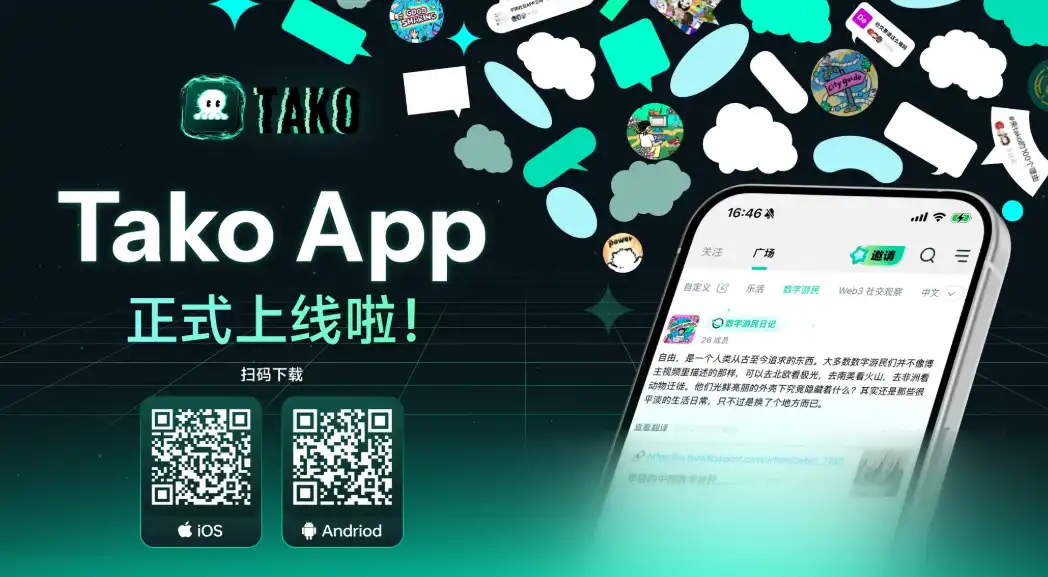
Among the first batch of seed beta users are not only OGs and Founders from various Web3 tracks who believe in personal data sovereignty and anti-censorship ideology but also a wide range of Web3 enthusiasts eager to explore how technology will empower social interactions in the future, including renowned science fiction writer Chen Qiufan. Of course, in the foreseeable future, this space will also become a hotbed for artificial intelligence entities and agent economies: users will be able to interact deeply with decentralized AI agents, and even AI agents will engage with each other in intricate ways. This vision took shape some time ago with the emergence of the Farcaster ecosystem Clanker auto-coinbot, and Tako, which has received official Farcaster support and focuses on the Asia-Pacific market, is closely following this trend.
It is important to note that the Tako Protocol is a protocol, while the Tako App is the flagship client built on the protocol, representing a specific implementation of the protocol. Tako has always aimed to provide not just an app but a virgin land where all developers and users can have a complete, freely combinable set of components to incubate more wild and imaginative applications that interconnect to form the next generation of open social network ecosystems.
Further Reading: The Tako Protocol layer is a decentralized, scalable social network protocol that consolidates data from various social platforms such as Farcaster, Lens, Twitter, etc., providing developers with a unified and convenient development experience akin to building with LEGO bricks. We refer to it as the "social LEGO" module. With flexible APIs, SDKs, and diverse application development scenarios, developers can build decentralized social networks and empower the creator economy in a low-barrier, high-efficiency manner. Tako offers permissionless access to its tech stack, allowing developers to utilize modular "LEGO bricks" to construct and deploy their own social dApps. It aggregates and unifies the social graph while providing foundational features such as SAA login, social asset issuance and trading, content distribution, content propagation, and peer-to-peer recommendations.
What Kind of Community Will Develop Around This App?
The Tako App is an avant-garde lifestyle sharing community platform built on a decentralized social media protocol, forked from Farcester's content and adding its own native content section. Each creator can create their own community, and this content is not closed off; high-quality content will be synchronized to the main feed. In the early days of the Tako App, following the concept that "1,000 fans can support a creator and even a platform," and to establish an early culture of high tech/high life content sharing, the official team covered all registration costs. They gradually built a diverse, culturally free-growing community collection by inviting high-quality beta users, catering to a range of individuals such as scientists conducting cutting-edge brain-computer research, biohackers experimenting on their bodies to explore longevity, travelers sharing digital nomad guides from around the world, meditation practitioners using mindfulness to heal themselves and others, open-source enthusiasts who believe code is law, and sci-fi fans envisioning encounters between bionic humans and electronic sheep, all finding their cozy corners. After the official app launch and gradual opening of registrations, Tako will also welcome numerous ordinary individuals hoping to have their voices heard.
In terms of Tako App's design philosophy, it differs from the Farcester client's attempt to be a crypto Twitter and instead takes a different path focused on maximizing community. When you open the Tako App, you automatically enter the communities section, where you can easily discover the topics being passionately discussed by community members—such as whether intermittent fasting can lead to a longer life, or how meditation can help you see your true self, or what kind of people are in Zuzalu, and so on.
As you discover a fun community through participating in a trending topic on the main feed and subsequently engaging with friends who share similar interests and interact daily, the social network's energy begins to take effect.
At Tako, you'll find that these tightly knit, cozy, and interesting communities are just the beginning, and high-quality content is just the foundation. Their greater appeal lies in being like blobs of clay or LEGO bricks, where users can piece together, decorate, and combine them with other communities and mini-apps based on their tastes and preferences. For example, if you're running a meditation community, you could choose to embed a zk anonymity tool provided by the community's developers to allow your community friends to share their stories and experiences more openly. You could also choose a mod tool to set it up so only friends holding your favorite NFTs can successfully join. Moreover, when you're dissatisfied with these tools, your community members can collaborate and create together, as few things are more rewarding than collectively creating a brighter future.
What kind of community will Tako develop? Will it be a group of people discussing longevity like in the Elderly Olympics every day? Will it be like the STEPN community sharing their daily runs? Will it be exploring the future cyberspace together like a "cyber nation"? Perhaps all of these will exist because there are all kinds of people here. Imagine this scenario—you and your friends in a shared community initiate a bet, where the bet is "ETH will reach 10K USD by the end of 2026; if it doesn't, you will give 150 SOL to your friend, but if it does, your friend will give you 10 ETH." Here's the catch—you don't have SOL; you need a third-party credit loan protocol to help you deposit it first. You don't need to have enough SOL at the moment or any collateral; you just need to use your on-chain social reputation to guarantee and sign your name. In the end, if you win, you only need to pay the platform interest from your winnings—such wonderful scenarios were originally only imagined in the world of Web3 Desoc, but next, they will occur one by one on Tako until they explode.
Tako's goal is to enable one after another of your casual ideas to be tried, combined, and realized in the community you love, allowing interesting souls to connect with more interesting souls and grow into creative, energetic communities.
Based on the social graph of these communities and peer-to-peer information flow, more fun things will happen, such as:
· Information Finance: Prediction markets embedded in social flows, disrupting information dissemination methods—you can predict the outcome of each couple's relationship in the variety show "Goodbye, My Love" with friends on the Tako app using a mechanism similar to Polymarket;
· New Community Organization: Design economic models to create diverse interest communities—you can set up a bounty pool to launch the Tako ZK Cruel Co-Learning Program, where members can receive bounties based on completion level through community voting, bringing the hackathon format onto the chain;
· Creator Economy: Support fan tokens, live streaming tips, referral programs, and other creative monetization methods—you can crowdfund niche research based on the logic of tipping influencers, achieving "research online, funding on-chain";
· Mini-Apps: From social betting to esports mini-games, everything is available—mini-app experiences based on the social graph will be even smoother than Telegram mini-apps;
· AI Agent: Build open data-driven AI service scenarios—you can let an AI agent issue coins and have another AI agent engage in PvP;
· Defi 2.0: Credit lending service based on social graph and reputation data — Imagine if you are a person who frequently interacts with Vitalik, wouldn't your borrowing credit be higher?
A LEGO-like explosion of content and creativity can be brought about by free content creation + free economic settlement layering.
Why Now? Why Tako?
During the development of the past decade plus, Web2 platforms have become increasingly centralized, with absolute control and management over user information dissemination, propagation, and account existence. Idealists began to explore the path to decentralization of social networks, giving rise to Mastodon, Bluesky, Nostr, Lens, Farcaster, and Tako. Among the aforementioned applications, some faltered midway with strategic pivots, some were designed simply but lacked playability, and some struggled to operate with few users. Currently, on this path, only Farcaster and Tako remain.
Currently, Farcaster's V1 solution has encountered significant bottlenecks, and V2 is reverting to a blockchain design approach. On the other hand, Tako has learned from Farcaster's correct technical architecture points — its openness and programmability provide developers with a good testing ground, and its native cryptographic features have led to various standout projects. Tako chooses to follow the DHT solution towards a high-performance, highly scalable path. To some extent, both Farcaster and Tako are pursuing a solution that better suits themselves.
We have reached a bottleneck stage in blockchain infrastructure innovation, where asset issuance and chain creation have reached the simplest and least frictional levels possible, and the foundational protocol modules have also been established (various liquidity and trading protocols). When the foundational chain creation becomes extremely low-friction, and these application-type protocol modules begin to scale, the next worthwhile endeavor is the construction of the intermediate protocol layer. This is also the bottleneck for various applications at the current stage: there is no intermediate layer that connects users and network effects together; the effects of many applications can never be amplified and scaled without the endorsement of a social network.
With early-stage funding ammunition, official support from Farcaster (Farcaster unable to localize in the Asia-Pacific region) and attention from Base officials, rich social practices rooted in Asia-Pacific/domestic Web2 (learning from a wealth of successful or failed experiences from platforms such as Kuaishou, Douban, Zhihu, Xiaohongshu, Weibo), Tako is undoubtedly the best choice to act as this intermediate coupling layer.
If you are also looking for:
· A platform where you don't have to worry about your account disappearing ✓
· A space where you have full control of your own content ✓
· A community where you can meet like-minded friends ✓
· A creative environment with valuable rewards ✓
Then, welcome to Tako, the oasis of the new cyber era.
This article is contributed content and does not represent the views of BlockBeats
You may also like

Morning Report | BitMine increased its holdings by 126,971 ETH last week; trader Eugene announced his exit from the crypto market

Wang Chuan: How can one not feel anxious after the neighbor Old Wang made thirty times profit by investing in storage stocks? (Seven) - A quarter-century cycle

Cryptocurrency CEXs are flocking to sell US stocks, and traditional brokerages are facing an "uninvited guest."

$75 billion in foreign capital has fled, and South Korean retail investors have absorbed it all using leverage

Japan’s Three Megabanks Plan Joint Stablecoin Issuance in Fiscal 2026
MUFG, SMBC, and Mizuho reportedly plan to jointly issue fiat-pegged stablecoins in fiscal 2026, signaling Japan’s growing push into bank-led digital payment infrastructure.

Humanity Discloses H Token Dual-Chain Attack Details, With Losses on Ethereum and BSC Exceeding $36 Million
Humanity said the H token attack across Ethereum and BSC caused more than $36 million in losses after leaked ProxyAdmin keys enabled malicious contract upgrades and token minting.
White House Discusses CLARITY Act With Law Enforcement Ahead of Senate Vote
The White House discussed the CLARITY Act with law enforcement ahead of a Senate vote, focusing on illicit finance risks and developer protections.

Bitcoin Trading Guide 2026: Strategies for Experienced Traders

What Is XAUT and PAXG? Why Tokenized Gold Is Booming in 2026

Will the SpaceX IPO Hurt Bitcoin? Here's What Traders Are Watching

Foreign selling in the South Korean stock market accelerates, with cumulative net sales reportedly reaching $75 billion this year
On June 9, The Kobeissi Letter, citing Goldman Sachs data, reported that global investors are selling South Korean stocks at an unusually rapid pace. In the latest trading session, foreign investors sold about $801 million worth of Kospi constituent stocks again; total foreign outflows last week reached about $10 billion, and the market has been in net foreign selling on nearly every trading day over the past month. According to the data cited in the report, foreign investors have sold about $75 billion worth of South Korean stocks so far this year. Meanwhile, South Korean retail and institutional investors together recorded roughly $69 billion in net buying over the same period, suggesting that the market’s main buying support has come from domestic capital rather than returning overseas funds. The information currently disclosed still mainly comes from The Kobeissi Letter’s retelling and Goldman Sachs data summaries, while public details on the statistical period and the specific definition of “selling” remain relatively limited.

Fortune Warns of Strategy’s Financing Structure Risks as Bitcoin Premium Narrows
Fortune warned that Strategy’s Bitcoin treasury model faces growing financing risks as MSTR’s net asset premium narrows and preferred stock dividend pressure increases.

Ferrari Challenge Le Mans: Carl Moon to Dominate in WEEX Livery

Sahara AI Responds to SAHARA’s Sharp Drop: No Contract or Product Security Issues Found, Internal Investigation Underway
Sahara AI responded to SAHARA’s 60% price drop, saying no token contract or product security issues have been found and an internal investigation is underway.

WEEX Deposit/Withdrawal Dynamic Island: Your Asset Status, Always in Sight
Scaling Crypto Derivatives: The Digital Asset Infrastructure Behind High-Volume Trading
In the fast-moving digital asset ecosystem, derivatives platforms face an extreme architectural test. High-leverage futures markets demand more than just standard security—they require absolute operational precision, zero-latency matching engines, and ironclad structural scalability, all while navigating intense market volatility.
As global platforms scale to meet these demands, the industry is shifting away from rigid, monolithic setups toward a more agile, "decoupled" infrastructure philosophy.
The Blueprint for High-Volume Copy TradingFor elite global exchanges like WEEX (founded in 2018), this architectural choice becomes critical when scaling high-volume retail features like social copy trading. When thousands of users automatically mirror the real-time strategies of elite traders simultaneously, it triggers sudden, monumental spikes in concurrent transactional volume.
To prevent execution latency or settlement bottlenecks during these peak volatility events, a platform's primary engine must remain entirely dedicated to risk management, copy-trade synchronization, and order matching.
The Architectural Rule: New-generation platforms must separate front-end user execution engines from heavy backend infrastructural overhead to eliminate operational friction.
By separating these layers, platforms can maintain complete sovereignty over their trading environments and user experiences while strategically aligning with institutional-grade infrastructure ecosystems. This strategic framework allows modern exchanges to leverage advanced Digital Asset Custody infrastructure such as Cobo’s behind the scenes, ensuring that backend wallet management scales elastically alongside trading spikes.
Capitalizing on Market Momentum and 400× LeverageIn a derivatives arena where platforms offer up to 400× leverage on perpetual contracts, capital efficiency and market agility are core business metrics. To capture market momentum, an exchange needs the ability to rapidly expand its asset offerings, supporting everything from legacy crypto assets to sudden, trending altcoins across a massive library of trading pairs.
Adopting a flexible, scalable Wallet-as-a-Service (WaaS) solution such as Cobo’s could completely rewrite the development timeline for high-growth exchanges. Instead of spending months of engineering capital building out custom backend wallet architectures for every new blockchain network, platforms can deploy localized infrastructure in days.
This agility allows platforms to instantly scale their listings to over a thousand trading pairs without compromising security or delaying time-to-market. It mirrors the exact operational advantages seen during high-velocity market events, similar to how advanced wallet infrastructure empowers platforms during sudden asset surges; allowing exchanges to pass that speed and liquidity directly to their global user base.
A Mature Foundation for GrowthThe synergy between trusted infrastructure ecosystems and global trading platforms represents the natural evolution of a maturing crypto market. As WEEX continues to scale its global spot and derivatives offerings for over 6 million users, adopting robust backend paradigms proves that platforms no longer have to compromise between cutting-edge trading velocity and uncompromised structural security.

Get Paid to Onboard? Try WEEX’s New Homepage with Rewards for Registration, Deposit & Trade
WEEX Custom Layout: Build Your Perfect Trading Workspace in Seconds
Morning Report | BitMine increased its holdings by 126,971 ETH last week; trader Eugene announced his exit from the crypto market
Wang Chuan: How can one not feel anxious after the neighbor Old Wang made thirty times profit by investing in storage stocks? (Seven) - A quarter-century cycle
Cryptocurrency CEXs are flocking to sell US stocks, and traditional brokerages are facing an "uninvited guest."
$75 billion in foreign capital has fled, and South Korean retail investors have absorbed it all using leverage
Japan’s Three Megabanks Plan Joint Stablecoin Issuance in Fiscal 2026
MUFG, SMBC, and Mizuho reportedly plan to jointly issue fiat-pegged stablecoins in fiscal 2026, signaling Japan’s growing push into bank-led digital payment infrastructure.
Humanity Discloses H Token Dual-Chain Attack Details, With Losses on Ethereum and BSC Exceeding $36 Million
Humanity said the H token attack across Ethereum and BSC caused more than $36 million in losses after leaked ProxyAdmin keys enabled malicious contract upgrades and token minting.


