
Solana's Summer Gem: Was Metaplex, the Quiet Beneficiary of the Meme Craze, Underrated?

Original Title: "Solana's Summer Gem: Has Metaplex, Quietly Enriched in the Meme Craze, Been Underestimated?"
Original Author: Alex Xu, Mint Ventures
1. Introduction
If you were to ask which Layer 1 protocol had the best business development during this bull market cycle, most people's answer would be: Solana.
Whether it's the number of active addresses or fee revenue, Solana's market share on Layer 1 has expanded rapidly:
Active Addresses: Solana's active address share has grown from 3.48% to 56.83%, a 1533% year-on-year increase;
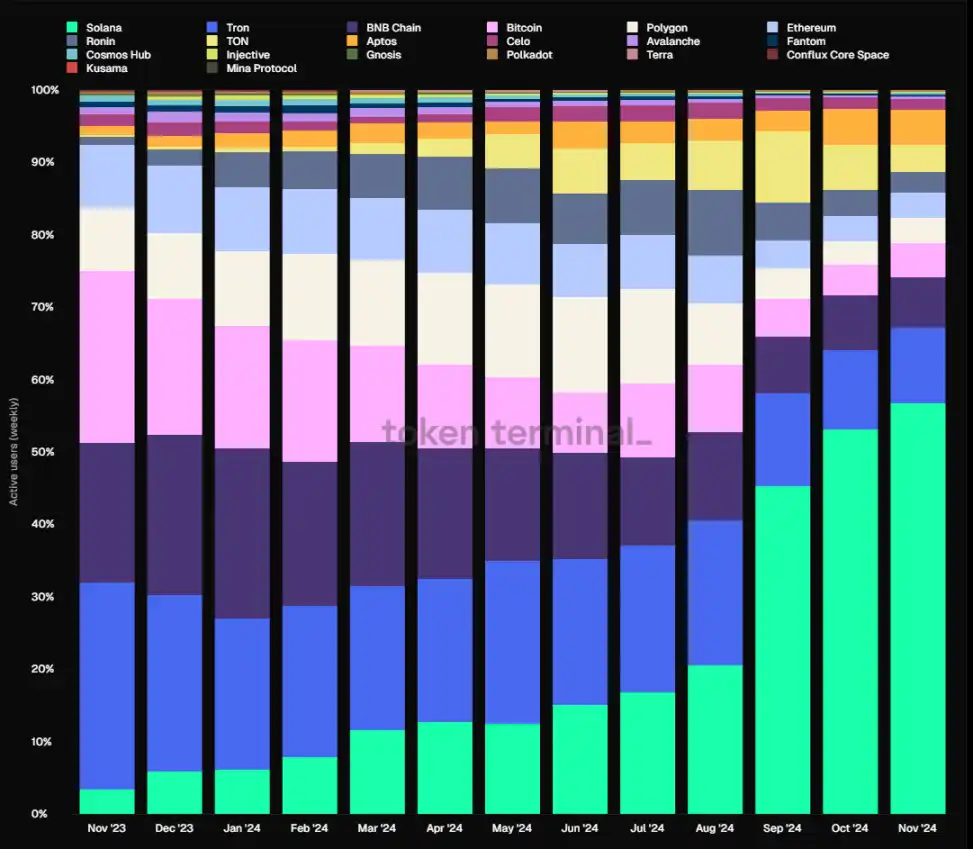
Layer 1 Monthly Active Address Market Share, data source: tokenterminal
Fee Revenue: Solana's fee revenue share has grown from 0.62% to 28.92%, a 4564% year-on-year increase.
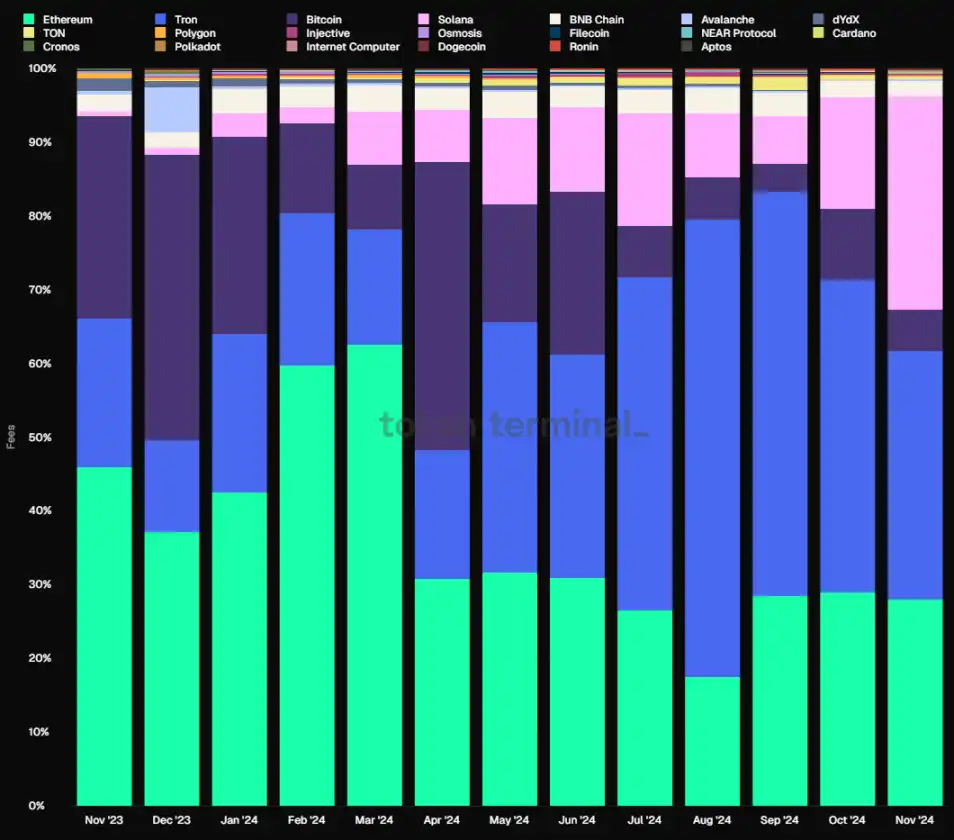
Layer 1 Monthly Fee Revenue Market Share, data source: tokenterminal
The Meme craze has been the driving force behind the rapid growth of key metrics within Solana during this cycle. In addition to Solana, other projects benefiting from the Meme craze include decentralized exchanges like Raydium, where Meme trading activity has contributed a significant amount of volume and protocol revenue, with its price recently hitting a new high this cycle.
In this article, the author will focus on another project that has benefited from the substantial asset issuance on Solana: @metaplex.
This content will present and discuss the following 4 questions:
· What is Metaplex's business positioning and business model? Does it have a moat?
· How is Metaplex's business data? How has its business development been?
· What is Metaplex's team background and funding situation, and how should the project team be evaluated?
· What is Metaplex's current valuation level, and is there a margin of safety?
This article represents the author's interim thoughts as of the publication date, which may change in the future. The views expressed are highly subjective and may contain errors in facts, data, or reasoning. Criticism and further discussion from peers and readers are welcome, but this article does not constitute any investment advice.
Below is the main body of the text.
2. Metaplex's Business Positioning and Business Model
The Metaplex protocol is a digital asset creation, sales, and management system built on the Solana blockchain and supporting the Solana Virtual Machine (SVM). It provides developers, creators, and enterprises with tools and standards to build decentralized applications. Metaplex supports various types of crypto assets, including NFTs, FTs (Fungible Tokens), Real-World Assets (RWA), in-game assets, and DePIN assets.
Recently, Metaplex has expanded its business horizontally into other foundational service areas within the Solana ecosystem, such as data indexing and data availability services.
In the long run, Metaplex is poised to become one of the most critical cross-disciplinary foundational service projects in the Solana ecosystem.
2.1 Metaplex's Product Matrix
As an asset issuance, management, and standard system, Metaplex serves assets that include both NFTs and fungible tokens. The following listed products constitute a comprehensive matrix of services for Solana ecosystem assets.
Core
Core is a next-generation NFT standard on the Solana blockchain that adopts a "single-account design." This design significantly reduces minting costs and computational power, supports advanced plug-ins, and enforces royalty payments.
Background: Solana's Account Model
To understand the advantages of the "single-account design" architecture, it is necessary to first grasp Solana's blockchain account model and the storage method of traditional NFTs.
On the Solana blockchain, all state storage (such as token balances, NFT metadata, etc.) is associated with specific accounts. Each account can store a certain amount of data, and the account's size is limited, requiring rent payment to maintain this data storage. Therefore, efficiently managing on-chain accounts and stored data is a key consideration for developers on Solana.
Traditional NFT Design
In traditional NFT design, typically each NFT has multiple accounts to store different pieces of information. For example, a typical NFT may involve the following accounts:
1. Primary Account: Stores ownership information of the NFT (e.g., who the current owner is).
2. Metadata Account: Stores the NFT's metadata (e.g., name, description, image link, etc.).
3. Royalty Account: Stores information related to creator royalties.
Although this multi-account design is flexible, it poses some challenges in practical implementation:
· Complexity: Managing and interacting with multiple accounts increases complexity, especially when frequent data queries and updates are required.
· Costs: Each account needs to pay rent to maintain its storage state, and more accounts mean higher costs.
· Performance: Involving multiple accounts may require more blockchain resources during operations, affecting performance and transaction speed.
Advantages of "Single Account Design"
To address these issues, Metaplex Core has proposed the standard of "Single Account Design." The single account design consolidates all NFT-related information (such as ownership, metadata, royalties, etc.) into one account. This simplifies the account structure, reduces account costs, improves interaction efficiency, and enhances NFT scalability. This design is particularly suitable for implementing large-scale NFT projects (such as games, DePins, etc.) on high-performance, low-cost blockchains like Solana.
Bubblegum
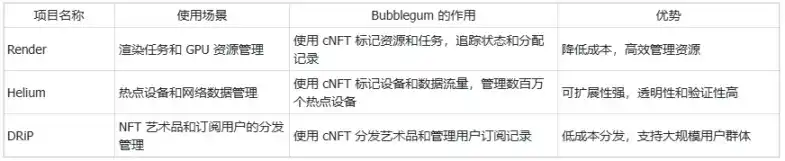
Bubblegum is the program used by Metaplex to create and manage Compressed NFTs (cNFTs). Through compression technology, creators can mint a large number of NFTs at a very low cost. The minting cost of 100 million NFTs is only 500 SOL (achieving over 99% cost reduction compared to traditional minting methods). This provides unprecedented scalability and flexibility. It is due to the introduction of Bubblegum technology that large-scale, low-cost NFT minting has become possible. Projects like Render, Helium, and the DePIN project have begun migrating to Solana, and innovative NFT platforms like DRiP have emerged. The following table lists examples of how these three projects utilize Bubblegum.
Token Metadata
The Token Metadata program allows additional data to be attached to both fungible and non-fungible assets on Solana. While Token Metadata is crucial for information-rich NFTs, in reality, most fungible token projects on Solana also benefit from Token Metadata.
What most people don't know is that currently, all tokens created on the largest Meme issuance platform on Solana, Pump.fun, rely on Metaplex's metadata service. Now, the greatest demand for Token Metadata is not from NFTs, but from large-scale Meme projects.
For Meme projects, utilizing the Token Metadata program during token issuance has clear benefits:
· First, it ensures the standardization and compatibility of the issued tokens. By using Metaplex's Metadata service, these tokens will be more easily recognized by mainstream wallets (such as Phantom, Solflare), correctly displayed with their name, icon, and other additional information on trading platforms, and seamlessly integrated into other Solana applications.
· Second, it provides on-chain storage and transparency. The Metaplex Metadata service stores the tokens' metadata on-chain, making the token's information and data more easily verifiable and preventing tampering.
· Additional information such as images and text provides multi-dimensional material for Meme speculation, turning memes from just a name and a contract address into a source for Meme's dissemination, remixing, and storytelling.

New Meme tokens constantly emerging on pump.fun, Source: pump.fun
As the Meme frenzy on Solana continues to heat up, over 90% of Metaplex's protocol revenue has long been contributed by fungible tokens (Meme), a stark contrast to the public perception that "Metaplex is an NFT foundational protocol in the Solana ecosystem," highlighting a serious cognitive gap.
Candy Machine
Metaplex's Candy Machine is the most commonly used NFT minting and distribution program on Solana, enabling the efficient, fair, and transparent launch of NFT collections.
Other Product Array
Metaplex's other services include:
MPL-Hybrid: A hybrid NFT storage and management solution aimed at combining the advantages of on-chain and off-chain storage to provide an efficient and cost-effective storage method for NFTs, particularly suitable for storing large files (such as high-resolution) or NFT projects that require dynamic updates.
Fusion: NFT merging feature that allows users to merge multiple NFTs into a new NFT, enhancing user interaction experience and providing more gameplay options for NFT projects, including games, collectibles, and art projects.
Hydra: An efficient, scalable large-scale NFT minting solution designed specifically for projects requiring the minting of a large number of NFTs (such as games, social platforms, or loyalty programs). ...
Metaplex's existing product list (asset service class) is as follows:
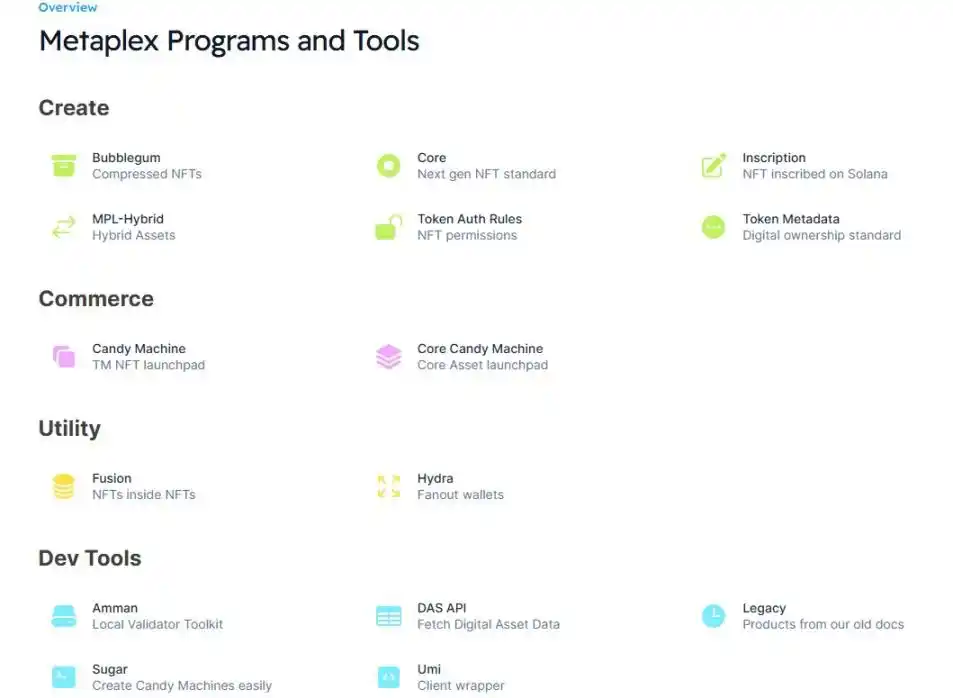
Image Source: Metaplex Developer Documentation
Aura
In addition, in September, the Metaplex Foundation announced the launch of Metaplex Aura—a decentralized index and data availability network serving Solana and SVM (Solana Virtual Machine), a testnet. Through the indexing and data availability services provided by Aura, Solana and other blockchain projects adopting the SVM standard can efficiently read asset data, support batch operations at a lower cost, reduce their operation costs by over 99%, as shown below:
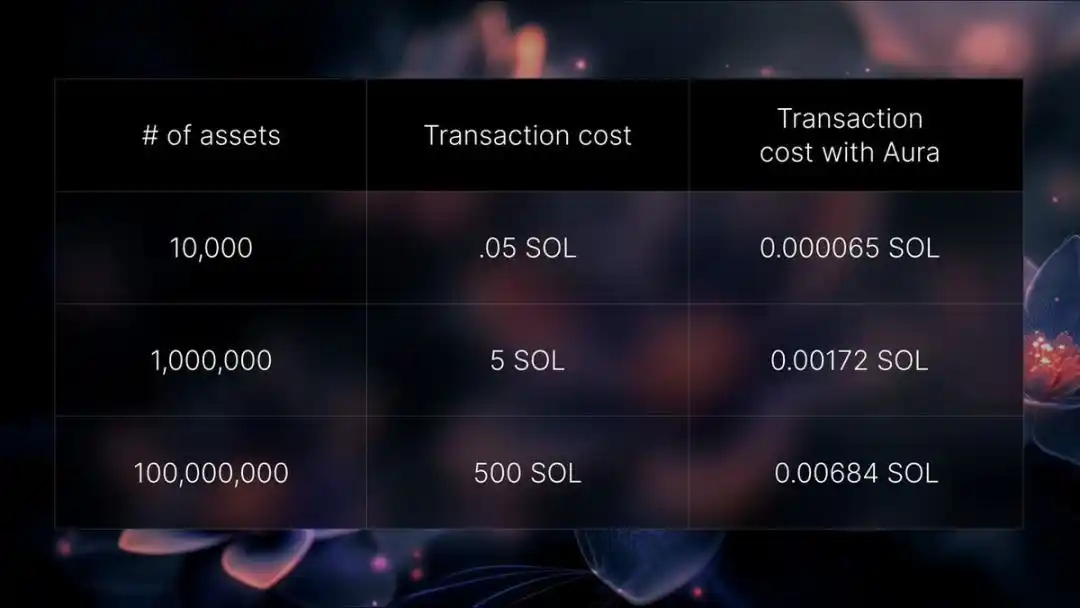
Comparison of operation costs for bulk asset operations before and after adopting Aura, Source: Metaplex Official Twitter
During the product preview release, Metaplex also listed the partnership agreements supporting the product, many of which are well-known projects in the Solana ecosystem and will also be potential users of Aura in the future.
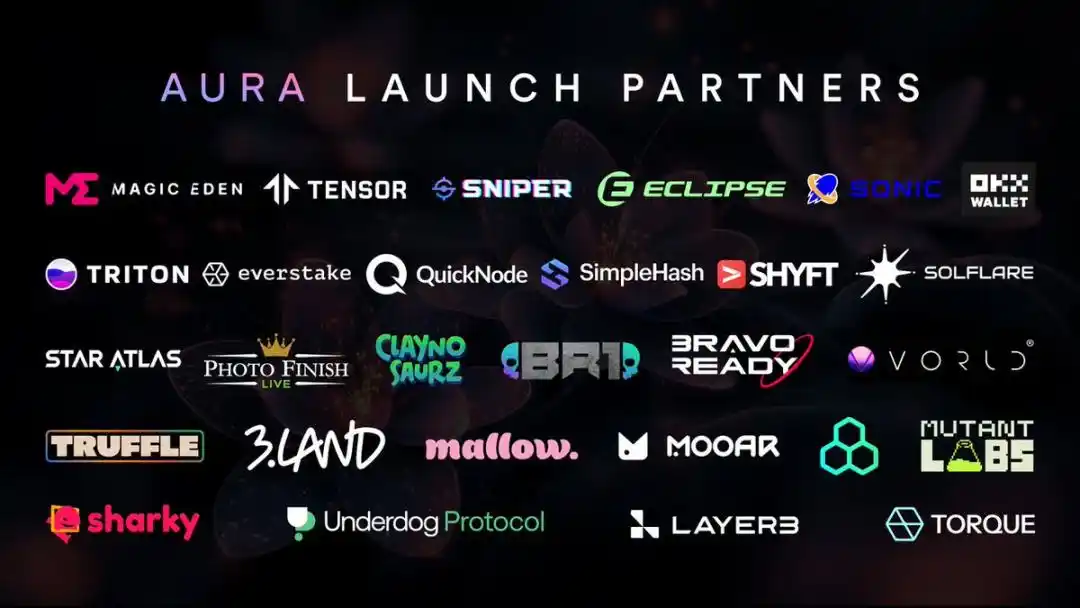
Source: Metaplex Official Tweet
From asset servicing systems to data indexing and data availability service protocols, as services expand horizontally, Metaplex is evolving into a full-stack infrastructure platform for the Solana ecosystem.
2.2 Metaplex's Business Model
Metaplex's business model is simple and easy to understand, charging fees for providing on-chain asset-related services. Some of the services mentioned in the product array above are free, while others are paid.
Although Metaplex's direct partners are other projects on Solana, like a TOB-expanded business, most of its revenue comes from small-scale projects or retail users of large-scale projects on the B side, including project teams creating various types of fungible tokens and individual users minting NFTs.
In the author's view, charging dispersed users is a better business model compared to charging large-scale B-side (such as Pump.fun) partnership projects, because:
· Small-scale project users or retail users make decisions more emotionally and are less price-sensitive than B-side users, as the cost of Metaplex's services is a small part of their total cost, and although the absolute cost paid by each small-scale user is not high, the total cost is considerable when the number is large enough
· B-side projects can serve as distribution channels for their services, helping Metaplex reach more dispersed users without Metaplex having to spend additional effort and costs on marketing and channels
· The user base is more dispersed, with low concentration, making it more difficult to negotiate with basic service providers like Metaplex, who are able to maintain product profit margins and even raise prices when appropriate
Specifically, the pricing standards for Metaplex products on Solana are as follows:
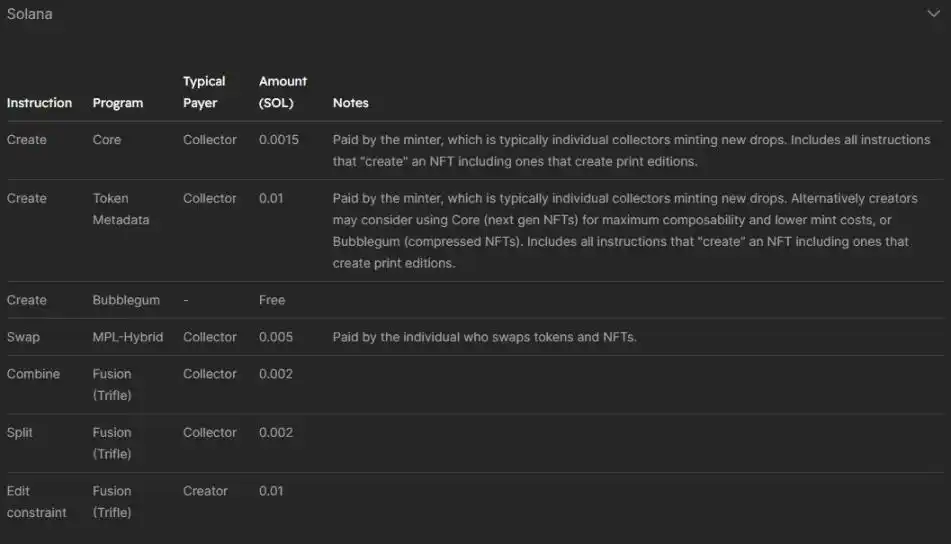
Image Source: Metaplex Developer Documentation
As can be seen, in fact, the absolute cost for a user to independently call Metaplex's product service once is not expensive. For example, the cost for a user to mint an NFT is only 0.0015 SOL; a Meme issuer issuing a project and using Token Metadata to add text and graphic information to their Meme project only requires 0.01 Sol at a time. Such costs are relatively minuscule compared to the expected benefits for users, or can be said to be basically negligible.
Of course, it should be noted that the issuance of a large number of homogeneous tokens represented by Memes has brought revenue to Metaplex on one hand, but on the other hand, the sustainability of the Meme frenzy is questionable, which will also affect the sustainability of Metaplex's revenue. Even for a powerhouse like Solana, the fluctuation in Meme popularity is quite significant. During the coldest week of Meme heat in September, the number of new tokens listed on Dex was only about one-third of the hottest period in May, while this number increased by 10 times in mid-November.
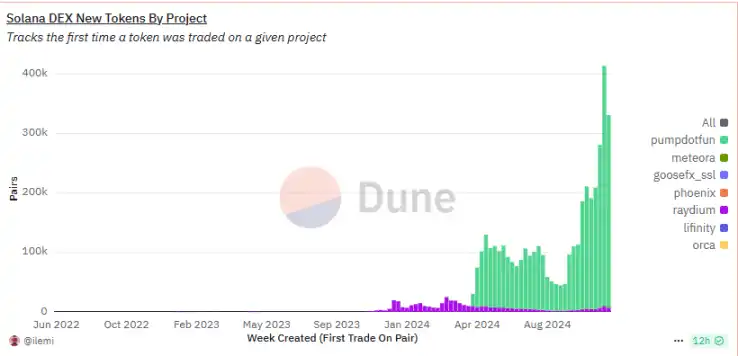
Number of new token varieties added weekly to Solana Dex, Source: Dune
2.3 Metaplex's Moat
In the business world, a company's/project's moat may come from various advantages, such as scale, cost advantages from geographical location, value accumulation from network effects, high user stickiness and premium ability from brand effects, competitive barriers from administrative franchises and patents, etc.
Projects with a strong moat manifest in the competitive landscape as when later competitors enter the same track, they find it difficult to catch up or the overall cost of catching up is so high that it far exceeds their expected returns, causing relative fewer competitors in that track; financially, this project shows a steadily rising profit-making ability, with marketing and development costs relatively low compared to revenue.
In the Web3 field, projects with a strong moat are not that many, such as Tether in the stablecoin field and Aave in the centralized lending field.
In the author's opinion, Metaplex also belongs to projects with a moat, and its moat comes from "high switching costs" and "setting standards."
Firstly, when developers and users heavily rely on Metaplex's tools and protocols for asset issuance and management, if they later want to switch the project's assets to another protocol for management, they will inevitably face high time, technical, and economic costs.
Secondly, when Metaplex's asset format (including NFTs and FTs) becomes the prevailing standard within the Solana ecosystem and is adopted as a consensus for compatibility by various infrastructure and applications within the ecosystem, this will also become a key consideration for new developers and projects when choosing an asset service platform, prioritizing platforms that are more ecologically compatible with Metaplex's asset format.
Benefiting from Metaplex's moat, there is currently a lack of projects within the Solana ecosystem that can compete on the same level, ensuring Metaplex's strong profit-making ability, which will be discussed further in the next section.
Beyond asset services, Metaplex's data indexing and data availability services currently in testing also have the potential to create a second business growth curve for Metaplex in the future. Considering that the target audience of this service highly overlaps with Metaplex's existing customer base, the new expanded business may be more readily accepted and experienced by current collaborative clients.
3. Metaplex Business Data: PMF Fully Validated, Strong Core Data Growth
Metaplex's current core business is to provide asset-related services, and we can observe key metrics such as the number of active users of its services, the number of projects minting assets, and protocol revenue.
3.1 Metaplex Monthly Active Users
Metaplex Monthly Active Users refer to unique addresses that have transacted with the Metaplex protocol each month
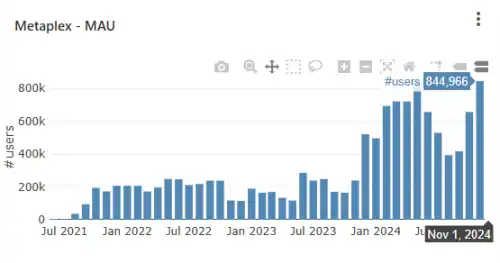
Metaplex Monthly Active Addresses, Data Source: Metaplex Public Dashboard, the same below
As of the author's drafting date (2024.11.30), the latest monthly active users number for Metaplex is 844,966, reaching a new monthly historical high, with a YoY growth of 253%.
3.2 Assets Minted via Protocol
Assets minted via protocol refer to the number of asset types minted through the Metaplex protocol
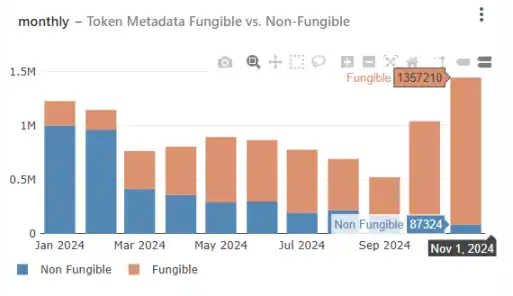
Number of Asset Types Minted Monthly via Metaplex
As of the author's draft date (2024.11.30), Metaplex's data has also hit a new all-time high, with over 1.44 million total assets minted in November.
Of particular note: 94% of the assets are fungible tokens, with only 6% being NFTs. This represents a significant shift from January of this year, where the split was 18.6% to 81.4%. In other words, from a transaction volume perspective, Metaplex's primary business is now focused on fungible token asset services rather than NFT services. The majority of the minting of fungible assets has come from the Meme craze.
3.3 Protocol Revenue
Protocol revenue refers to the fees received by Metaplex for providing services.
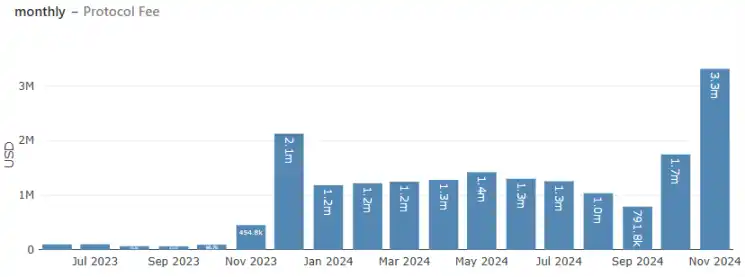
Metaplex Monthly Protocol Revenue
As of the author's draft date (2024.11.30), Metaplex's monthly protocol revenue has reached a high of $3.3 million, also setting a new all-time high.
It is worth noting that unlike many projects in the Web3 world that rely on token subsidies to drive product demand, exchanging project tokens for protocol revenue, Metaplex's business revenue is quite organic and does not involve direct token subsidies. It is a typical project that has achieved PMF (Product-Market Fit).
From the data in this section, we can see:
· Metaplex, as the underlying asset protocol, directly benefits from Solana's ecosystem development, with its key metrics rising in sync with Solana's key metrics, especially protocol revenue
· Metaplex also benefits from the active participation in both NFTs and fungible tokens (FTs), not just being an "NFT asset service protocol." After the Meme craze, if Solana can see more active tracks emerge, such as DeFi, gaming, or RWA, Metaplex's demand will further expand
· Metaplex's business demand is organic, and it can generate revenue without relying on token subsidies
Next, let's take a look at the team behind the Metaplex project and the situation with the project's token.
4. Metaplex Team: Ecosystem OG Close to the Solana Core Circle

Stephen Hess
The founder of Metaplex is Stephen Hess, who also serves as the Chairman of the Metaplex Foundation, and he founded Metaplex Studios in November 2021.
A graduate in Symbolic Systems from Stanford University (a major focusing on the design of human-computer interaction systems), Stephen Hess is also one of the earliest employees of Solana (joining when Solana was just a year old). At that time, Solana co-founder Raj invited him to join Solana as the Head of Product. During his tenure, his work included Solana Stake Pools, the SPL governance system, and Wormhole development. He was also a team member of the first version of the Solana NFT standard, which eventually evolved into Metaplex.
In January 2022, shortly after Metaplex was founded, Metaplex secured a $46 million strategic investment from institutions such as Multicoin, Jump, and Alameda. Based on the 10.2% share corresponding to the strategic round funding in the token allocation table, it can be estimated that the $46 million financing round at that time corresponded to a valuation of around $4.5 billion for Metaplex, a very high first-round valuation even during a bull market.
Just as Metaplex approached its one-year anniversary, in November 2022, FTX collapsed due to a massive financial insolvency. Although Metaplex's financial situation was not directly impacted by the FTX collapse, Stephen Hess quickly announced a layoff decision on Twitter, preparing for the impending downturn in the Solana ecosystem at that time. In hindsight, his actions were proven to be very prudent, showing a clear understanding of the future and a lack of the lavish spending habits seen in many Web3 teams when it comes to cost control.
According to Metaplex's current LinkedIn information, the team size is just over 10 people, still quite streamlined. However, based on their monthly project work reports, this lean team demonstrates strong delivery capabilities and ambition in product development, showing high efficiency in product iteration and new product development.
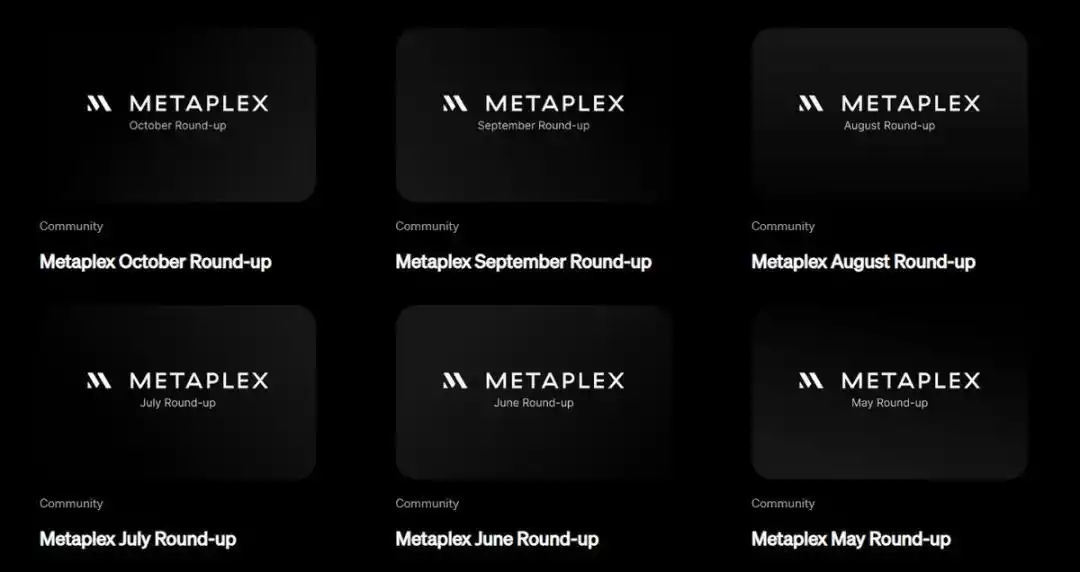
Metaplex Monthly Work Report, Source: Official Blog
Looking back at the work history of Metaplex's founders and the project's development, Metaplex fundamentally aligns with the author's comprehensive concept of an excellent Web3 team:
· Core members have education, work skills, and experience background that match the entrepreneurial project, with no credit stains
· Close to the core circle of the native chain's ecosystem, with smooth communication channels and product concepts recognized by the native chain ecosystem community
· Good product sense (fewer detours), hardworking, and good at delivering results
· Cost-conscious, not extravagant
· Received top-tier VC investment, with excellent comprehensive business resources
Additionally, on September 9, 2024, The Block revealed that prominent institutions such as Pantera Capital and ParaFi Capital purchased a large amount of Metaplex (MPLX) tokens from Wave Digital Assets this year, which were originally held by FTX. The comprehensive cost of the purchase was roughly between 0.2-0.25 USD per token (with certain lock-up provisions).
5. MPLX: Token Utility and Valuation Level
5.1 Token Basic Information
Metaplex's protocol token is MPLX, with a total supply of 1 billion.
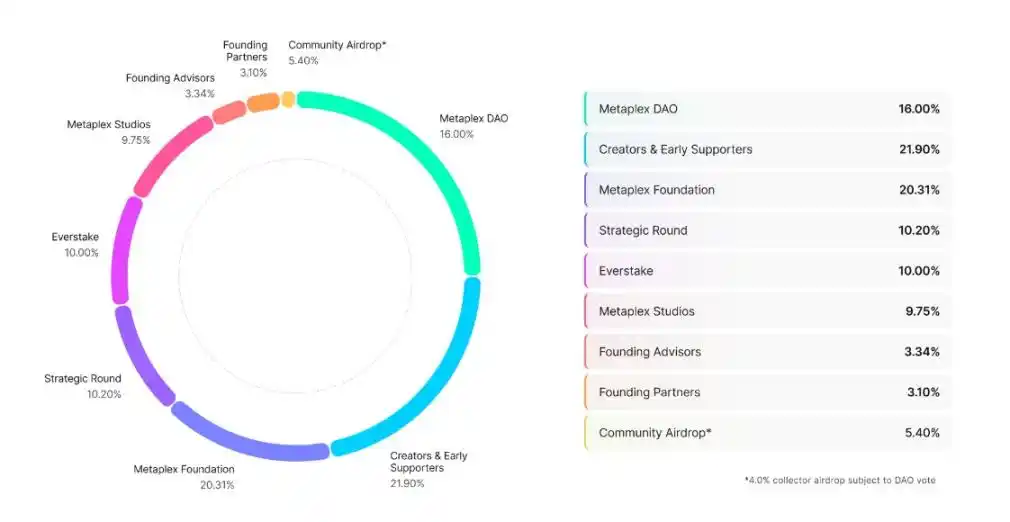
Image Source: Project Whitepaper
The specific token allocation is as follows:
· Creators and early supporters 21.9%, with 50% distributed through airdrops within one year (initial airdrop starting in September 22nd), and the remaining 50% released monthly in the following year;
· Metaplex DAO 16%, unlocked, distributed based on DAO proposals;
· Metaplex Foundation 20.31%, unlocked;
· Strategic Round 10.2%, with 50% distributed in the initial airdrop (September 22) with a 50% release after one year and the remaining 50% unlocking monthly in the following year;
· Partner Everstake 10%, locked for two years (until September 2024), with a one-year linear release, currently unlocking;
· Metaplex Studios 9.75%, locked for one year (until September 2023), with a two-year linear release, currently unlocking;
· Community Airdrop 5.4%, immediately released;
· Founding Advisors allocation 3.34%, locked for one year, with a one-year linear release, fully unlocked;
· Founding Partners 3.1%, locked for one year, with a one-year linear release, fully unlocked.
Based on the current official circulating supply data, MPLX has a circulation rate of 75.6%, with the majority already in circulation, especially the investors' shares, which are mostly already in circulation, resulting in minimal unlocking pressure.
The "uncirculated" portion of the total supply mainly comes from the shares controlled by Metaplex DAO and Metaplex Foundation, the treasury-held tokens, and the unreleased portions held by Everstake and Metaplex Studios.
5.2 Token Utility
Currently, the main utility of MPLX is governance voting. In addition, Metaplex announced in March 2024 that 50% of the protocol's income will be used for token buybacks (including historically accumulated protocol income), with the bought-back tokens going into the treasury for ecosystem development.
The protocol officially started token buybacks in June 24, using 10,000 SOL to buy back MPLX tokens each month. So far, this has been ongoing for 5 months.
Due to the rapid increase in protocol income, next month Metaplex will raise the monthly buyback amount from 10,000 SOL to 12,000 SOL.
In addition to governance and buybacks, MPLX's next scenario will be activated by the Aura feature mentioned above. After the Aura feature is officially launched, MPLX is expected to become a staking asset for Aura nodes, capturing the yield generated by Aura.
5.3 Protocol Valuation
When measuring Metaplex's valuation, we still use the comparative valuation method. However, considering that there is no project on Solana that directly aligns with Metaplex to serve as a benchmark, the author ultimately chose Raydium, which is also within the Solana ecosystem, has experienced a significant increase in protocol revenue this year due to the Meme trend, and has a buyback mechanism, as a reference for comparative valuation.
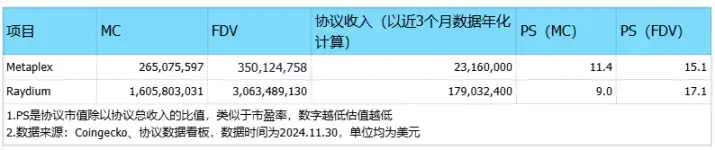
From the comparison of protocol revenue and protocol market cap, Metaplex's valuation is slightly higher.
However, it is important to emphasize that although the two projects share some similarities, they are still on different tracks within the same ecosystem, with significant differences in business positioning. The above valuation comparison only provides a certain reference value.
5.4 Potential Drivers and Risks
Overall, the advantages of Metaplex are quite apparent:
· Positioned upstream in the asset service track, controlling asset standard setting, directly benefiting from the prosperity of the Solana ecosystem
· The product's Product/Market Fit (PMF) has been thoroughly validated, able to achieve positive cash flow without relying on token subsidies, and has a relatively clear business moat
· Building on its existing business, actively expanding the second growth curve. The team has good overall quality, is close to the core ecosystem circle, is diligent and enterprising, and has cost control awareness
· The token has a buyback mechanism, and the project's absolute market value is relatively low (circulating market value of 260 million +, FDV 3.5 billion +), making it relatively undervalued
Potential upward drivers for Metaplex's future market value include:
· Besides Meme, other active tracks emerge in the Solana ecosystem, further expanding the market for asset issuance, whether it's DeFi, gaming, RWA, or even NFTs that have been quiet for a long time
· Metaplex can list on larger exchanges such as Binance or Coinbase to gain better liquidity premium (Considering the quality of the project and its relatively low market value, the author believes it is worth considering listing on exchanges. Projects with real business needs and positive cash flow are scarce in the market)
· Directly increase service fees. The current fee base is low, and the project has the full capability to raise fees. Even with a 100% fee increase, the asset creation fee paid to Metaplex remains extremely low for users and can be overlooked
Of course, Metaplex also faces some potential risks and challenges, such as:
· The fading of the Solana Meme trend, resulting in a rapid decline in asset minting volume and a decrease in business revenue
· Metaplex's current revenue is collected as a one-time fee based on the type of asset created. For projects with relatively fixed asset types, they cannot provide sustained revenue for Metaplex in the long term
Summary
Unlike the common investor perception that "Metaplex is an NFT asset protocol," in reality, Metaplex is a foundational protocol serving the entire range of assets in the Solana ecosystem and is a direct beneficiary of the meme frenzy that has persisted since the beginning of the year.
If you continue to have a positive outlook on the Solana ecosystem in the future, then Metaplex, occupying the "asset issuance and management" upstream ecological position, is worth our long-term attention.
References and Data Sources
Project Data: https://analytics.topledger.xyz/metaplex/public/dashboards/T50WQTTu2Cbz8hG0vge18izUO5ghEDrWhzb92knN
Whitepaper: https://whitepaper.metaplex.com/whitepaper.pdf
Official Blog: https://www.metaplex.com/blo
You may also like

Champion's Final Bow: FC Barcelona vs Real Betis – Celebrate the Title with a Home Finale

Best Oil Trading Platform for Crypto Users in 2026

5 Futures Trading Strategies Smart Traders Use to Cut Crypto Fees and Boost Futures Returns

What Is TradFi? How Crypto Traders Can Now Access Crude Oil, Gold, and Global Markets

How WEEX Bridges Crypto and Football: A Deep Look at the LALIGA Partnership Inside the WEEX App
WEEX is not just a LALIGA sponsor. It’s a true partner. From iPhone Dynamic Island to LALIGA-themed app icons and smart posters, see how WEEX brings football passion into every trade — and builds a real bridge between crypto and sports.

FC Barcelona vs Real Madrid Preview: El Clásico – Can Barça Clinch the Title at Spotify Camp Nou?
FC Barcelona vs Real Madrid El Clásico match preview for May 11, 2026. Barça need just 1 point to win LALIGA. Can Madrid delay the trophy? Full preview inside.

At the Stripe conference, I saw the future of the AI economy

Miners welcome a new life

Seven Important Judgments by Claude Code's Founder at the Sequoia Conference

The payment moment of AI agents: Who will become the Stripe of the machine economy?

Morning Report | MoonPay acquires Solana's execution layer DFlow; Strategy releases Q1 financial report; Manta Network announces the termination of Manta staking program

Rented Tracks: What is this wave of stablecoin FX hot money really paying for?

Dialogue Velocity Eric: What is the stablecoin track that the CFO really wants?

Strategy should have said that selling coins is not ruled out

How MegaETH Achieved a TVL of 700m Within a Week of TGE? Analyzing the Packaging Strategy

Futures Trading Hours: Trade Cryptocurrency 24/7 and Earn Back Up to 45% in Trading Fees
Learn futures trading hours and the best time to trade crypto futures. Discover 24/7 market insights, peak trading sessions, and how to earn back up to 45% in fees.
Why is a16z Crypto raising another $2.2 billion to heavily invest in Web3?
Polymarket Underlying Algorithm Explained
Champion's Final Bow: FC Barcelona vs Real Betis – Celebrate the Title with a Home Finale
Best Oil Trading Platform for Crypto Users in 2026
5 Futures Trading Strategies Smart Traders Use to Cut Crypto Fees and Boost Futures Returns
What Is TradFi? How Crypto Traders Can Now Access Crude Oil, Gold, and Global Markets
How WEEX Bridges Crypto and Football: A Deep Look at the LALIGA Partnership Inside the WEEX App
WEEX is not just a LALIGA sponsor. It’s a true partner. From iPhone Dynamic Island to LALIGA-themed app icons and smart posters, see how WEEX brings football passion into every trade — and builds a real bridge between crypto and sports.
FC Barcelona vs Real Madrid Preview: El Clásico – Can Barça Clinch the Title at Spotify Camp Nou?
FC Barcelona vs Real Madrid El Clásico match preview for May 11, 2026. Barça need just 1 point to win LALIGA. Can Madrid delay the trophy? Full preview inside.


