
SK Hynix Stock Price Prediction: What the Data Says After This Week's Volatility

 Prefer us on Google


SK Hynix stock trades under two very different price regimes depending on which listing you're looking at, and that split matters more than most coverage of this week's selloff has acknowledged.
The Korean listed shares (000660) move in the millions of won and carry one set of technical signals. The separately traded SKHY listing moves in the tens to hundreds of dollars and shows a distinctly different setup. Reading SK Hynix stock price prediction from just one of these charts, without checking the other, misses half the picture, and understanding SK Hynix stock's actual technical position right now requires looking at both.
The Two Listings Aren't Telling the Same Story Right Now
On the Korean exchange, 000660 has spent the past several weeks recovering from a sharp drop. Shares fell 9.61% on July 29, closing at ₩1,401,000 after touching an intraday low of ₩1,246,000, before buyers stepped in and produced what TradingView's own analysis described as one of the strongest rebounds among AI memory names. A buy signal from a pivot bottom on July 30 has since carried the stock up roughly 20.5%, with the short-term moving average issuing a buy signal even as the long-term average still points toward sell, a genuinely mixed technical picture rather than a clean directional call in either direction.
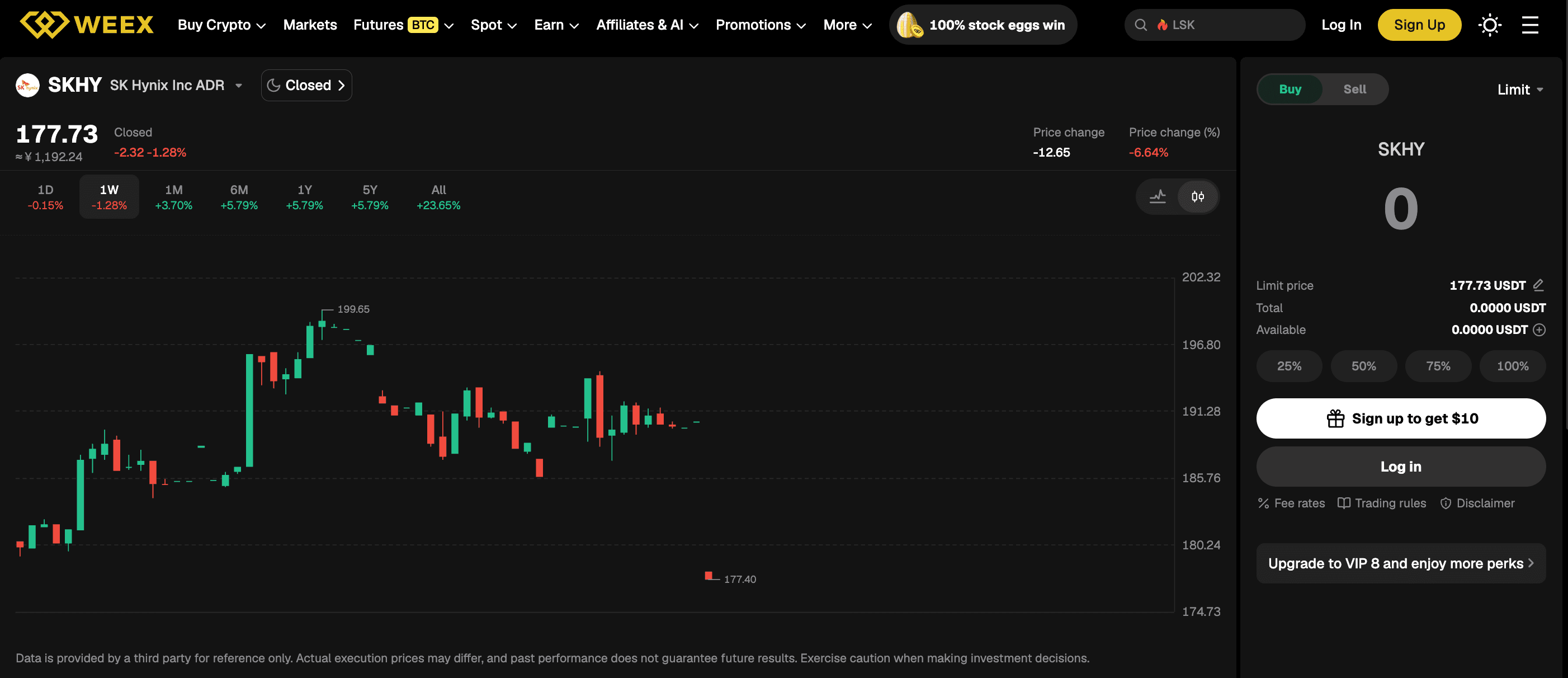
The separately listed SKHY, by contrast, has been behaving like a newly public stock still finding its footing, because in a meaningful sense it is one. Following what one analyst described as heavy oversubscription and one of the biggest market debuts of the year, SKHY spent recent sessions testing a support zone around $168.2, with $170 acting as the key level to reclaim before any move toward $174.5 becomes plausible. A failure to hold that support opens the door back toward a prior low near $166.2. That's a tight, closely watched range on a stock that's had considerably less trading history to establish itself than its Korean listed counterpart.
Why the Volatility Numbers Themselves Are Worth Sitting With
Separate from direction, the sheer size of SK Hynix stock's daily price swings is worth treating as its own data point. One technical service tracking the stock's most recent session recorded average daily volatility of 6.74%, with an expected trading range wide enough that a single day could plausibly swing more than 12% from close to close under normal conditions, not during a crisis. A separate reading closer to the September 4 rally showed daily volatility closer to 4.59%, still elevated by the standards of a large, established semiconductor manufacturer.
This matters directly for how today's 4% decline should actually be read. A single day move of that size sits comfortably within the volatility band this stock has been trading in over recent weeks, rather than representing some unprecedented break from its normal behavior. That doesn't make the AI slowdown statement irrelevant to the move, but it does mean the size of today's drop alone isn't unusual enough, on its own, to signal that today's news carries more weight than the stock's baseline volatility would produce on any given session.
What the Long-Term Capacity Story Adds to This Picture
Buried underneath the near-term technical noise is a structural commitment worth weighing against any single week's price action. SK Hynix has joined Samsung in a plan to invest more than $500 billion in a South Korean chip hub aimed at expanding memory and semiconductor fabrication capacity. A commitment at that scale isn't something a company walks back over a single joint statement about AI development pacing, and it says something concrete about how the company itself is positioning for demand over the coming decade, independent of this week's sentiment swings.
That long-horizon investment is also part of why some analysis has specifically flagged SK Hynix's valuation gap relative to Micron as a trend worth watching, rather than a settled comparison. Despite what's described as a strong market position and its status as Nvidia's largest memory partner, SK Hynix has continued trading at a discount to Micron, a gap some analysts expect to narrow as the company's profile in AI infrastructure continues building, separate entirely from short-term price swings tied to any single week's headlines.
-- Price
Why a Rating Upgrade Landed in the Middle of This Volatility
One data point worth flagging specifically: a technical scoring system tracking SKHY moved the stock from a Sell rating to a Buy Candidate rating, with a technical score of 2.47 on a scale running from negative 10 to positive 10, based on market data collected in early September, before this week's decline. That upgrade reflected price action closer to the stock's support level than its resistance at the time, alongside rising volume accompanying the price gain, generally read as a constructive technical signal rather than a purely speculative move.
The relevant question this week isn't whether that upgrade was wrong. It's whether today's decline pushes the stock's technical position back toward where it sat before the upgrade, or whether it's absorbed within the kind of volatility band this stock has already demonstrated it can produce without breaking its underlying trend. That's a question the next several sessions, not today's single print, will actually answer.
Source: WEEX Stock Spot 2.0, September 14, 2026.
Trading SK Hynix Across Both of These Signals
Given how differently these two listings are currently behaving, WEEX lists SK Hynix as SKHYUSDT under its Stock Spot 2.0 offering, funded directly with USDT rather than requiring separate access to either the Korean exchange or a US brokerage account for the ADR.
For anyone weighing a position specifically because of this week's technical picture, being able to size an entry against the $168-$174 range on SKHY, or simply track how that range holds up against today's news, without juggling two separate account structures, is the practical use case this kind of dual-listing situation actually creates. A minimum entry of 5 USDT means testing a thesis around one of these specific support or resistance levels doesn't require committing a large position upfront, and WEEX's publicly disclosed 1,000 BTC protection fund is worth knowing about for anyone holding a position through a stock currently swinging within a 6%-plus daily range.
Conclusion
SK Hynix stock's technical picture right now is less about a single directional call and more about two separate listings sending somewhat different signals: the Korean shares recovering within a mixed short-term bullish, long-term mixed setup, and the SKHY listing testing a tight support zone still being defined by its recent debut. Today's 4% decline, viewed against volatility levels that have regularly run in the 4.5% to 6.7% daily range recently, sits within the stock's normal behavior rather than outside it, even as the underlying AI demand question the selloff was tied to remains genuinely unresolved. The $500 billion capacity investment alongside Samsung is the structural detail worth weighing against any single week's price swings, since it reflects a bet on demand over years rather than days.
FAQ
1. Why do SK Hynix's two stock listings show different technical signals?
The Korean-listed shares (000660) have a longer trading history and have been recovering from a July decline, while the separately listed SKHY has traded with less history since a heavily oversubscribed debut, meaning each chart reflects a different stage of price discovery.
2. Is today's 4% decline unusual for this stock?
Not based on recent volatility data. SK Hynix has shown daily average volatility in the 4.59% to 6.74% range over recent weeks, meaning a single-day move of this size falls within its recent normal trading behavior.
3. What are the key support and resistance levels for SKHY right now?
Recent technical analysis places support near $168.2, with $170 as the level needed to reopen a path toward $174.5, while losing support risks a retest of a prior low near $166.2.
4. Does SK Hynix trade at a discount to Micron?
Yes, according to recent analysis, despite SK Hynix's position as Nvidia's largest memory partner, with some analysts expecting that gap to narrow as its AI infrastructure profile continues to build.
5. What long-term commitment is SK Hynix making beyond near-term price swings?
SK Hynix has joined Samsung in a plan to invest more than $500 billion in a South Korean chip hub to expand memory and semiconductor fabrication capacity, a structural commitment independent of any single week's volatility.
This content is provided for general informational purposes only and doesn't constitute financial, investment, legal, or tax advice. Any events, rewards, online promotions, or related information mentioned herein should not be considered a recommendation, solicitation, or invitation to purchase, sell, trade, or otherwise deal in any crypto assets. Crypto assets are highly volatile and may result in loss. The availability of WEEX services, products, and related events may vary by region. You are responsible for ensuring that your participation is in accordance with applicable local laws and regulations.
You may also like
Retail Investors Support South Korea's Crypto Market as Corporate Accounts Remain Unopened

ByteDance Syndicated Loan: Demand for $30 Billion Against $20 Billion Requested
Why Did Kraken Buy Reap Instead of a U Card?
Cryptomarket enters 'the week of the year' - all eyes on Wednesday

The 82 Trillion Won Gap: The Corporate Market South Korea Missed

Bitcoin Now Accounts for 85% of Some Portfolios, Up from 2% Initially
BlackRock Bitcoin ETF Outflows: $19 Million Exited from IBIT, Only 0.03%
The Turning Point for Crypto VCs: From Token Arbitrage to Project Quality Reevaluation

Decoding Pump.fun: Average Age 25, Treasury Close to $2 Billion, Skeptical of Decentralization

SK Hynix Stock Falls 4%: AI Leaders Just Called for a Development Slowdown
A joint call from Anthropic, OpenAI, and SpaceX to slow AI development sent SK Hynix stock down 4%, just a day after JPMorgan initiated bullish coverage.

What is wash trading? The trading minute

SWIFT Accelerates Blockchain Utilization, Three Singapore Banks Successfully Conduct Interbank Tokenized Deposit Transactions
Which Crypto Apps Offer Real-Money Rewards? Win iPhone Duo on WEEX in Sep 2026
CPI Surpasses Expectations, Raising Rate Hike Bets; U.S. Bonds Face Dual Challenges at 5% Threshold and Fiscal Concerns

WEEX Sep 2026 Rewards: Trade & Win iPhone Duo

Financing Weekly Report | Nasdaq Invests $100 Million in Kraken's Parent Company Payward; Mistral AI Completes €3 Billion Series D Financing
Born in Argentina, it became the safest global crypto asset app in Latin America

Killa: Bitcoin Prices Move Ahead of Macroeconomic Changes

Bitget UEX Daily Report | Brent Oil Returns to $107; Federal Reserve's Rate Decision Week Approaches; Nvidia Negotiates Up to $10 Billion Investment in Anthropic IPO (September 14, 2026)

Robinhood CEO's New Article: Stocks on the Blockchain Without Issuer's Consent

Debunking the Ethereum 'Abandoning' ETH Argument: What Does It Mean to Pay Gas Without ETH?
From Public Value to Token: The Bridge That Must Be Built
Three Elon Musk Employees Plan to Build a Startup in 72 Hours Using AI!
Sam Price Focuses on FOMC Decision, 25bp Rate Hike as Benchmark
Revolut Accelerates in Crypto: Stablecoins, Trading, and Payments at the Heart of Its Strategy
Tokenization of Stocks Reaches 300,000 Holders on Solana
Suicidal Shorts and Nine-Digit Leverage: The Top 10 Boldest Trades in Crypto History
Mark Karpelès on the Revolut case: they should not have sent the information
Crypto Aggressions: The Gendarmerie Details Its Strategy Against the Surge in Kidnappings

Martín Tobal, economist at the Bank of Mexico: "Relaxing monetary policy does not guarantee a real improvement in wages"
Retail Investors Support South Korea's Crypto Market as Corporate Accounts Remain Unopened
ByteDance Syndicated Loan: Demand for $30 Billion Against $20 Billion Requested
Why Did Kraken Buy Reap Instead of a U Card?
Cryptomarket enters 'the week of the year' - all eyes on Wednesday
The 82 Trillion Won Gap: The Corporate Market South Korea Missed
Bitcoin Now Accounts for 85% of Some Portfolios, Up from 2% Initially





