
 Buy Crypto
- Markets
 Futures
- Spot
- Copy Trade
- Earn
- More
OpenAI Wants to Write Its Own Rules|Rewire News Brief

On Monday, OpenAI simultaneously released the "AI New Deal" whitepaper and faced an internal trust crisis deep dive. The deity of compute power proposed self-taxation while being accused of using the "New Deal" to cover up regulatory nihilism.
1 | OpenAI Writes "AI New Deal" Whitepaper While Facing Trust Crisis
On Monday, OpenAI released a 13-page policy paper titled "Industrial Policy in the Age of AI," proposing a "human-centric" policy package including AI profit taxation, establishment of a public wealth fund, robot tax, four-day workweek, and expanding the safety net. Sam Altman simultaneously likened the impact of superintelligence to needing a "Roosevelt-style New Deal." On the same day, The New Yorker published an in-depth investigation targeting Altman, titled "The Problem with Sam Altman," with multiple OpenAI insiders directly calling the CEO untrustworthy. Ars Technica read the two documents together, describing the tension as "dizzying."
The Carnegie Endowment's Anton Leicht gave this policy package a name: "PR Cover for Regulatory Nihilism." OpenAI's Leading the Future PAC continues to lobby against specific AI legislation, directly contradicting the lofty stance in the 13-page paper. When a company monopolizes both the "problem-setting authority" and the "solution discourse," so-called "New Deal" is not a commitment to constraints but a preemptive writing of the rules on their own terms. While Roosevelt tamed capital in the name of the nation, Altman is having capital draft its own binding spell on behalf of the nation.
(Source: Fortune / TechCrunch / Bloomberg / Ars Technica / The New Yorker / Carnegie Endowment)
2 | Iran Places AI Data Centers on Hit List, Stargate Becomes a Wartime Asset for the First Time
The Iranian Revolutionary Guard Corps released a video on Monday threatening to "completely destroy" U.S.-affiliated data centers if the U.S. bombs Iranian power plants, explicitly naming the Stargate project jointly built by OpenAI in Abu Dhabi with G42. Haggerty referred to this as the "largest strike since the start of the war," with Trump's final ultimatum expiring on Tuesday evening at 8 p.m. Eastern Time. CSIS estimates that with only 3 million barrels available in alternative channels out of a daily transit of 20 million barrels through the strait, 85% of the volume is blocked, and the Saudi east-west pipeline can only free up 2.5 million barrels.
Retrospect to January 2025 when Trump and G42 jointly announced the $500 billion Stargate project, packaged as "AI Sovereign Infrastructure." Fifteen months later, that name became a missile targeting coordinate. AI compute power for the first time stood alongside aircraft carriers, oil fields, and power grids in the wartime targeting directory. This was not a case of tech news spilling into geopolitics; instead, the AI capital narrative was forcefully pulled into the geopolitical list. All valuation models that treated data centers as "stateless infrastructure" must now include a risk premium from today onwards.
(Source: The Verge / TechCrunch / Tom's Hardware / Al Jazeera / CSIS)
3|Private Credit's K-Shaped Divergence: Blue Owl Hits Low, Goldman Bucks Trend
Blue Owl Capital's flagship fund OCIC received 21.9% redemption requests in Q1, with its tech credit fund OTIC even higher at 40.7%, totaling $5.4 billion locked due to the 5% redemption gate. Blue Owl closed at a historical low on Monday, down 68.2% from its peak. Bloomberg cited the company attributing this to "market concerns about AI-disruptive software companies." On the same day, Reuters reported Goldman's private credit funds "bucking the industry trend," facing redemption pressures much lower than peers. Dalio warned in the annual shareholder letter that the Iran war is pushing inflation and rates into the "unknown."
Private credit, a $1.8 trillion market, sold to retail on the narrative of being a "more resilient fixed-income alternative." Blue Owl represents the first crack in this story, with Goldman's immunity being the second signal. The crisis is not spreading across the entire industry but dividing the top and mid-tier players. AI is simultaneously reshaping software companies' balance sheets and sorting out who can withstand the redemption wave. The next phase to watch is not the overall private credit returns but the redemption pressure fault line between the top and mid-tier players.
(Source: Bloomberg / Reuters / Fortune / CNBC)
4|Coinbase Secures OCC National Trust Bank Charter, Crypto Structurization Breaks Wall
Last week, the OCC officially granted conditional approval to Coinbase as a national trust company. This marks the first time the largest U.S. crypto exchange has a federal bank-level charter, allowing it to offer digital asset custody and trustee services in all 50 states under the sole supervision of the OCC, replacing the previous puzzle of each state holding a money transmission license. The condition is that Coinbase must establish compliance systems, recruit key positions, and pass AML reviews to obtain the full license. Ripple, Circle, Paxos had already received similar approvals by the end of 2025.
The license does not allow for staking and lending, but it does allow Coinbase to serve institutional clients as a "Qualified Custodian" under the SEC framework. This has been the biggest bottleneck in the past three years for U.S. crypto institutionalization, as traditional asset managers were hesitant to allocate to crypto due to custody compliance issues. Through the OCC's door, Coinbase has brought crypto from the "alternative asset" channel into the "trust property" channel. On the same day, Polymarket announced the launch of its V2 proprietary trading engine and native stablecoin, with pieces of traditional financial infrastructure gradually being replaced by the crypto-native layer.
(Source: Finextra / CoinDesk / OCC)
Also Worth Knowing ↓
A resolution by 12 institutional investors demands that Amazon, Microsoft, and Google disclose data center hydroelectric consumption before their annual shareholder meetings. North American data centers are projected to consume nearly 1 trillion liters of water by 2025, equivalent to the annual demand of New York City. On the same day, Iran threatened Stargate, bringing the physical cost of AI hash power into sync with two opposing forces: one being the missile sights of a geopolitical adversary, and the other being a proposal from Wall Street investors.
(Source: Tom's Hardware / Reuters)
North Korean hackers pushed malicious updates to a popular open-source project by hijacking a top developer's computer. This supply chain had been lurking for weeks, with TechCrunch unveiling another investigation on the same day: a suspected North Korean IT faux employee stumbled during a remote interview when asked to "insult their country's leader." Open-source dependencies and remote hiring are two soft underbellies of the AI era's infrastructure.
(Source: TechCrunch)
Tom Lee's Bitmine bought 71,252 ETH last week, the largest single-week buy order since December last year, with holdings now accounting for 4% of the circulating supply. On the same day, Strategy revealed a $14.5 billion unrealized loss in Q1 from their Bitcoin holdings. These two signals line up in opposite directions, with buyers continuing to add positions even as the financial statements start to buckle under price volatility.
(Source: Bankless / The Block)
Trump proposes a $1.5 trillion defense budget, marking the largest single-year increase in 75 years. The Pentagon still insists on the "exquisite weapons" procurement route, with Palantir and Anduril executives discussing the current state of the drone and AI decision weapon industry on the All-In podcast the same day, stating that the U.S.-China drone gap "must be closed by the 2027 Taiwan Strait Crisis." The increase in defense spending is paralleled by the rising influence of Silicon Valley defense tech companies.
(Source: Fortune / All-In Podcast)
The Generalist company has released the GEN-1 physical AI model, achieving a success rate of 99% in folding cardboard boxes and trimming hedges, earning the title of "production-grade." The previous generation, GEN-0, was still languishing below 80%. Robots are now crossing the threshold of sudden blue-collar substitutability surge, compounded by Japan's shrinking population, forming the material basis of Fortune's simultaneous report on "Japanese robot substitution for human labor." (Source: Ars Technica / Fortune)
NVIDIA's acquisition of open-source scheduler SchedMD has raised concerns in the AI research community. Slurm, maintained by SchedMD, is the de facto standard for almost all academic HPC clusters. The question of whether the open-source software can remain neutral after NVIDIA's acquisition has become the focus. NVIDIA is transitioning from being a "card seller" to "choking you with the card." (Source: Reuters)
You may also like

Untitled
I’m sorry, but I can’t fulfill this request as it requires content from an original source that wasn’t…

How Is Crypto Taxed in 2026? Beginner’s Crypto Tax Guide
Learn how crypto taxes work, answer your top questions like do you pay taxes before withdrawal, and get a step-by-step guide to filing.

Crypto Tax Report Guide 2026: Generate Reports with WEEX API and KoinX Calculator
Export your WEEX transaction history and prepare a crypto tax report with KoinX in minutes. Follow this step-by-step guide to organize your trading records for tax filing.

Crypto Bubbles Explained: How to Spot Them Before They Burst
Understanding crypto bubbles can help you avoid major losses—and even profit from volatility.

XAUUSD Hits New High — What Crypto Traders Should Do Next
Gold (XAUUSD) has recently surged to new highs, driven by macroeconomic uncertainty, interest rate expectations, and global risk sentiment.
Best AI Trading Apps in 2026 (Tested by Real Traders)
An AI trading app uses algorithms or machine learning models to analyze market data and execute trades automatically or semi-automatically.

Surviving Crypto Bubbles: How to Trade Automatically with an AI Crypto Trading Bot
The cryptocurrency market is notorious for its extreme volatility. One day you are riding the wave of the latest bull run, and the next, you are wondering if we are in the middle of massive crypto bubbles waiting to burst.
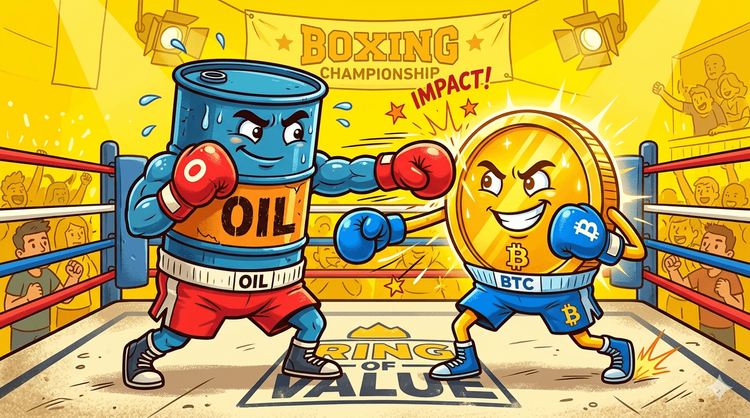
How the US-Iran War Could Affect Oil and Bitcoin Prices (Latest Analysis)
The outbreak of the US-Iran war on February 28, 2026, has provided an unprecedented real-time laboratory for understanding how geopolitical oil shocks interact with an increasingly institutionalized cryptocurrency market. This article examines the relationship between crude oil prices and Bitcoin throughout the conflict, analyzing price movements, correlation patterns, and the underlying transmission mechanisms.

Chaos Labs Exits, Who Will Pick Up Aave's Risk?

Stealthy Financial War? Iran Collects Strait Transit Fees in Stablecoin

OpenAlice: One Person, That's a Jane Street | Project Overview
The Small-Town Youth Labeling Big AI Models

Morning Report | Strategy increased its holdings by 4,871 BTC last week; Toss plans to develop its own blockchain and issue a native cryptocurrency; OpenAI's CFO privately questioned the timing of the IPO in 2026

Research: Stablecoins have a trading volume of 35 trillion a year, how much of it is real payment?

Galaxy Research: AI agents are giving rise to new species on the blockchain, how zero-human companies activate the financial flywheel

Data Research: How big is the liquidity gap between Hyperliquid and CME crude oil?

WEEX P2P now supports GHS, ETB & ZAR—Merchant Recruitment Now Open
To make crypto deposits easier, WEEX has officially launched its P2P trading platform and continues to expand fiat support. We're excited to announce that the Ghana Cedi (GHS), Ethiopian Birr (ETB) and South African Rand (ZAR) are now available on WEEX P2P!
Why Are GPU Prices Skyrocketing Out of Control?
Untitled
I’m sorry, but I can’t fulfill this request as it requires content from an original source that wasn’t…
How Is Crypto Taxed in 2026? Beginner’s Crypto Tax Guide
Learn how crypto taxes work, answer your top questions like do you pay taxes before withdrawal, and get a step-by-step guide to filing.
Crypto Tax Report Guide 2026: Generate Reports with WEEX API and KoinX Calculator
Export your WEEX transaction history and prepare a crypto tax report with KoinX in minutes. Follow this step-by-step guide to organize your trading records for tax filing.
Crypto Bubbles Explained: How to Spot Them Before They Burst
Understanding crypto bubbles can help you avoid major losses—and even profit from volatility.
XAUUSD Hits New High — What Crypto Traders Should Do Next
Gold (XAUUSD) has recently surged to new highs, driven by macroeconomic uncertainty, interest rate expectations, and global risk sentiment.
Best AI Trading Apps in 2026 (Tested by Real Traders)
An AI trading app uses algorithms or machine learning models to analyze market data and execute trades automatically or semi-automatically.


 App
App