
- Buy Crypto
- Markets
 Futures
- Spot
- Copy Trade
- Earn
- More
Mr. Beast's Financial Gamble

In October 2025, MrBeast submitted a trademark application to the United States Patent and Trademark Office for "MrBeast Financial."
This 27-year-old individual, who in the real world has buried himself alive for video content and boasts 4.5 billion fans in the virtual world, plans to expand his business empire from fast food and snacks to banking, investment, and even cryptocurrency trading platforms.
According to the application file, he envisions a SaaS platform covering crypto payment processing, microloans, and investment management. MrBeast, with his empire valued at a soaring $5 billion, is preparing to enter a field tightly locked by trust, risk, and regulation—the financial sector.
This is not an entirely unexpected crossover. He already owns a snack brand, Feastables, and a virtual restaurant chain, MrBeast Burger. However, financial services are a whole different ball game, touching on people's most sensitive nerves.
What's more nuanced is that just a year ago, he found himself at the center of controversy due to cryptocurrency investments. Blockchain researchers accused him of using his influence to rug pull in multiple projects, making profits exceeding tens of millions of dollars.
Now, this controversial content behemoth, accompanied by his hundreds of millions of primarily Gen Z fans, is stepping into a tightly regulated financial world.
This is a high-stakes gamble. The wager is his reputation, and the chips are the trust of a generation. The outcome of this gamble will redefine the relationship between influence, finance, and trust.
Gen Z's Banking Exodus
Traditional banks are losing their future.
Youth no longer walk into those temples constructed of marble and bulletproof glass. They switch banks at a rate two to three times higher than their parents, not for higher deposit rates, but for a better digital experience. Only 16% of Gen Z expresses "very high trust" in traditional banks, a proportion nearly double that of millennials and close to triple that of baby boomers.
For those who grew up in algorithms and screens, a bank teller in a suit and tie is far less reliable than a smooth app interface.
Traditional banks took a century to build a trust mechanism, with offline branches symbolizing "reachable," brand history representing "tested," government endorsement signifying "secure," and marble counters and suited staff conveying "professionalism" and "stability." These visual symbols and institutional arrangements were indeed effective in the past.
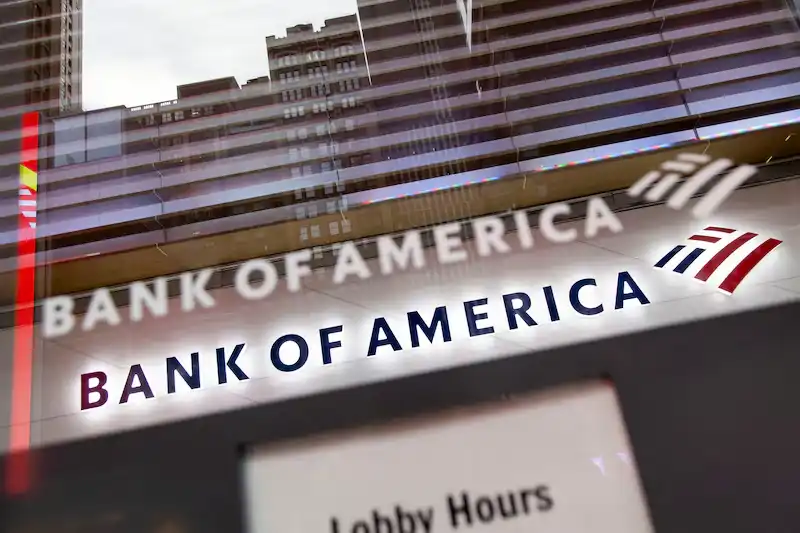
Bank of America | Image Source: BloomBeag
However, for Gen Z, they live in a world of high-frequency interaction and instant feedback where what they need is not static, institutional proof of trust, but a dynamic, perceptible trust experience. Whether a bank has a hundred-year history is far less important to them than whether the app's interface is user-friendly, if customer service responds promptly, and if products can be customized according to individual needs.
At a deeper level, Gen Z harbors a deep-seated dissatisfaction with the traditional financial system. They grew up after the 2008 financial crisis, witnessed how big banks were bailed out during the crisis while ordinary people bore the brunt of unemployment and wealth shrinkage. They saw repeated scandals of data breaches by financial institutions and witnessed how Wall Street elites abandoned moral boundaries in the face of interests. These experiences have shaped their instinctive skepticism toward traditional finance.
The vast majority of Gen Z are influenced by financial influencers on the internet. They discover new financial products through social media, learn about investment knowledge on Xiaohongshu (Little Red Book), and follow financial content creators on Douyin (TikTok). Behind these behavioral patterns is a collapse and rebuild of the foundation of trust.
Gen Z is not looking for a "better bank"; they are looking for something entirely different—an ecosystem that seamlessly integrates financial services, social experiences, and personal values. They hope that finance will no longer be a cold numerical game but a partner that can understand them, respond to them, and even represent their values.
This is exactly the opportunity Mr. Beast sees.
The relationship between him and his fans has long surpassed the traditional brand-consumer relationship and evolved into a quasi-social relationship. Social media researchers refer to this phenomenon as "quasi-social interaction," where audiences develop a strong emotional connection through continuous consumption of a particular content creator's content, as if this person is a friend in their lives.
Mr. Beast understands this well.
Each week, the videos he releases are carefully orchestrated performances of wealth redistribution. He challenges 100 kids to take on the world's strongest man, lets strangers survive in a nuclear bunker for 100 days to win $500,000, and buries himself alive for 50 hours. Behind these extreme challenges is a continuous stream of cash giveaways.
The cash, cars, and houses he gives away amount to tens of millions of dollars. These acts of generosity are not mere adjuncts to his marketing strategy; they are the content themselves and a continuous fulfillment of the trust contract between him and his fans.

Mr. Beast Challenges Himself to be Buried Alive for 50 Hours | Image Source: Instagram
With each giveaway, he proves to his fans that he is a man of his word, that his promises are genuine, and that he is willing to share the wealth he has accumulated. This "visible generosity," in the eyes of Generation Z, is more convincing than any brand declaration.
In 2024, Mr. Beast partnered with the fintech company MoneyLion to launch a $4.2 million giveaway event. Young users willingly downloaded the MoneyLion app because they believed in Mr. Beast. They were not just choosing a financial product; they were following someone they trusted.
The success of this event showed Mr. Beast a greater possibility. If he could directly convert his traffic into financial services, bypassing intermediaries, the monetization efficiency would reach unprecedented levels.
A traditional bank says, "We have a 100-year history, we have been through the Great Depression and financial crises, we have government backing."
Mr. Beast says, "I just gave $100,000 to 100 people each."
The former's trust is based on past accumulation, while the latter's trust is based on present performance. The former relies on institutional endorsement, the latter relies on algorithmic amplification. The former is static and abstract, the latter is dynamic and visible.
However, the paradox lies in the fact that Generation Z's distrust of traditional finance stems precisely from the latter's transparency and ethical flaws. The global trust in the financial services industry has long ranked low among all industries, and young people's dissatisfaction with financial institutions largely comes from their ethical lapses in the face of self-interest.
So, how did Mr. Beast, an online celebrity with a "stain" in the cryptocurrency world, become their financial savior?
The Distance Between the "Reaper" and the "Whale"
In October 2024, blockchain detective SomaXBT published a detailed report on social platform X, dissecting Mr. Beast's other side in the crypto world like a surgical knife.
The report traced wallet addresses associated with Mr. Beast, accusing him of participating in multiple "rug pull" projects. These accusations were not baseless but were based on publicly transparent transaction records on the blockchain. In a decentralized world, every transaction is permanently recorded and cannot be erased or denied.
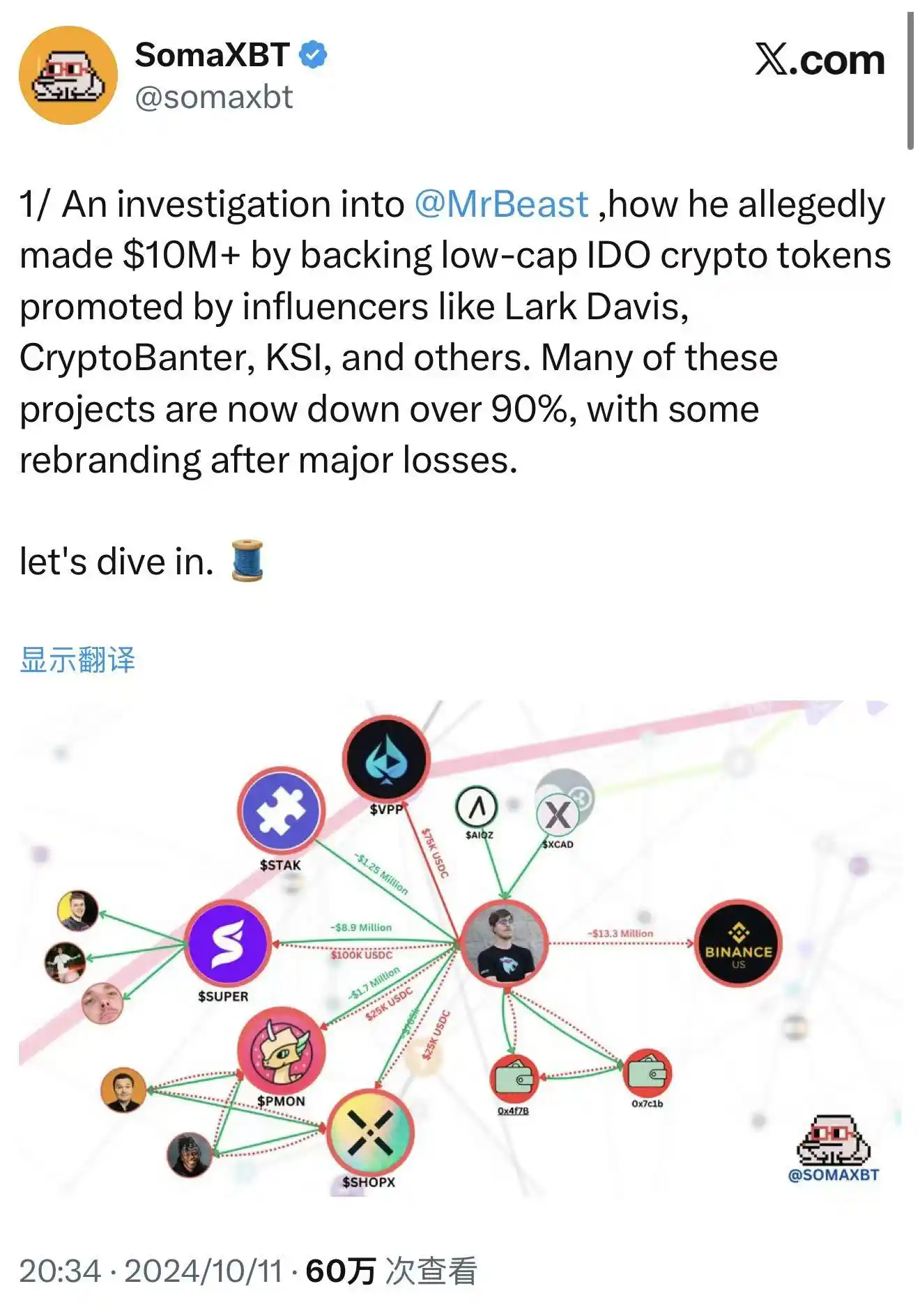
SomaXBT's Exposure of MrBeast | Image Source: X
The most typical case is SuperFarmDAO. MrBeast invested $100,000 in the presale phase of the project, receiving 1 million SUPER tokens. He then used his unparalleled influence to promote the project. The token price quickly skyrocketed, igniting market sentiment. He then began to sell off.
Ultimately, this $100,000 investment brought him profits of millions of dollars. Behind this astonishing number lies the losses of numerous retail investors. Seeing MrBeast's involvement in the project, they thought it was a reliable investment opportunity and rushed to buy in. However, when he started selling off, the coin price quickly collapsed, leaving retail investors as the final bagholders.
A similar operating pattern has been repeated in multiple projects such as Polychain Monsters, STAK, VPP, SHOPX, and others. SomaXBT estimates that MrBeast has made over $10 million in profits from these projects combined.
Legally, these operations may indeed not have violated any rules. MrBeast did not explicitly commit to holding these tokens long-term, nor did he violate any specific securities regulations. At that time, the cryptocurrency market was still in a regulatory gray area, and many rules from traditional financial markets did not fully apply. In the traditional stock market, this behavior could constitute market manipulation and face severe legal sanctions. However, in the crypto world, there are no such rules.
However, from an ethical perspective, these actions have sparked considerable controversy. Many in the cryptocurrency community believe that pumping up token prices with influence and then dumping them is essentially profiting from fans' trust. This not only destroys the long-term value of the projects but also damages the reputation of the entire industry. When large KOLs leverage information asymmetry and influence to harvest retail investors, this market becomes another version of the Wall Street game.
MrBeast's team responded to this by denying direct involvement, claiming that these investments were managed by a third party, and he was unaware. However, this defense seems weak. Even if investment decisions were executed by others, his name and influence were still the core attractors of these projects for retail investors.
When he mentions a project on social media or features elements of a project in a video, fans naturally assume it is an endorsement. Regardless of who pulled the trigger, the bullet bears his name.
Now, fast forward to October 2025. Less than a year since the initial findings of the SomaXBT investigation, MrBeast has filed a trademark application for "MrBeast Financial." What's even more intriguing is that among the services he plans to offer are "Cryptocurrency Exchange" and "Decentralized Exchange Operation," precisely the areas that once stirred controversy.
He seems to want to tell the world that the former "Reaper" is now transforming into a compliant "House."
There are two possible business logics behind this transformation, and they are not mutually exclusive.
The first is a business-oriented "whitewashing." By establishing a compliant financial platform, he is attempting to cover up his speculative past, rebranding himself as a responsible financial service provider. This strategy is not uncommon in business history. Many former speculators have transitioned from "barbarians" to the establishment by building formal institutions. The founder of J.P. Morgan was also a radical speculator in his early years but eventually became one of Wall Street's most respected bankers.
The second is a deeper business logic. He sees a more efficient path to monetize traffic directly into financial assets. Instead of investing and trading through third-party platforms to earn one-time speculative profits, he prefers to build his platform, controlling the entire ecosystem. This way, he can profit not only from content creation but also extract commissions from every financial transaction by fans, earn interest from every loan, and share returns from every investment.
This is the ultimate form of creator economy monetization, transitioning from content monetization to financial monetization, from influence to capital, from fans to customers. If successful, Mr. Beast will pioneer a new business model and become the first truly "celebrity banker."
However, regardless of the logic, he must face one central issue. Trust is at the core of finance, and once broken, the cost of rebuilding is exponential. He needs to convince regulatory bodies that someone who once preyed on retail investors in the crypto market now has the ability, willingness, and systems in place to protect consumer interests systematically.
Moreover, the sword of Damocles of regulation is hanging over his head.
Dancing on the Edge of Regulation
By 2025, cryptocurrency regulation in the United States is undergoing a subtle shift.
On July 31, SEC Chair Paul Atkins announced the launch of "Project Crypto," aiming to reform securities laws and promote crypto innovation. This is a significant signal. In the past few years, the SEC has taken a harsh stance on the cryptocurrency industry, filing lawsuits against several exchanges like Coinbase and Binance, attempting to bring most crypto assets under the securities regulatory framework. However, in 2025, the winds have changed.
On September 29, the SEC and CFTC held a historic joint roundtable discussion on the regulatory framework for spot cryptocurrency trading. This was the first time the two major regulatory bodies came together to discuss crypto regulation, marking a new phase in U.S. cryptocurrency regulation from "strict enforcement" to "clear rules."

SEC and CFTC Roundtable Meeting | Image Source: YouTube
For companies looking to enter the cryptocurrency financial field, this is a rare regulatory window. Regulatory agencies are sending friendly signals, trying to find a balance between protecting consumers and promoting innovation. According to the U.S. Patent and Trademark Office timeline, the trademark application for "MrBeast Financial" will undergo its first review in mid-2026, with final approval or rejection expected by the end of 2026. This means that even if everything goes smoothly, this platform will not be able to operate officially until 2027.
However, a window of opportunity does not equal a pass. "MrBeast Financial" will face multi-layered, comprehensive regulatory challenges.
At the federal level, the SEC will review whether it involves securities issuance. If the investment products offered by the platform are deemed securities, then it must register as a broker-dealer or investment advisor, subject to strict regulation. The CFTC will regulate its derivatives and commodity trading to ensure the platform does not engage in market manipulation or fraud. FinCEN (Financial Crimes Enforcement Network) will require compliance with anti-money laundering (AML) and know your customer (KYC) protocols, meaning the platform must establish a robust identity verification system, monitor suspicious transactions, and report unusual activities to regulatory authorities.
If the platform promotes cryptocurrency payments and transactions, it is likely to be classified as a Money Services Business (MSB), meaning more stringent compliance requirements, including registration, regular reporting, and accepting audits. Each requirement demands a significant investment of manpower, resources, and finances.
At the state level, the challenges become even more complex. The U.S. financial regulation operates under a dual federal and state system, and operating a cryptocurrency exchange or mobile bank in various states requires obtaining money transmission licenses (MTL) from dozens of different states. Each state has different licensing requirements, and the application process is time-consuming and costly.
MrBeast's direct appeal to young retail investors will place his business under regulatory scrutiny. Regulatory agencies will pose a fundamental question: Does a creator whose brand core is extreme content have the "prudence" to manage consumer deposits and investments?
This involves not only compliance but also reputation risk. When regulatory agencies assess financial license applications, they not only look at technical capabilities and capital strength but also at "risk culture" and "governance ability." They will review the company's track record, assess the integrity and professionalism of the management, and judge if the company has the ability to protect consumer interests over the long term.
Just a few weeks before the trademark application, Mr. Beast's video "Would You Risk Your Life for $500,000?" sparked a huge controversy. In the video, a professional stunt performer escaped from a simulated fire in a building to win a prize. Mr. Beast argued that safety measures were "stricter than anyone could imagine," with a professional stunt and pyrotechnic team present, and all risks were within a controlled range.
However, critics believe that this high-risk, high-drama content conveys a dangerous value proposition, associating human life safety with monetary rewards. Even though the actual risk was very low, this presentation implies that "one can risk their life for money." For young audiences, this could have a negative modeling effect.
For companies seeking financial licenses, this controversy could serve as negative evidence. Regulatory bodies may see it as an embodiment of "risk culture." Would a creator willing to let people risk their lives for a prize also adopt similar risk-taking behavior in financial product design? Would they design high-risk, high-reward products that are actually detrimental to consumers in order to attract attention?
These concerns are not unfounded. The design of financial products requires extreme caution; any elements that encourage risk-taking or speculation could lead to significant consumer losses. A celebrity's aura is no match for the compliance and ethics of financial products.
The design of financial products requires deep professional knowledge and genuine concern for consumer welfare, not just relying on brand effects. Regulatory bodies and consumer protection organizations are more vigilant towards celebrity financial products, and any suspicious fee structures or risk designs will be scrutinized more closely.
Mr. Beast's challenge is even more complex. He not only needs to prove the compliance and fairness of the product but also, under the shadow of cryptocurrency controversies, rebuild his ethical image. He must perform a precise balancing act within the regulatory window, maintaining his "beastly" persona to attract young users while demonstrating enough "prudence" to persuade regulatory bodies.
This is a dance on the razor's edge. One wrong step could send the entire plan into the abyss. But if successful, he will pioneer a new business model, directly converting the trust of his 44.5 million fans into financial capital.
An Ultimate Experiment on Trust
Mr. Beast's financial gamble is not so much a business venture as it is an ultimate experiment on the essence of "trust" in our era.
It is the product of the confluence of three forces: the financialization of influencer economy, Gen Z's rebellion against traditional finance, and the regulatory process of cryptocurrency compliance.
At this point in 2025, these three forces converged, creating a unique window of opportunity but also unprecedented risks.
If he succeeds, it will prove that a trust-generating mechanism has undergone a paradigm shift. It no longer necessarily arises from the sedimentation of time and institutional endorsement but can be rapidly generated through individual charisma and algorithmic amplification in a short period. Traditional financial institutions will be forced to admit that their proud centuries-old legacy may indeed not stand up to scrutiny in the eyes of the Z generation.
This will compel traditional banks to reassess their strategies for young users, rethink how to build trust in a world of algorithms and screens, and potentially require them to set aside their pride, learn the language of internet celebrities, embrace the logic of social media, and even collaborate with influencers to reach young users leveraging their influence.
It will also open up a new monetization path for other influencers. The creator economy will enter a new stage where content creators are no longer just sellers of advertising and products but can become providers of financial services. We may see more "influencer banks," "influencer funds," and "influencer insurance." The boundaries of traffic and trust will be redefined.
However, if he fails, it will once again validate an ancient lesson that while traffic can create wonders, it cannot magically create trust. Especially in the financial field, ethical flaws and compliance risks are sufficient to erode any fan base regardless of size. Influence can bring attention, but it cannot be directly converted into the most valuable asset in the financial world, responsibility.
It will remind regulators that influencer-driven financial innovation requires stricter scrutiny and clearer rules. When financial services deeply integrate with content creation and the fan economy, traditional regulatory frameworks may no longer apply. Regulators need to consider whether the influence of an influencer with a fan base numbering in the billions becoming a financial service provider itself constitutes a systemic risk. When fan relationships are transformed into financial relationships, how can consumer rights be protected?
Mr. Beast's brand is built on "wonders" and "extremes," with content centered around burying alive, nuclear bunkers, and extreme challenges, where the core is to break norms and create amazement.
However, financial services precisely require "stability" and "prudence," necessitating predictability, security, and long-term viability.
Can he, while maintaining entertainment value, establish a trusted financial brand? This is not just a business issue but also a difficult problem related to identity. When a creator known for "madness" tries to convince you to entrust your hard-earned money to him, is he expanding the brand's boundaries or diluting its core values?
This paradox does not have a simple answer. Perhaps Mr. Beast will create a new form of financial brand that maintains entertainment value while being professional. Maybe he will find these two are fundamentally incompatible and ultimately have to make a choice between the two.
Regardless of the outcome, the game has already begun. It will force all of us to rethink, in an era of ubiquitous media, who should we trust? Should we trust the institutions in suits speaking in incomprehensible jargon, or should we trust that internet celebrity who brings us joy and dreams on our screens?
When the first user completes the first transaction on MrBeast Financial, whether they press "Buy" or "Sell," they will cast a vote, answering the trust dilemma of this era with their own response. And billions of young people will, with their hard-earned money, collectively script the end of this experiment.
You may also like

Some Key News You Might Have Missed Over the Chinese New Year Holiday

Key Market Information Discrepancy on February 24th - A Must-Read! | Alpha Morning Report

$1,500,000 Salary Job: How to Achieve with $500 AI?

Bitcoin On-Chain User Attrition at 30%, ETF Hemorrhage at $4.5 Billion: What's Next for the Next 3 Months?

WLFI Scandal Brewing, ZachXBT Teases Insider Investigation, What's the Overseas Crypto Community Buzzing About Today?

Debunking the AI Doomsday Myth: Why Establishment Inertia and the Software Wasteland Will Save Us
Editor's Note: Citrini7's cyberpunk-themed AI doomsday prophecy has sparked widespread discussion across the internet. However, this article presents a more pragmatic counter perspective. If Citrini envisions a digital tsunami instantly engulfing civilization, this author sees the resilient resistance of the human bureaucratic system, the profoundly flawed existing software ecosystem, and the long-overlooked cornerstone of heavy industry. This is a frontal clash between Silicon Valley fantasy and the iron law of reality, reminding us that the singularity may come, but it will never happen overnight.
The following is the original content:
Renowned market commentator Citrini7 recently published a captivating and widely circulated AI doomsday novel. While he acknowledges that the probability of some scenes occurring is extremely low, as someone who has witnessed multiple economic collapse prophecies, I want to challenge his views and present a more deterministic and optimistic future.
In 2007, people thought that against the backdrop of "peak oil," the United States' geopolitical status had come to an end; in 2008, they believed the dollar system was on the brink of collapse; in 2014, everyone thought AMD and NVIDIA were done for. Then ChatGPT emerged, and people thought Google was toast... Yet every time, existing institutions with deep-rooted inertia have proven to be far more resilient than onlookers imagined.
When Citrini talks about the fear of institutional turnover and rapid workforce displacement, he writes, "Even in fields we think rely on interpersonal relationships, cracks are showing. Take the real estate industry, where buyers have tolerated 5%-6% commissions for decades due to the information asymmetry between brokers and consumers..."
Seeing this, I couldn't help but chuckle. People have been proclaiming the "death of real estate agents" for 20 years now! This hardly requires any superintelligence; with Zillow, Redfin, or Opendoor, it's enough. But this example precisely proves the opposite of Citrini's view: although this workforce has long been deemed obsolete in the eyes of most, due to market inertia and regulatory capture, real estate agents' vitality is more tenacious than anyone's expectations a decade ago.
A few months ago, I just bought a house. The transaction process mandated that we hire a real estate agent, with lofty justifications. My buyer's agent made about $50,000 in this transaction, while his actual work — filling out forms and coordinating between multiple parties — amounted to no more than 10 hours, something I could have easily handled myself. The market will eventually move towards efficiency, providing fair pricing for labor, but this will be a long process.
I deeply understand the ways of inertia and change management: I once founded and sold a company whose core business was driving insurance brokerages from "manual service" to "software-driven." The iron rule I learned is: human societies in the real world are extremely complex, and things always take longer than you imagine — even when you account for this rule. This doesn't mean that the world won't undergo drastic changes, but rather that change will be more gradual, allowing us time to respond and adapt.
Recently, the software sector has seen a downturn as investors worry about the lack of moats in the backend systems of companies like Monday, Salesforce, Asana, making them easily replicable. Citrini and others believe that AI programming heralds the end of SaaS companies: one, products become homogenized, with zero profits, and two, jobs disappear.
But everyone overlooks one thing: the current state of these software products is simply terrible.
I'm qualified to say this because I've spent hundreds of thousands of dollars on Salesforce and Monday. Indeed, AI can enable competitors to replicate these products, but more importantly, AI can enable competitors to build better products. Stock price declines are not surprising: an industry relying on long-term lock-ins, lacking competitiveness, and filled with low-quality legacy incumbents is finally facing competition again.
From a broader perspective, almost all existing software is garbage, which is an undeniable fact. Every tool I've paid for is riddled with bugs; some software is so bad that I can't even pay for it (I've been unable to use Citibank's online transfer for the past three years); most web apps can't even get mobile and desktop responsiveness right; not a single product can fully deliver what you want. Silicon Valley darlings like Stripe and Linear only garner massive followings because they are not as disgustingly unusable as their competitors. If you ask a seasoned engineer, "Show me a truly perfect piece of software," all you'll get is prolonged silence and blank stares.
Here lies a profound truth: even as we approach a "software singularity," the human demand for software labor is nearly infinite. It's well known that the final few percentage points of perfection often require the most work. By this standard, almost every software product has at least a 100x improvement in complexity and features before reaching demand saturation.
I believe that most commentators who claim that the software industry is on the brink of extinction lack an intuitive understanding of software development. The software industry has been around for 50 years, and despite tremendous progress, it is always in a state of "not enough." As a programmer in 2020, my productivity matches that of hundreds of people in 1970, which is incredibly impressive leverage. However, there is still significant room for improvement. People underestimate the "Jevons Paradox": Efficiency improvements often lead to explosive growth in overall demand.
This does not mean that software engineering is an invincible job, but the industry's ability to absorb labor and its inertia far exceed imagination. The saturation process will be very slow, giving us enough time to adapt.
Of course, labor reallocation is inevitable, such as in the driving sector. As Citrini pointed out, many white-collar jobs will experience disruptions. For positions like real estate brokers that have long lost tangible value and rely solely on momentum for income, AI may be the final straw.
But our lifesaver lies in the fact that the United States has almost infinite potential and demand for reindustrialization. You may have heard of "reshoring," but it goes far beyond that. We have essentially lost the ability to manufacture the core building blocks of modern life: batteries, motors, small-scale semiconductors—the entire electricity supply chain is almost entirely dependent on overseas sources. What if there is a military conflict? What's even worse, did you know that China produces 90% of the world's synthetic ammonia? Once the supply is cut off, we can't even produce fertilizer and will face famine.
As long as you look to the physical world, you will find endless job opportunities that will benefit the country, create employment, and build essential infrastructure, all of which can receive bipartisan political support.
We have seen the economic and political winds shifting in this direction—discussions on reshoring, deep tech, and "American vitality." My prediction is that when AI impacts the white-collar sector, the path of least political resistance will be to fund large-scale reindustrialization, absorbing labor through a "giant employment project." Fortunately, the physical world does not have a "singularity"; it is constrained by friction.
We will rebuild bridges and roads. People will find that seeing tangible labor results is more fulfilling than spinning in the digital abstract world. The Salesforce senior product manager who lost a $180,000 salary may find a new job at the "California Seawater Desalination Plant" to end the 25-year drought. These facilities not only need to be built but also pursued with excellence and require long-term maintenance. As long as we are willing, the "Jevons Paradox" also applies to the physical world.
The goal of large-scale industrial engineering is abundance. The United States will once again achieve self-sufficiency, enabling large-scale, low-cost production. Moving beyond material scarcity is crucial: in the long run, if we do indeed lose a significant portion of white-collar jobs to AI, we must be able to maintain a high quality of life for the public. And as AI drives profit margins to zero, consumer goods will become extremely affordable, automatically fulfilling this objective.
My view is that different sectors of the economy will "take off" at different speeds, and the transformation in almost all areas will be slower than Citrini anticipates. To be clear, I am extremely bullish on AI and foresee a day when my own labor will be obsolete. But this will take time, and time gives us the opportunity to devise sound strategies.
At this point, preventing the kind of market collapse Citrini imagines is actually not difficult. The U.S. government's performance during the pandemic has demonstrated its proactive and decisive crisis response. If necessary, massive stimulus policies will quickly intervene. Although I am somewhat displeased by its inefficiency, that is not the focus. The focus is on safeguarding material prosperity in people's lives—a universal well-being that gives legitimacy to a nation and upholds the social contract, rather than stubbornly adhering to past accounting metrics or economic dogma.
If we can maintain sharpness and responsiveness in this slow but sure technological transformation, we will eventually emerge unscathed.
Source: Original Post Link

Have Institutions Finally 'Entered Crypto,' but Just to Vampire?

A $2 Trillion Denouement: The AI-Driven Global Economic Crisis of 2028

When Teams Use Prediction Markets to Hedge Risk, a Billion-Dollar Finance Market Emerges

Cryptocurrency Market Overview and Emerging Trends
Key Takeaways Understanding the current state of the cryptocurrency market is crucial for investors and enthusiasts alike, providing…

Untitled
I’m sorry, I cannot perform this task as requested.
Why Are People Scared That Quantum Will Kill Crypto?

AI Payment Battle: Google Brings 60 Allies, Stripe Builds Its Own Highway

What If Crypto Trading Felt Like Balatro? Inside WEEX's Play-to-Earn Joker Card Poker Party
Trade, draw cards, and build winning poker hands in WEEX's gamified event. Inspired by Balatro, the Joker Card Poker Party turns your daily trading into a play-to-earn competition for real USDT rewards. Join now—no expertise needed.

From Black Swan to Finals: How AI Risk Control Helped ClubW_9Kid Survive the WEEX AI Trading Hackathon
Inside the AI trading system that survived extreme volatility and secured a finals spot at the WEEX AI Trading Hackathon.

How to View the Neobank Era Post Crypto Boom?

《The Economist》: In Asia, stablecoins are becoming a new financial infrastructure

Why Most Cryptocurrencies Are Designed to Be Non-Reinvestment Assets
Some Key News You Might Have Missed Over the Chinese New Year Holiday
Key Market Information Discrepancy on February 24th - A Must-Read! | Alpha Morning Report
$1,500,000 Salary Job: How to Achieve with $500 AI?
Bitcoin On-Chain User Attrition at 30%, ETF Hemorrhage at $4.5 Billion: What's Next for the Next 3 Months?
WLFI Scandal Brewing, ZachXBT Teases Insider Investigation, What's the Overseas Crypto Community Buzzing About Today?
Debunking the AI Doomsday Myth: Why Establishment Inertia and the Software Wasteland Will Save Us
Editor's Note: Citrini7's cyberpunk-themed AI doomsday prophecy has sparked widespread discussion across the internet. However, this article presents a more pragmatic counter perspective. If Citrini envisions a digital tsunami instantly engulfing civilization, this author sees the resilient resistance of the human bureaucratic system, the profoundly flawed existing software ecosystem, and the long-overlooked cornerstone of heavy industry. This is a frontal clash between Silicon Valley fantasy and the iron law of reality, reminding us that the singularity may come, but it will never happen overnight.
The following is the original content:
Renowned market commentator Citrini7 recently published a captivating and widely circulated AI doomsday novel. While he acknowledges that the probability of some scenes occurring is extremely low, as someone who has witnessed multiple economic collapse prophecies, I want to challenge his views and present a more deterministic and optimistic future.
In 2007, people thought that against the backdrop of "peak oil," the United States' geopolitical status had come to an end; in 2008, they believed the dollar system was on the brink of collapse; in 2014, everyone thought AMD and NVIDIA were done for. Then ChatGPT emerged, and people thought Google was toast... Yet every time, existing institutions with deep-rooted inertia have proven to be far more resilient than onlookers imagined.
When Citrini talks about the fear of institutional turnover and rapid workforce displacement, he writes, "Even in fields we think rely on interpersonal relationships, cracks are showing. Take the real estate industry, where buyers have tolerated 5%-6% commissions for decades due to the information asymmetry between brokers and consumers..."
Seeing this, I couldn't help but chuckle. People have been proclaiming the "death of real estate agents" for 20 years now! This hardly requires any superintelligence; with Zillow, Redfin, or Opendoor, it's enough. But this example precisely proves the opposite of Citrini's view: although this workforce has long been deemed obsolete in the eyes of most, due to market inertia and regulatory capture, real estate agents' vitality is more tenacious than anyone's expectations a decade ago.
A few months ago, I just bought a house. The transaction process mandated that we hire a real estate agent, with lofty justifications. My buyer's agent made about $50,000 in this transaction, while his actual work — filling out forms and coordinating between multiple parties — amounted to no more than 10 hours, something I could have easily handled myself. The market will eventually move towards efficiency, providing fair pricing for labor, but this will be a long process.
I deeply understand the ways of inertia and change management: I once founded and sold a company whose core business was driving insurance brokerages from "manual service" to "software-driven." The iron rule I learned is: human societies in the real world are extremely complex, and things always take longer than you imagine — even when you account for this rule. This doesn't mean that the world won't undergo drastic changes, but rather that change will be more gradual, allowing us time to respond and adapt.
Recently, the software sector has seen a downturn as investors worry about the lack of moats in the backend systems of companies like Monday, Salesforce, Asana, making them easily replicable. Citrini and others believe that AI programming heralds the end of SaaS companies: one, products become homogenized, with zero profits, and two, jobs disappear.
But everyone overlooks one thing: the current state of these software products is simply terrible.
I'm qualified to say this because I've spent hundreds of thousands of dollars on Salesforce and Monday. Indeed, AI can enable competitors to replicate these products, but more importantly, AI can enable competitors to build better products. Stock price declines are not surprising: an industry relying on long-term lock-ins, lacking competitiveness, and filled with low-quality legacy incumbents is finally facing competition again.
From a broader perspective, almost all existing software is garbage, which is an undeniable fact. Every tool I've paid for is riddled with bugs; some software is so bad that I can't even pay for it (I've been unable to use Citibank's online transfer for the past three years); most web apps can't even get mobile and desktop responsiveness right; not a single product can fully deliver what you want. Silicon Valley darlings like Stripe and Linear only garner massive followings because they are not as disgustingly unusable as their competitors. If you ask a seasoned engineer, "Show me a truly perfect piece of software," all you'll get is prolonged silence and blank stares.
Here lies a profound truth: even as we approach a "software singularity," the human demand for software labor is nearly infinite. It's well known that the final few percentage points of perfection often require the most work. By this standard, almost every software product has at least a 100x improvement in complexity and features before reaching demand saturation.
I believe that most commentators who claim that the software industry is on the brink of extinction lack an intuitive understanding of software development. The software industry has been around for 50 years, and despite tremendous progress, it is always in a state of "not enough." As a programmer in 2020, my productivity matches that of hundreds of people in 1970, which is incredibly impressive leverage. However, there is still significant room for improvement. People underestimate the "Jevons Paradox": Efficiency improvements often lead to explosive growth in overall demand.
This does not mean that software engineering is an invincible job, but the industry's ability to absorb labor and its inertia far exceed imagination. The saturation process will be very slow, giving us enough time to adapt.
Of course, labor reallocation is inevitable, such as in the driving sector. As Citrini pointed out, many white-collar jobs will experience disruptions. For positions like real estate brokers that have long lost tangible value and rely solely on momentum for income, AI may be the final straw.
But our lifesaver lies in the fact that the United States has almost infinite potential and demand for reindustrialization. You may have heard of "reshoring," but it goes far beyond that. We have essentially lost the ability to manufacture the core building blocks of modern life: batteries, motors, small-scale semiconductors—the entire electricity supply chain is almost entirely dependent on overseas sources. What if there is a military conflict? What's even worse, did you know that China produces 90% of the world's synthetic ammonia? Once the supply is cut off, we can't even produce fertilizer and will face famine.
As long as you look to the physical world, you will find endless job opportunities that will benefit the country, create employment, and build essential infrastructure, all of which can receive bipartisan political support.
We have seen the economic and political winds shifting in this direction—discussions on reshoring, deep tech, and "American vitality." My prediction is that when AI impacts the white-collar sector, the path of least political resistance will be to fund large-scale reindustrialization, absorbing labor through a "giant employment project." Fortunately, the physical world does not have a "singularity"; it is constrained by friction.
We will rebuild bridges and roads. People will find that seeing tangible labor results is more fulfilling than spinning in the digital abstract world. The Salesforce senior product manager who lost a $180,000 salary may find a new job at the "California Seawater Desalination Plant" to end the 25-year drought. These facilities not only need to be built but also pursued with excellence and require long-term maintenance. As long as we are willing, the "Jevons Paradox" also applies to the physical world.
The goal of large-scale industrial engineering is abundance. The United States will once again achieve self-sufficiency, enabling large-scale, low-cost production. Moving beyond material scarcity is crucial: in the long run, if we do indeed lose a significant portion of white-collar jobs to AI, we must be able to maintain a high quality of life for the public. And as AI drives profit margins to zero, consumer goods will become extremely affordable, automatically fulfilling this objective.
My view is that different sectors of the economy will "take off" at different speeds, and the transformation in almost all areas will be slower than Citrini anticipates. To be clear, I am extremely bullish on AI and foresee a day when my own labor will be obsolete. But this will take time, and time gives us the opportunity to devise sound strategies.
At this point, preventing the kind of market collapse Citrini imagines is actually not difficult. The U.S. government's performance during the pandemic has demonstrated its proactive and decisive crisis response. If necessary, massive stimulus policies will quickly intervene. Although I am somewhat displeased by its inefficiency, that is not the focus. The focus is on safeguarding material prosperity in people's lives—a universal well-being that gives legitimacy to a nation and upholds the social contract, rather than stubbornly adhering to past accounting metrics or economic dogma.
If we can maintain sharpness and responsiveness in this slow but sure technological transformation, we will eventually emerge unscathed.
Source: Original Post Link


 App
App