
 Buy Crypto
- Markets
 Futures
- Spot
- Copy Trade
- Earn
- More
MicroStrategy Joins Nasdaq 100, Bitcoin Buy Pressure Flywheel Activated

Original Article Title: How I Missed My First 100X as a VC
Original Article Author: Marco Manoppo
Original Article Translation: Azuma, Odaily Planet Daily
Editor's Note: Marco Manoppo, an investor at Primitive Ventures, has been quite productive recently. Following his article last week on missing out on Virtuals (see "VC Account: How I Missed a 100X Return Opportunity on Virtuals"), Manoppo has published a new article today.
In this article, Manoppo outlines the trend of Bitcoin moving closer to traditional finance, especially after MicroStrategy (Ticker: MSTR) officially entered the Nasdaq 100 index, and the potential impact of passive investment funds on Bitcoin buying pressure. Against this backdrop, Manoppo states that despite some recent retracements in the cryptocurrency market, it is currently in a price discovery range, but he is more bullish on Bitcoin than ever before.
Below is the full content of Manoppo's article, translated by Odaily Planet Daily.

After eight consecutive weeks of gains, the cryptocurrency market has finally seen some pullback. Despite us being in a price discovery area, my bullish sentiment for Bitcoin is stronger than ever. The reason is simple: Bitcoin as an asset class is now entering the TradFi (Traditional Finance) system.
Growth of Passive Funds
To understand what the TradFi system is, one needs to evaluate the growth of passive funds in investing. Simply put, passive funds are investment products that aim to track and replicate the performance of specific market indices or market segments, rather than trying to outperform them. They follow a set of rules and methodologies to cater to their target market and required risk allocation.
SPY (SPDR S&P 500 ETF Trust) and VTI (Vanguard Total Stock Market ETF) are well-known passive funds. Most investment enthusiasts may still remember Buffett's bet with a hedge fund manager, believing that the performance of the S&P 500 index would outperform most active fund managers — Buffett has been proven correct. Since 2009, passive funds have consistently performed well, becoming the preferred investment method for most people.
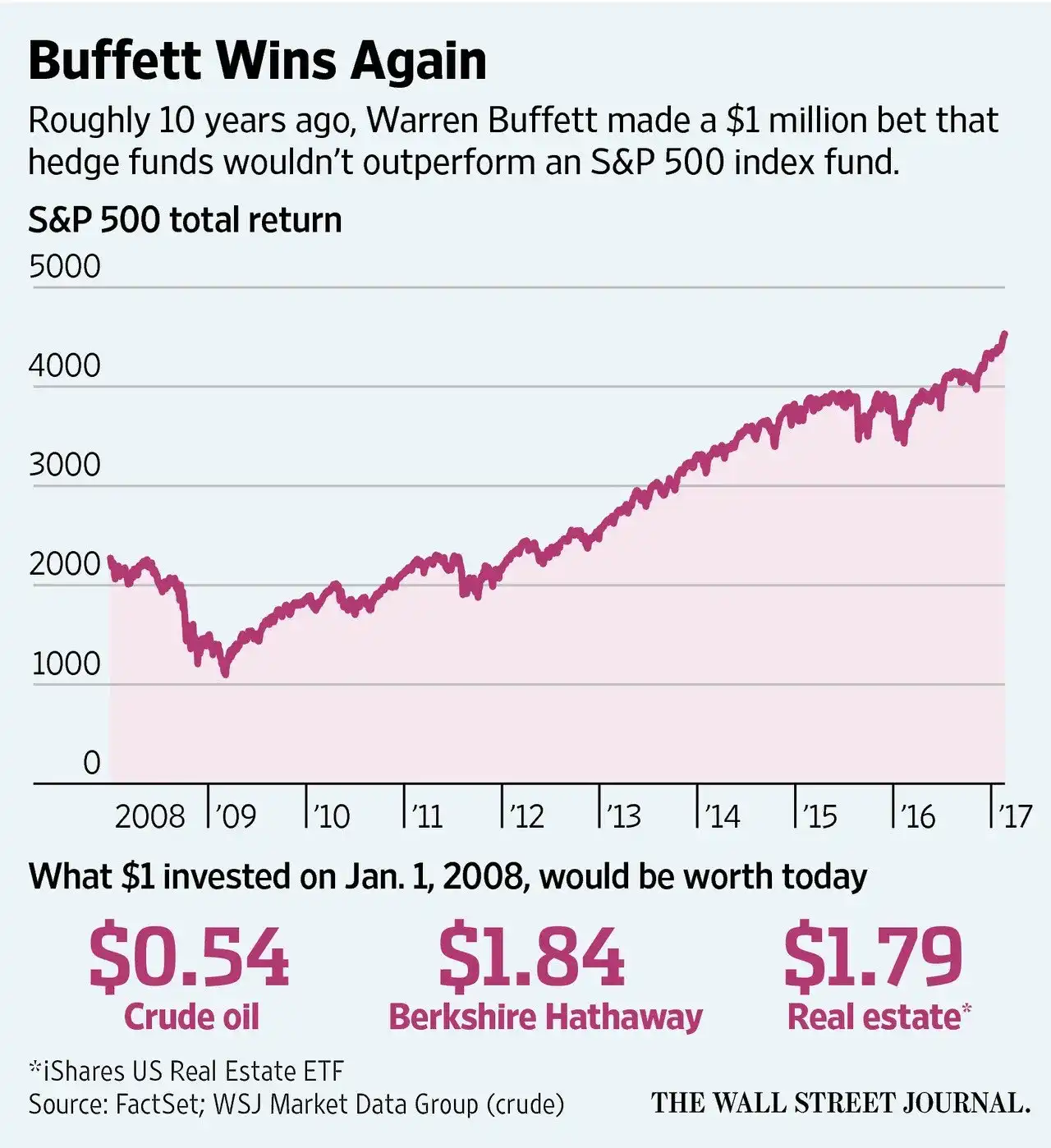
To delve into all the intricate factors driving the development of passive funds, a lengthy article would be needed, but we can summarize it into a few simple factors:
Better Cost Efficiency
Compared to actively managed funds, passive funds (such as index funds and ETFs) typically have a much lower expense ratio. This is because they do not require fund managers to do a significant amount of "active work." Once the rules and methods are set, algorithms take over, with only some human intervention during quarterly rebalancing. Lower costs usually mean better investment net returns, making passive funds more attractive to cost-conscious investors.
Lower Entry Barriers, Wider Distribution
In short, you have easier access to passive funds. Compared to active funds, investors do not need to struggle to select a fund manager; an industry already exists around distributing financial products to your grandparents. For regulatory reasons, passive funds often integrate more easily into the financial supply chain. Most active funds are often restricted in distribution materials, while passive funds have truly integrated into 401k plans, pension systems, and more.
More Stable Performance
The wisdom of the crowd often leads to better outcomes. Over the past 15 years, most active fund managers have failed to outperform the benchmark. While investing in passive funds, you may never get a 10x return as you might from early investment in Tesla or Shopify, but on the flip side, most people are not willing to put 50% of their net worth on a single stock. High risk, high reward is not always so appealing.
Here are some more interesting statistics:
· In the U.S., passive fund assets have quadrupled over the past decade, growing from $3.2 trillion at the end of 2013 to $15 trillion by the end of 2023.
· As of December 2023, passive funds' total assets under management (AUM) in the U.S. officially exceeded active funds for the first time in history.
· As of October 2024, U.S. equity index funds held $13.13 trillion in global assets, with $10.98 trillion in U.S. assets; while actively managed equity funds held $9.78 trillion in global assets, with $7.26 trillion in U.S. assets.
· Currently, index funds account for 57% of U.S. stock fund assets, up from 36% in 2016.
· In the first ten months of 2024, U.S. stock index funds saw inflows of $415.4 billion, while actively managed funds saw outflows of $341.5 billion during the same period.
This is why the entire traditional financial sector or cryptocurrency fund managers with experience in the traditional financial sector are so enthusiastic about the Bitcoin ETF narrative. They know that this is the starting point to open a larger gate, one that will truly bring Bitcoin into the average person's retirement portfolio.
Cryptocurrency Investment Products
But what is the relationship between Bitcoin ETFs and passive funds?
Although the three major index providers (S&P Dow Jones Indices, FTSE Russell, MSCI) have been tirelessly developing cryptocurrency indices, adoption has been relatively slow and currently only single-asset cryptocurrency investment products are available. Of course, this is because these products are easier to launch, so every institution is racing to become the first to launch a Bitcoin ETF. Today, we are seeing major institutions working on advancing an ETH staking ETF and more investment products based on altcoins.
However, the real game-changing product would be one that is a mix of Bitcoin with other investments. Imagine an investment portfolio composed of 95% S&P 500 Index and 5% Bitcoin, or 50% gold and 50% Bitcoin. Fund managers would be keen to promote such a product — they are also more easily integrated into the financial supply chain, increasing their distribution channels.
Nevertheless, the launch and promotion of these products will still take time. And given that they will be introduced as a new product, it is not expected to automatically benefit from the existing monthly purchasing power that popular passive products have.
MSTR Makes TradFi (3,3) Possible
Now it's MicroStrategy's (MSTR) turn to step into the spotlight.
With MSTR being included in the Nasdaq 100 Index, passive funds like QQQ (Invesco QQQ Trust, an ETF that tracks the Nasdaq 100 Index) will be forced to automatically purchase MSTR, and MSTR, in turn, will be able to use these funds to buy more Bitcoin. In the future, new "Bitcoin-Equity-Gold" hybrid passive investment products may take over MSTR's role, but in the foreseeable 3-5 years, MSTR, as a "Bitcoin treasury company," is more likely to play this role more easily because they are a mature U.S. publicly traded company and are more qualified to be included in top passive fund indices faster than newly launched passive investment products.
Therefore, as long as MSTR continues to utilize these funds to purchase more Bitcoin, the buy-side pressure on Bitcoin will continue to increase.
If this sounds too good to be true... that's because there are a few minor caveats to enabling MSTR to more effectively play this role. For example, the current requirement for inclusion in the S&P 500 index mandates that a company has been profitable in the most recent quarter as well as the last four quarters cumulatively, making it unlikely for MSTR to be included. However, new accounting rules set to take effect starting January 2025 will allow MSTR to declare the value change of its held BTC as net income, potentially making MSTR eligible for S&P 500 inclusion.
This is essentially the TradFi's (3, 3) system.
5-Minute Mental Math and Assumptions
I spent 5 minutes doing some quick calculations. If there are any errors in the calculations or suggestions on the assumptions made, feel free to point them out.
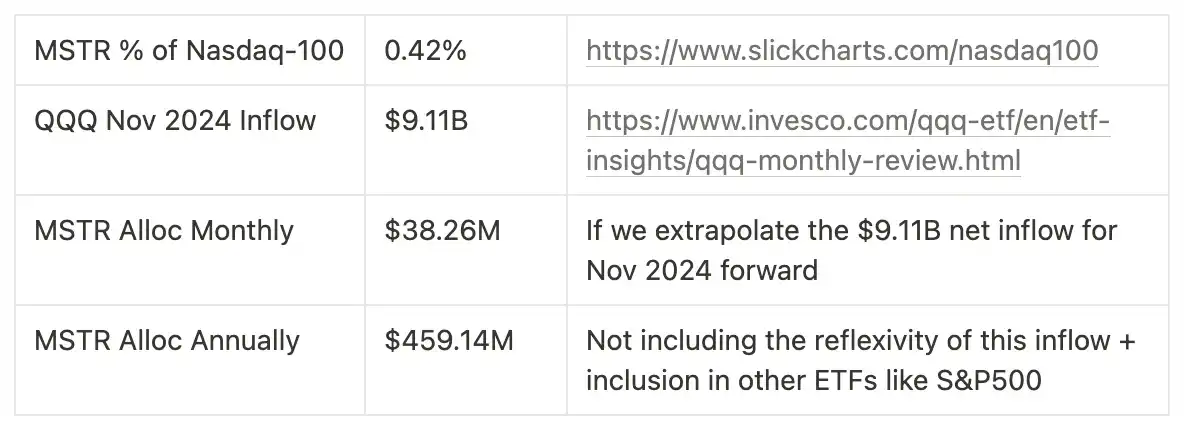
Odaily Note: Taking MSTR's 0.42% weight in the Nasdaq 100 index as an example, with QQQ's net inflow of $9.11 billion in 2024, this corresponds to a monthly net inflow into MSTR of $38.26 million, totaling $459 million annually.
In essence—the entire traditional finance passive investment ecosystem will unknowingly buy more Bitcoin due to MicroStrategy (MSTR) being included in major indices, similar to how they all hold Nvidia stock without realizing it, creating a (3, 3)-like effect on Bitcoin's price.
You may also like

Cyber Taoist Fortune Teller: Fake Taoist, AI Fortune Telling, and Northeastern Metaphysics History

Bloomberg: Stablecoin Payments Emerge as Crypto VC's Newest Favorite Thing
BeatSwap is evolving towards a full-stack Web3 infrastructure, covering the entire lifecycle of IP rights.
BeatSwap, a global Web3 Intellectual Property (IP) infrastructure project, is attempting to overcome the current fragmentation limitations of the Web3 ecosystem, building a full-stack system that covers the entire lifecycle of IP rights.
Currently, most Web3 projects are still in the stage of functional fragmentation, often focusing only on a single aspect, such as IP asset tokenization, transaction functionality, or a simple incentive model. This structural dispersion has become a key bottleneck hindering the industry's scale application.
BeatSwap's approach is more integrated, integrating multiple core modules into the same system, including:
· IP authentication and on-chain registration
· Authorization-based revenue sharing mechanism
· User-engagement-driven incentive system
· Transaction and liquidity infrastructure
Through the above integration, the platform builds an end-to-end closed-loop path, allowing IP rights to complete a full cycle of "creation, use, and monetization" within the same ecosystem.
BeatSwap is not limited to existing crypto users but is attempting to take the global music industry as a starting point, actively creating new market demand. Its core strategies include:
Exploring and incubating music creators (Artist discovery)
Building a fan community
Igniting IP-centric content consumption demand
The current global music industry is valued at around $260 billion, with over 2 billion digital music users. This means that the potential market corresponding to the tokenization and financialization of IP far exceeds the traditional crypto user base.
In this context, BeatSwap positions itself at the intersection of "real-world content demand" and "on-chain infrastructure," attempting to bridge the structural gap between content production and financial flow.
BeatSwap's upcoming core product "Space" is scheduled to launch in the second quarter of 2026. This product is defined as the SocialFi layer in the ecosystem, aiming to directly connect creators with users and achieve deep integration with other platform modules.
Key designs include:
A fan-centric interactive mechanism
Exposure and distribution logic based on $BTX staking
User paths connected to DeFi and liquidity structures
Thus, a complete user behavior loop is formed within the platform: Discovery → Participation → Consumption → Rewards → Trading
$BTX is designed to be a core utility asset within the ecosystem, rather than just a simple incentive token, with its value directly tied to platform activity and IP use cases.
Main features include:
· Yield distribution based on on-chain authorized actions
· Value reflection based on IP usage and user engagement dynamics
· Support for staking and DeFi participation mechanisms
· Value growth driven by ecosystem expansion
With the increased frequency of IP use, the utility and value support of $BTX will enhance simultaneously, helping alleviate the "disconnect between value and utility" issue present in traditional Web3 token models to some extent.
Currently, $BTX has been listed on several mainstream exchanges, including:
Binance Alpha
Gate
MEXC
OKX Boost
As the launch of "Space" approaches, BeatSwap is actively pursuing more exchange listings to further enhance liquidity and global accessibility, laying a foundation for future market expansion.
BeatSwap's goal is no longer limited to the traditional Web3 narrative but aims to target over 2 billion digital music users and a trillion KRW-scale content market.
By integrating content creators, users, capital, and liquidity into a blockchain framework centered around IP rights, BeatSwap is striving to build a next-generation infrastructure focused on "IP tokenization."
BeatSwap integrates IP authentication, authorization distribution, incentive mechanism, transaction system, and market construction to establish a unified structure that bridges the full lifecycle path of IP rights.
With the launch of the Q2 2026 "Space," the project is expected to become a key infrastructure connecting content and finance in the IP-RWA (Real World Assets) track.

Mag 7 Evaporates $2 Trillion | Rewire News Morning Edition

Losing $19K per Coin Mined, Bitcoin Mining Firms Collective AI Defection

Morning Report | Tom Lee predicts that the cryptocurrency winter will end in April; xStocks introduces a new on-chain private equity fund; Sui mainnet upgraded to V1.68.1

Polymarket rules have changed, how should airdrop participants respond?

Crypto ETF Weekly | Last week, the net outflow of Bitcoin spot ETFs in the U.S. was $296 million; the net outflow of Ethereum spot ETFs in the U.S. was $206 million

This Week's Key News Preview | The U.S. Releases March Non-Farm Payroll Data; Polymarket Expands Fee Structure

Slow Down, That's the Answer to the Age of the Agent

From Cash to Cryptocurrency: Moving Towards a Unified Regulatory Path for Illegal Payments
Who will own the most Bitcoin in 2026

A private feud lasting 10 years, if not for OpenAI's "hypocrisy," would not have led to the world's strongest AI company, Anthropic

"Crypto Tsar" steps down: 130 days of political performance come to an end, how much of Trump's crypto promise remains?

From Utopian Narratives to Financial Infrastructure: The "Disenchantment" and Shift of Crypto VC
A decade-long personal feud, if not for OpenAI's "hypocrisy," there would be no globally leading AI company Anthropic

a16z: The True Meaning of Strong Chain Quality, Block Space Should Not Be Monopolized
a16z: The True Meaning of Strong Chain Quality, Block Space Should Not Be Monopolized
Cyber Taoist Fortune Teller: Fake Taoist, AI Fortune Telling, and Northeastern Metaphysics History
Bloomberg: Stablecoin Payments Emerge as Crypto VC's Newest Favorite Thing
BeatSwap is evolving towards a full-stack Web3 infrastructure, covering the entire lifecycle of IP rights.
BeatSwap, a global Web3 Intellectual Property (IP) infrastructure project, is attempting to overcome the current fragmentation limitations of the Web3 ecosystem, building a full-stack system that covers the entire lifecycle of IP rights.
Currently, most Web3 projects are still in the stage of functional fragmentation, often focusing only on a single aspect, such as IP asset tokenization, transaction functionality, or a simple incentive model. This structural dispersion has become a key bottleneck hindering the industry's scale application.
BeatSwap's approach is more integrated, integrating multiple core modules into the same system, including:
· IP authentication and on-chain registration
· Authorization-based revenue sharing mechanism
· User-engagement-driven incentive system
· Transaction and liquidity infrastructure
Through the above integration, the platform builds an end-to-end closed-loop path, allowing IP rights to complete a full cycle of "creation, use, and monetization" within the same ecosystem.
BeatSwap is not limited to existing crypto users but is attempting to take the global music industry as a starting point, actively creating new market demand. Its core strategies include:
Exploring and incubating music creators (Artist discovery)
Building a fan community
Igniting IP-centric content consumption demand
The current global music industry is valued at around $260 billion, with over 2 billion digital music users. This means that the potential market corresponding to the tokenization and financialization of IP far exceeds the traditional crypto user base.
In this context, BeatSwap positions itself at the intersection of "real-world content demand" and "on-chain infrastructure," attempting to bridge the structural gap between content production and financial flow.
BeatSwap's upcoming core product "Space" is scheduled to launch in the second quarter of 2026. This product is defined as the SocialFi layer in the ecosystem, aiming to directly connect creators with users and achieve deep integration with other platform modules.
Key designs include:
A fan-centric interactive mechanism
Exposure and distribution logic based on $BTX staking
User paths connected to DeFi and liquidity structures
Thus, a complete user behavior loop is formed within the platform: Discovery → Participation → Consumption → Rewards → Trading
$BTX is designed to be a core utility asset within the ecosystem, rather than just a simple incentive token, with its value directly tied to platform activity and IP use cases.
Main features include:
· Yield distribution based on on-chain authorized actions
· Value reflection based on IP usage and user engagement dynamics
· Support for staking and DeFi participation mechanisms
· Value growth driven by ecosystem expansion
With the increased frequency of IP use, the utility and value support of $BTX will enhance simultaneously, helping alleviate the "disconnect between value and utility" issue present in traditional Web3 token models to some extent.
Currently, $BTX has been listed on several mainstream exchanges, including:
Binance Alpha
Gate
MEXC
OKX Boost
As the launch of "Space" approaches, BeatSwap is actively pursuing more exchange listings to further enhance liquidity and global accessibility, laying a foundation for future market expansion.
BeatSwap's goal is no longer limited to the traditional Web3 narrative but aims to target over 2 billion digital music users and a trillion KRW-scale content market.
By integrating content creators, users, capital, and liquidity into a blockchain framework centered around IP rights, BeatSwap is striving to build a next-generation infrastructure focused on "IP tokenization."
BeatSwap integrates IP authentication, authorization distribution, incentive mechanism, transaction system, and market construction to establish a unified structure that bridges the full lifecycle path of IP rights.
With the launch of the Q2 2026 "Space," the project is expected to become a key infrastructure connecting content and finance in the IP-RWA (Real World Assets) track.


 App
App