
Like the legendary 30x El Dorado Mastiff, what is the x402 Protocol?

 Prefer us on Google


Yesterday, a special Gold Dog was born on Base, and it's called $PING. Based on the cost of initial minting and the current coin price, a successful Mint results in approximately an 18x return.
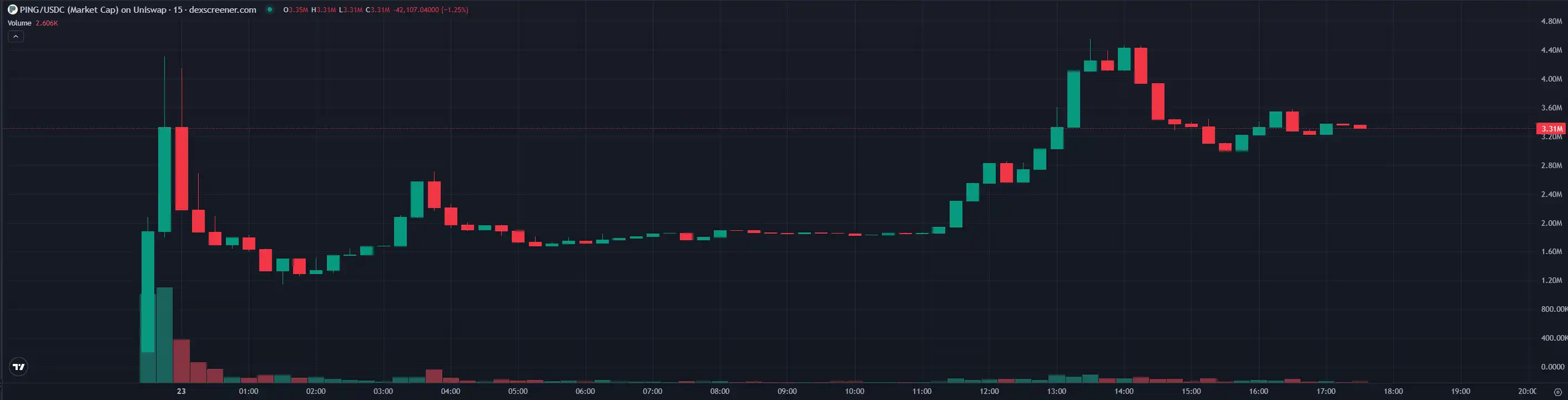
The uniqueness of $PING lies in the fact that its minting process is reminiscent of the inscription from 2 years ago. The cost of minting $PING once is around $1, and if successful, you can receive 5000 $PING. The minting page for $PING is also similar to the inscription from that year, lacking an exquisite front-end interface, and appearing more hard-core.
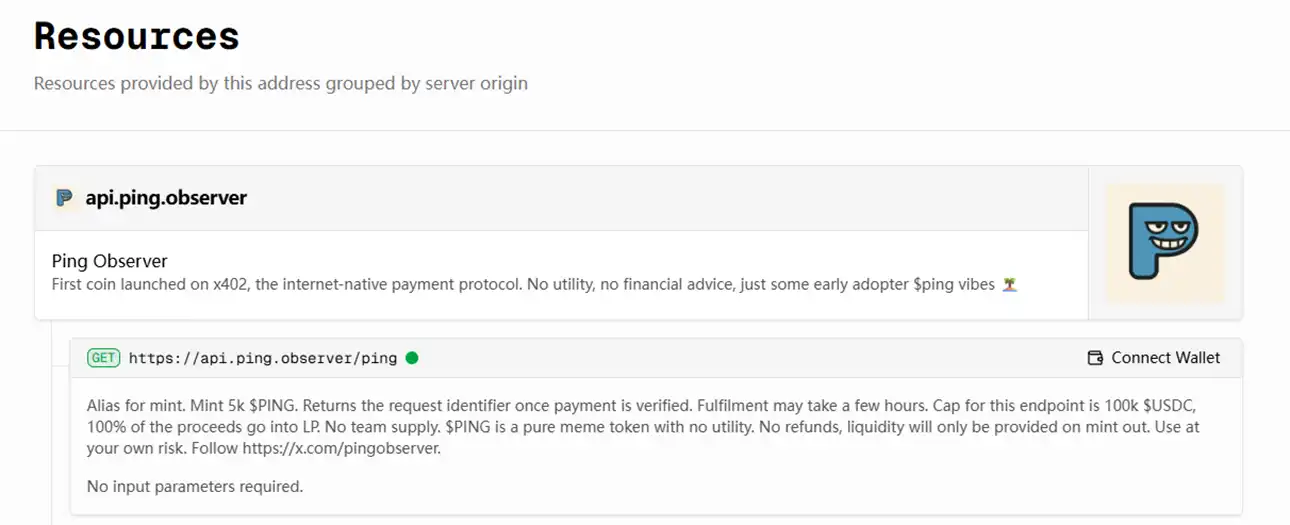
This is the first token issued through the x402 protocol. So, what is the x402 protocol? Why is the minting process of $PING so special? And what is the current ecosystem of this protocol like?
What is the x402 Protocol?
x402 is an open payment protocol developed by Coinbase that allows AI agents to autonomously complete transactions.
The x402 protocol leverages the long-standing "HTTP 402 "Payment Required" status code to request payment to fulfill an API request or load a webpage. If an API request lacks payment information, x402 returns an HTTP 402 status code, prompting the client to pay and retry the request.
The workflow diagram below intuitively explains how the x402 protocol operates:
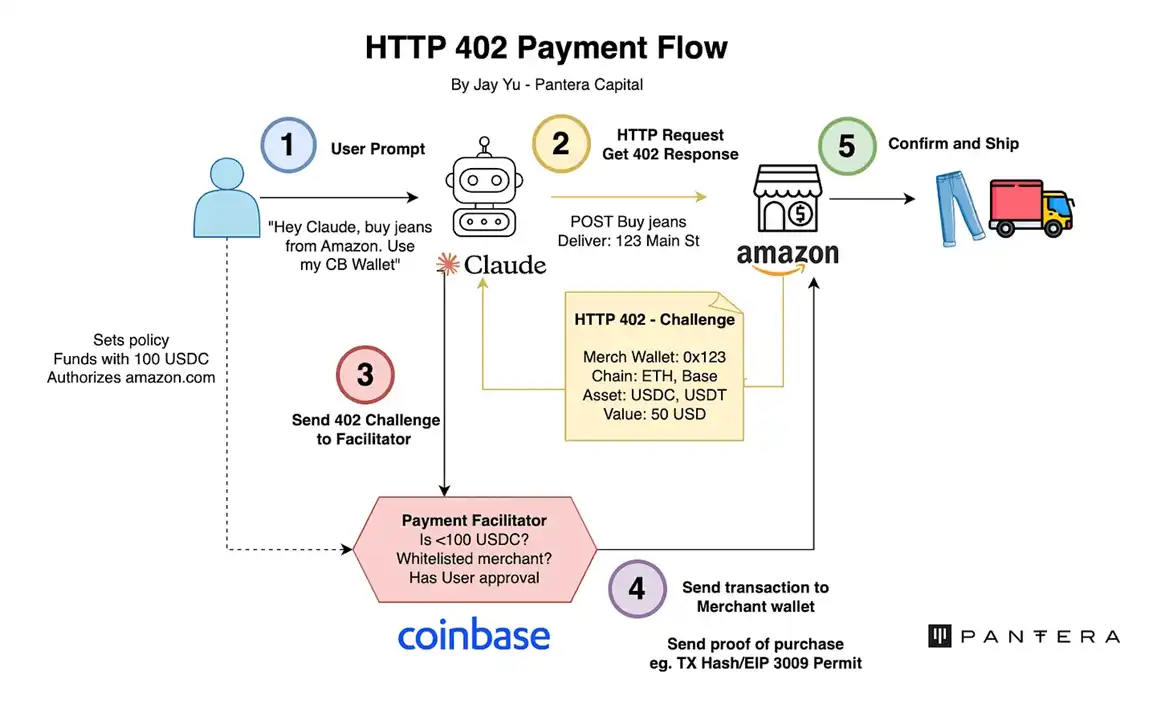
(Image Source: Jay Yu - Pantera Capital)
A user makes a request to Claude, "Use my Coinbase wallet to help me buy a pair of jeans on Amazon." Upon receiving the request, the AI initiates a purchase request to Amazon. Amazon then constructs an initial transaction, including the wallet address to be used, the chain to be used, the cryptocurrency, and the specific amount. Once the AI receives this, it sends the transaction to the x402 protocol validator to check if the wallet on the corresponding chain has sufficient assets, if the product is tradable, and if the user has confirmed authorization. Once everything is confirmed, the amount and payment proof are sent to the merchant's address. With that, the transaction is completed.
Overall, the HTTP 402 status code in the protocol serves as an "informational" role, indicating whether a transaction was successful. Coinbase, based on this status code, has added a feature to use blockchain for payments, creating the x402 protocol.
It may sound simple, but looking at the protocol flow above, there are two anticipated aspects. The first is further simplification of the on-chain asset channel for actual payments, eliminating the need for users to cash out into fiat currency before spending, allowing direct spending of assets like USDT, USDC, or other on-chain assets. However, the key to this is widespread adoption, with enough merchants supporting it.
Any Web API or content provider (crypto or Web2) looking to offer a low-cost, frictionless payment path for small or usage-based transactions can integrate x402.
The second aspect is the AI Agent. The AI Agent, acting as the payer/receiver, is well-suited for blockchain payments because unlike humans, AI Agents do not naturally have bank or payment app accounts through KYC. As the intelligence of AI Agents continues to grow, some novel consumption experiences or on-chain experiences are also worth looking forward to.
The workflow also explains why the minting process of $PING is likened to an inscription, as it needs confirmation from the x402 validator. During the minting process, a large number of minting requests not only bombarded the minting interface repeatedly but also provided the first real stress test for the x402 protocol.
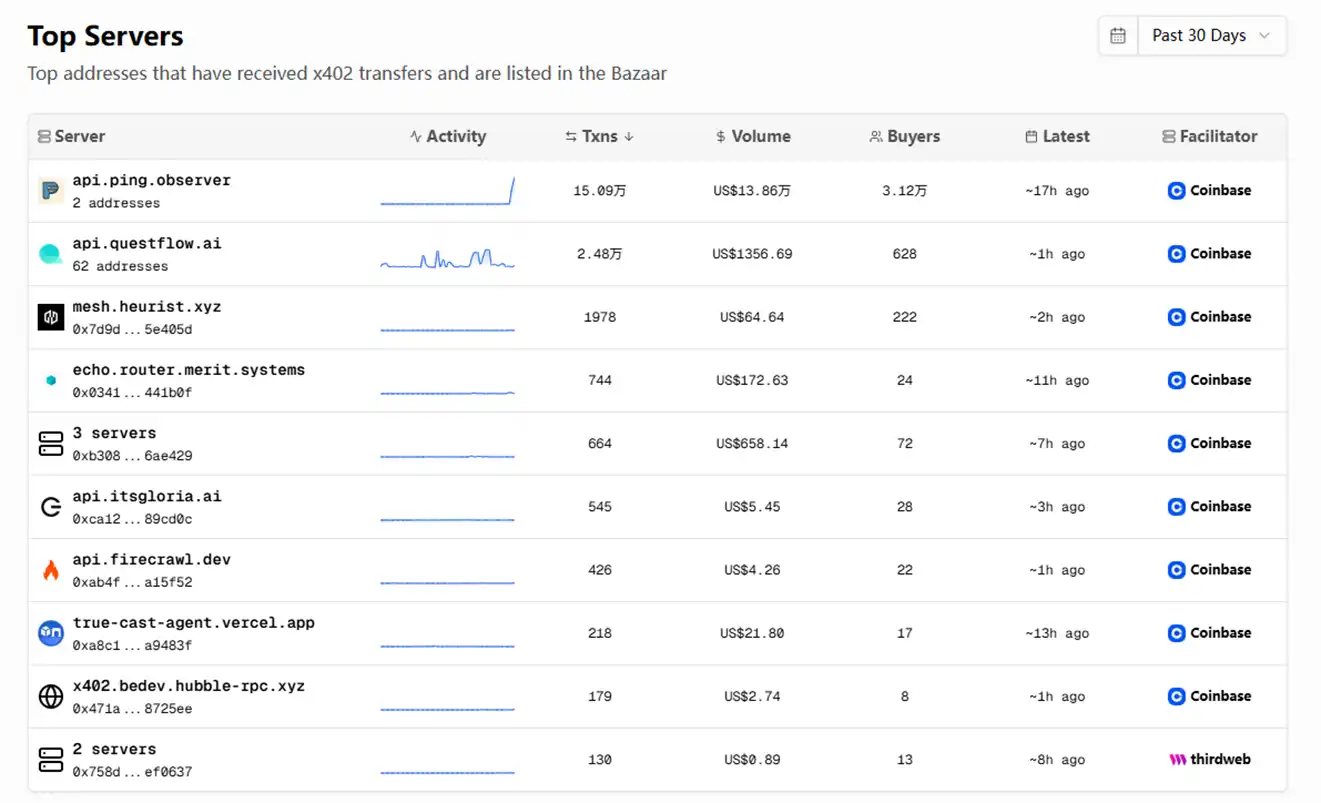
Data from the past 30 days shows that the $PING interface has received over 150,000 x402 transactions, totaling approximately $140,000, leading by a landslide over the second-ranked Questflow
This is the first time the x402 protocol has been so lively and well-known in nearly half a year since its launch. Regardless of the chain or protocol, new asset issuance is always a hot topic in the crypto world.
x402 Ecosystem Overview
So, besides $PING, what other projects related to the x402 protocol are worth paying attention to?
The Ecosystem page on the x402 protocol's official website provides a summary of current projects. By checking out each project individually, it feels like this protocol is still in a fairly early stage of development. Many projects either directly lead to technical documentation or jump to the projects' GitHub repositories.
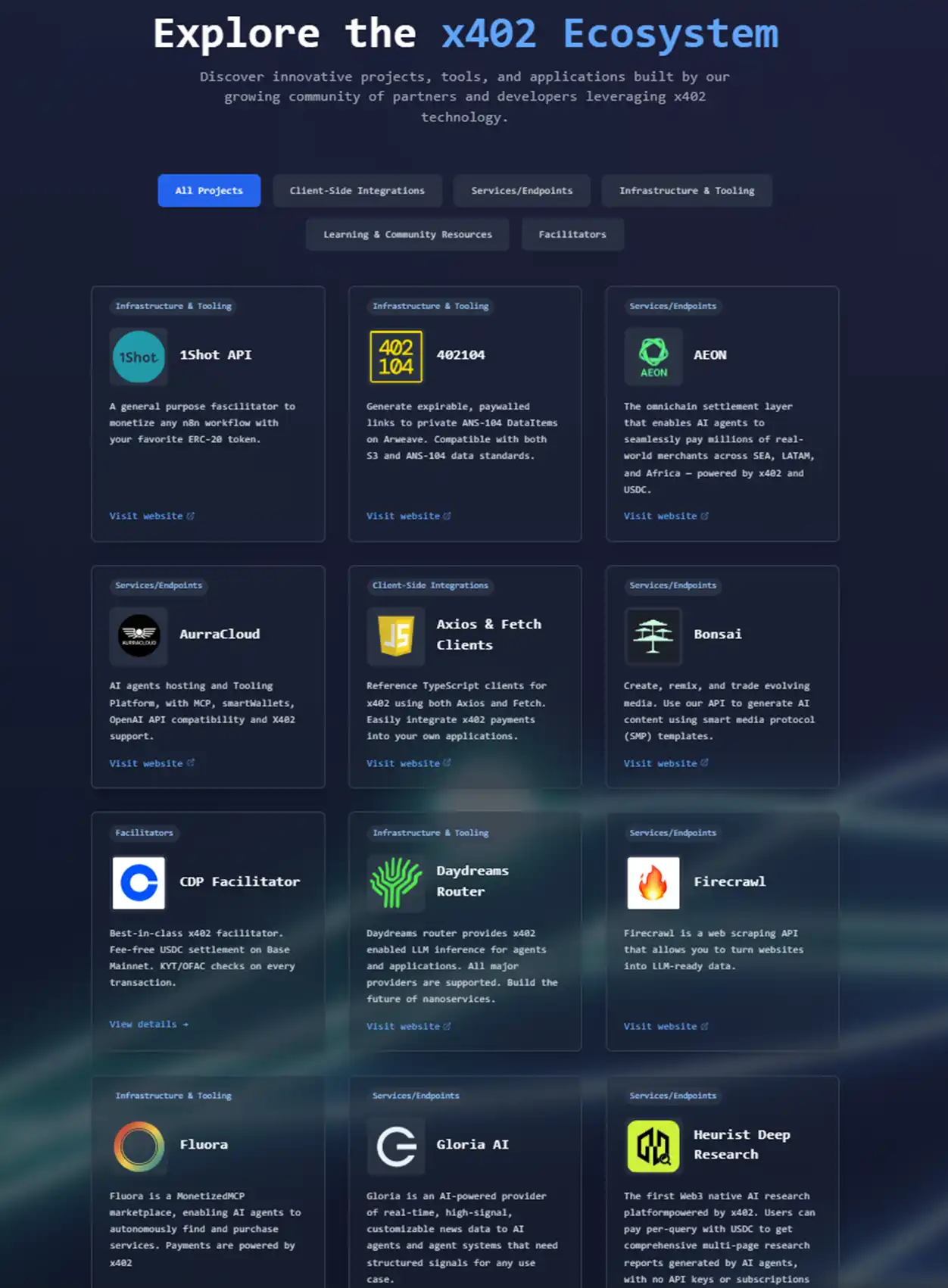
Here we summarize some existing token projects and upcoming launches.
Questflow

A multi-AI Agent work-ordering layer that enables multiple AI Agents to autonomously coordinate task execution. In July of this year, it was announced that they successfully raised a $6.5 million seed round led by cyber•Fund, with participation from Delphi Labs, Systemic Ventures, Eden Block, HashKey Capital, Animoca Brands, Tezos, among others. Additionally, they received grants from the Coinbase Developer Platform, Aptos, and Virtuals.
There is currently no official token, but in December of last year, they collaborated with Virtuals to launch $SANTA, an autonomous Agent cluster utilizing Questflow's QDP (Questflow Developer Platform) and MAOP (Multi-Agent Orchestration Protocol).
The current market value of $SANTA is approximately $4.5 million.
AurraCloud

An AI Agent infrastructure for crypto-native applications. It can immediately host AI Agents using an OpenAI-compatible API or an MCP server and achieve AI monetization through the on-chain x402 protocol on Base.
Additionally, earlier this month, the project also offered x402 validation services.
The $AURA token was launched through Virtuals and currently has a market value of approximately $1.6 million.
Meridian

Incubated by uOS, they provide cross-chain settlement and custody services based on the x402 protocol.
The $MRDN token currently has a market capitalization of approximately $1.5 million.
PayAI

Provides multi-chain x402 payment service support, including Solana, and also offers x402 verification services.
The $PAYAI token currently has a market capitalization of approximately $5 million.
Daydreams

Supports the LLM inference process for apps and AI Agents using x402. Additionally, it is building Lucid—an accessible platform for anyone to deploy Daydreams Agents to solve problems. Users can sign transactions with x402 to pay in USDC, and Agents can mutually pay for access.
The $dreams token currently has a market capitalization of approximately $6.7 million.
Gloria AI

A real-time news platform built for traders, creators, AI Agents, and automated systems, which can be accessed with $GLORIA via x402 payments.
The $GLORIA token currently has a market capitalization of approximately $1.65 million.
Kite AI

Kite AI is creating the foundation transaction layer for the "Agentic Internet," providing a unified identity, payment, and governance infrastructure for autonomous intelligent agents. Kite AI's work is closely related to x402, having referenced support for x402 as early as July and being arguably the only project within the x402 ecosystem that can be classified as part of the "chain."
On September 2nd, according to Fortune, Kite AI announced a total of $33 million in funding, with the latest Series A round amounting to $18 million. The round was led by PayPal Ventures and General Catalyst, with participation from 8VC, Samsung Next, SBI US Gateway Fund, Vertex Ventures, Hashed, HashKey Capital, Dispersion Capital, Alumni Ventures, Avalanche Foundation, GSR Markets, LayerZero, Animoca Brands, Essence VC, and Alchemy.
Kite AI has not yet launched its coin, but recently introduced the Kite Foundation X account, which clearly indicates that a coin launch is imminent. The only tradable asset currently available is the official FLY THE KITE NFT, with a floor price of 0.375 ETH.
Conclusion
In September of this year, Coinbase and Cloudflare announced the formation of the x402 Foundation to drive protocol development. While there are some similar competitors, such as h402 from bitGPT and EVMAuth from Radius, there is no doubt that x402 has the strongest background and highest level of attention.
If the market cap of $PING experiences a significant increase in the near future, x402 will attract more market attention. This is not only beneficial for meme coins but also for infrastructure projects.
Disclaimer: This content is provided for general branding and informational purposes only and doesn't constitute financial, investment, legal, or tax advice. Any events, rewards, online events, or related information mentioned herein should not be considered a recommendation, solicitation, or invitation to purchase, sell, trade, or otherwise deal in any crypto assets or to use any services. Crypto assets are highly volatile and may result in loss. WEEX services and online events may not be available in all regions and are subject to applicable laws, regulations, and eligibility requirements. You are responsible for ensuring that your use of WEEX services complies with local laws and for carefully assessing the risks before participating in any crypto-related activities.
You may also like

Standard Chartered Reaffirms: Bitcoin Will Surpass $100,000 by the End of 2026! Now is the Perfect Buying Opportunity

Bank of America: Keep an Eye on the Japanese Market, It Will Be the "Canary in the Coal Mine" for a Global Decline

AscendEX Exchange Announces Shutdown! Concerns Over Insufficient Hot Wallet Assets Rise, Users Panic Withdrawals
Computing Capital Markets
IPCA Below Expectations in June: What It Means for the Dollar and Interest Rates
SemiAnalysis Latest Interview: Storage Has Room to Double, Be Cautious with CPO in the Short to Medium Term, CPU is Just a Supporting Role

FDV vs market cap: The two numbers that decide if a token is cheap

Is Ethereum Really a 'World Computer'?
An Investor's 17 Judgments on Embodiment, Models, and Computing Power
The Intellectual Arbitrage Trap of Bittensor: Capital Only Speculates on Tokens, Quality AI Goes Unnoticed
Litecoin Wallet Addresses Grow by Over 22 Million in Just 6 Months
Shiba Inu: After a Pause, Eternity and Metaverse Projects Prepare for Their Return

What are wallet drainers? Inside the approval-phishing industry
The Era of AI Trading Has Arrived: LTP Launches the World's First AI Agent Live Quantitative Trading Championship

Can Changing Chains Really Change the Game?
Revolut integrates its crypto exchange with AI assistants as agentic trading spreads
DOJ charges inmate over alleged $290K forfeited crypto theft
June Trading Volume Doubles: x402 Ecosystem Continues to Expand, Content Monetization Narrative Faces Key Test
Walsh's 'Unified Front': Aiming for Rate Cuts?
Ethereum vs Solana Whitepaper Comparison (2026)

French Tech: AI and Quantum on the Rise, Crypto Absent

Home Robot NEO Grows "Dexterous Hands": How Do Hands Become the API to the Physical World?

What is SCEX? The Cryptocurrency Exchange for Vietnam's Market by Sacombank
Major Update for ChatGPT: Cross-Platform Functionality, One-Click Website Creation, and Lower Costs

BTC Challenges 64,000 After Breaking 63,000, Market Trading 'Manageable Risks'
As the Bubble Bursts, Who Dominates Attention in the AI Era? A 2026 Guide to Influential AI KOLs in China and the UK

Old Money in Crypto Shifts: Paradigm Raises $1.2 Billion, Half Bet on AI and Robotics

Bitdeer unveils $36M Nevada factory to shake up Bitcoin mining
Perplexity Fine-Tuned a Chinese AI Model to Match Claude Opus 4.8 at One-Third the Cost

Bank of Korea defends bank-first stablecoin plan amid bill deadlock
Standard Chartered Reaffirms: Bitcoin Will Surpass $100,000 by the End of 2026! Now is the Perfect Buying Opportunity
Bank of America: Keep an Eye on the Japanese Market, It Will Be the "Canary in the Coal Mine" for a Global Decline
AscendEX Exchange Announces Shutdown! Concerns Over Insufficient Hot Wallet Assets Rise, Users Panic Withdrawals
Computing Capital Markets
IPCA Below Expectations in June: What It Means for the Dollar and Interest Rates
SemiAnalysis Latest Interview: Storage Has Room to Double, Be Cautious with CPO in the Short to Medium Term, CPU is Just a Supporting Role

Contents
Latest articles







Latest coin listings on WEEX


