
 Buy Crypto
- Markets
 Futures
- Spot
- Copy Trade
- Earn
- More
If the Bitcoin Reserve Bill is passed, it may bring an end to the cryptocurrency's four-year boom-bust cycle.

Original Title: A Bitcoin Reserve Act may end crypto's 4-year boom-bust cycle
Original Author: DANIEL RAMIREZ-ESCUDERO, Cointelegraph
Original Translation: Lawrence, MarsBit
The "Bitcoin Reserve Act" may break the halving cycle. Will this four-year cycle unfold in a different way? Are we entering a mythical supercycle?
Speculation is growing that the incoming President Donald Trump may sign an executive order on his first day in office to announce the establishment of a Bitcoin reserve, or establish a reserve through legislation during his term, leaving many wondering whether this move could lead to a cryptocurrency supercycle.
Since Wyoming Senator Cynthia Lummis introduced the "Bitcoin Reserve Act" earlier this year, states like Texas and Pennsylvania have also introduced similar proposals. Reports indicate that Russia, Thailand, and Germany are also considering their own proposals, further intensifying the pressure.
If governments around the world are all rushing to secure their own Bitcoin reserves, will we bid farewell to what many believe is the cryptocurrency price's four-year boom-bust cycle caused by Bitcoin halving?
Analyst Iliya Kalchev from cryptocurrency lending institution Nexo believes that the "Bitcoin Reserve Act" could be a milestone moment for Bitcoin, indicating its "recognition as a legitimate global financial instrument."
"Every Bitcoin cycle has had this kind of narrative, attempting to push the idea of 'this time it's different.' The conditions have never been more ideal. Cryptocurrency has never had a pro-crypto U.S. President with control of the Senate and Congress."
Lummis' proposed 2024 Bitcoin bill would allow the U.S. government to introduce Bitcoin by purchasing 200,000 BTC per year over five years to deposit it as a reserve asset in its treasury, accumulating 1 million BTC, and holding it for at least 20 years.
Jack Mallers, the founder and CEO of Strike, believes that Trump "could potentially utilize an executive order to purchase Bitcoin," but he warns that this does not equate to purchasing 1 million Bitcoin.
The co-founder of the Satoshi Act Fund, a non-profit organization supporting US policy bills favorable to Bitcoin, Dennis Porter, also believes that Trump is exploring establishing a strategic Bitcoin reserve through an executive order.
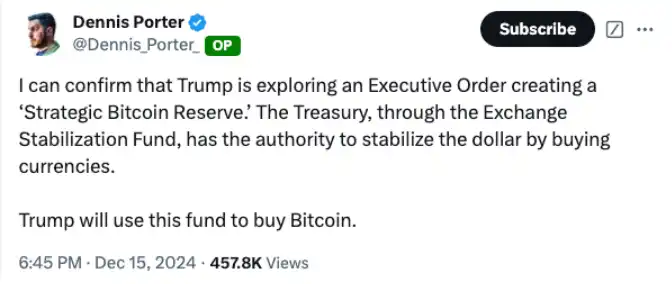
Dennis Porter announced that Trump is looking into an executive order regarding a strategic Bitcoin reserve. Source: Dennis Porter
So far, Trump's team has not directly confirmed the rumor about the executive order. However, when asked on CNBC whether the US would create a BTC reserve similar to its oil reserve (which could imply legislation), Trump replied, "Yes, I think so."
However, executive orders lack stability as subsequent presidents often overturn such orders. The only way to ensure a strategic Bitcoin reserve for the long term future is through legislation supported by a majority.
With the Republican Party in control of Congress, holding a slim majority in the Senate, Bitcoin proponents in Trump's team have ample reason to advocate for the Lummis bill. However, as long as a few Republican defectors are swayed by progressive voices, they may block the bill, believing it hands over government wealth to Bitcoin holders.
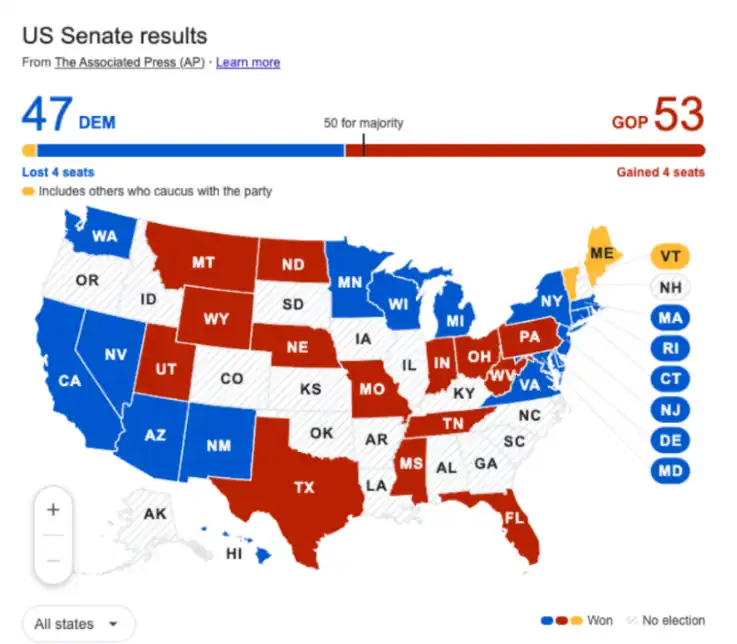
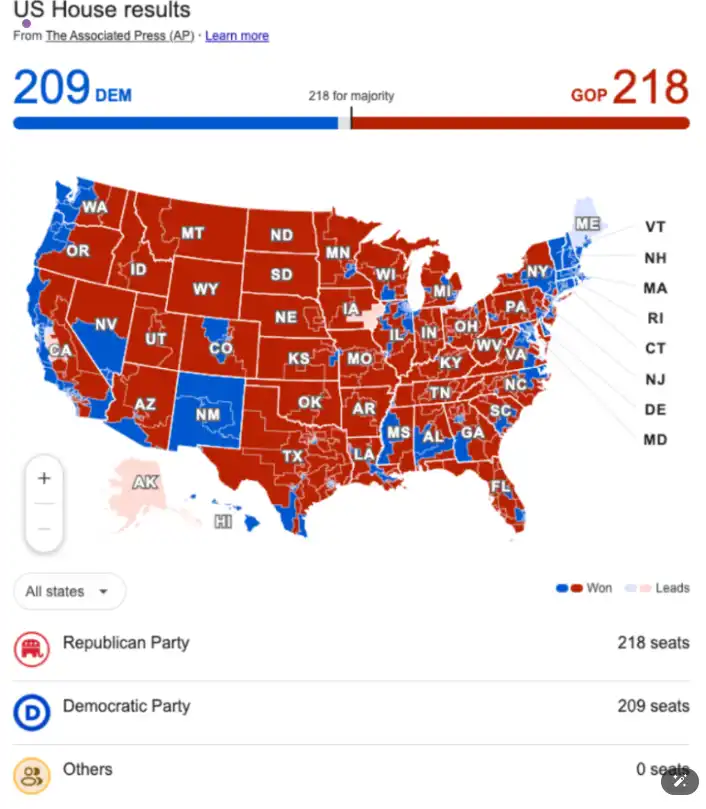
Election results for the US Senate and House of Representatives after the 2024 elections. Source: Associated Press
Avoid Comparing This Cycle to Previous Ones
At the beginning of this month, Alex Krüger, founder of macro digital asset consulting firm Asgard Markets and an economist, stated that the election results made him believe "Bitcoin is very likely entering a super-cycle."
He believes that Bitcoin's unique situation can be compared to that of gold. Following former US President Richard Nixon's announcement of abandoning the gold standard, ending the Bretton Woods system, Bitcoin's price surged from $35 per ounce in 1971 to $850 in 1981.
Krüger does not rule out the possibility of Bitcoin going through a bear market as it has in the past. However, he urges cryptocurrency investors "not to compare this cycle to previous cycles," as this time may be different.
Trump's actions so far undeniably indicate that government policy will move in a favorable direction. After Gary stepped down, he nominated Paul Atkins, a supporter of cryptocurrency and deregulation, as the chairman of the U.S. Securities and Exchange Commission.
He also nominated cryptocurrency supporter Scott Bessent as Treasury Secretary and appointed former PayPal COO David Sacks as the AI and cryptocurrency czar, tasked with developing a clear legal framework for the cryptocurrency industry.
Super Cycle Theory Has Never Seen Super Success
However, the concept of "this time is different" has emerged in every past Bitcoin bull market, with narratives around mainstream and institutional adoption as support each time.
During the 2013-2014 bull market, the Super Cycle Theory gained support as a theory that Bitcoin would become an internationally prominent alternative asset to fiat currency.
During the 2017-2018 cycle, the rapid price increase was seen as a sign of mainstream financial adoption and the beginning of Bitcoin's mainstream acceptance, with institutional interest expected to flourish.
During the 2020-2021 cycle, as tech companies like MicroStrategy, Square, and Tesla entered the Bitcoin market, they believed many tech-related companies would follow suit.
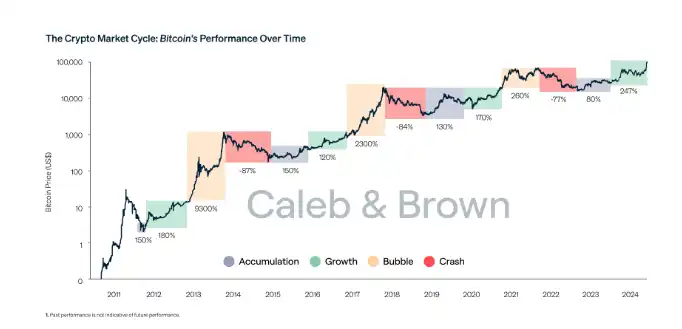
Bitcoin's price performance reached peaks and valleys in the previous cycles. Data Source: Caleb & Brown
However, in each cycle, the narrative of the super cycle has failed to materialize, ultimately leading to price crashes, with supporters going bust and entering a long bear market. Su Zhu, co-founder of Three Arrows Capital, is the most famous proponent of the 2021 super cycle theory, believing that even without a sustained bear market, the cryptocurrency market will remain in a bull market, with Bitcoin eventually reaching a peak of $5 million.
3AC did indeed borrow money, as if the super cycle theory were true, and when it was eventually liquidated, the cryptocurrency market cap plummeted by nearly 50% on that news, causing a collapse that led to lenders such as Voyager Digital, Genesis Trading, and BlockFi declaring bankruptcy and facing financial difficulties.
Therefore, the supercycle is a dangerous theory and should not be the basis for gambling your life savings.
For Chris Brunsike, a partner at the venture capital firm Placeholder and former Blockchain Product Lead at ARK Invest, the Bitcoin supercycle is nothing but a myth.
The supercycle is undoubtedly a mass delusion. Nevertheless, considering the support from the U.S. President, the U.S. election results have provided unprecedented and extremely bullish conditions for Bitcoin, with the U.S. President seemingly fulfilling his commitment to supporting cryptocurrencies, including a pledge to never sell the Bitcoin held in the U.S. reserves.
Potential Global Domino Effect
If the "Bitcoin Reserves Bill" is passed, it could trigger a global race to hold Bitcoin, with other countries following suit to avoid falling behind.
George S. Georgiades, a lawyer who switched from providing financing advice to Wall Street companies in 2016 to serving the cryptocurrency industry, told Cointelegraph that enacting the "Bitcoin Reserves Bill" would "mark a turning point in global Bitcoin adoption" and could potentially "trigger other countries and private institutions to follow suit, driving broader adoption and enhancing market liquidity."
Basel Ismail, CEO of the crypto investment analysis platform Blockcircle, agreed and stated that approval would be "one of the most exciting events in crypto history" as "it will catalyze a race to acquire as much Bitcoin as possible."
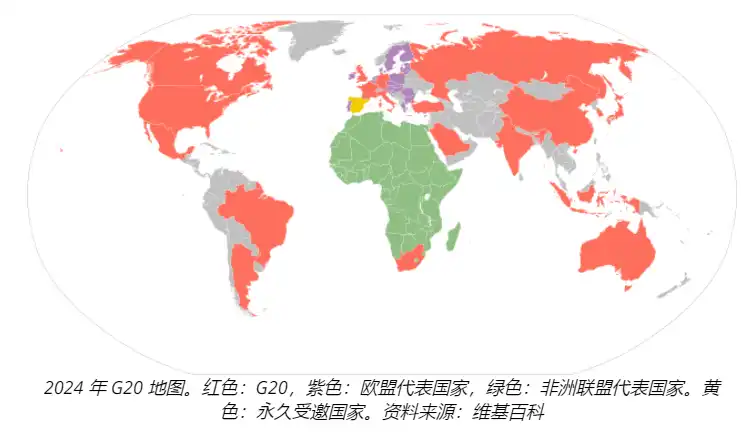
Other countries will have no say; they will be forced to act. Either pivot, compete, or perish. He believes that "most countries in the G20, the world's most powerful and economically advanced countries, will also mimic and build their reserves."
Seasoned cryptocurrency investor and Bitcoin educator Chris Dunn told Cointelegraph that this FOMO-driven frenzy of countries racing to buy in may completely alter the current cryptocurrency market cycle.
If the U.S. or other major economic powers start accumulating, Bitcoin could set off FOMO, potentially creating a market cycle and supply-demand dynamic unlike anything we have seen before.
OKX Exchange CEO Hong Fang told Cointelegraph that other countries may already be prepared for such a race.
Game theory is likely already at play.
However, Ismail noted that most Bitcoin purchases will be conducted through over-the-counter brokers and settled in large trades, so "it may not have a direct impact on Bitcoin's price," but it will create a persistent demand force that will ultimately drive up Bitcoin's price.
A New Wave of Cryptocurrency Investors Could Change the Dynamics of the Cryptocurrency Market
If countries become market buyers, the Bitcoin market could undergo a fundamental transformation. A new wave of investors from global financial centers will enter the cryptocurrency market, altering market dynamics, psychology, and reactions to certain events.
Nexo analyst Kalchev stated that while this legislation may disrupt Bitcoin's well-known four-year halving cycle, it is speculative, but several dynamic changes may occur.
Bitcoin is a unique market, driven so far by retail trading, with prices strongly reacting to market psychology. The emergence of new types of investors could change market dynamics, altering historical cycles.
Ismail believes that "investor behavior in the stock market will be different from" the overreacting retail investors. Institutional investors have substantial funds and advanced risk management strategies, enabling them to treat Bitcoin differently from retail investors.
Over time, Wall Street's participation will help create a more stable, less reactive market environment. Stability is another way of saying reduced volatility, which logically means that bear markets will not be as intense as in past cycles.
Georgeades believes that "the price cycle will continue," but "sustained demand from large-scale buyers like the United States can reduce volatility and the fluctuations we have seen in past cycles."
Meanwhile, Ismail pointed out that Bitcoin's market performance has already been different from previous four-year cycles. Bitcoin's price in the current cycle fell below the previous cycle's all-time high (ATH), "everyone thought this was impossible," and then, prior to the official halving, Bitcoin set a new all-time high.
The Four-Year Cycle Has Been Exposed and Broken Several Times
So far, Bitcoin has only undergone four halvings, with nearly thirty halving events yet to occur. "It's hard to imagine all these halvings following the same predictable four-year pattern," Kalchev said, especially as broader macroeconomic and political factors (such as central bank policies and regulatory developments) have a greater impact on Bitcoin's market trends.
Kalchev believes that the price of Bitcoin will no longer be as influenced by internal mechanisms such as halving, but more by external factors such as institutional adoption and geopolitical events.
You may also like

Cyber Taoist Fortune Teller: Fake Taoist, AI Fortune Telling, and Northeastern Metaphysics History

Bloomberg: Stablecoin Payments Emerge as Crypto VC's Newest Favorite Thing
BeatSwap is evolving towards a full-stack Web3 infrastructure, covering the entire lifecycle of IP rights.
BeatSwap, a global Web3 Intellectual Property (IP) infrastructure project, is attempting to overcome the current fragmentation limitations of the Web3 ecosystem, building a full-stack system that covers the entire lifecycle of IP rights.
Currently, most Web3 projects are still in the stage of functional fragmentation, often focusing only on a single aspect, such as IP asset tokenization, transaction functionality, or a simple incentive model. This structural dispersion has become a key bottleneck hindering the industry's scale application.
BeatSwap's approach is more integrated, integrating multiple core modules into the same system, including:
· IP authentication and on-chain registration
· Authorization-based revenue sharing mechanism
· User-engagement-driven incentive system
· Transaction and liquidity infrastructure
Through the above integration, the platform builds an end-to-end closed-loop path, allowing IP rights to complete a full cycle of "creation, use, and monetization" within the same ecosystem.
BeatSwap is not limited to existing crypto users but is attempting to take the global music industry as a starting point, actively creating new market demand. Its core strategies include:
Exploring and incubating music creators (Artist discovery)
Building a fan community
Igniting IP-centric content consumption demand
The current global music industry is valued at around $260 billion, with over 2 billion digital music users. This means that the potential market corresponding to the tokenization and financialization of IP far exceeds the traditional crypto user base.
In this context, BeatSwap positions itself at the intersection of "real-world content demand" and "on-chain infrastructure," attempting to bridge the structural gap between content production and financial flow.
BeatSwap's upcoming core product "Space" is scheduled to launch in the second quarter of 2026. This product is defined as the SocialFi layer in the ecosystem, aiming to directly connect creators with users and achieve deep integration with other platform modules.
Key designs include:
A fan-centric interactive mechanism
Exposure and distribution logic based on $BTX staking
User paths connected to DeFi and liquidity structures
Thus, a complete user behavior loop is formed within the platform: Discovery → Participation → Consumption → Rewards → Trading
$BTX is designed to be a core utility asset within the ecosystem, rather than just a simple incentive token, with its value directly tied to platform activity and IP use cases.
Main features include:
· Yield distribution based on on-chain authorized actions
· Value reflection based on IP usage and user engagement dynamics
· Support for staking and DeFi participation mechanisms
· Value growth driven by ecosystem expansion
With the increased frequency of IP use, the utility and value support of $BTX will enhance simultaneously, helping alleviate the "disconnect between value and utility" issue present in traditional Web3 token models to some extent.
Currently, $BTX has been listed on several mainstream exchanges, including:
Binance Alpha
Gate
MEXC
OKX Boost
As the launch of "Space" approaches, BeatSwap is actively pursuing more exchange listings to further enhance liquidity and global accessibility, laying a foundation for future market expansion.
BeatSwap's goal is no longer limited to the traditional Web3 narrative but aims to target over 2 billion digital music users and a trillion KRW-scale content market.
By integrating content creators, users, capital, and liquidity into a blockchain framework centered around IP rights, BeatSwap is striving to build a next-generation infrastructure focused on "IP tokenization."
BeatSwap integrates IP authentication, authorization distribution, incentive mechanism, transaction system, and market construction to establish a unified structure that bridges the full lifecycle path of IP rights.
With the launch of the Q2 2026 "Space," the project is expected to become a key infrastructure connecting content and finance in the IP-RWA (Real World Assets) track.

Mag 7 Evaporates $2 Trillion | Rewire News Morning Edition

Losing $19K per Coin Mined, Bitcoin Mining Firms Collective AI Defection

Morning Report | Tom Lee predicts that the cryptocurrency winter will end in April; xStocks introduces a new on-chain private equity fund; Sui mainnet upgraded to V1.68.1

Polymarket rules have changed, how should airdrop participants respond?

Crypto ETF Weekly | Last week, the net outflow of Bitcoin spot ETFs in the U.S. was $296 million; the net outflow of Ethereum spot ETFs in the U.S. was $206 million

This Week's Key News Preview | The U.S. Releases March Non-Farm Payroll Data; Polymarket Expands Fee Structure

Slow Down, That's the Answer to the Age of the Agent

From Cash to Cryptocurrency: Moving Towards a Unified Regulatory Path for Illegal Payments
Who will own the most Bitcoin in 2026

A private feud lasting 10 years, if not for OpenAI's "hypocrisy," would not have led to the world's strongest AI company, Anthropic

"Crypto Tsar" steps down: 130 days of political performance come to an end, how much of Trump's crypto promise remains?

From Utopian Narratives to Financial Infrastructure: The "Disenchantment" and Shift of Crypto VC
A decade-long personal feud, if not for OpenAI's "hypocrisy," there would be no globally leading AI company Anthropic

a16z: The True Meaning of Strong Chain Quality, Block Space Should Not Be Monopolized
a16z: The True Meaning of Strong Chain Quality, Block Space Should Not Be Monopolized
Cyber Taoist Fortune Teller: Fake Taoist, AI Fortune Telling, and Northeastern Metaphysics History
Bloomberg: Stablecoin Payments Emerge as Crypto VC's Newest Favorite Thing
BeatSwap is evolving towards a full-stack Web3 infrastructure, covering the entire lifecycle of IP rights.
BeatSwap, a global Web3 Intellectual Property (IP) infrastructure project, is attempting to overcome the current fragmentation limitations of the Web3 ecosystem, building a full-stack system that covers the entire lifecycle of IP rights.
Currently, most Web3 projects are still in the stage of functional fragmentation, often focusing only on a single aspect, such as IP asset tokenization, transaction functionality, or a simple incentive model. This structural dispersion has become a key bottleneck hindering the industry's scale application.
BeatSwap's approach is more integrated, integrating multiple core modules into the same system, including:
· IP authentication and on-chain registration
· Authorization-based revenue sharing mechanism
· User-engagement-driven incentive system
· Transaction and liquidity infrastructure
Through the above integration, the platform builds an end-to-end closed-loop path, allowing IP rights to complete a full cycle of "creation, use, and monetization" within the same ecosystem.
BeatSwap is not limited to existing crypto users but is attempting to take the global music industry as a starting point, actively creating new market demand. Its core strategies include:
Exploring and incubating music creators (Artist discovery)
Building a fan community
Igniting IP-centric content consumption demand
The current global music industry is valued at around $260 billion, with over 2 billion digital music users. This means that the potential market corresponding to the tokenization and financialization of IP far exceeds the traditional crypto user base.
In this context, BeatSwap positions itself at the intersection of "real-world content demand" and "on-chain infrastructure," attempting to bridge the structural gap between content production and financial flow.
BeatSwap's upcoming core product "Space" is scheduled to launch in the second quarter of 2026. This product is defined as the SocialFi layer in the ecosystem, aiming to directly connect creators with users and achieve deep integration with other platform modules.
Key designs include:
A fan-centric interactive mechanism
Exposure and distribution logic based on $BTX staking
User paths connected to DeFi and liquidity structures
Thus, a complete user behavior loop is formed within the platform: Discovery → Participation → Consumption → Rewards → Trading
$BTX is designed to be a core utility asset within the ecosystem, rather than just a simple incentive token, with its value directly tied to platform activity and IP use cases.
Main features include:
· Yield distribution based on on-chain authorized actions
· Value reflection based on IP usage and user engagement dynamics
· Support for staking and DeFi participation mechanisms
· Value growth driven by ecosystem expansion
With the increased frequency of IP use, the utility and value support of $BTX will enhance simultaneously, helping alleviate the "disconnect between value and utility" issue present in traditional Web3 token models to some extent.
Currently, $BTX has been listed on several mainstream exchanges, including:
Binance Alpha
Gate
MEXC
OKX Boost
As the launch of "Space" approaches, BeatSwap is actively pursuing more exchange listings to further enhance liquidity and global accessibility, laying a foundation for future market expansion.
BeatSwap's goal is no longer limited to the traditional Web3 narrative but aims to target over 2 billion digital music users and a trillion KRW-scale content market.
By integrating content creators, users, capital, and liquidity into a blockchain framework centered around IP rights, BeatSwap is striving to build a next-generation infrastructure focused on "IP tokenization."
BeatSwap integrates IP authentication, authorization distribution, incentive mechanism, transaction system, and market construction to establish a unified structure that bridges the full lifecycle path of IP rights.
With the launch of the Q2 2026 "Space," the project is expected to become a key infrastructure connecting content and finance in the IP-RWA (Real World Assets) track.


 App
App