
How did the whale unload in this round? Let's see what pitfalls you have encountered.


The overall market has been in a continuous decline, with many altcoins having already reached rock bottom. Many believe that the bear market has arrived. The market adjustment period is often a stage where risks are concentrated, but it also presents an opportunity for investors to enhance their understanding and accumulate strength. Reflecting on this market cycle, various types of market manipulators have employed a variety of exit strategies, and their carefully crafted distribution methods are worth a deep analysis.
Traditional market manipulation theory holds that market manipulators typically go through four main stages: accumulation, pump, shakeout, and distribution. However, the core essence has always been the precise control of market participants' emotions and behaviors. Through price fluctuations and the passage of time, market manipulators can subtly influence retail investors' decisions, ultimately maximizing their own benefits.
So, in the complex and ever-changing market environment, how should retail investors effectively identify signals of market manipulators' distribution? How can they enhance their risk awareness to avoid falling into traps? BlockBeats, in conjunction with community discussions, has summarized typical distribution routines, including one-sided liquidity pools, false buyback hype, spot market control for futures contract harvesting, high-yield staking, and more for readers' reference.
Utilizing One-Sided Liquidity Pools, The Empty-Handed Trick
The most typical operation of distribution through a one-sided liquidity pool is exemplified by the recent event where the President of Argentina endorsed the LIBRA token. The LIBRA project team set up a one-sided liquidity pool for LIBRA-USDC and LIBRA-SOL on the Meteora platform, where they only added the LIBRA token to the pool without adding any USDC or SOL or other counterparty assets.
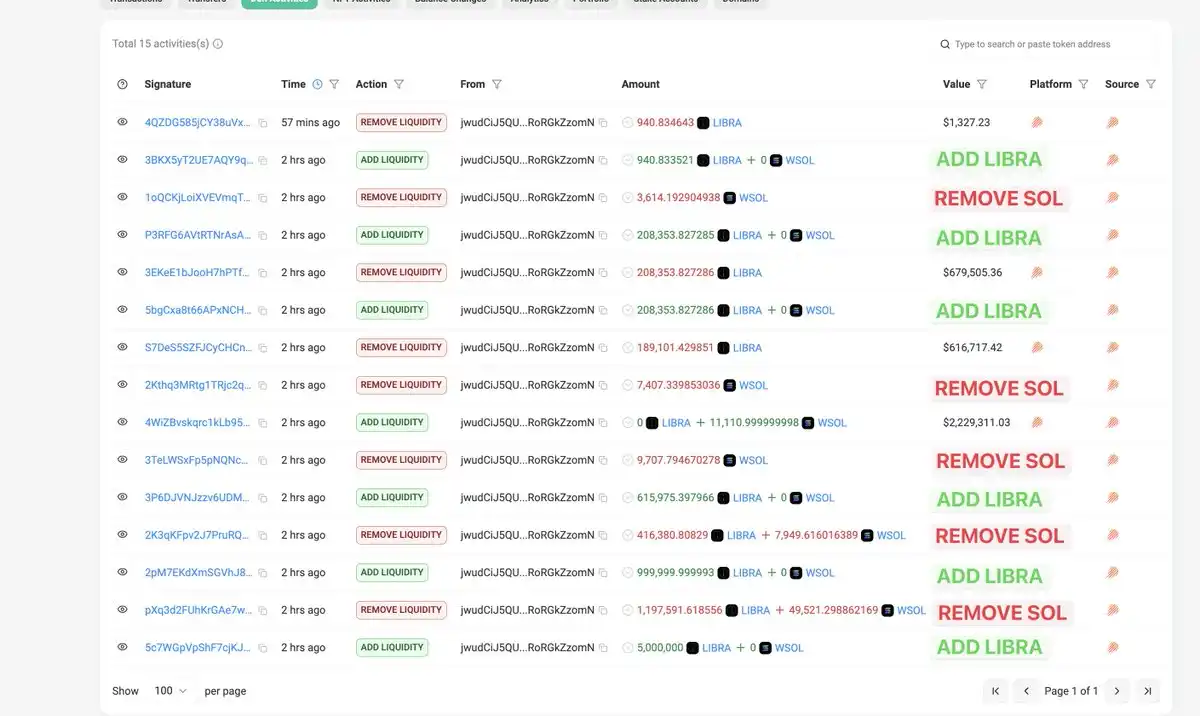
Image Source: Bublemaps
The operation of a one-sided pool is such that if only SOL is added, then when the price of SOL rises, it is equivalent to continuously selling SOL for USDC. If only USDC is added, it will continue to buy SOL as the price of SOL falls. Applying this logic to LIBRA, since the LIBRA pool only contains LIBRA without USDC or SOL, any purchase of LIBRA directly drives up the price because there is no sell-side liquidity, creating the illusion of "only going up, never down" in the early stages.
As the project team controlled the majority of the circulating LIBRA tokens in the early stages, they did not need to provide stablecoins or ETH as counterparties like platforms such as Uniswap. Instead, the project team simply placed buy orders for their LIBRA tokens at different price levels. Since there were almost no circulating sell orders in the market, these buy orders were continuously executed, further driving up the price and creating a false sense of prosperity.
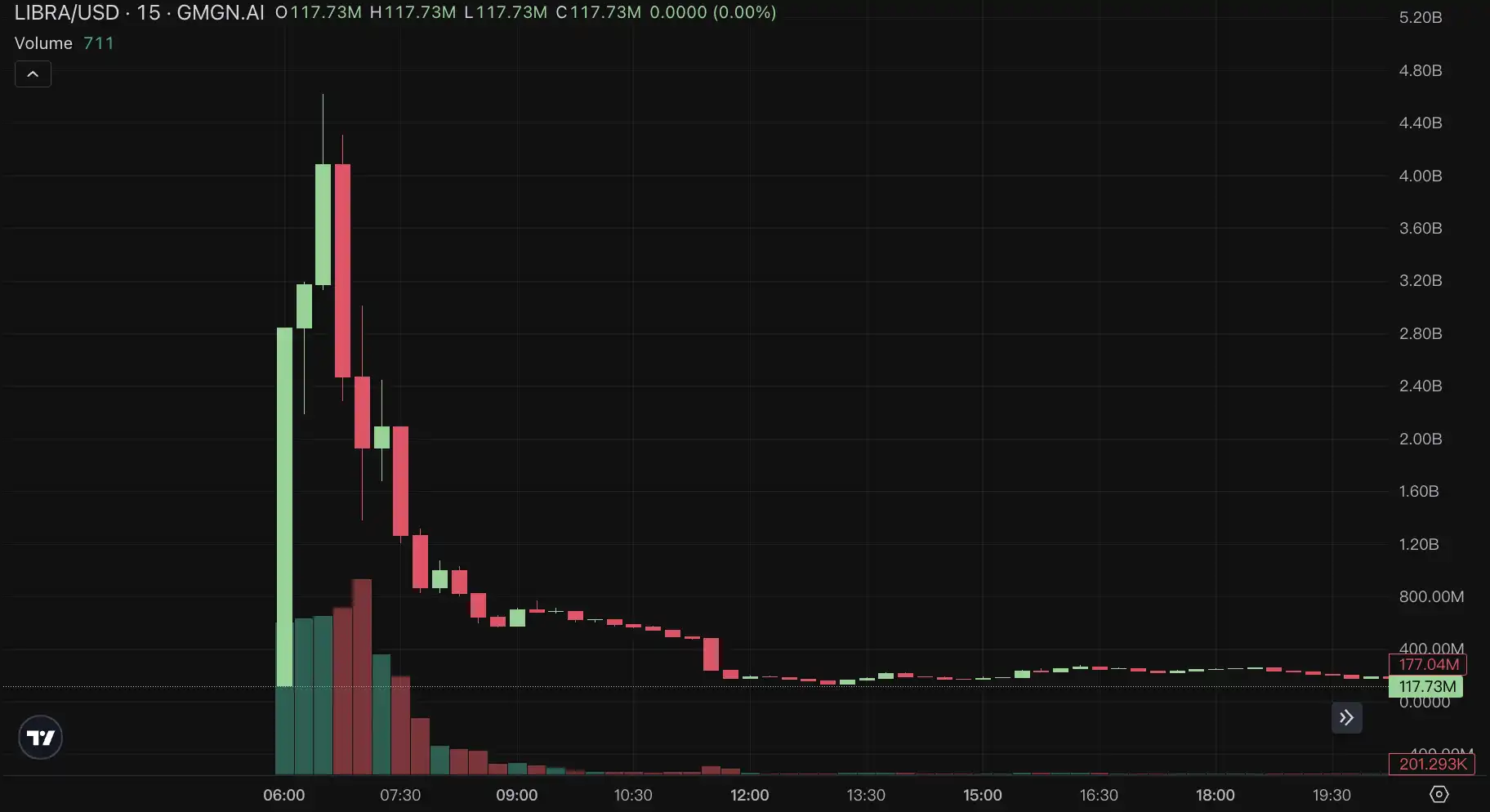
When a "false prosperity" attracts a large number of investors, driving the price up to a high level and with sufficient funds injected, the project team will start the next move — rug pulling. They will swiftly transfer the stablecoins or other assets that the previous investors used to purchase LIBRA to a predetermined collecting address. Due to the uniqueness of the one-sided liquidity pool, there are no assets available for redemption in the pool. At this point, investors are actually unable to sell LIBRA, and any new buy orders will only further drive up the price, which is already unsupported. The project team has also achieved its goal of offloading at this point.
In addition to price manipulation, the LIBRA project team also utilized the customized fee feature of the CLMM pool. In this way, they earned an additional amount of up to over ten to twenty million dollars in fees throughout the process, which is similar to the high fees of TRUMP at that time.
Furthermore, Mindao, the founder of the DeFi protocol dForce, analyzed that although Uniswap V3 also provides one-sided liquidity, its main purpose is to increase capital utilization and meet the needs of professional market makers. The key to LIBRA lies in its complex pool settings and high level of customization, which means that the original intention of its one-sided liquidity pool design was not to provide liquidity but to facilitate subsequent price manipulation and liquidity extraction.
Buyback Positivity Yet Fails to Break Through the Range
In August 2023, shortly after the TGE, the GambleFi platform Rollbit officially announced a change in the tokenomics, where 10% of Casino revenue, 20% of Sportsbook revenue, and 30% of the revenue from 1000x contracts would be used for daily buyback and burn of RLB. After this news was released, the token price surged due to the excitement, but just two months later, the token price began to decline continuously as community members gradually discovered a hidden "offloading" operation behind the scenes — the Rollbit team engaged in money laundering through the Rollbit Hot Wallet, and then sold the tokens to the market through an algorithm-controlled sell-off address.

Buyback is usually seen as a way for the project team to stabilize the market and increase the token price. Normally, the buyback funds should come from the project's profits or capital appreciation. However, if these funds come from the project team's "hot wallet" — an internal wallet used to store a large number of tokens or funds — then these funds are not external funds flowing into the market but funds that the project team already holds.
If the project team injects funds into the buyback market through their own hot wallet, in reality, these funds still belong to the project team itself. When the project team uses these funds to purchase tokens on the market, they may not actually be destroyed or disappear but return to the project team. Because the repurchased tokens may flow back through the project team's hot wallet to algorithm-controlled sell-off addresses under their control, they re-enter the market once again.

The token price continues to fall, and community members have questioned Rollbit's team for not providing transparency across different chains and markets
The "30% out, 10% buyback" approach is bound to fail to effectively boost the coin price and is instead another carefully orchestrated exit scam by the project team.
Spot Control, Contract Short Selling Frenzy
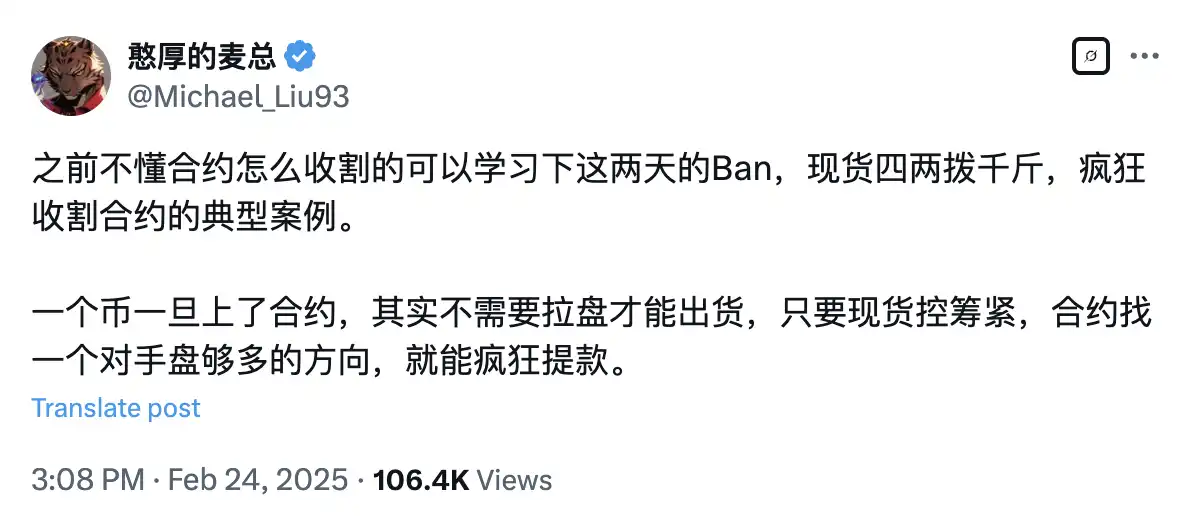
The "if you don't like it, you can short it" tactic has become the most successful intra-cycle trading method, despite the fact that most new coins now have exorbitant fee rates swinging wildly between the two extremes. Since the criticism of "VC coins," most secondary trading targets have initially experienced a few days of decline, followed by a quick surge, after which they enter a prolonged period of decline. Little do most know that this is also one of the exit strategies, with the key being to exploit the illiquidity of the futures market and the retail investors' FOMO (Fear Of Missing Out) psychology.
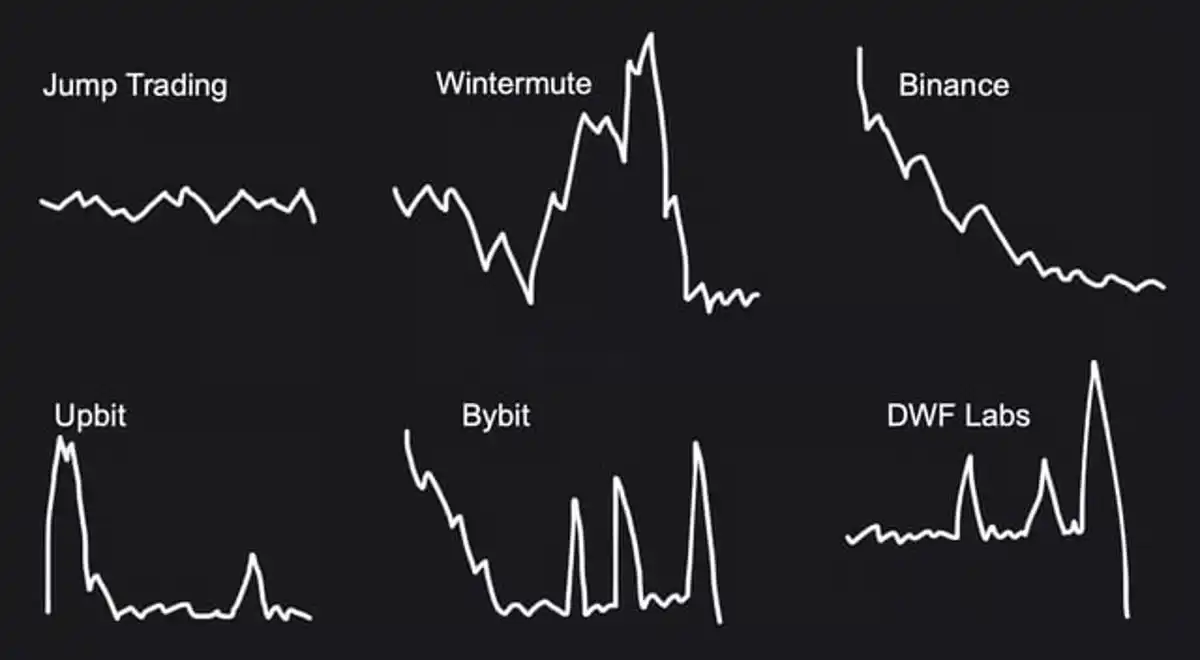
The entire process can be summarized into several stages: first, in the early stages of a new coin listing, market makers usually choose not to support the market, allowing early airdrop recipients to sell off, with the main goal of cleansing short-term speculators to make room for subsequent operations.
Subsequently, market makers begin preparing for a pump and exit strategy. Before this, they will try to control the spot chips as much as possible, reduce the circulating supply, ensure that the sell side cannot materially impact the price, and also limit the ability of short sellers to borrow coins. With spot chips firmly controlled, market makers can pump the price using relatively little capital, even triggering a short squeeze. When users choose to buy spot and open long contracts together, they accumulate enough buyers for the project team/market maker/institutional whales to start dumping in batches and begin another round of harvesting.
As the number of short positions in the market decreases and the price is pushed to a certain level, market makers begin to harvest liquidity in the futures market. By rapidly pumping the coin price, they attract retail investors to chase the rise, creating a false prosperity. This wave of pumping is usually substantial but generally does not exceed the opening price. Subsequently, the open interest in the futures market significantly increases, and the funding rate starts to turn negative, signaling that the market makers are establishing short positions.
Lastly, the operators gradually sell off in the spot market. Although the profits from this part are limited, more importantly, they have gained sufficient liquidity to exit by shorting in the futures market. Many retail investors have become long positions in the process of chasing the rise, becoming counterparties to the market makers' short positions. As market makers continue to increase short positions in the futures market and sell off in the spot market, the coin price begins to fall, causing a large number of long positions to be liquidated, thereby achieving a double harvest.
No Small Fish Can Play the Staking Game
Once upon a time, a token's staking launch was considered a bullish announcement in the project's development roadmap. The original intention was to incentivize users to participate in network maintenance, reduce market circulation by locking up tokens, and increase token scarcity. However, many project teams have used this mechanism as a cover to engage in exit scams.
Project teams attract investors to lock up a large amount of chips through high staking rewards, ostensibly aiming to stabilize the token price by reducing market circulation. However, the actual result is often that most of the circulating chips are trapped in the lockup and cannot be withdrawn promptly. In this process, the project team and the retail investors staking are in an asymmetric information environment, where, on the one hand, the team can freely exit the market, and on the other hand, even if the project team or whales choose to stake, they will still receive high staking rewards and continue to dump the price.
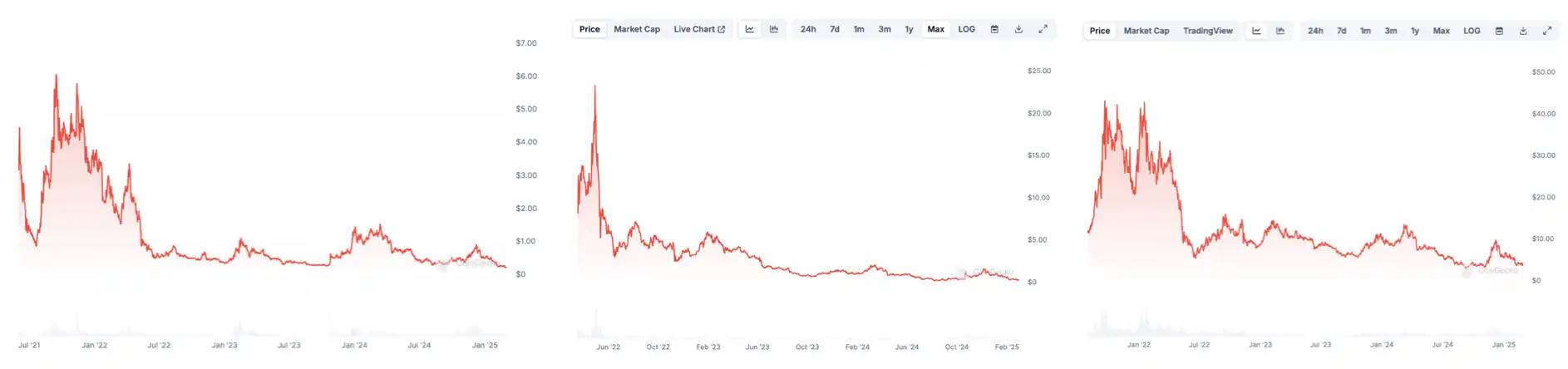
Furthermore, another scenario is when the staking period ends, and investors panic-sell the token, the project team absorbs chips at a low price. Then, when the market sentiment stabilizes and the price rebounds, they cash out. At this point, investors rush in as the price rises, but the main players have already completed their exit strategy, leaving behind the bagholders who bought high.
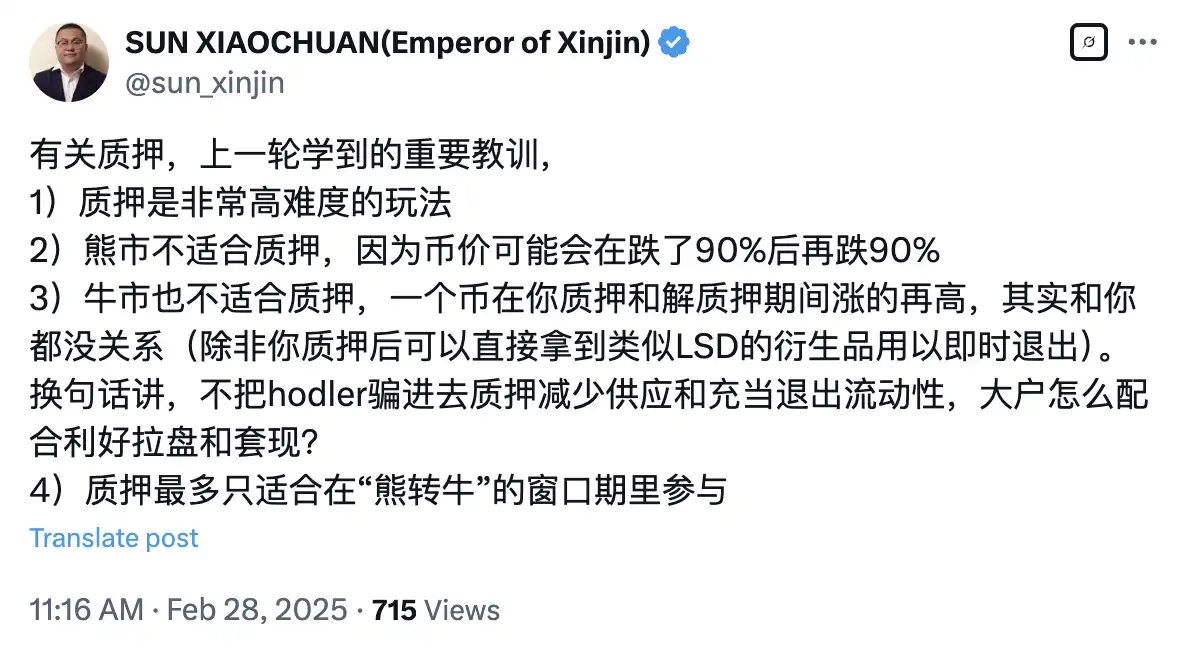
Looking at the various exit strategies above, they all boil down to precise control and manipulation of market expectations and investor psychology. To survive in the unpredictable market, retail investors need to have the mentality of an institution. The so-called "institutional mentality" does not mean manipulating the market like an institution but rather having the ability to think independently, not be swayed by market sentiment, predict risks in advance, and formulate corresponding strategies.
The market amplifies emotions, and only by staying calm and rational can one avoid being harvested. Next time you hear terms like "buyback," "staking," or "single-sided pool," it's worth being extra cautious, as you may be able to avoid the "traps" carefully laid out by the project teams. Feel free to share in the comments section other exit strategies you are aware of!
Reference Links:
https://x.com/MasonCanoe/status/1891364478572462296
https://x.com/kylopeung/status/1891063885911716341
https://x.com/Michael_Liu93/status/1830425923403059603
You may also like

In the name of charity, for the benefit of the family: How the Trump family turned charity into profit?

Will Gold Break $4,500 After Tonight's Fed Decision? What XAUT and PAXG Traders Need to Know

Cursor, why did you get on Musk's spaceship?

Morning Report | DeepSeek completes over $7 billion in financing, with a valuation exceeding $50 billion; Musk's personal wealth has surpassed the total market value of Bitcoin

SharpLink CEO: How to understand that Ethereum developers have just surpassed 1 million?

Morning Report | MiCA grace period expires on July 1; Kalshi's trading volume in the first week of the World Cup breaks $5.1 billion, setting a record

The foundation of SpaceX's trillion-dollar valuation: Who is dividing Musk's annual capital expenditure of tens of billions?

How to exit after asset tokenization?

The stablecoin positioning battle escalates: When compliance is just a ticket to entry, will USD1 become the biggest winner?

A16Z: The sun bears witness, SpaceX is worth 7.5 trillion
Mergers and acquisitions in the cryptocurrency market are exceptionally active

Concerns Behind the Binance Customer Service Controversy

SpaceX Stock Prediction After the IPO: Can SPCX Reach $200 Before QQQ Inclusion?

Congratulations to Carl Moon on His Historic Ferrari Challenge Le Mans Podium Triumph
Crypto influencer and racing enthusiast Carl Moon finished third in the Ferrari Challenge Le Mans Coppa Shell class, marking his best result of the year. As his racing partner and sponsor, WEEX celebrates this remarkable achievement and continues to lead crypto’s journey beyond boundaries, uniting the innovation of digital assets with the passion of motorsport.
Can the CLARITY Act Become Law by July 4? Everything You Need to Know About the Final Battle

France vs Senegal World Cup 2026: Mbappe’s New Era Begins Against a Historic Rival
What is the connection between Huang Zheng of Pinduoduo and blockchain?

Morning Report | Prediction market platforms like Kalshi and Polymarket jointly sue Kentucky over 14.25% trading tax; Bridgewater founder discusses decision-making in the AI era: principled thinking should run parallel to AI, human insight remains irre...
In the name of charity, for the benefit of the family: How the Trump family turned charity into profit?
Will Gold Break $4,500 After Tonight's Fed Decision? What XAUT and PAXG Traders Need to Know
Cursor, why did you get on Musk's spaceship?
Morning Report | DeepSeek completes over $7 billion in financing, with a valuation exceeding $50 billion; Musk's personal wealth has surpassed the total market value of Bitcoin
SharpLink CEO: How to understand that Ethereum developers have just surpassed 1 million?
Morning Report | MiCA grace period expires on July 1; Kalshi's trading volume in the first week of the World Cup breaks $5.1 billion, setting a record


