
 Buy Crypto
- Markets
 Futures
- Spot
- Copy Trade
- Earn
- More
Historical Perspective: The 12 Months Post-Election Are Typically the Golden Period of a Crypto Bull Market

Original Article Title: Republican Victory Ushers in a New Era for Crypto
Original Article Author: Kelvin Koh, Spartan Group
Original Article Translation: Fu Ruhe, Odaily Planet Daily
The 2024 U.S. presidential election has become one of the most watched elections in recent years. Despite widespread expectations of a fiercely contested election, the election results still took many by surprise. Not only did Trump convincingly win the presidential election, but the Republican Party also secured a majority in both the Senate and the House. Such a sweeping victory will give the Republican Party enough political leverage to drive multiple reforms in the coming years. The cryptocurrency field is expected to undergo significant changes, and we believe the next 12 months will be a bullish period for crypto assets.
One key difference in the 2024 election compared to the past is the emergence of a "crypto agenda," with the winning president and his core advisory team holding a crypto-friendly stance. Crypto companies strongly supported Trump and key Republican candidates through donations. Therefore, it is not surprising that the crypto industry has become one of the major beneficiaries of the Republican Party's resounding victory.
There has been much discussion about the significance of this election for the crypto industry, but here are some of the key impacts:
· Changes in SEC Policy. Under Gary Gensler's leadership, the SEC and other appointed officials of the Biden administration have implemented aggressive regulation on the crypto industry. Despite industry calls for regulatory guidance, the SEC has continued to pursue enforcement actions. During Gensler's tenure, over 2,700 enforcement actions were initiated, resulting in total fines of up to $210 billion. This has made it difficult for many projects to operate in the U.S. Trump clearly stated during his campaign that if elected, he would replace Gensler. As expected, last week Gensler announced that he would step down as SEC chairman on January 20, 2025. Several nominees have already been named to succeed him, and they are generally seen as more supportive of the crypto industry. This means that existing enforcement actions may be reversed, and the SEC will adopt a more cooperative regulatory approach.
· Improvement in Congressional Environment. In the past, a major challenge facing the crypto industry was the difficulty of passing any favorable bills in the U.S. Congress, as most lawmakers lacked an understanding of cryptocurrency. However, after this election, about two-thirds of Congress members are considered crypto-friendly. This could lead to a regulatory framework that supports innovation, making it easier for projects to raise funds and clearing obstacles for institutional capital to enter the crypto space.
· Proposal for a Strategic Bitcoin Reserve. During his campaign, Trump mentioned to his crypto supporters that if elected, he would push for the establishment of a Strategic Bitcoin Reserve instead of having the U.S. government continue to dispose of previously seized bitcoins. This proposal quickly gained attention after the election. If this proposal were to be implemented, the market would start speculating whether this means the U.S. government would become a net buyer rather than a seller of Bitcoin. If MicroStrategy alone can influence the price of Bitcoin, imagine the impact of the U.S. government establishing a Strategic Bitcoin Reserve. More importantly, how would other countries react to this? Would they also come up with similar plans?
· Support for DeFi. Even before the election, a team supported by Trump had launched World Liberty Financial in September 2024, aiming to provide decentralized lending services and governance through the native token WLF. The project has raised over $50 million to date, with the latest investment coming from crypto entrepreneur Justin Sun, who invested $30 million this week. WLF plans to raise a total of $300 million. Whether it reaches $300 million or $50 million, the significance of this project goes far beyond the amount raised—it has provided a huge boost to DeFi developers and innovators. Importantly, a DeFi project supported by the incoming U.S. president will have a profound impact on the entire industry.
Each of the above events alone is enough to have a significant driving force on the crypto market, and the combined impact of these events on the crypto industry is profound. The market has not yet fully reflected the potential impact of these changes, which is why the U.S. media refers to this period as the "golden age of crypto."
In addition to all of the above, Trump has also expressed his desire for the U.S. to become the "global capital of crypto." To some extent, the U.S. is already the de facto leading crypto nation. Many major infrastructure projects, some of the largest blockchain infrastructure companies, and decentralized applications originated in the U.S. The U.S. also has the world's largest licensed cryptocurrency exchanges, the largest crypto investment banks, and the largest Web3 venture capital pool. Furthermore, the U.S. controls around 40% of the global Bitcoin mining hash rate (compared to 17% in 2021), making it the largest center for Bitcoin mining, partly due to policy changes in China. Most of the world's crypto trading is also denominated in dollars, and major stablecoins are pegged to the dollar. Therefore, the U.S. is already a global crypto hub in many ways. However, if the U.S. government plans to consolidate or further expand its dominance, what does this mean for other governments, especially major financial centers like London, Tokyo, Dubai, and Hong Kong? More importantly, can Europe afford to miss out on the Web3 innovation era and once again lag behind after the Web2 era?
Some people may question whether Trump will actually fulfill these promises, but I believe the likelihood of fulfillment is high. Trump does not follow traditional rules, and the political leverage brought by this election victory is very strong. Additionally, Trump has two native cryptocurrency advisors—Elon Musk and JD Vance. The new Secretary of Commerce, Howard Lutnick, also serves as the Chairman and CEO of Cantor Fitzgerald, which has just acquired a 5% stake in Tether (the issuer of the world's largest stablecoin USDT). With a more crypto-friendly Congress, pushing forward these measures should not be difficult.
Historical Data: Strong Cryptocurrency Price Performance in the 12 Months Following the U.S. Election, Altcoins Outperform Bitcoin
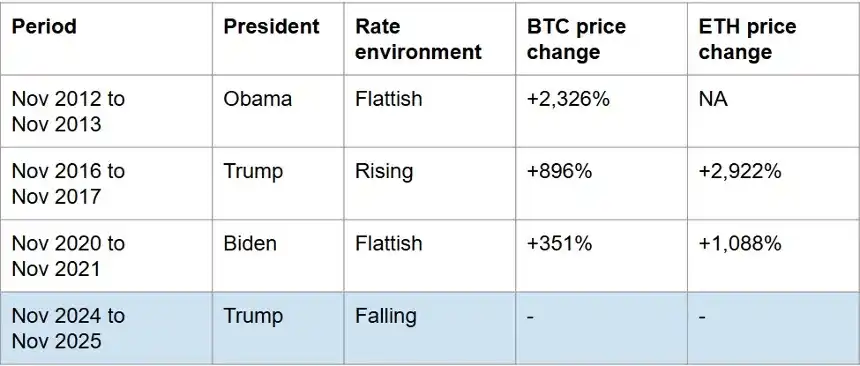
Against this background, discussing the impact of all this on cryptocurrency asset prices becomes particularly important. As seen in the table below, historically, the 12 months following a U.S. election have typically been a period of strong cryptocurrency price performance.
There are two main observations here:
· Regardless of who wins the presidential election and the interest rate environment, cryptocurrency assets have performed very well in the 12 months following the U.S. election. We attribute this to two factors:
a) Clarity brought by the election results and optimism about the new government;
b) The continued momentum of the Bitcoin halving cycle/cryptocurrency cycle.
· In the 12 months following the last two elections, altcoins (represented by ETH) have returned about three times as much as Bitcoin.
30 days after the 2024 election, Bitcoin rose by 46%, and Ethereum rose by 58%. We believe there is still significant upside potential in the next 11 months.
To better understand the opportunity with altcoins, let's look at the chart below, which shows the performance of altcoins relative to Bitcoin. It can be seen that there are stages within the cycle where altcoins significantly outperform Bitcoin. We refer to these stages as "altcoin cycles" or "altcoin seasons." The most recent major altcoin cycle occurred in January 2021 and peaked in November 2021. The previous cycle started in February 2017 and peaked in January 2018.

It is worth noting that these altcoin cycles roughly overlap with the 12-month period following the election. We believe the main reason is the strong price performance in the initial weeks after the election and the shift in investor sentiment towards risk appetite. Additionally, this trend has also attracted retail funds into the cryptocurrency asset class, with retail funds often preferring smaller and mid-sized tokens with higher risk due to the lack of liquidity constraints from institutional investors. Furthermore, at this point in the cycle, altcoins tend to underperform, making their risk-return profile more attractive compared to large-cap tokens. This is also the case in this cycle.
If this historical relationship holds, then we should expect the altcoin season to be imminent.
You may also like

Cyber Taoist Fortune Teller: Fake Taoist, AI Fortune Telling, and Northeastern Metaphysics History

Bloomberg: Stablecoin Payments Emerge as Crypto VC's Newest Favorite Thing
BeatSwap is evolving towards a full-stack Web3 infrastructure, covering the entire lifecycle of IP rights.
BeatSwap, a global Web3 Intellectual Property (IP) infrastructure project, is attempting to overcome the current fragmentation limitations of the Web3 ecosystem, building a full-stack system that covers the entire lifecycle of IP rights.
Currently, most Web3 projects are still in the stage of functional fragmentation, often focusing only on a single aspect, such as IP asset tokenization, transaction functionality, or a simple incentive model. This structural dispersion has become a key bottleneck hindering the industry's scale application.
BeatSwap's approach is more integrated, integrating multiple core modules into the same system, including:
· IP authentication and on-chain registration
· Authorization-based revenue sharing mechanism
· User-engagement-driven incentive system
· Transaction and liquidity infrastructure
Through the above integration, the platform builds an end-to-end closed-loop path, allowing IP rights to complete a full cycle of "creation, use, and monetization" within the same ecosystem.
BeatSwap is not limited to existing crypto users but is attempting to take the global music industry as a starting point, actively creating new market demand. Its core strategies include:
Exploring and incubating music creators (Artist discovery)
Building a fan community
Igniting IP-centric content consumption demand
The current global music industry is valued at around $260 billion, with over 2 billion digital music users. This means that the potential market corresponding to the tokenization and financialization of IP far exceeds the traditional crypto user base.
In this context, BeatSwap positions itself at the intersection of "real-world content demand" and "on-chain infrastructure," attempting to bridge the structural gap between content production and financial flow.
BeatSwap's upcoming core product "Space" is scheduled to launch in the second quarter of 2026. This product is defined as the SocialFi layer in the ecosystem, aiming to directly connect creators with users and achieve deep integration with other platform modules.
Key designs include:
A fan-centric interactive mechanism
Exposure and distribution logic based on $BTX staking
User paths connected to DeFi and liquidity structures
Thus, a complete user behavior loop is formed within the platform: Discovery → Participation → Consumption → Rewards → Trading
$BTX is designed to be a core utility asset within the ecosystem, rather than just a simple incentive token, with its value directly tied to platform activity and IP use cases.
Main features include:
· Yield distribution based on on-chain authorized actions
· Value reflection based on IP usage and user engagement dynamics
· Support for staking and DeFi participation mechanisms
· Value growth driven by ecosystem expansion
With the increased frequency of IP use, the utility and value support of $BTX will enhance simultaneously, helping alleviate the "disconnect between value and utility" issue present in traditional Web3 token models to some extent.
Currently, $BTX has been listed on several mainstream exchanges, including:
Binance Alpha
Gate
MEXC
OKX Boost
As the launch of "Space" approaches, BeatSwap is actively pursuing more exchange listings to further enhance liquidity and global accessibility, laying a foundation for future market expansion.
BeatSwap's goal is no longer limited to the traditional Web3 narrative but aims to target over 2 billion digital music users and a trillion KRW-scale content market.
By integrating content creators, users, capital, and liquidity into a blockchain framework centered around IP rights, BeatSwap is striving to build a next-generation infrastructure focused on "IP tokenization."
BeatSwap integrates IP authentication, authorization distribution, incentive mechanism, transaction system, and market construction to establish a unified structure that bridges the full lifecycle path of IP rights.
With the launch of the Q2 2026 "Space," the project is expected to become a key infrastructure connecting content and finance in the IP-RWA (Real World Assets) track.

Mag 7 Evaporates $2 Trillion | Rewire News Morning Edition

Losing $19K per Coin Mined, Bitcoin Mining Firms Collective AI Defection

Morning Report | Tom Lee predicts that the cryptocurrency winter will end in April; xStocks introduces a new on-chain private equity fund; Sui mainnet upgraded to V1.68.1

Polymarket rules have changed, how should airdrop participants respond?

Crypto ETF Weekly | Last week, the net outflow of Bitcoin spot ETFs in the U.S. was $296 million; the net outflow of Ethereum spot ETFs in the U.S. was $206 million

This Week's Key News Preview | The U.S. Releases March Non-Farm Payroll Data; Polymarket Expands Fee Structure

Slow Down, That's the Answer to the Age of the Agent

From Cash to Cryptocurrency: Moving Towards a Unified Regulatory Path for Illegal Payments
Who will own the most Bitcoin in 2026

A private feud lasting 10 years, if not for OpenAI's "hypocrisy," would not have led to the world's strongest AI company, Anthropic

"Crypto Tsar" steps down: 130 days of political performance come to an end, how much of Trump's crypto promise remains?

From Utopian Narratives to Financial Infrastructure: The "Disenchantment" and Shift of Crypto VC
A decade-long personal feud, if not for OpenAI's "hypocrisy," there would be no globally leading AI company Anthropic

a16z: The True Meaning of Strong Chain Quality, Block Space Should Not Be Monopolized
a16z: The True Meaning of Strong Chain Quality, Block Space Should Not Be Monopolized
Cyber Taoist Fortune Teller: Fake Taoist, AI Fortune Telling, and Northeastern Metaphysics History
Bloomberg: Stablecoin Payments Emerge as Crypto VC's Newest Favorite Thing
BeatSwap is evolving towards a full-stack Web3 infrastructure, covering the entire lifecycle of IP rights.
BeatSwap, a global Web3 Intellectual Property (IP) infrastructure project, is attempting to overcome the current fragmentation limitations of the Web3 ecosystem, building a full-stack system that covers the entire lifecycle of IP rights.
Currently, most Web3 projects are still in the stage of functional fragmentation, often focusing only on a single aspect, such as IP asset tokenization, transaction functionality, or a simple incentive model. This structural dispersion has become a key bottleneck hindering the industry's scale application.
BeatSwap's approach is more integrated, integrating multiple core modules into the same system, including:
· IP authentication and on-chain registration
· Authorization-based revenue sharing mechanism
· User-engagement-driven incentive system
· Transaction and liquidity infrastructure
Through the above integration, the platform builds an end-to-end closed-loop path, allowing IP rights to complete a full cycle of "creation, use, and monetization" within the same ecosystem.
BeatSwap is not limited to existing crypto users but is attempting to take the global music industry as a starting point, actively creating new market demand. Its core strategies include:
Exploring and incubating music creators (Artist discovery)
Building a fan community
Igniting IP-centric content consumption demand
The current global music industry is valued at around $260 billion, with over 2 billion digital music users. This means that the potential market corresponding to the tokenization and financialization of IP far exceeds the traditional crypto user base.
In this context, BeatSwap positions itself at the intersection of "real-world content demand" and "on-chain infrastructure," attempting to bridge the structural gap between content production and financial flow.
BeatSwap's upcoming core product "Space" is scheduled to launch in the second quarter of 2026. This product is defined as the SocialFi layer in the ecosystem, aiming to directly connect creators with users and achieve deep integration with other platform modules.
Key designs include:
A fan-centric interactive mechanism
Exposure and distribution logic based on $BTX staking
User paths connected to DeFi and liquidity structures
Thus, a complete user behavior loop is formed within the platform: Discovery → Participation → Consumption → Rewards → Trading
$BTX is designed to be a core utility asset within the ecosystem, rather than just a simple incentive token, with its value directly tied to platform activity and IP use cases.
Main features include:
· Yield distribution based on on-chain authorized actions
· Value reflection based on IP usage and user engagement dynamics
· Support for staking and DeFi participation mechanisms
· Value growth driven by ecosystem expansion
With the increased frequency of IP use, the utility and value support of $BTX will enhance simultaneously, helping alleviate the "disconnect between value and utility" issue present in traditional Web3 token models to some extent.
Currently, $BTX has been listed on several mainstream exchanges, including:
Binance Alpha
Gate
MEXC
OKX Boost
As the launch of "Space" approaches, BeatSwap is actively pursuing more exchange listings to further enhance liquidity and global accessibility, laying a foundation for future market expansion.
BeatSwap's goal is no longer limited to the traditional Web3 narrative but aims to target over 2 billion digital music users and a trillion KRW-scale content market.
By integrating content creators, users, capital, and liquidity into a blockchain framework centered around IP rights, BeatSwap is striving to build a next-generation infrastructure focused on "IP tokenization."
BeatSwap integrates IP authentication, authorization distribution, incentive mechanism, transaction system, and market construction to establish a unified structure that bridges the full lifecycle path of IP rights.
With the launch of the Q2 2026 "Space," the project is expected to become a key infrastructure connecting content and finance in the IP-RWA (Real World Assets) track.


 App
App