
- Buy Crypto
- Markets
 Futures
- Spot
- Copy Trade
- Earn
- More
Hedged Market Shrouded in Fear: Bitcoin May Need Extended Consolidation

Original Article Title: A Market Hedged in Fear
Original Article Authors: Chris Beamish, CryptoVizArt, Antoine Colpaert, Glassnode
Original Article Translation: AididiaoJP, Foresight News
Bitcoin trading below a key short-term holder cost basis indicates exhausted demand and waning momentum. Long-term holders are selling into market strength, while the options market shifts to a defensive posture with increasing demand for put options and heightened volatility, signaling a cautious phase before any sustainable recovery.
Abstract
· Bitcoin trading below short-term holder cost basis indicates waning momentum and exacerbated market fatigue. Multiple failures to reclaim have increased the risk of entering a more prolonged consolidation phase.
· Long-term holders have accelerated selling since July, now disposing of over 22,000 BTC daily, signaling continued profit-taking putting pressure on market stability.
· Open interest has reached an all-time high, but market sentiment leans bearish as traders prefer put options over call options. Short-term bounces are met with hedging activity rather than new optimism.
· Implied volatility remains elevated, and realized volatility has caught up, ending a period of calm low volatility. Market makers' short positions have amplified selling and suppressed rebounds.
· Both on-chain and options data indicate the market is in a cautious transition phase. Market recovery may hinge on the emergence of new spot demand and a moderation in volatility.
· Bitcoin has gradually retraced from its recent highs, stabilizing below the short-term holder cost basis of around $113,000. Historically, this structure often heralds the start of a mid-term bearish phase as weaker holders begin to capitulate.
· In this issue, we assess the current state of market profitability, examine the scale and sustainability of long-term holder spending, and finally determine whether this pullback is a healthy consolidation or a sign of deeper weakness to come by evaluating sentiment in the options market.
On-chain Insights
Testing Conviction
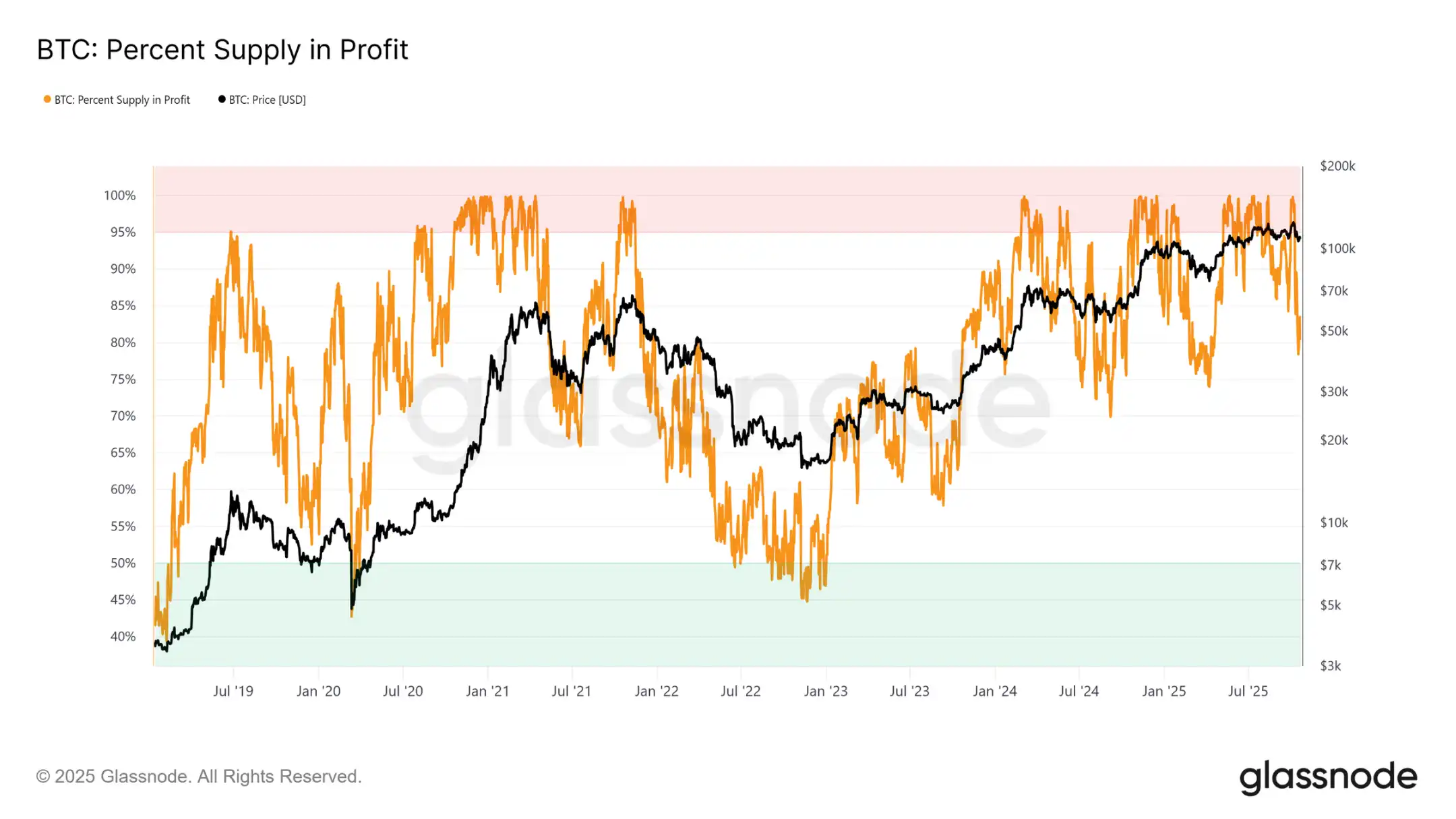
Trading near the short-term holder cost basis signifies a crucial stage where the market tests the conviction of investors who bought near recent highs. Historically, breaking below this level after setting new all-time highs has led to a decline in profit-supply percentage to around 85%, meaning over 15% of the supply is in a loss position.
We are now witnessing this pattern for the third time in the current cycle. If Bitcoin fails to reclaim the key level around $113.1K, a deeper retracement could flush out a larger portion of the supply, intensify selling pressure from recent buyers, and potentially set the stage for a broader market capitulation.
Key Threshold
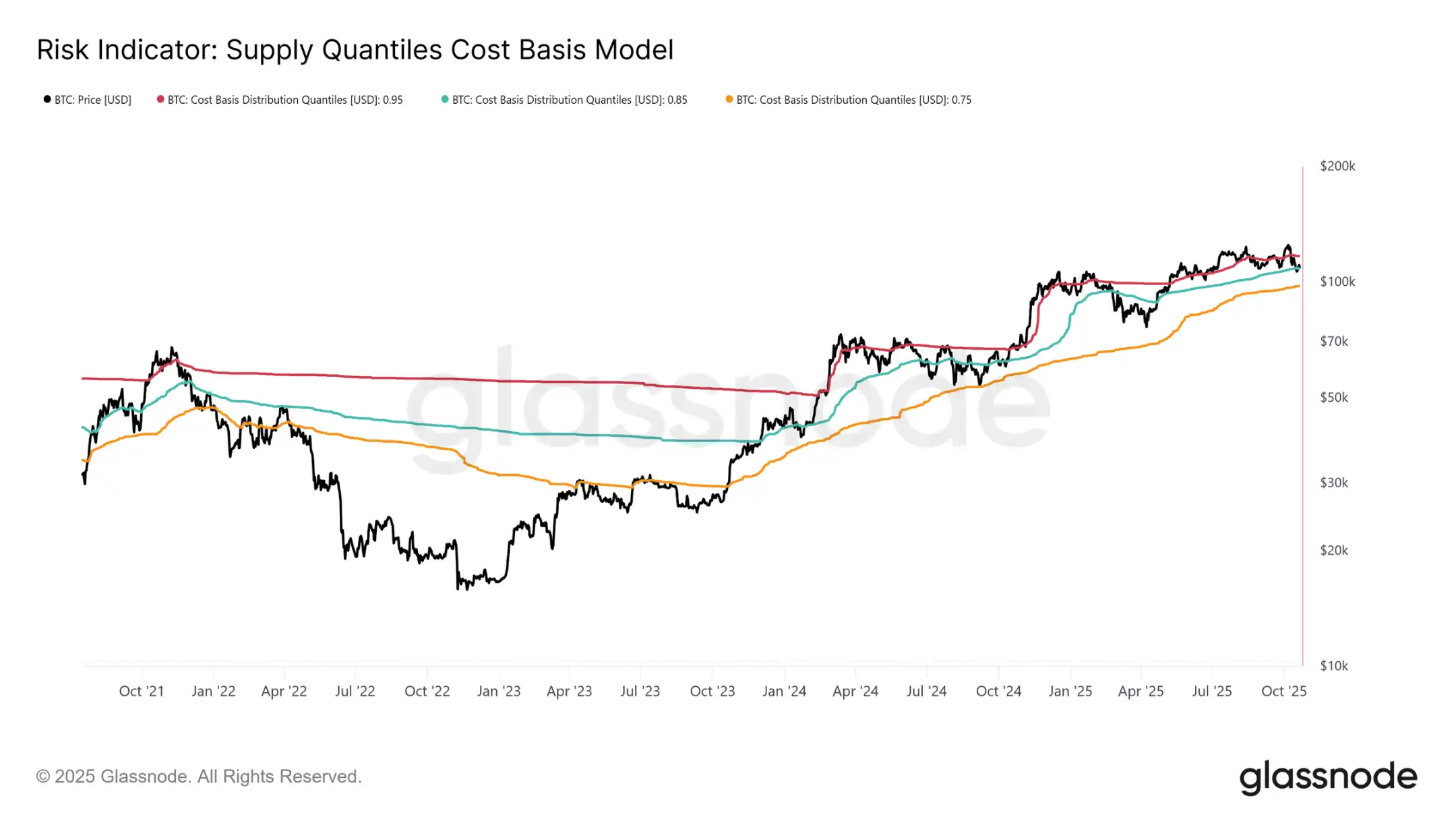
To further grasp this structure, understanding why reclaiming the short-term holder cost basis is crucial for sustaining the bullish phase is key. The supply percentile cost basis model, mapping the 0.95, 0.85, and 0.75 percentiles, provides a clear framework indicating that 5%, 15%, and 25% of the supply is at a loss, respectively.
Currently, Bitcoin is not only trading below the short-term holder cost basis ($113.1K) but also struggling to stay above the 0.85 percentile at $108.6K. Historically, failing to hold this threshold signals a weakened market structure and typically foreshadows a deeper pullback towards the 0.75 percentile, currently around $97.5K.
Depletion of Demand
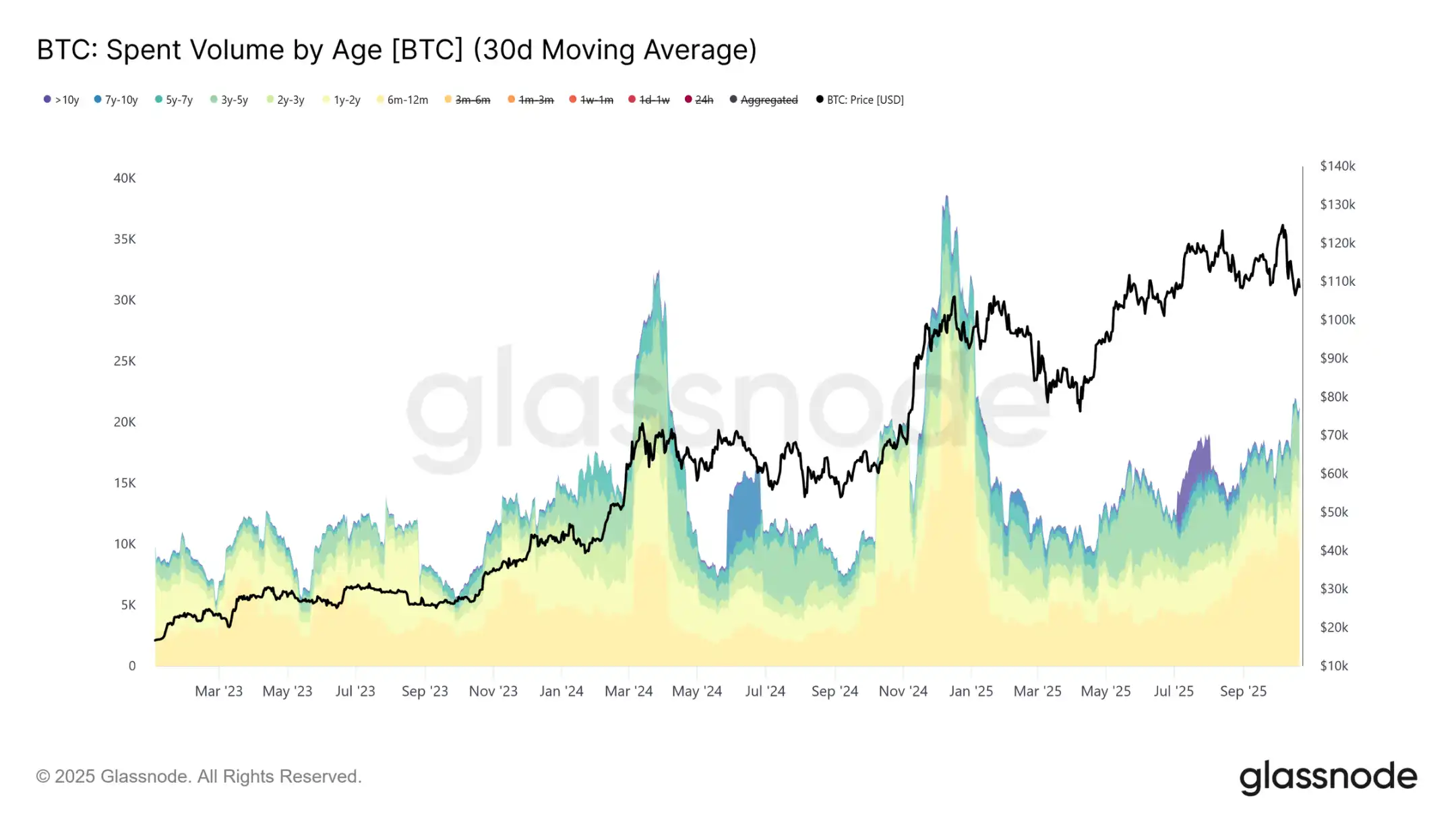
The third retracement to the short-term holder cost basis and below the 0.85 percentile in this cycle has sparked structural concerns. From a macro perspective, repeated depletion of demand suggests the market may need a more extended consolidation phase to regain strength.
Examining the spending behavior of long-term holders makes this depletion even clearer. Since the market peak in July 2025, long-term holders have steadily increased their spending, with the 30-day simple moving average rising from a baseline of 10,000 BTC to over 22,000 BTC daily. Such sustained distribution indicates that experienced investors are facing profit-taking pressure, a key factor in the current market vulnerability.
Having assessed the risk of a prolonged bearish phase resulting from demand depletion, we now turn to the options market to gauge short-term sentiment and observe how speculators are positioning amid rising uncertainty.
On-Chain Insights
Rising Open Interest in Futures
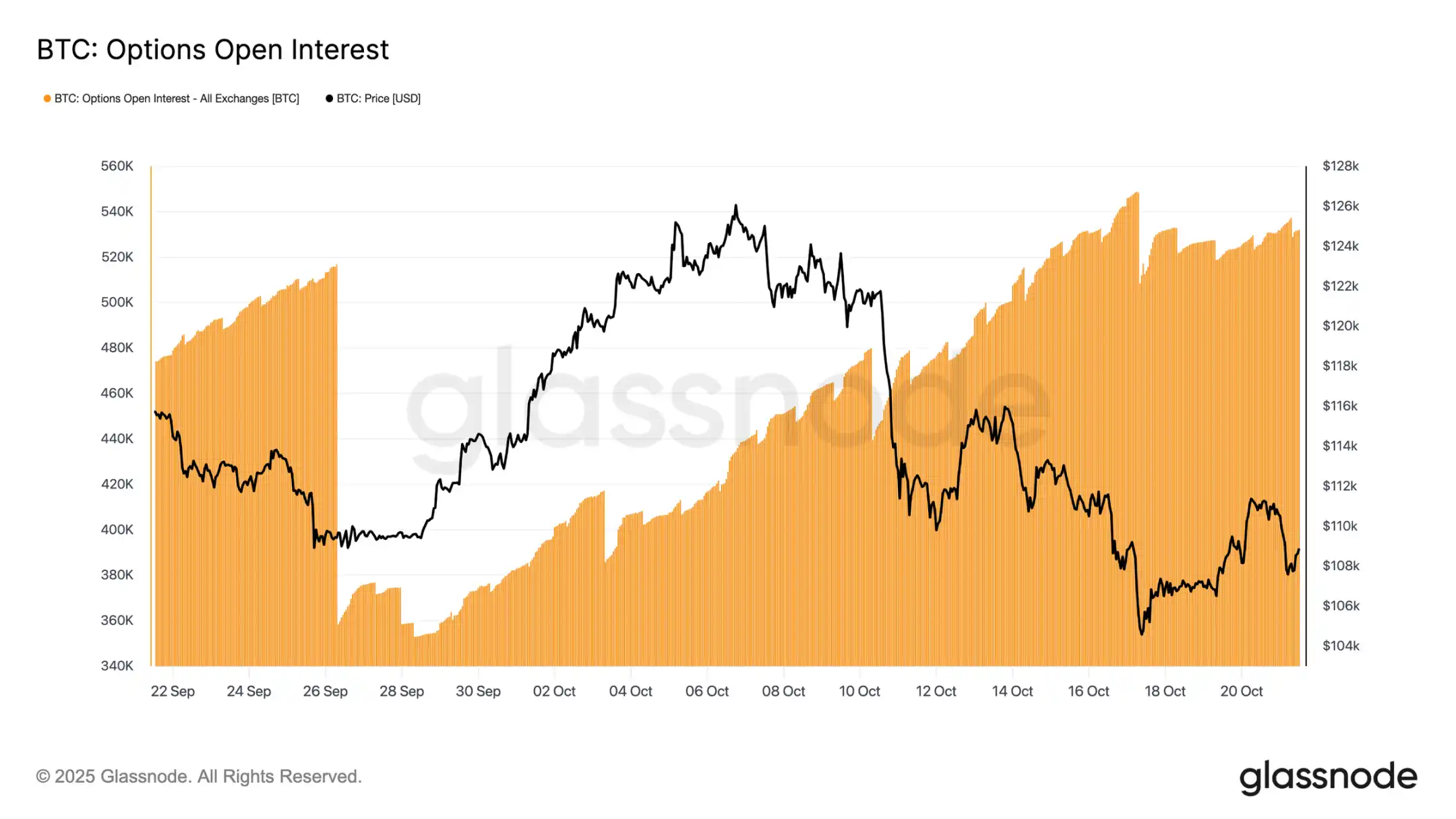
Bitcoin futures' open interest has reached a new all-time high and continues to expand, signaling a structural evolution in market behavior. Investors are increasingly using futures to hedge risk exposure or speculate on volatility rather than selling spot. This shift reduces direct selling pressure in the spot market but amplifies short-term volatility driven by market maker hedging activities.
With the growth of open interest in futures contracts, price volatility is more likely to be driven by funding flows in the futures and perpetual contract markets, led by Delta and Gamma. Understanding these dynamics is becoming increasingly important, as options positions now play a dominant role in shaping short-term market trends and amplifying reactions to macro and on-chain catalysts.
Volatility Regime Shift
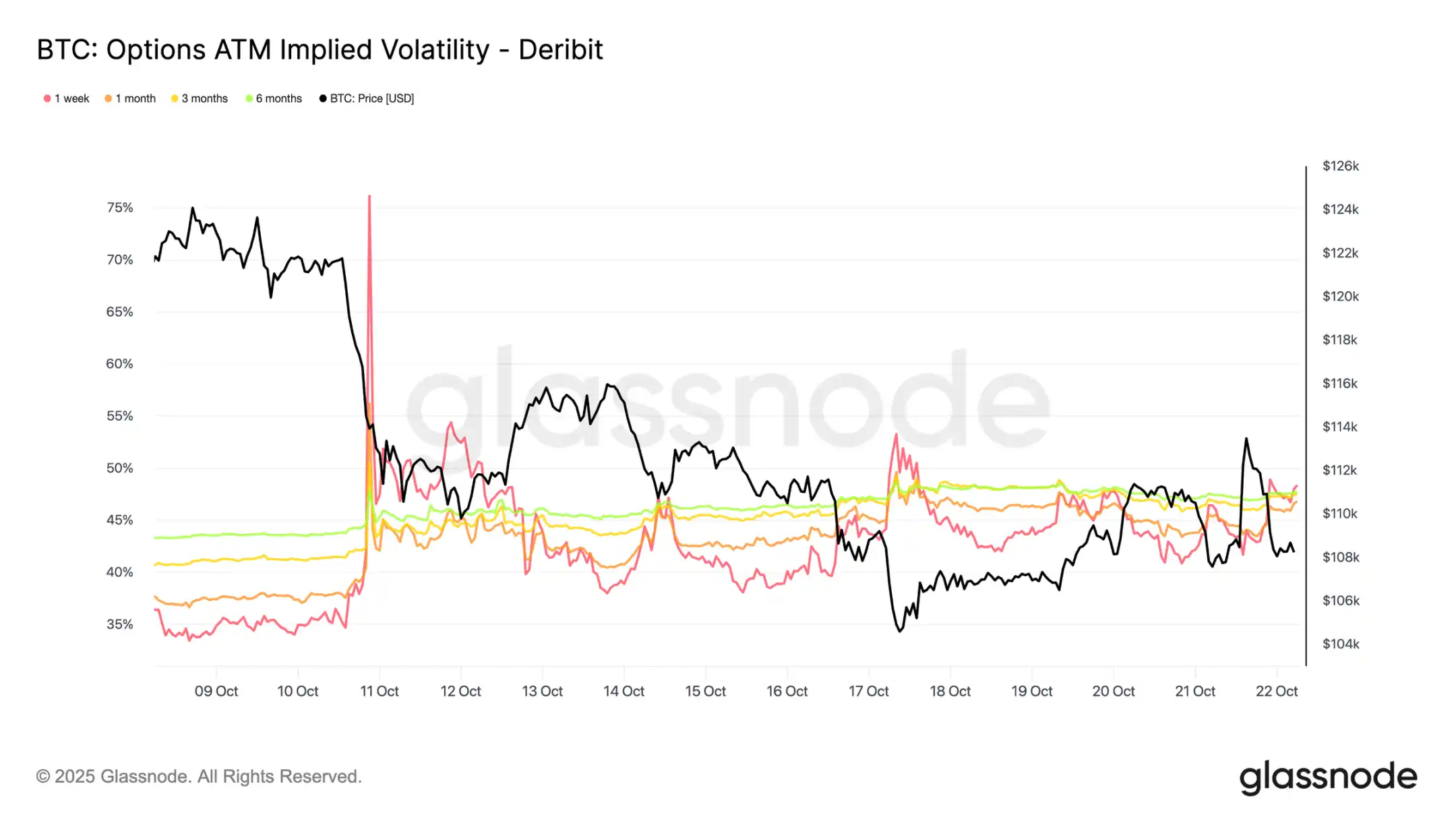
Since the liquidation event on the 10th, the volatility pattern has undergone a significant change. Implied volatility is now around 48 across all maturities, up from 36-43 just two weeks ago. The market has not fully absorbed this shock yet, and market makers are cautious, not selling volatility cheaply.
The 30-day realized volatility is at 44.1%, while the 10-day realized volatility is at 27.9%. As the realized volatility gradually cools off, we can expect the implied volatility to follow suit and normalize in the coming weeks. For now, the volatility remains elevated, but it appears more like a short-term repricing rather than the start of a sustained high-volatility regime.
Increased Put Option Demand
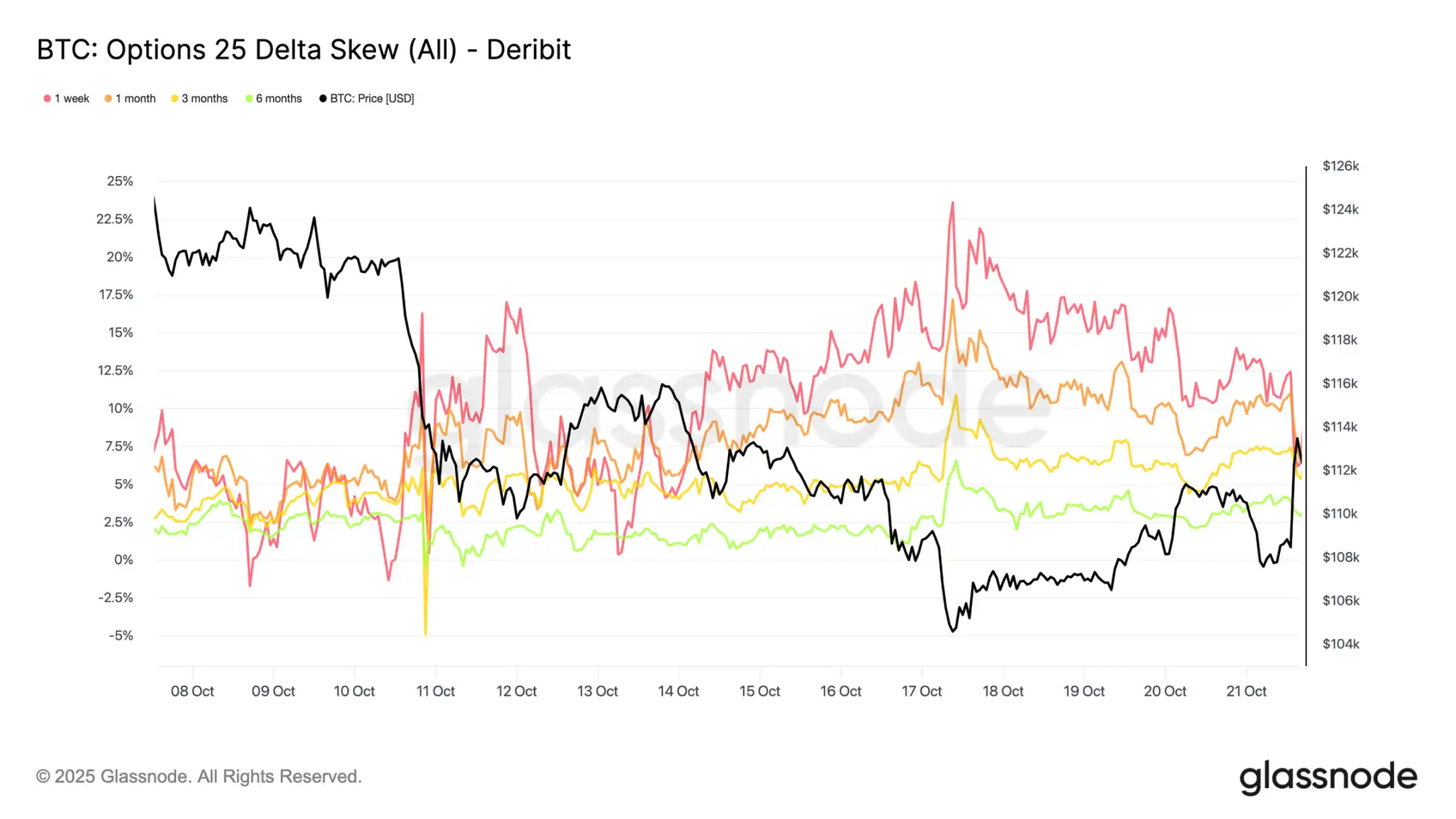
In the past two weeks, demand for put options has steadily risen. The surge in large-scale liquidations has driven a sharp increase in put option skew, which, although briefly reset, has since stabilized at a structurally higher level, indicating that put options are still more expensive than call options.
The skew in the 1-week maturity over the past week has been oscillating but staying in a highly uncertain territory, while all other maturities have further shifted 2-3 volatility points towards put options. This inter-maturity widening indicates a cautious sentiment spreading across the entire curve.
This structure reflects a market willing to pay a premium for downside protection while maintaining limited upside exposure, balancing short-term fears with long-term prospects. Tuesday's minor rebound illustrates this sensitivity, with put option premiums halving within hours, showing how tense the market sentiment still is.
Shift in Risk Premium
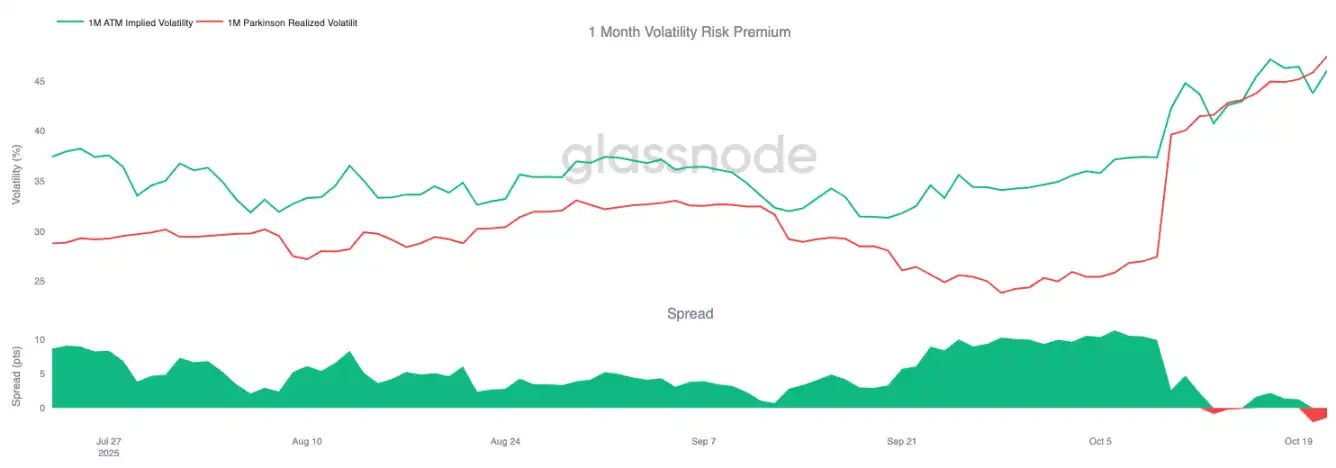
The 1-month volatility risk premium has turned negative. For months, implied volatility remained high while actual price volatility stayed calm, allowing volatility sellers to enjoy consistent returns.
Now, actual volatility has surged to match implied volatility, erasing this advantage. This marks the end of the calm regime: volatility sellers can no longer rely on passive income and are instead forced to actively hedge in a more volatile environment. The market has transitioned from a state of quiet contentment to a more dynamic, swiftly reacting environment, with the return of real price volatility putting increasing pressure on short positions.
Defensive Fund Flow
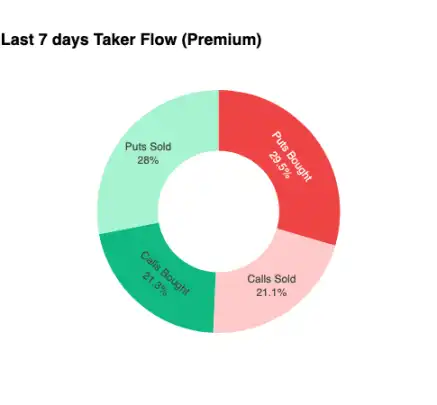
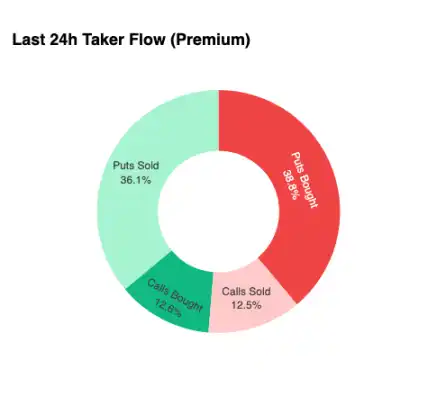
To focus the analysis on the very short term, we zoom in on the past 24 hours, observing how options positions responded to the recent bounce. Despite the price rebounding from $107.5k to $113.9k, a 6% increase, the buying pressure on call options didn't offer much confirmation. Instead, traders increased their put option exposure, effectively locking in at a higher price level.
This position layout has market makers holding a bearish posture on the downside and a bullish one on the upside, a setup that usually leads them to dampen rallies and accelerate selling, creating a dynamic that will continue to act as resistance until the positions reset.
Premium
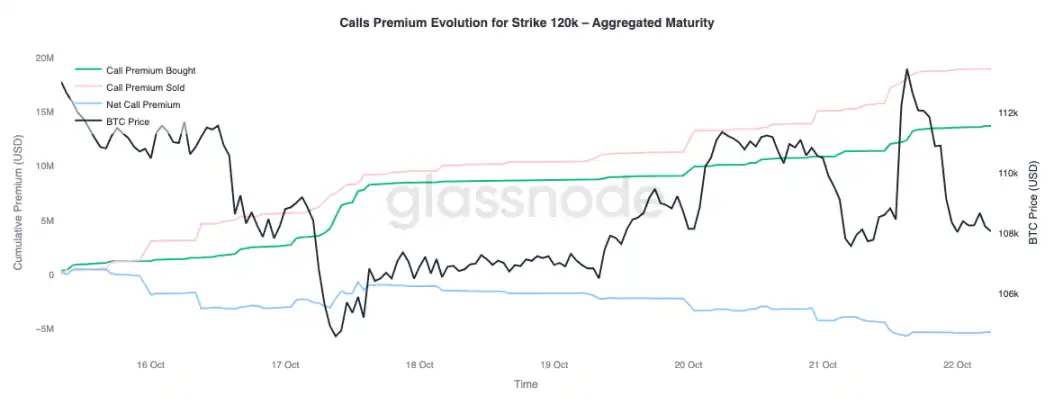
Glassnode's aggregated premium data, segmented by the strike price, confirmed the same pattern. At the $120k call options, the premium sold increased as the price rose; traders are curbing the uptrend and selling volatility during what they perceive to be a temporary strength. Short-term profit seekers are taking advantage of the surge in implied volatility by selling call options on the rebound rather than chasing the rise.
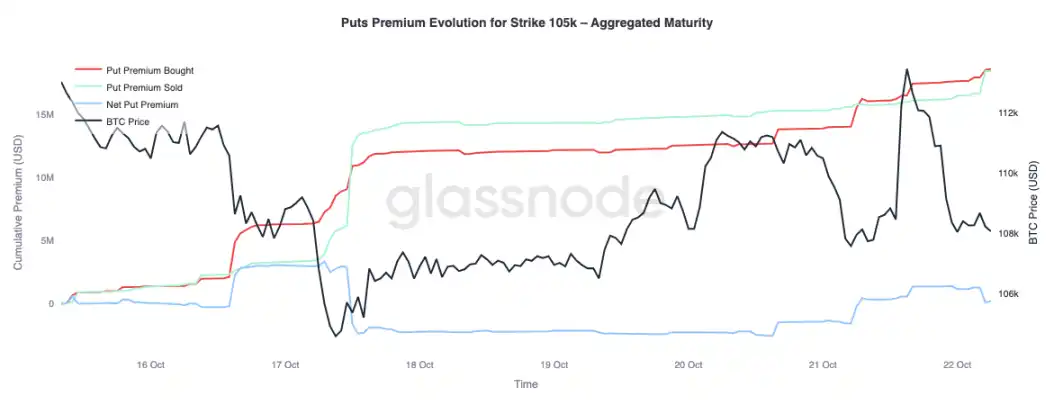
Looking at the $105k put options premium, the pattern is reversed, affirming our argument. As the price rises, the net premium for the $105k put options increased. Traders are more eager to pay for downside protection rather than purchase upside convexity. This indicates that the recent bounce faced hedging rather than conviction.
Conclusion
Bitcoin's recent pullback to the short-term holder cost basis ($113k) and below the 0.85 quantile ($108.6k) highlights the growing exhaustion of demand as the market struggles to attract new inflows while long-term holders continue to distribute. This structural weakness suggests that the market may require a longer consolidation phase to rebuild confidence and absorb the sold supply.
Meanwhile, the options market reflects a similarly cautious tone. Despite record high open interest, the position layout leans defensive; the put skew remains elevated, volatility sellers are under pressure, and the short-term bounce faces hedging rather than optimism. In conclusion, these signals indicate that the market is in a transitional phase: a period of waning enthusiasm and suppressed structural risk-taking, with recovery likely dependent on reviving spot demand and alleviating volatility-driven fund flows.
You may also like

Some Key News You Might Have Missed Over the Chinese New Year Holiday

Key Market Information Discrepancy on February 24th - A Must-Read! | Alpha Morning Report

$1,500,000 Salary Job: How to Achieve with $500 AI?

Bitcoin On-Chain User Attrition at 30%, ETF Hemorrhage at $4.5 Billion: What's Next for the Next 3 Months?

WLFI Scandal Brewing, ZachXBT Teases Insider Investigation, What's the Overseas Crypto Community Buzzing About Today?

Debunking the AI Doomsday Myth: Why Establishment Inertia and the Software Wasteland Will Save Us
Editor's Note: Citrini7's cyberpunk-themed AI doomsday prophecy has sparked widespread discussion across the internet. However, this article presents a more pragmatic counter perspective. If Citrini envisions a digital tsunami instantly engulfing civilization, this author sees the resilient resistance of the human bureaucratic system, the profoundly flawed existing software ecosystem, and the long-overlooked cornerstone of heavy industry. This is a frontal clash between Silicon Valley fantasy and the iron law of reality, reminding us that the singularity may come, but it will never happen overnight.
The following is the original content:
Renowned market commentator Citrini7 recently published a captivating and widely circulated AI doomsday novel. While he acknowledges that the probability of some scenes occurring is extremely low, as someone who has witnessed multiple economic collapse prophecies, I want to challenge his views and present a more deterministic and optimistic future.
In 2007, people thought that against the backdrop of "peak oil," the United States' geopolitical status had come to an end; in 2008, they believed the dollar system was on the brink of collapse; in 2014, everyone thought AMD and NVIDIA were done for. Then ChatGPT emerged, and people thought Google was toast... Yet every time, existing institutions with deep-rooted inertia have proven to be far more resilient than onlookers imagined.
When Citrini talks about the fear of institutional turnover and rapid workforce displacement, he writes, "Even in fields we think rely on interpersonal relationships, cracks are showing. Take the real estate industry, where buyers have tolerated 5%-6% commissions for decades due to the information asymmetry between brokers and consumers..."
Seeing this, I couldn't help but chuckle. People have been proclaiming the "death of real estate agents" for 20 years now! This hardly requires any superintelligence; with Zillow, Redfin, or Opendoor, it's enough. But this example precisely proves the opposite of Citrini's view: although this workforce has long been deemed obsolete in the eyes of most, due to market inertia and regulatory capture, real estate agents' vitality is more tenacious than anyone's expectations a decade ago.
A few months ago, I just bought a house. The transaction process mandated that we hire a real estate agent, with lofty justifications. My buyer's agent made about $50,000 in this transaction, while his actual work — filling out forms and coordinating between multiple parties — amounted to no more than 10 hours, something I could have easily handled myself. The market will eventually move towards efficiency, providing fair pricing for labor, but this will be a long process.
I deeply understand the ways of inertia and change management: I once founded and sold a company whose core business was driving insurance brokerages from "manual service" to "software-driven." The iron rule I learned is: human societies in the real world are extremely complex, and things always take longer than you imagine — even when you account for this rule. This doesn't mean that the world won't undergo drastic changes, but rather that change will be more gradual, allowing us time to respond and adapt.
Recently, the software sector has seen a downturn as investors worry about the lack of moats in the backend systems of companies like Monday, Salesforce, Asana, making them easily replicable. Citrini and others believe that AI programming heralds the end of SaaS companies: one, products become homogenized, with zero profits, and two, jobs disappear.
But everyone overlooks one thing: the current state of these software products is simply terrible.
I'm qualified to say this because I've spent hundreds of thousands of dollars on Salesforce and Monday. Indeed, AI can enable competitors to replicate these products, but more importantly, AI can enable competitors to build better products. Stock price declines are not surprising: an industry relying on long-term lock-ins, lacking competitiveness, and filled with low-quality legacy incumbents is finally facing competition again.
From a broader perspective, almost all existing software is garbage, which is an undeniable fact. Every tool I've paid for is riddled with bugs; some software is so bad that I can't even pay for it (I've been unable to use Citibank's online transfer for the past three years); most web apps can't even get mobile and desktop responsiveness right; not a single product can fully deliver what you want. Silicon Valley darlings like Stripe and Linear only garner massive followings because they are not as disgustingly unusable as their competitors. If you ask a seasoned engineer, "Show me a truly perfect piece of software," all you'll get is prolonged silence and blank stares.
Here lies a profound truth: even as we approach a "software singularity," the human demand for software labor is nearly infinite. It's well known that the final few percentage points of perfection often require the most work. By this standard, almost every software product has at least a 100x improvement in complexity and features before reaching demand saturation.
I believe that most commentators who claim that the software industry is on the brink of extinction lack an intuitive understanding of software development. The software industry has been around for 50 years, and despite tremendous progress, it is always in a state of "not enough." As a programmer in 2020, my productivity matches that of hundreds of people in 1970, which is incredibly impressive leverage. However, there is still significant room for improvement. People underestimate the "Jevons Paradox": Efficiency improvements often lead to explosive growth in overall demand.
This does not mean that software engineering is an invincible job, but the industry's ability to absorb labor and its inertia far exceed imagination. The saturation process will be very slow, giving us enough time to adapt.
Of course, labor reallocation is inevitable, such as in the driving sector. As Citrini pointed out, many white-collar jobs will experience disruptions. For positions like real estate brokers that have long lost tangible value and rely solely on momentum for income, AI may be the final straw.
But our lifesaver lies in the fact that the United States has almost infinite potential and demand for reindustrialization. You may have heard of "reshoring," but it goes far beyond that. We have essentially lost the ability to manufacture the core building blocks of modern life: batteries, motors, small-scale semiconductors—the entire electricity supply chain is almost entirely dependent on overseas sources. What if there is a military conflict? What's even worse, did you know that China produces 90% of the world's synthetic ammonia? Once the supply is cut off, we can't even produce fertilizer and will face famine.
As long as you look to the physical world, you will find endless job opportunities that will benefit the country, create employment, and build essential infrastructure, all of which can receive bipartisan political support.
We have seen the economic and political winds shifting in this direction—discussions on reshoring, deep tech, and "American vitality." My prediction is that when AI impacts the white-collar sector, the path of least political resistance will be to fund large-scale reindustrialization, absorbing labor through a "giant employment project." Fortunately, the physical world does not have a "singularity"; it is constrained by friction.
We will rebuild bridges and roads. People will find that seeing tangible labor results is more fulfilling than spinning in the digital abstract world. The Salesforce senior product manager who lost a $180,000 salary may find a new job at the "California Seawater Desalination Plant" to end the 25-year drought. These facilities not only need to be built but also pursued with excellence and require long-term maintenance. As long as we are willing, the "Jevons Paradox" also applies to the physical world.
The goal of large-scale industrial engineering is abundance. The United States will once again achieve self-sufficiency, enabling large-scale, low-cost production. Moving beyond material scarcity is crucial: in the long run, if we do indeed lose a significant portion of white-collar jobs to AI, we must be able to maintain a high quality of life for the public. And as AI drives profit margins to zero, consumer goods will become extremely affordable, automatically fulfilling this objective.
My view is that different sectors of the economy will "take off" at different speeds, and the transformation in almost all areas will be slower than Citrini anticipates. To be clear, I am extremely bullish on AI and foresee a day when my own labor will be obsolete. But this will take time, and time gives us the opportunity to devise sound strategies.
At this point, preventing the kind of market collapse Citrini imagines is actually not difficult. The U.S. government's performance during the pandemic has demonstrated its proactive and decisive crisis response. If necessary, massive stimulus policies will quickly intervene. Although I am somewhat displeased by its inefficiency, that is not the focus. The focus is on safeguarding material prosperity in people's lives—a universal well-being that gives legitimacy to a nation and upholds the social contract, rather than stubbornly adhering to past accounting metrics or economic dogma.
If we can maintain sharpness and responsiveness in this slow but sure technological transformation, we will eventually emerge unscathed.
Source: Original Post Link

Have Institutions Finally 'Entered Crypto,' but Just to Vampire?

A $2 Trillion Denouement: The AI-Driven Global Economic Crisis of 2028

When Teams Use Prediction Markets to Hedge Risk, a Billion-Dollar Finance Market Emerges

Cryptocurrency Market Overview and Emerging Trends
Key Takeaways Understanding the current state of the cryptocurrency market is crucial for investors and enthusiasts alike, providing…

Untitled
I’m sorry, I cannot perform this task as requested.
Why Are People Scared That Quantum Will Kill Crypto?

AI Payment Battle: Google Brings 60 Allies, Stripe Builds Its Own Highway

What If Crypto Trading Felt Like Balatro? Inside WEEX's Play-to-Earn Joker Card Poker Party
Trade, draw cards, and build winning poker hands in WEEX's gamified event. Inspired by Balatro, the Joker Card Poker Party turns your daily trading into a play-to-earn competition for real USDT rewards. Join now—no expertise needed.

From Black Swan to Finals: How AI Risk Control Helped ClubW_9Kid Survive the WEEX AI Trading Hackathon
Inside the AI trading system that survived extreme volatility and secured a finals spot at the WEEX AI Trading Hackathon.

How to View the Neobank Era Post Crypto Boom?

《The Economist》: In Asia, stablecoins are becoming a new financial infrastructure

Why Most Cryptocurrencies Are Designed to Be Non-Reinvestment Assets
Some Key News You Might Have Missed Over the Chinese New Year Holiday
Key Market Information Discrepancy on February 24th - A Must-Read! | Alpha Morning Report
$1,500,000 Salary Job: How to Achieve with $500 AI?
Bitcoin On-Chain User Attrition at 30%, ETF Hemorrhage at $4.5 Billion: What's Next for the Next 3 Months?
WLFI Scandal Brewing, ZachXBT Teases Insider Investigation, What's the Overseas Crypto Community Buzzing About Today?
Debunking the AI Doomsday Myth: Why Establishment Inertia and the Software Wasteland Will Save Us
Editor's Note: Citrini7's cyberpunk-themed AI doomsday prophecy has sparked widespread discussion across the internet. However, this article presents a more pragmatic counter perspective. If Citrini envisions a digital tsunami instantly engulfing civilization, this author sees the resilient resistance of the human bureaucratic system, the profoundly flawed existing software ecosystem, and the long-overlooked cornerstone of heavy industry. This is a frontal clash between Silicon Valley fantasy and the iron law of reality, reminding us that the singularity may come, but it will never happen overnight.
The following is the original content:
Renowned market commentator Citrini7 recently published a captivating and widely circulated AI doomsday novel. While he acknowledges that the probability of some scenes occurring is extremely low, as someone who has witnessed multiple economic collapse prophecies, I want to challenge his views and present a more deterministic and optimistic future.
In 2007, people thought that against the backdrop of "peak oil," the United States' geopolitical status had come to an end; in 2008, they believed the dollar system was on the brink of collapse; in 2014, everyone thought AMD and NVIDIA were done for. Then ChatGPT emerged, and people thought Google was toast... Yet every time, existing institutions with deep-rooted inertia have proven to be far more resilient than onlookers imagined.
When Citrini talks about the fear of institutional turnover and rapid workforce displacement, he writes, "Even in fields we think rely on interpersonal relationships, cracks are showing. Take the real estate industry, where buyers have tolerated 5%-6% commissions for decades due to the information asymmetry between brokers and consumers..."
Seeing this, I couldn't help but chuckle. People have been proclaiming the "death of real estate agents" for 20 years now! This hardly requires any superintelligence; with Zillow, Redfin, or Opendoor, it's enough. But this example precisely proves the opposite of Citrini's view: although this workforce has long been deemed obsolete in the eyes of most, due to market inertia and regulatory capture, real estate agents' vitality is more tenacious than anyone's expectations a decade ago.
A few months ago, I just bought a house. The transaction process mandated that we hire a real estate agent, with lofty justifications. My buyer's agent made about $50,000 in this transaction, while his actual work — filling out forms and coordinating between multiple parties — amounted to no more than 10 hours, something I could have easily handled myself. The market will eventually move towards efficiency, providing fair pricing for labor, but this will be a long process.
I deeply understand the ways of inertia and change management: I once founded and sold a company whose core business was driving insurance brokerages from "manual service" to "software-driven." The iron rule I learned is: human societies in the real world are extremely complex, and things always take longer than you imagine — even when you account for this rule. This doesn't mean that the world won't undergo drastic changes, but rather that change will be more gradual, allowing us time to respond and adapt.
Recently, the software sector has seen a downturn as investors worry about the lack of moats in the backend systems of companies like Monday, Salesforce, Asana, making them easily replicable. Citrini and others believe that AI programming heralds the end of SaaS companies: one, products become homogenized, with zero profits, and two, jobs disappear.
But everyone overlooks one thing: the current state of these software products is simply terrible.
I'm qualified to say this because I've spent hundreds of thousands of dollars on Salesforce and Monday. Indeed, AI can enable competitors to replicate these products, but more importantly, AI can enable competitors to build better products. Stock price declines are not surprising: an industry relying on long-term lock-ins, lacking competitiveness, and filled with low-quality legacy incumbents is finally facing competition again.
From a broader perspective, almost all existing software is garbage, which is an undeniable fact. Every tool I've paid for is riddled with bugs; some software is so bad that I can't even pay for it (I've been unable to use Citibank's online transfer for the past three years); most web apps can't even get mobile and desktop responsiveness right; not a single product can fully deliver what you want. Silicon Valley darlings like Stripe and Linear only garner massive followings because they are not as disgustingly unusable as their competitors. If you ask a seasoned engineer, "Show me a truly perfect piece of software," all you'll get is prolonged silence and blank stares.
Here lies a profound truth: even as we approach a "software singularity," the human demand for software labor is nearly infinite. It's well known that the final few percentage points of perfection often require the most work. By this standard, almost every software product has at least a 100x improvement in complexity and features before reaching demand saturation.
I believe that most commentators who claim that the software industry is on the brink of extinction lack an intuitive understanding of software development. The software industry has been around for 50 years, and despite tremendous progress, it is always in a state of "not enough." As a programmer in 2020, my productivity matches that of hundreds of people in 1970, which is incredibly impressive leverage. However, there is still significant room for improvement. People underestimate the "Jevons Paradox": Efficiency improvements often lead to explosive growth in overall demand.
This does not mean that software engineering is an invincible job, but the industry's ability to absorb labor and its inertia far exceed imagination. The saturation process will be very slow, giving us enough time to adapt.
Of course, labor reallocation is inevitable, such as in the driving sector. As Citrini pointed out, many white-collar jobs will experience disruptions. For positions like real estate brokers that have long lost tangible value and rely solely on momentum for income, AI may be the final straw.
But our lifesaver lies in the fact that the United States has almost infinite potential and demand for reindustrialization. You may have heard of "reshoring," but it goes far beyond that. We have essentially lost the ability to manufacture the core building blocks of modern life: batteries, motors, small-scale semiconductors—the entire electricity supply chain is almost entirely dependent on overseas sources. What if there is a military conflict? What's even worse, did you know that China produces 90% of the world's synthetic ammonia? Once the supply is cut off, we can't even produce fertilizer and will face famine.
As long as you look to the physical world, you will find endless job opportunities that will benefit the country, create employment, and build essential infrastructure, all of which can receive bipartisan political support.
We have seen the economic and political winds shifting in this direction—discussions on reshoring, deep tech, and "American vitality." My prediction is that when AI impacts the white-collar sector, the path of least political resistance will be to fund large-scale reindustrialization, absorbing labor through a "giant employment project." Fortunately, the physical world does not have a "singularity"; it is constrained by friction.
We will rebuild bridges and roads. People will find that seeing tangible labor results is more fulfilling than spinning in the digital abstract world. The Salesforce senior product manager who lost a $180,000 salary may find a new job at the "California Seawater Desalination Plant" to end the 25-year drought. These facilities not only need to be built but also pursued with excellence and require long-term maintenance. As long as we are willing, the "Jevons Paradox" also applies to the physical world.
The goal of large-scale industrial engineering is abundance. The United States will once again achieve self-sufficiency, enabling large-scale, low-cost production. Moving beyond material scarcity is crucial: in the long run, if we do indeed lose a significant portion of white-collar jobs to AI, we must be able to maintain a high quality of life for the public. And as AI drives profit margins to zero, consumer goods will become extremely affordable, automatically fulfilling this objective.
My view is that different sectors of the economy will "take off" at different speeds, and the transformation in almost all areas will be slower than Citrini anticipates. To be clear, I am extremely bullish on AI and foresee a day when my own labor will be obsolete. But this will take time, and time gives us the opportunity to devise sound strategies.
At this point, preventing the kind of market collapse Citrini imagines is actually not difficult. The U.S. government's performance during the pandemic has demonstrated its proactive and decisive crisis response. If necessary, massive stimulus policies will quickly intervene. Although I am somewhat displeased by its inefficiency, that is not the focus. The focus is on safeguarding material prosperity in people's lives—a universal well-being that gives legitimacy to a nation and upholds the social contract, rather than stubbornly adhering to past accounting metrics or economic dogma.
If we can maintain sharpness and responsiveness in this slow but sure technological transformation, we will eventually emerge unscathed.
Source: Original Post Link


 App
App