
Glassnode: What Does the Sharp Decline in Market Selling Risk Mean?



Original Title: Seeking Liquidity
Original Source: Glassnode
Original Translation: White Water, Golden Finance
Abstract
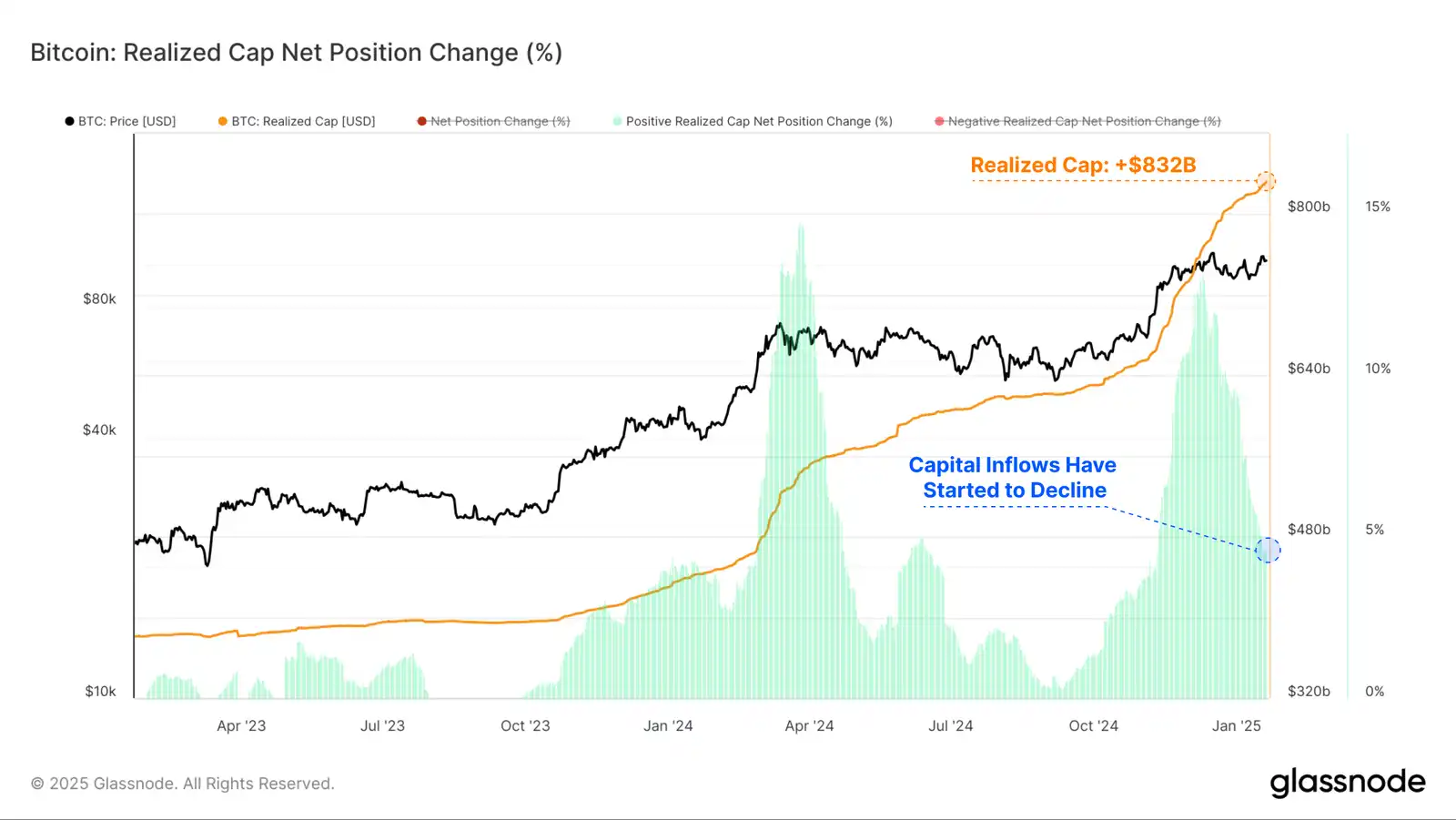
· Capital inflows into Bitcoin remain positive, although the inflow volume has decreased since first reaching $100,000. This highlights a period where seller pressure is decreasing as the market nears short-term balance.
· Seller pressure from long-term investors has also decreased, while the amount held on exchanges for sale has also decreased.
· Several volatility indicators are tightening, with the market trading price within a historically narrow 60-day price range, which typically indicates the market is almost ready to fluctuate again.
Capital Flow Approaching Balance
As the price reached the $100,000 level, Bitcoin's net capital inflow surged, indicating investors were locking in significant profits. As the market consolidates and adjusts to a new price range, these inflows have begun to decline.
The slowing of profit-taking represents a net reduction in selling pressure, thus requiring less new capital to maintain the price within the trading range.
Currently, the market value realized price stands at $832 billion and is growing at a rate of $386 billion per month.
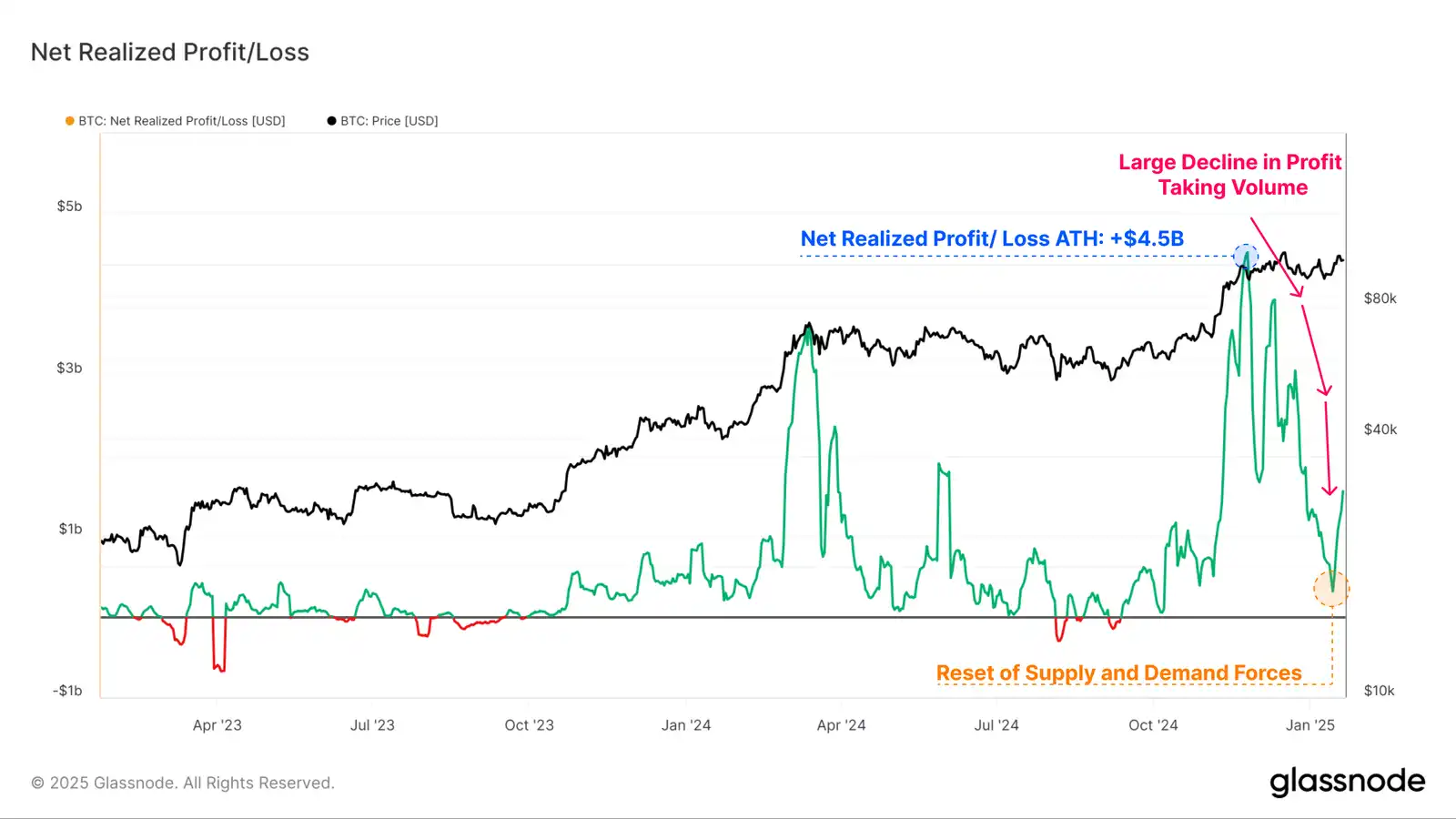
The net realized profit/loss indicator is the first derivative of realized market value, allowing us to discretely observe the scale of on-chain net capital flow in USD terms.
As the market digests profit-taking allocation pressure, the balance of realized profit and loss volume is gradually trending towards a neutral position. This indicates supply and demand forces are resetting, and most tokens currently being traded have not locked in significant value gains relative to their initial purchase price.
Profit-taking volume peaked at +$4.5 billion in December 2024 and has now decreased to +$3.167 billion (-93%).
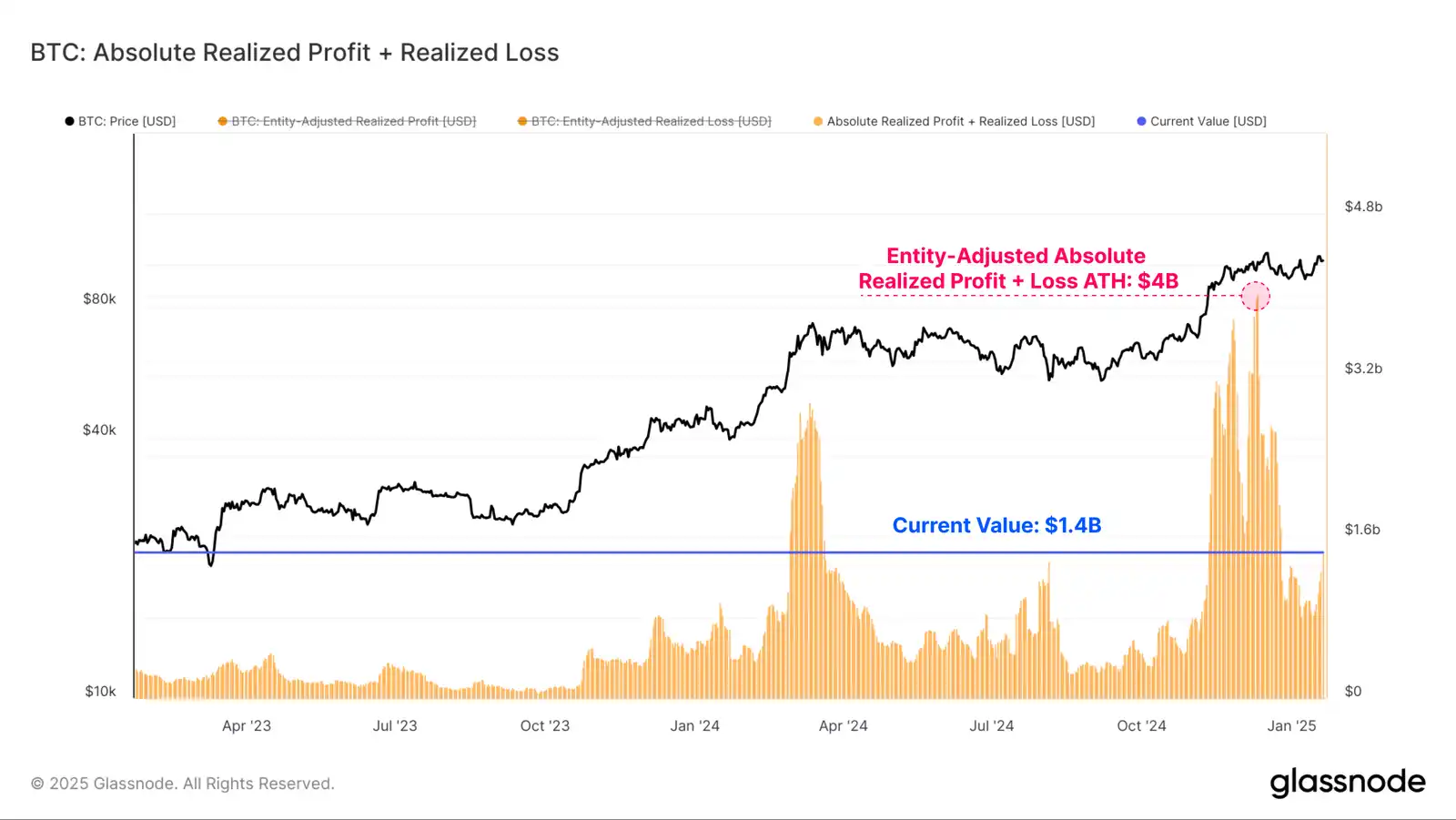
The absolute volume of realized profit and realized loss (entity-adjusted) is another set of tools that can help us measure the direction and sentiment of capital flowing into and out of Bitcoin.
When we add realized profits and losses together, we can see that this comprehensive metric has sharply dropped from a high of $40 billion to a value of $14 billion. Despite a 65% decrease, from a historical perspective, the current value is still high, highlighting the daily scale of demand that absorbed this capital during the bull market.
Supply Side Slowdown
We have identified that overall selling pressure has significantly decreased. We can further explore these dynamics using metrics like Coinday Destruction and exchange inflow to confirm this view.
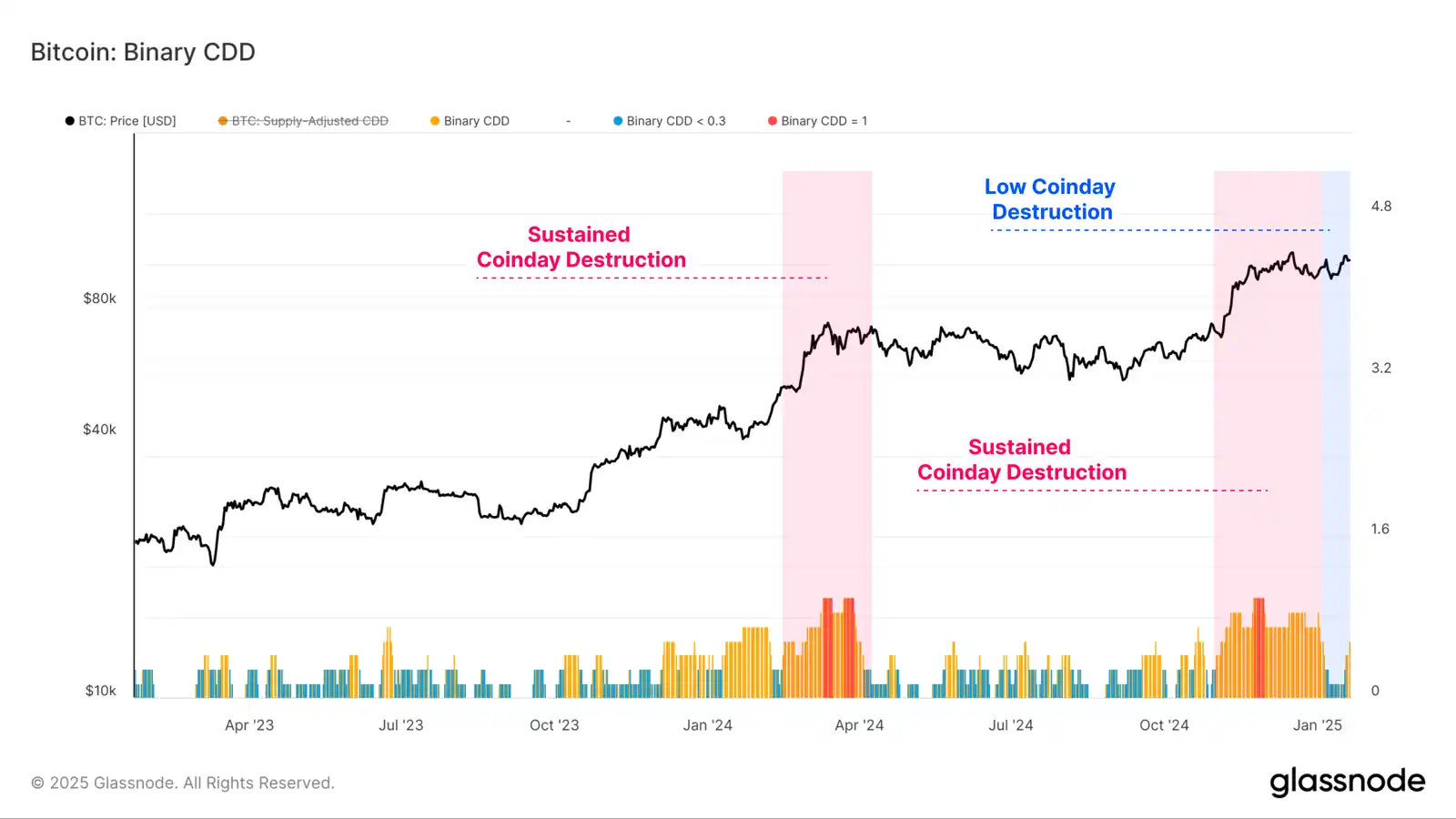
The first tool we can use to better describe investor allocation pressure is the Binary CDD metric. This metric tracks the market-wide "holding time" expenditure, monitoring when older supply holders are increasingly trading more.
We saw a continued period of severe coinday destruction at the end of 2024 and beginning of January. In recent weeks, as relatively lighter coinday destruction has taken over, this metric has started to cool down.
This indicates that investors planning to take profits in large amounts may have already realized gains within the current price range. In general, this suggests that the market may need to "look elsewhere" to attract and unlock the next wave of supply.
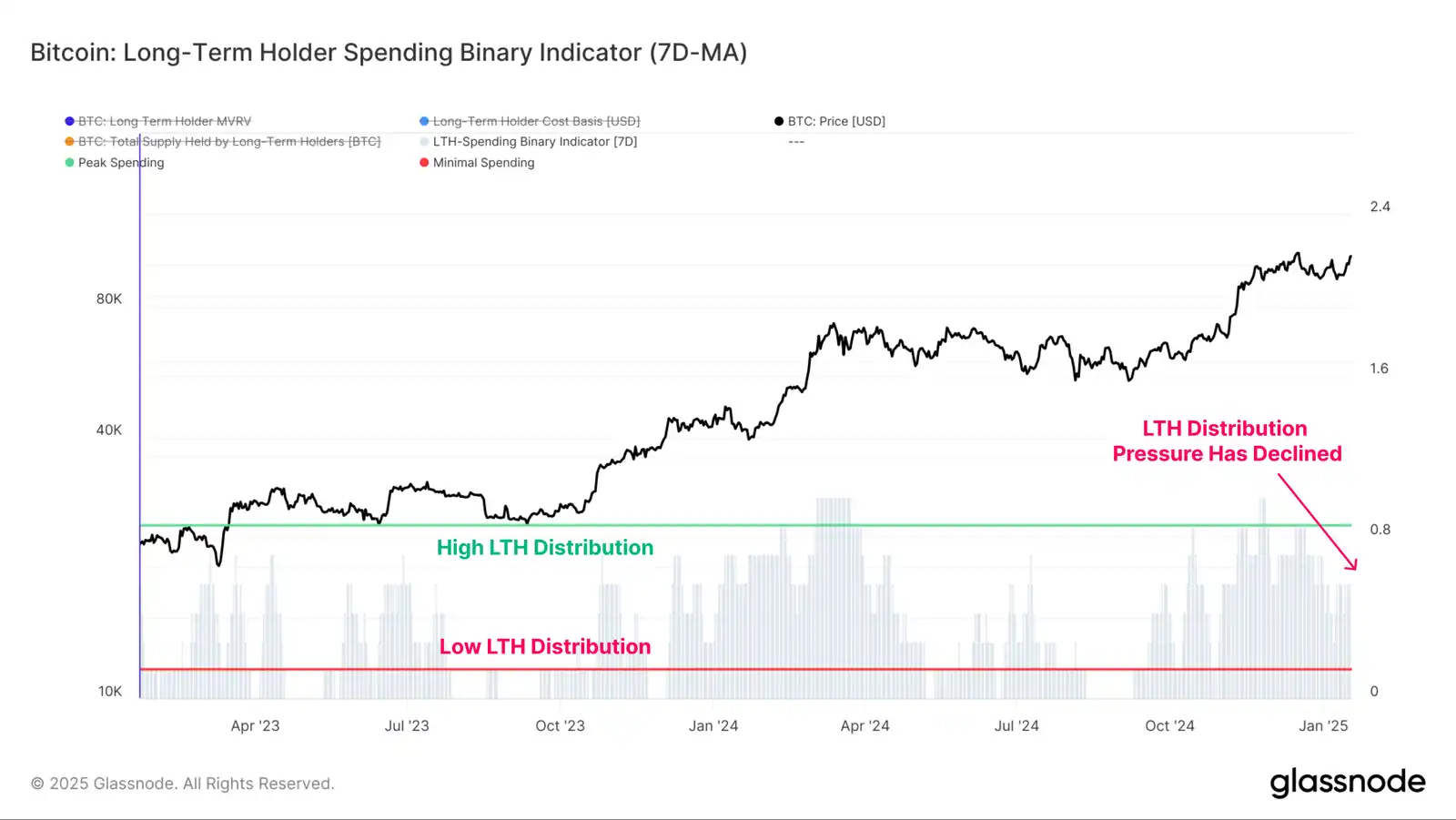
Long-Term Holder (LTH) Binary Expense is another metric we can use to assess the duration of persistent selling pressure, specifically targeting long-term investors.
Consistent with the previous substantial profit-taking volume, we can see that as the market reached $100,000 in December, the total LTH supply dropped significantly. The speed of the subsequent LTH supply decrease has plateaued, indicating a weakening of this allocation pressure in recent weeks.
Currently, the total LTH supply is showing signs of recovery, indicating that for this group, accumulation and HODLing behavior now outweigh distribution pressure.
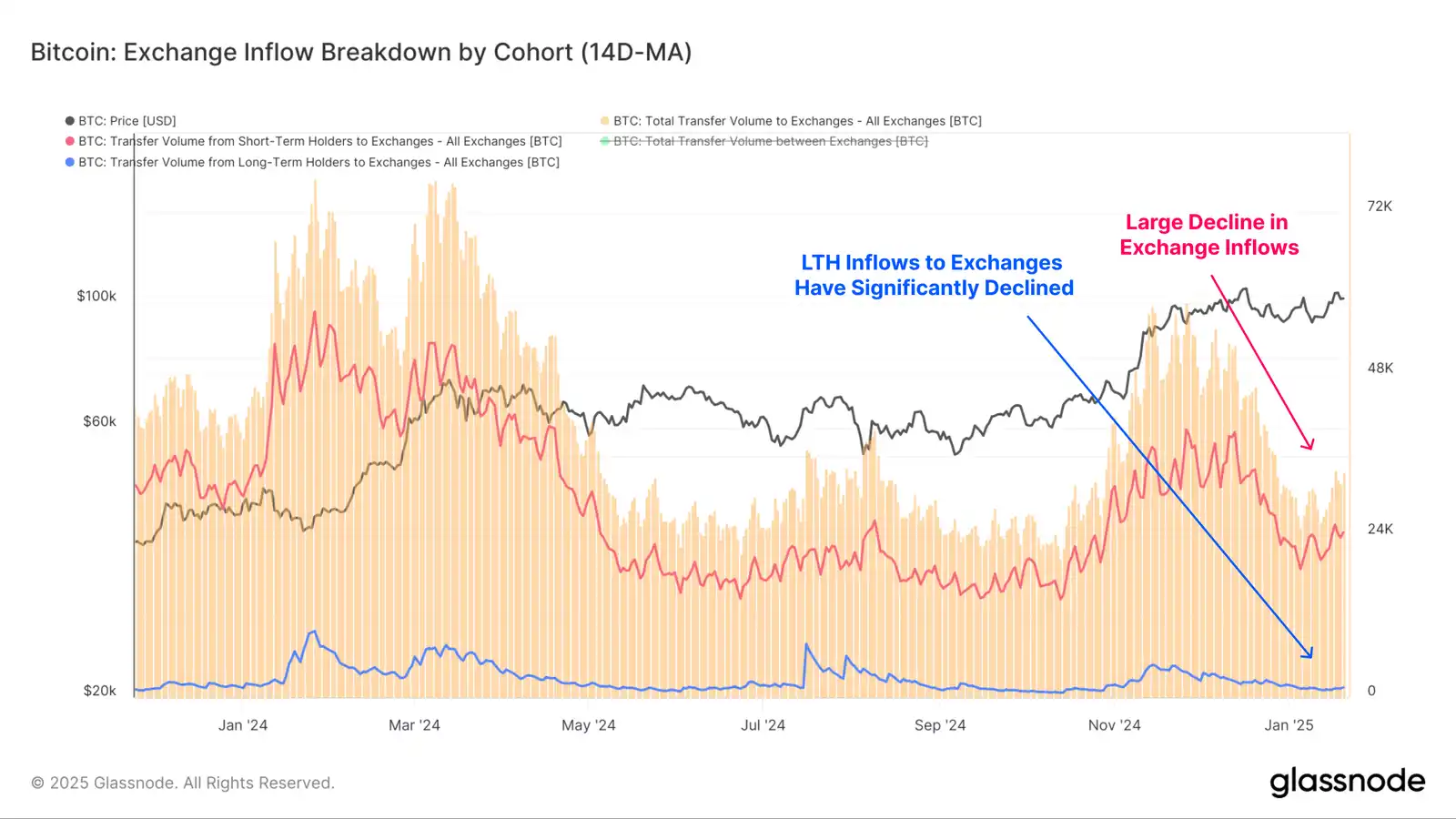
Centralized exchanges remain the primary venues for speculation and trading, processing billions of dollars in daily fund flows. Exchange inflow has dramatically dropped from a peak of $61 billion to $28 billion (-54%), underscoring a significant reduction in recent speculative activity.
Notably, the amount of funds flowing into exchanges from LTH has decreased from $526.9 million in December to the current $92.3 million, a -83% decrease in deposits.
This further supports the following argument: Long-term investors may have already completed a significant amount of profit-taking within this price range.
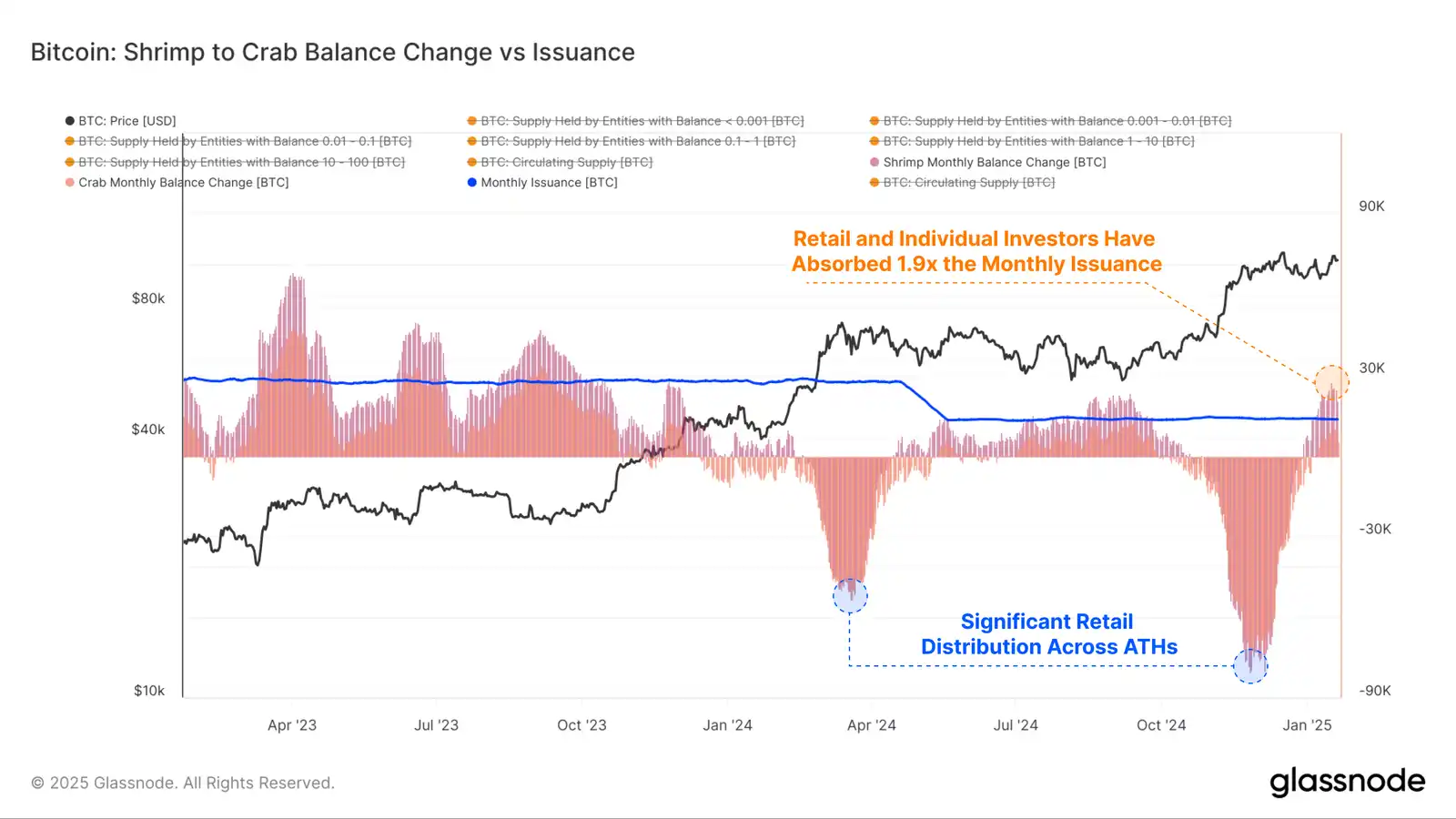
To further analyze supply-demand balance, we can compare the balance change rates of different groups and standardize them to Bitcoin's mining output. This provides a relative measure to compare against the new issuance theoretically absorbed by each group.
Taking the Shrimp Crab group (holding <10 BTC) as a representation of retail and individual investors, we note that this group has absorbed around +25.6k BTC in the past month. In contrast, miners issue around +13.6k BTC per month.
Therefore, these retail and individual holders have actually absorbed 1.9 times the new supply entering the market through primary production.
Coiling Volatility
It can be observed that there is a strong convergence between the two on-chain models and a historically narrow 60-day price range, enabling investors to capitalize on intensified volatility.
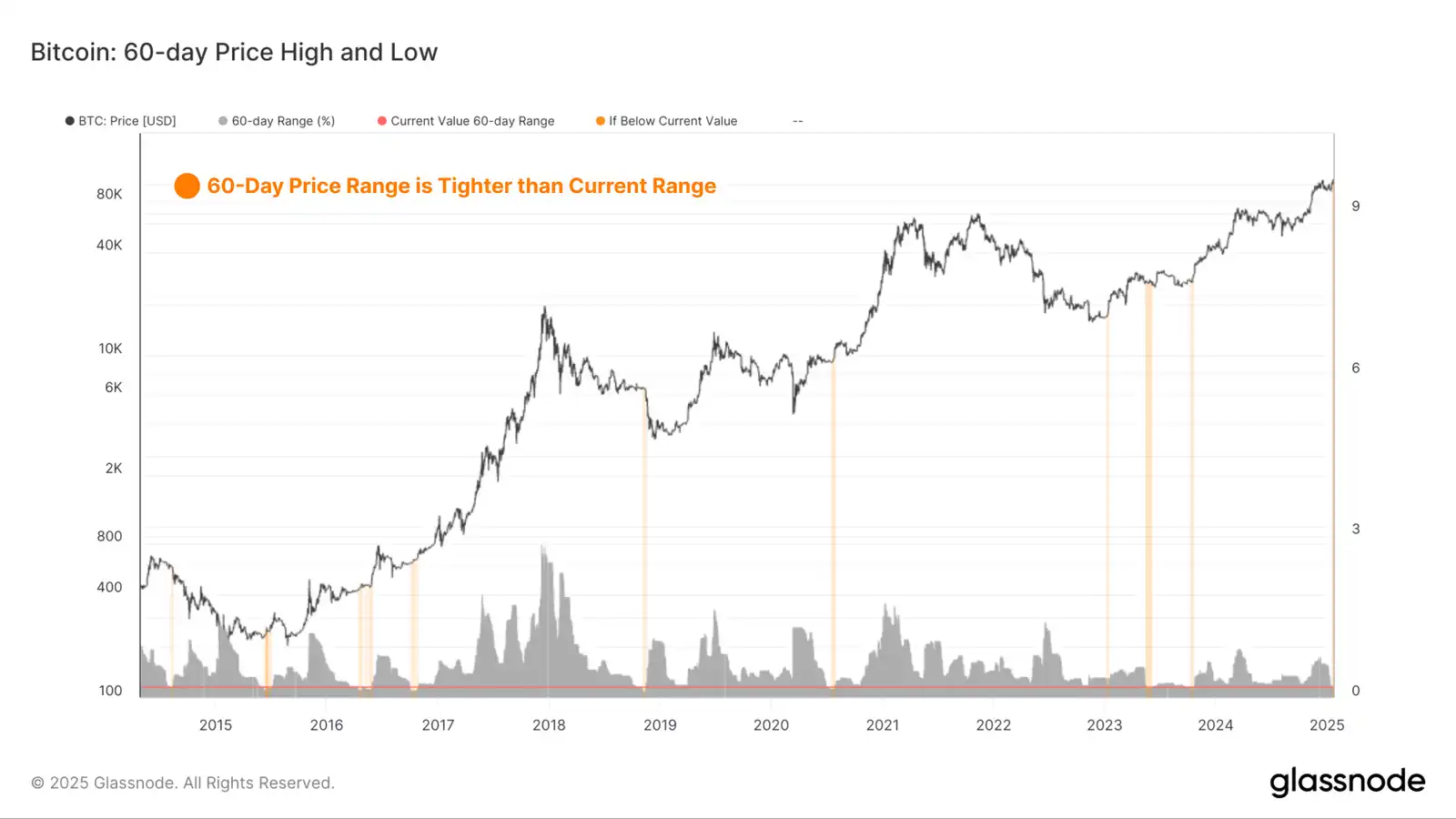
By measuring the percentage range between the highest and lowest prices in the past 60 days, we can see how market volatility changes over time. The chart below highlights periods where the 60-day price range was narrower compared to the current trading range. All of these instances occurred before significant volatility spikes, mostly at the beginning of bullish markets or just before late-stage bear market sell-offs.
A sustained sideways price trend within a narrow range allows a significant portion of circulating supply to be redistributed and concentrated at relatively higher cost bases.
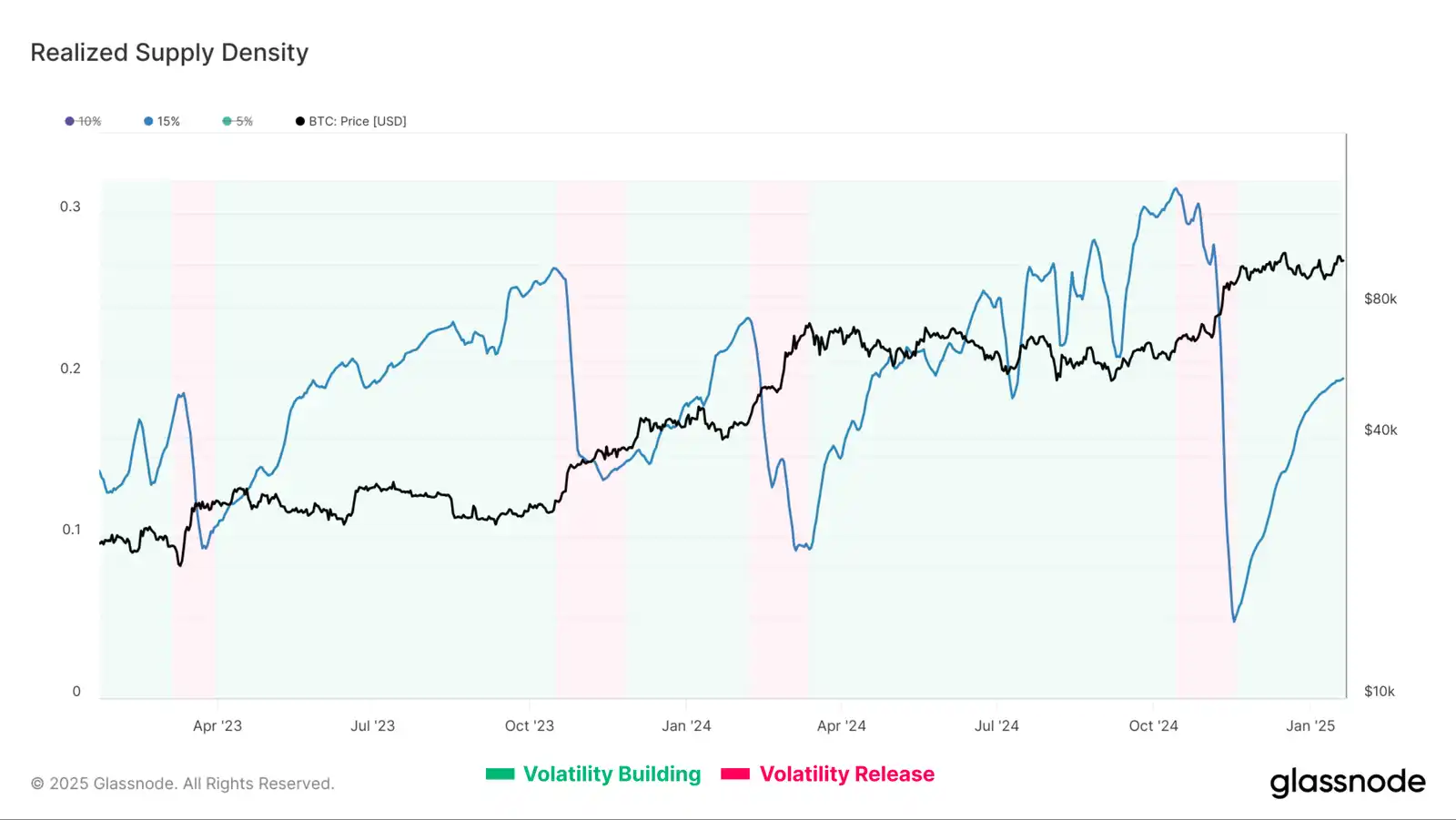
The realized supply density metric quantifies the concentration of supply within a ±15% price fluctuation range around the current spot price. When supply is highly concentrated around the spot price, small price movements significantly impact investors' profitability, thereby exacerbating market volatility.
After reaching its peak price in December, Bitcoin began consolidating, forming a dense supply concentration, with the cost base approaching the spot price. Currently, 20% of the supply is within a ±15% range of the spot price.
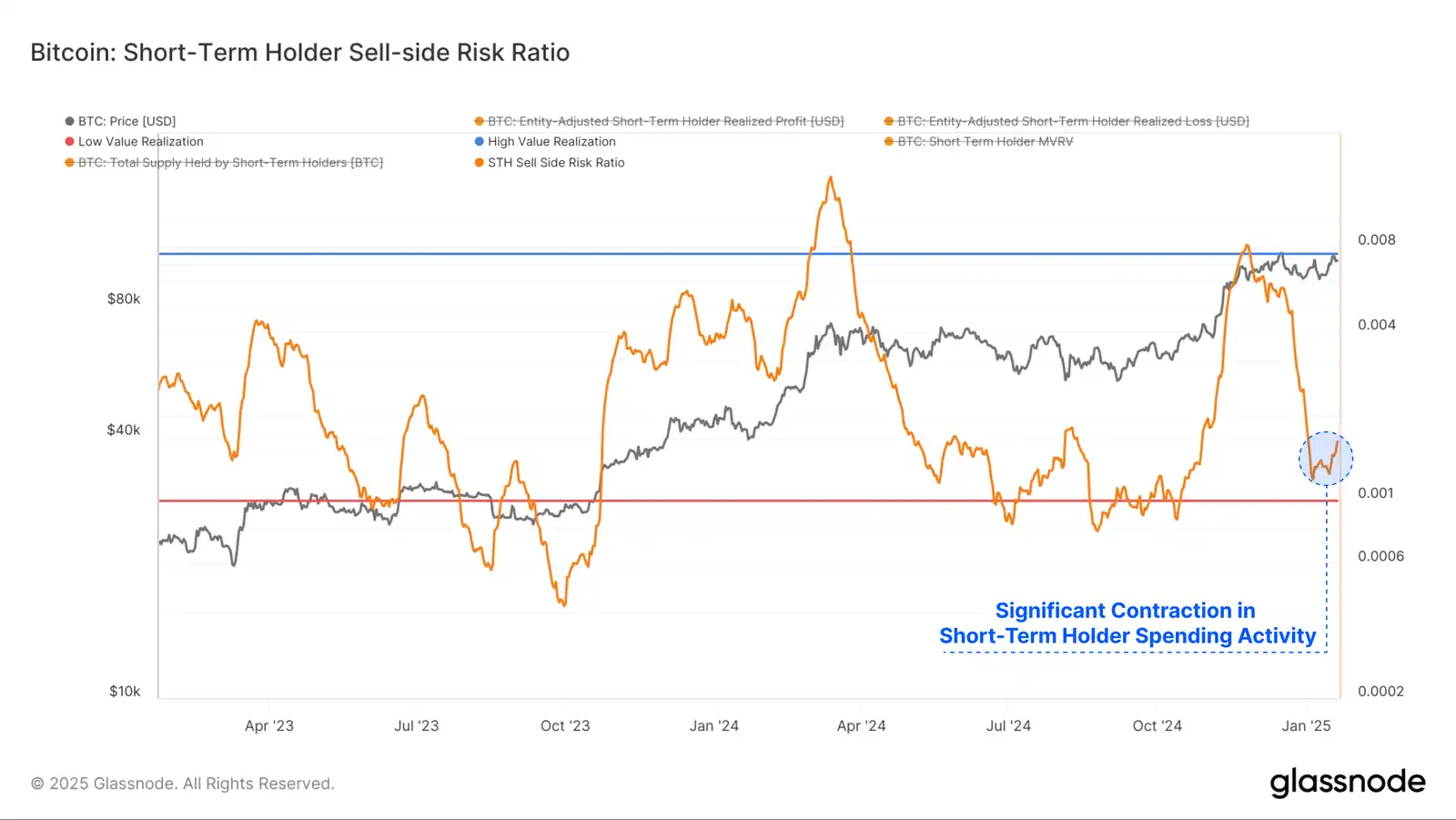
The seller risk ratio describes this phenomenon from a different perspective. This metric evaluates the proportion of investors' locked-in realized gains and losses relative to the asset size (measured by realized market value). We can consider this metric within the following framework:
· High value represents a situation where investors incur a significant profit or loss when spending tokens relative to their cost basis. This scenario indicates that the market may need to find a new equilibrium and usually occurs after a period of high volatility.
· Low value indicates that the spending of most tokens is relatively close to their breakeven cost basis, suggesting that a certain level of equilibrium has been reached. This situation typically signals that the "profit and loss" in the current price range has been exhausted, often describing a low-volatility environment.
In recent weeks, the spending activity of short-term holders has significantly contracted, leading to a sharp decline in selling pressure. This usually implies that all planned profit and loss events by investors have now been executed. It often indicates that the market is nearing a local equilibrium and is a precursor to the next wave of volatility.
Summary
The price of Bitcoin has undergone intense intraday volatility, first surging to a new high of $109,000, then experiencing a sharp decline before stabilizing above $100,000. The macro backdrop leading up to and during the U.S. presidential inauguration is fraught with challenges and uncertainties, exacerbating the market's indecision.
In this article, we evaluate and analyze the conditions preceding the explosive yet erratic price action. We present a framework that identifies signs of impending volatility using the reduction in on-chain transaction volume and capital flows, along with the tightening of the price range.
You may also like

The pricing controversy of Trade.xyz exposes the fatal weakness of Pre-IPO perpetual contracts

World Cup 2026 Coming – WEEX Celebrates with $1M Prize Pool & Michael Owen Live

Galaxy in-depth report: Is Solana still worth paying attention to?
Young people in South Korea make a "final effort" in the epic bull market

Dialogue with OmenX Founder: Why does the prediction market need an evolution from "spot" to "derivatives"?
When the P2P illicit funds from ten years ago turned into 60,000 bitcoins

Morning News | CME Group launches Nasdaq Cryptocurrency Index futures; Asset management giant Janus Henderson strategically invests in Ethena

Why did Oracle deliver the strongest financial report in history, yet its stock price fell?

Bitcoin Layer 2 Network Botanix: Why Did We Choose to Dissolve?

Morning Report | OpenAI has submitted an S-1 registration statement draft to the U.S. SEC; Morpho completes $175 million financing

Galaxy Deep Research Report: How Hyperliquid's HIP-4 Upgrade Changes the Landscape of Prediction Markets?

Latest research from 13 top universities including Cornell University: The current state, challenges, and misconceptions of the fusion of Crypto and AI
Deconstructing Anthropic: The Best AI Company, Possibly Also a Type of Organizational Invention

Every exchange is a "Universal Exchange."

The counterattack of traditional finance: Alliance chains are quietly reviving
Pantera Capital Partner: How Tokenization is Restructuring the Private Equity and Early Investment Ecosystem?

Mastercard Launches Agent Pay for AI, Plans to Record AI Agent Payment Authorizations on Polygon
Mastercard launched Agent Pay for AI, a new payment protocol designed to help AI agents make small payments such as pay-per-use access to data and APIs. The system plans to record human-granted AI agent permissions on Polygon, focusing on verifiable authorization, identity, and payment controls.

Curve Deploys Llamalend v2 on Optimism With 250,000 OP Incentives
Curve launched Llamalend v2 on Optimism with 250,000 OP incentives from the Optimism Foundation. The upgrade expands Llamalend beyond its earlier crvUSD-focused model, adding broader collateral support, LlamaRisk market reviews, and the ability to use Curve LP tokens as collateral.
The pricing controversy of Trade.xyz exposes the fatal weakness of Pre-IPO perpetual contracts
World Cup 2026 Coming – WEEX Celebrates with $1M Prize Pool & Michael Owen Live
Galaxy in-depth report: Is Solana still worth paying attention to?
Young people in South Korea make a "final effort" in the epic bull market
Dialogue with OmenX Founder: Why does the prediction market need an evolution from "spot" to "derivatives"?
When the P2P illicit funds from ten years ago turned into 60,000 bitcoins


