
- Buy Crypto
- Markets
 Futures
- Spot
- Copy Trade
- Earn
- More
Fun Fact: The first DApp on Ethereum was the prediction market Augur

Original Article Title: "Fun Fact: The First DApp on Ethereum Was a Prediction Market"
Original Article Author: Eric, Foresight News
While recently organizing which Web3 prediction markets exist, I suddenly remembered Augur. Upon searching for related information, I found that Augur announced its relaunch in March of this year; however, I had no idea when it had stopped operating.
The reason I felt this way is because Augur was the focus of the first article I translated into the field. The article was published on March 19, 2019, and I vividly remember that the requirement at that time was to add personal insights to the translation. I also recall that I used the movie poster for "The Butterfly Effect" as the cover for the article I published on a public account, as my personal interpretation was that prediction markets have the ability to change the future.
I wonder if the viewpoint that arose more than six years ago can be considered prophetic. My perspective on why the current top Web3 prediction markets are approaching a valuation of nearly a billion dollars remains unchanged: when an event is bound to have a deterministic outcome in the future, and when the game around this outcome is mixed with economic interests, the game itself will have the ability and motivation to alter the final result.
The First DApp on Ethereum and the First ICO
Augur is unparalleled in the aspect of being "early." Since Ethereum is a permissionless network, it is difficult for me to confirm whether Augur is truly the first DApp on Ethereum. However, certain things can be affirmed, such as Augur starting its development on the testnet while Ethereum was still in its testnet phase. Augur can be considered the first to genuinely attract attention to an industry that was not yet referred to as "Web3" at the time, leading to the emergence of numerous ecosystem projects. Although Augur officially launched in 2018, it is not unreasonable to refer to it as the "first DApp on Ethereum."
As for Augur being the first successful ICO on Ethereum, this can be confirmed. An article by The Economist in 2018 titled "Blockchains could breathe new life into prediction markets" also mentioned that the Augur ICO took place in 2015, specifically in August 2015.
The timing of this event was quite early: Ethereum's genesis block was born on July 30, 2015, while the ERC-20 standard was formally proposed in November 2015. This means that when Augur initially sold REP tokens, REP did not yet comply with the ERC-20 standard.
Regarding the legendary Augur ICO, which institutional investors actually participated? The author has seen many versions, including well-known institutions such as Founders Fund, Pantera Capital, Blockchain Capital, 1confirmation, Multicoin Capital, but the author has not found a definitive source of information.
The Augur ICO raised over 5 million USD, with Bitcoin priced at only 300 to 400 USD in 2015, and Ethereum dropping to around 0.4 USD at the time of the Augur ICO. Over 8 years ago, on Reddit, the question was asked, "What was the first ICO/ERC20 token to run on an Ethereum smart contract?"
In the following discussion, a user with the nickname x_ETHeREAL_x mentioned that Ethereum didn't have a wallet or GUI interface at that time, and transactions had to be done via the Geth client through the command line. However, another user with the nickname adrianclv quickly corrected this statement, mentioning that there was no Geth client at that time, and it should have been Ethereum's co-founder Gavin Wood's CPP Ethereum client.
Building on the Past, Yet a Poor User Experience
Counting from the ICO, after nearly 3 years, in July 2018, Augur was officially launched.
At the time of its official launch, Augur provided a PC desktop application and a web-based application. The reason for launching a PC application was due to the limited number of Ethereum nodes at the time. Using a built-in full node application may have been more efficient. The team behind the Augur ecosystem project Guesser described the design of the desktop application:
The Augur App is a lightweight Electron application that bundles the Augur UI and Augur Node together and deploys it to your local machine. The Augur UI is a reference client (similar to Geth for Ethereum) used to interact with the Augur protocol's core smart contracts on the Ethereum blockchain. The Augur Node is a locally run program that scans event logs related to Augur on the Ethereum blockchain, stores them in a database, and provides the corresponding data to the Augur UI.

While there were also early NFT projects like Crypto Kitties and pure gambling applications like Fomo3D during the same period, Augur was still the "hottest guy" in the industry. Apart from implementing the functionality of prediction markets on-chain, Augur also developed its own decentralized oracle to provide outcomes. This in-house oracle was launched almost a year before Chainlink's oracle went live.
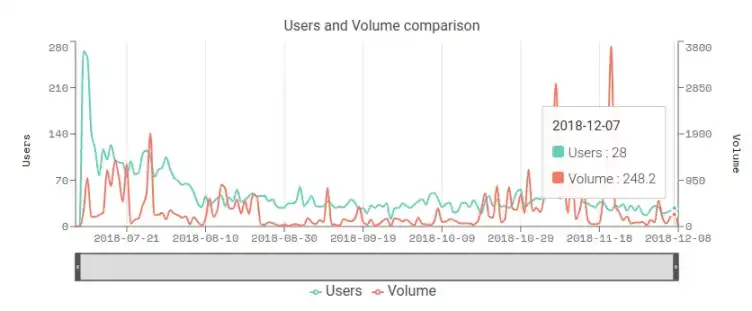
According to DappRadar data, Augur peaked at 265 Daily Active Users (DAU) at launch, but this number dropped to 37 on August 8th and by the end of the year, the daily active users were less than 30. As of December 11, 2018, there were a total of 1635 markets created on Augur, with 11825 orders and a total of 6331 completed orders. During the 2018 U.S. midterm elections, there were over 200 orders executed in a single day. These numbers, which may seem insignificant now, were considered impressive achievements at the time.
Furthermore, if you understand Augur's implementation mechanism, you would find it miraculous that there were still dozens of users trading thousands of orders.
In terms of the poor user experience on Augur, apart from the overall poor user experience factors including MetaMask at that time, Augur itself had fatal flaws in its design. Firstly, Augur did not design arbitrage opportunities like Polymarket to automatically balance probabilities. Instead, one had to match bids and asks one by one. In that era without market makers, you had to find someone with the exact opposite view as yours.
As an example, consider the second market on the trading market interface above, where the bet is on the price of ETH by the end of April (2019). The three options are: below $50, between $50 and $500, above $500. If you choose the second option to place a bet, you will see a page like this:
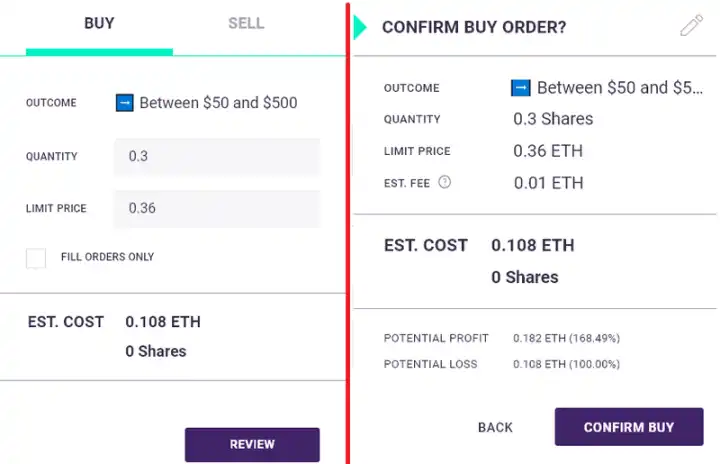
Users need to select the share and set the price (probability). The numbers in the image represent a bet of 0.3 shares, believing there is a 36% probability that the final price will fall between $50 and $500, with a total cost of 0.108 ETH. Similar to Polymarket, Augur also has an order book, but their order books are entirely different concepts.
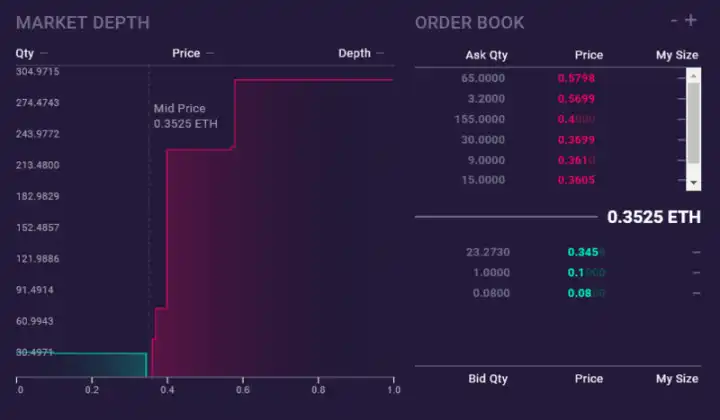
The sell order shown in the chart has a minimum price of 0.3605. This does not mean that someone believes there is a 36.05% chance it will not fall within the $50 to $500 range, but rather that they believe there is a 63.95% chance it will not be within the range. So, when you want to place a reverse bet, you need to calculate the probability yourself; otherwise, it is very likely that your order will not be matched. The newly placed order requires a user who precisely believes or is willing to believe that there is a 74% chance it will not be within this range to appear in order for the two sides to successfully match and walk away with the other's chips after the final result is revealed.
The inflexible point is here: Augur only has a "yes" option for each outcome. Users must choose to go long on "yes" or short on "yes".
Augur's permissionless nature has led to the emergence of many invalid markets. For example, the market mentioned above may have its end date set in mid-April, and the results provided by the oracle network support multiple challenges, causing an Augur market that should have settled quickly to drag on for almost 5 months, undergoing countless disputes before finally closing. In such a market environment, coupled with a mechanism that requires finding an evenly matched opponent, only 6331 out of 11825 orders were executed.
Lastly, the fees for using Augur are surprisingly high. In addition to gas fees and fees for users who were early adopters without wallet habits trading through fiat channels, as both the reporters providing results in the oracle network and the market creators need to stake a certain amount of REP, users also have to pay fees to these two parties.
While the fees charged by market creators and reporters are relatively low (1-2%), users must pay multiple layers of fees to use the platform, and the cumulative fees can be quite significant. In Augur, these fees, from low to high, are the reporting fee (0.01%), the market creator fee (1-2%), Ethereum gas fees (depending on the order size), and the fee for exchanging fiat to ETH (Coinbase charges 4% for debit card payments and 1.5% for ACH payments). Therefore, the total fees for trading on Augur range from 3.5% to 9% or even higher.
Poor wallet user experience, one-to-one matching mechanism, logical flaws, and high fees have made it difficult for Augur to scale up. However, this does not diminish Augur's almost "founder" influence in the Ethereum and DApp development history. The team that developed Augur back then has now become a cornerstone of the industry.
Team Infighting Leads to $150 Million Claim by Ousted Member
Augur, launched by the Forecast Foundation, publicly disclosed that the organization's team members included co-founder and Augur core developer Jack Peterson, co-founder and Augur's Chief Architect Joey Krug, early marketing and community lead Jeremy Gardner, full-stack engineer responsible for frontend and contract integration Stephen Sprinkle, and researcher Austin Williams who authored the appendix to the Augur whitepaper on game theory.
Among them, Joey Krug also took on the role of Co-Chief Investment Officer at Pantera Capital starting in June 2017 and currently serves as a partner at Founders Fund. Stephen Sprinkle, after leaving Augur in 2019, joined ConsenSys as a product manager, then moved to BlockFi as Director of Engineering. Following BlockFi's restructuring in 2022, he transitioned to Coinbase to continue overseeing institutional-level products.
However, according to a lawsuit filed by Matt Liston in 2018, a story before Augur's inception was revealed.
As reported by CoinDesk in 2018, Matt Liston claimed he initially registered a company named Dyffy in Delaware, USA, and hired Jack Peterson. At that time, Liston proposed the idea of developing a prediction market on the blockchain, which Peterson initially did not support.
Later, Liston came across the Truthcoin whitepaper written by Yale economist Paul Sztorc, believing it could be used as a basis to develop a prediction market and issue tokens. Liston successfully convinced Joseph Ball Costello to invest, and also persuaded Peterson to support the on-chain development idea through Paul Sztorc. With this foundation, Liston then hired Joey Krug and Jeremy Gardner, with the latter proposing to name the project Augur.
In the following months, the team continuously argued over technical and business strategy choices, with the end result of the argument being Matt Liston, who orchestrated all of this, being ousted in October 2014. Krug replaced Liston as a director, and Peterson became the CEO. In December of the same year, the Forecast Foundation, a non-profit organization in Oregon, USA, was established.
Matt Liston expressed that he may have wanted to completely sever ties with Dyffy. Under continuous pressure from Costello to refrain from taking legal action against Dyffy and to acknowledge Dyffy's acquisition, exchanging equity for cash or REP tokens, Liston reluctantly signed an agreement. Due to the so-called "specific allocation plan of the ICO being concealed," Liston relinquished a 5% share of his REP tokens, opting to take $65,000 in cash instead. Based on Augur's valuation at the time of the lawsuit, these originally forsaken tokens are now valued at over $20 million.
Against the backdrop of Augur, which had a valuation exceeding $450 million at the time, Matt Liston sought $38 million in general damages and $114 million in punitive damages, totaling $152 million. This amount exceeded one-third of Augur's valuation, making it the "highest claim in the history of cryptocurrency" lawsuit at the time.
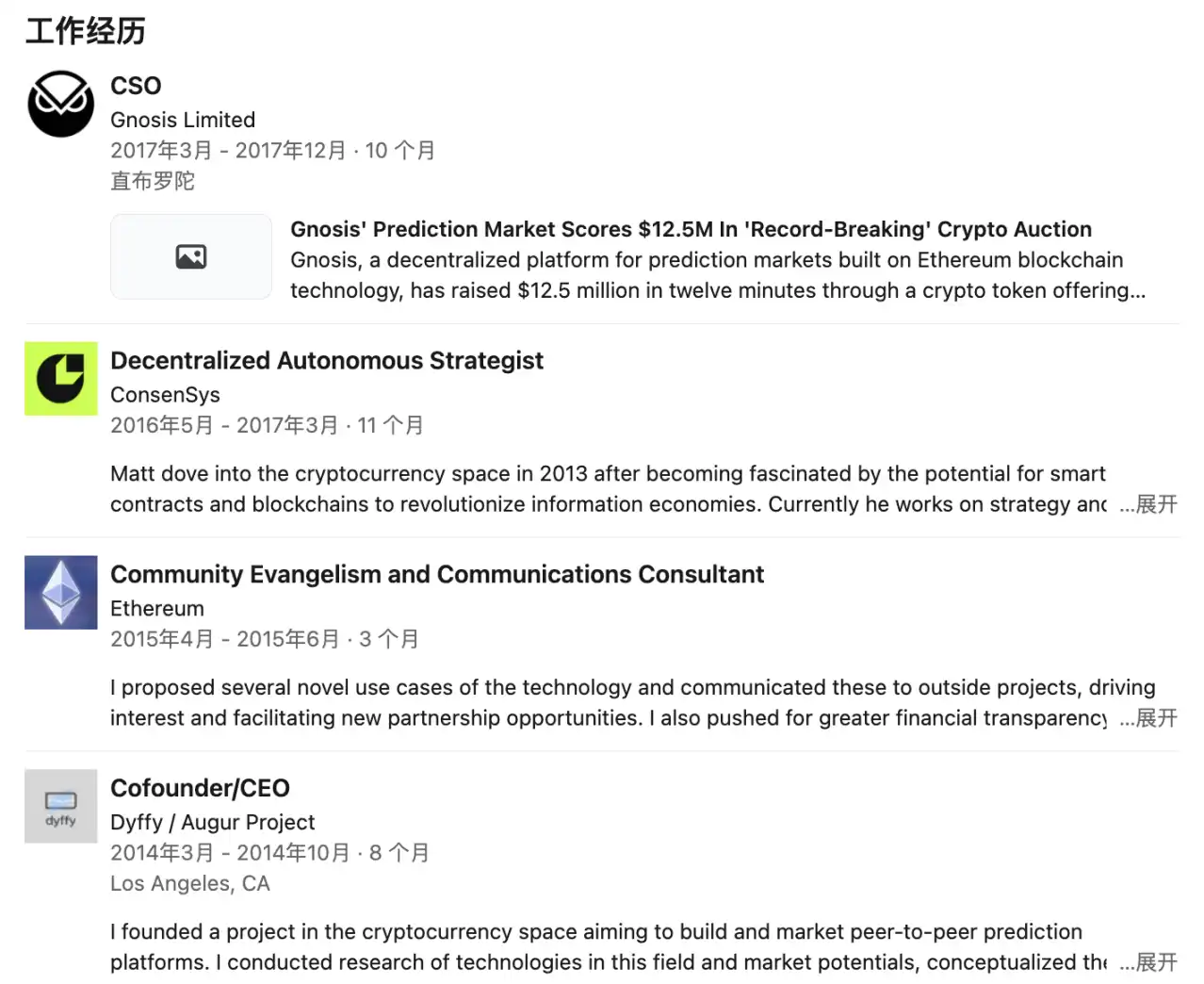
Several of Augur's defendants were surprised when Liston reneged on the agreement three years later. Additionally, Jack Peterson and Joey Krug both argued that Liston was not a co-founder of Augur. Krug stated, "Liston has made no contributions to Augur's GitHub repository or any other Augur repository; he is not a co-founder of Augur." Reports indicated that suspicion regarding his true identity led Liston to face unemployment, and his LinkedIn profile showed no new job records since resigning as Chief Strategy Officer of Gnosis in 2017.
According to insider sources cited in the reports, the main cause of the rift was Liston's proposition to develop Augur on Ethereum, while the team insisted on Bitcoin. Interestingly, Augur was eventually launched on Ethereum and became the first successful ICO project after the Ethereum mainnet went live. It is worth noting that there is no further public information on the case's progress. Considering that Augur managed to survive until the end of 2021, this matter will either be resolved amicably or fade away.
Quiet for Three and a Half Years, A New Start
In March of this year, Augur suddenly announced its comeback on X, marking the first tweet from that account since November 18, 2021.
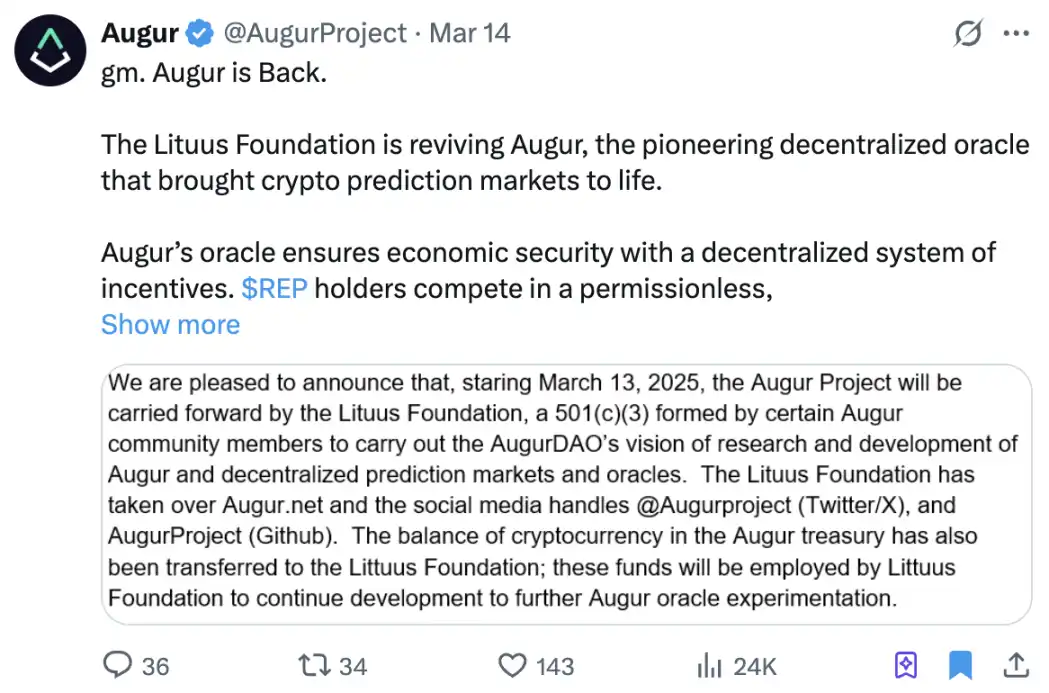
In 2020, Augur launched an updated version of v2, with adjustments in user experience and many other aspects. In July of that year, Forbes published an article calling it a "major leap forward in the decentralized application space." In the article "Ethereum's First ICO Blazes Trail To A World Without Bosses," Forbes journalist Michael del Castillo stated, "Its functionality is similar to the internet but without the need for a trusted third party. If successful, this significant upgrade will not only be limited to horse race betting without the need for a bookie; it may mark a turning point for the next generation of the internet."
Although Augur saw a single market surpassing $10 million in volume during the 2020 U.S. presidential election, the dazzle of DeFi was too bright, and Augur eventually succumbed during the peak of the roaring bull market in 2021. Perhaps Polymarket's rise to fame brought the prediction market back into the spotlight after nearly a decade, prompting the new team behind Augur to start afresh this year.
The reboot of Augur will be led by two teams: the Lituus Foundation will handle token and operational matters, develop the oracle, while Dark Florists will be responsible for implementing specific prediction markets. The Lituus Foundation describes itself as composed of long-time Augur community members, with currently no information available about its members.
Dark Florists, on the other hand, is a well-established Ethereum development team. Among its key members, Killari cracked the indistinguishability obfuscation developed jointly by the Ethereum Foundation, Phantom.zone, and 0xPARC at Devcon in 2024 and received a $10,000 bounty. Micah Zoltu is renowned for discovering a critical MakerDAO vulnerability in 2019 and is also a developer of EIP-3074 and EIP-2718.
Such a team aims to introduce the "new Augur," not as a purely commercial platform but, in the words of the Lituus Foundation, as a cross-chain decentralized truth machine. The Lituus Foundation intends to separate the oracle from Augur's prediction market and make it modular so that all applications can use the Augur oracle.
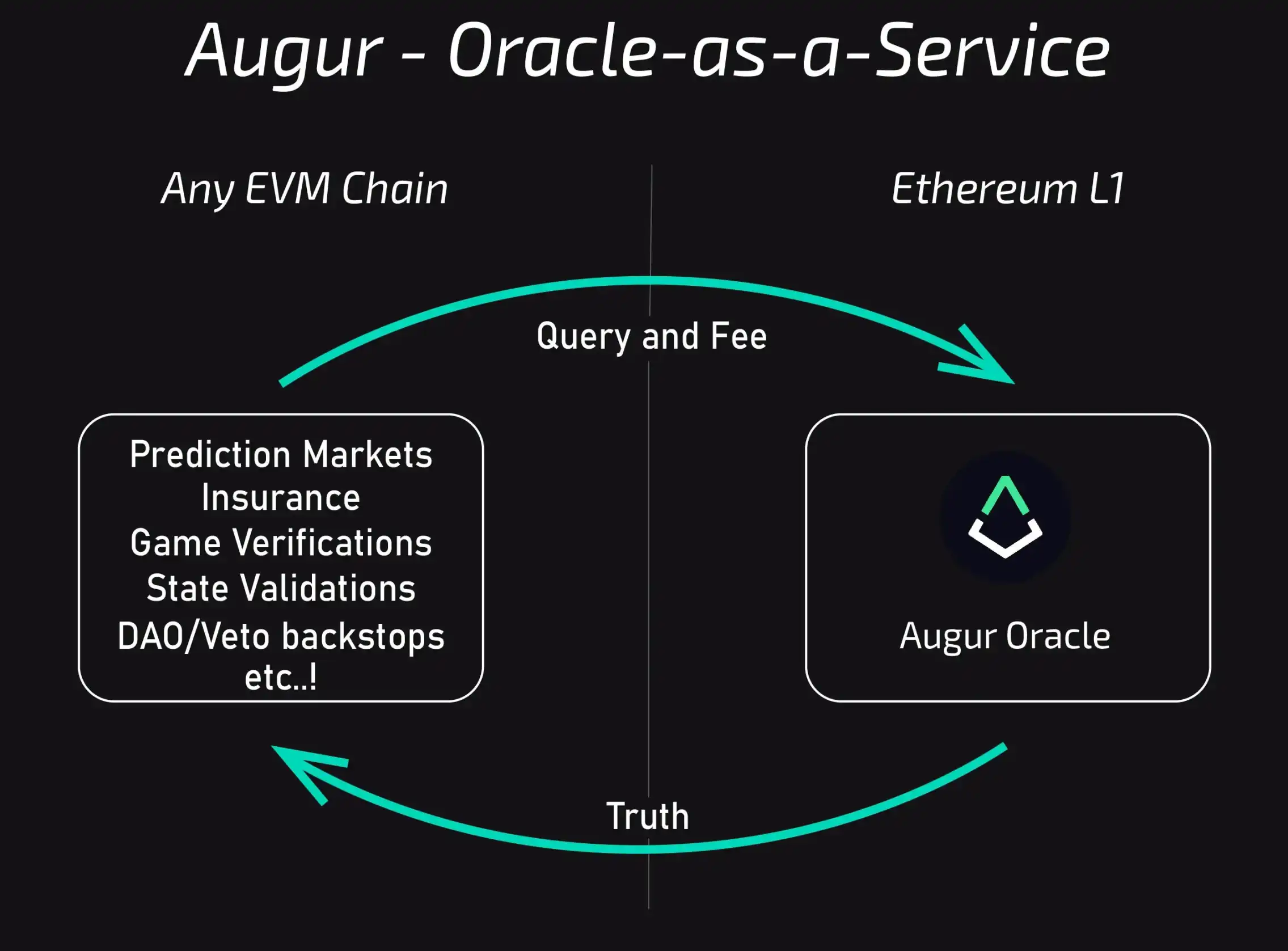
Augur was originally designed as a purely decentralized application, not relying on multisig, key management, or backdoors. Even its tokenomics design incorporates original game theory to ensure the platform's normal operation through incentive mechanisms. The new Augur will continue to uphold this spirit. The information we have now indicates that the new oracle will likely be deployed on Layer 2, and the initial prediction markets will be built on AMM.
As of now, the Lituus Foundation has released two progress reports. In the first quarter of the announced relaunch, Lituus increased the REP holdings from 250,000 to 550,000 and deployed $100,000 in liquidity on Uniswap v3, with plans to list on a centralized exchange. The following second quarter will see four key developments:
· Launching a website;
· Oracle research will pursue two complementary approaches, one focusing on consumer prediction markets and the other on enterprise-grade oracle use cases;
· Micah Zoltu initiated a crowdfund to intentionally trigger an algorithmic fork of REP to test Augur's core security model;
· The foundation's buyback scale will expand to 1 million REP.
The algorithmic fork is a very interesting design, with rather complex details. Here is a brief explanation:
In Augur's design, the "outcome" is not predetermined. Augur allows disputes to be initiated by staking REP votes on outcomes. When a dispute reaches a threshold (2.5% of total staked REP), the system will split into two parallel universes, each corresponding to an outcome. REP holders must choose the universe they agree with and migrate their REP holdings to that universe. If staked REP does not reach the threshold in a given time after the dispute begins, participants supporting the initial outcome will be rewarded.
Micah Zoltu launched the crowdfund to raise funds to invest in significantly incorrect outcomes during disputes, thus "sacrificing" a portion of REP to test the feasibility of this mechanism. However, due to this test, the plan to list on a centralized exchange had to be put on hold until after the dispute is fully resolved.
Conclusion
"Time ages all things, but Guang [Li] is forever young, unable to be sealed."
In his article "From prediction markets to info finance" published last November, Ethereum co-founder Vitalik mentioned that he was once a loyal user and supporter of Augur. As Ethereum's first ICO project, Augur's design now seems overly advanced.
This advancement is not solely due to the mechanism, but the premise of its implementation was too utopian. What were our discussions about prediction markets back then?
· Farmers could set up a prediction market for harvest season weather as a hedge against the potential impact of climate on yield;
· Use prediction markets to establish bug bounties and smart contract insurance;
· Conduct incentivized opinion polling markets and introduce conditional markets to guide policy-making;
· Tokenize RealT (real estate tokens) and establish a trading pair on Uniswap between the RealT token and a token betting on a drop in housing prices in a prediction market to allow hedging positions to earn trading fees;
…
Today's prediction markets are filled with trading and arbitrage, which is one perspective, and currently, it seems to be the only correct one. We have often criticized the lack of innovation in Web3 in recent years, but looking back at the thinking of the OGs from a decade ago, do we really have no room for innovation?
Web3 is like a massive Polymarket; once we were busy opening new markets, enjoying it tirelessly. There was a time when we suddenly began market-making on the order book, using bots to find millisecond probability and non-unity opportunities, and also arbitraging by placing stop-loss and take-profit orders before the market closes. It seems that suddenly everyone lost the courage to open a new market, to bet on a bigger future.
An article I translated six years ago mentioned the "3p theory," which stands for Predict, Prepare, and Persuade the future. At that time, I wrote a paragraph that I had since forgotten: A decentralized prediction market presents all possible parallel timelines before you, giving everyone the right to choose the door to the future they want to step into. The more people participate in the choice, the more likely it will guide time toward a further distance.
You may also like

a16z: Why Do AI Agents Need a Stablecoin for B2B Payments?

February 24th Market Key Intelligence, How Much Did You Miss?

Web4.0, perhaps the most needed narrative for cryptocurrency

Some Key News You Might Have Missed Over the Chinese New Year Holiday

Key Market Information Discrepancy on February 24th - A Must-Read! | Alpha Morning Report

$1,500,000 Salary Job: How to Achieve with $500 AI?

Bitcoin On-Chain User Attrition at 30%, ETF Hemorrhage at $4.5 Billion: What's Next for the Next 3 Months?

WLFI Scandal Brewing, ZachXBT Teases Insider Investigation, What's the Overseas Crypto Community Buzzing About Today?
Debunking the AI Doomsday Myth: Why Establishment Inertia and the Software Wasteland Will Save Us
Editor's Note: Citrini7's cyberpunk-themed AI doomsday prophecy has sparked widespread discussion across the internet. However, this article presents a more pragmatic counter perspective. If Citrini envisions a digital tsunami instantly engulfing civilization, this author sees the resilient resistance of the human bureaucratic system, the profoundly flawed existing software ecosystem, and the long-overlooked cornerstone of heavy industry. This is a frontal clash between Silicon Valley fantasy and the iron law of reality, reminding us that the singularity may come, but it will never happen overnight.
The following is the original content:
Renowned market commentator Citrini7 recently published a captivating and widely circulated AI doomsday novel. While he acknowledges that the probability of some scenes occurring is extremely low, as someone who has witnessed multiple economic collapse prophecies, I want to challenge his views and present a more deterministic and optimistic future.
In 2007, people thought that against the backdrop of "peak oil," the United States' geopolitical status had come to an end; in 2008, they believed the dollar system was on the brink of collapse; in 2014, everyone thought AMD and NVIDIA were done for. Then ChatGPT emerged, and people thought Google was toast... Yet every time, existing institutions with deep-rooted inertia have proven to be far more resilient than onlookers imagined.
When Citrini talks about the fear of institutional turnover and rapid workforce displacement, he writes, "Even in fields we think rely on interpersonal relationships, cracks are showing. Take the real estate industry, where buyers have tolerated 5%-6% commissions for decades due to the information asymmetry between brokers and consumers..."
Seeing this, I couldn't help but chuckle. People have been proclaiming the "death of real estate agents" for 20 years now! This hardly requires any superintelligence; with Zillow, Redfin, or Opendoor, it's enough. But this example precisely proves the opposite of Citrini's view: although this workforce has long been deemed obsolete in the eyes of most, due to market inertia and regulatory capture, real estate agents' vitality is more tenacious than anyone's expectations a decade ago.
A few months ago, I just bought a house. The transaction process mandated that we hire a real estate agent, with lofty justifications. My buyer's agent made about $50,000 in this transaction, while his actual work — filling out forms and coordinating between multiple parties — amounted to no more than 10 hours, something I could have easily handled myself. The market will eventually move towards efficiency, providing fair pricing for labor, but this will be a long process.
I deeply understand the ways of inertia and change management: I once founded and sold a company whose core business was driving insurance brokerages from "manual service" to "software-driven." The iron rule I learned is: human societies in the real world are extremely complex, and things always take longer than you imagine — even when you account for this rule. This doesn't mean that the world won't undergo drastic changes, but rather that change will be more gradual, allowing us time to respond and adapt.
Recently, the software sector has seen a downturn as investors worry about the lack of moats in the backend systems of companies like Monday, Salesforce, Asana, making them easily replicable. Citrini and others believe that AI programming heralds the end of SaaS companies: one, products become homogenized, with zero profits, and two, jobs disappear.
But everyone overlooks one thing: the current state of these software products is simply terrible.
I'm qualified to say this because I've spent hundreds of thousands of dollars on Salesforce and Monday. Indeed, AI can enable competitors to replicate these products, but more importantly, AI can enable competitors to build better products. Stock price declines are not surprising: an industry relying on long-term lock-ins, lacking competitiveness, and filled with low-quality legacy incumbents is finally facing competition again.
From a broader perspective, almost all existing software is garbage, which is an undeniable fact. Every tool I've paid for is riddled with bugs; some software is so bad that I can't even pay for it (I've been unable to use Citibank's online transfer for the past three years); most web apps can't even get mobile and desktop responsiveness right; not a single product can fully deliver what you want. Silicon Valley darlings like Stripe and Linear only garner massive followings because they are not as disgustingly unusable as their competitors. If you ask a seasoned engineer, "Show me a truly perfect piece of software," all you'll get is prolonged silence and blank stares.
Here lies a profound truth: even as we approach a "software singularity," the human demand for software labor is nearly infinite. It's well known that the final few percentage points of perfection often require the most work. By this standard, almost every software product has at least a 100x improvement in complexity and features before reaching demand saturation.
I believe that most commentators who claim that the software industry is on the brink of extinction lack an intuitive understanding of software development. The software industry has been around for 50 years, and despite tremendous progress, it is always in a state of "not enough." As a programmer in 2020, my productivity matches that of hundreds of people in 1970, which is incredibly impressive leverage. However, there is still significant room for improvement. People underestimate the "Jevons Paradox": Efficiency improvements often lead to explosive growth in overall demand.
This does not mean that software engineering is an invincible job, but the industry's ability to absorb labor and its inertia far exceed imagination. The saturation process will be very slow, giving us enough time to adapt.
Of course, labor reallocation is inevitable, such as in the driving sector. As Citrini pointed out, many white-collar jobs will experience disruptions. For positions like real estate brokers that have long lost tangible value and rely solely on momentum for income, AI may be the final straw.
But our lifesaver lies in the fact that the United States has almost infinite potential and demand for reindustrialization. You may have heard of "reshoring," but it goes far beyond that. We have essentially lost the ability to manufacture the core building blocks of modern life: batteries, motors, small-scale semiconductors—the entire electricity supply chain is almost entirely dependent on overseas sources. What if there is a military conflict? What's even worse, did you know that China produces 90% of the world's synthetic ammonia? Once the supply is cut off, we can't even produce fertilizer and will face famine.
As long as you look to the physical world, you will find endless job opportunities that will benefit the country, create employment, and build essential infrastructure, all of which can receive bipartisan political support.
We have seen the economic and political winds shifting in this direction—discussions on reshoring, deep tech, and "American vitality." My prediction is that when AI impacts the white-collar sector, the path of least political resistance will be to fund large-scale reindustrialization, absorbing labor through a "giant employment project." Fortunately, the physical world does not have a "singularity"; it is constrained by friction.
We will rebuild bridges and roads. People will find that seeing tangible labor results is more fulfilling than spinning in the digital abstract world. The Salesforce senior product manager who lost a $180,000 salary may find a new job at the "California Seawater Desalination Plant" to end the 25-year drought. These facilities not only need to be built but also pursued with excellence and require long-term maintenance. As long as we are willing, the "Jevons Paradox" also applies to the physical world.
The goal of large-scale industrial engineering is abundance. The United States will once again achieve self-sufficiency, enabling large-scale, low-cost production. Moving beyond material scarcity is crucial: in the long run, if we do indeed lose a significant portion of white-collar jobs to AI, we must be able to maintain a high quality of life for the public. And as AI drives profit margins to zero, consumer goods will become extremely affordable, automatically fulfilling this objective.
My view is that different sectors of the economy will "take off" at different speeds, and the transformation in almost all areas will be slower than Citrini anticipates. To be clear, I am extremely bullish on AI and foresee a day when my own labor will be obsolete. But this will take time, and time gives us the opportunity to devise sound strategies.
At this point, preventing the kind of market collapse Citrini imagines is actually not difficult. The U.S. government's performance during the pandemic has demonstrated its proactive and decisive crisis response. If necessary, massive stimulus policies will quickly intervene. Although I am somewhat displeased by its inefficiency, that is not the focus. The focus is on safeguarding material prosperity in people's lives—a universal well-being that gives legitimacy to a nation and upholds the social contract, rather than stubbornly adhering to past accounting metrics or economic dogma.
If we can maintain sharpness and responsiveness in this slow but sure technological transformation, we will eventually emerge unscathed.
Source: Original Post Link

Have Institutions Finally 'Entered Crypto,' but Just to Vampire?

A $2 Trillion Denouement: The AI-Driven Global Economic Crisis of 2028

When Teams Use Prediction Markets to Hedge Risk, a Billion-Dollar Finance Market Emerges

Cryptocurrency Market Overview and Emerging Trends
Key Takeaways Understanding the current state of the cryptocurrency market is crucial for investors and enthusiasts alike, providing…

Untitled
I’m sorry, I cannot perform this task as requested.
Why Are People Scared That Quantum Will Kill Crypto?
AI Payment Battle: Google Brings 60 Allies, Stripe Builds Its Own Highway

What If Crypto Trading Felt Like Balatro? Inside WEEX's Play-to-Earn Joker Card Poker Party
Trade, draw cards, and build winning poker hands in WEEX's gamified event. Inspired by Balatro, the Joker Card Poker Party turns your daily trading into a play-to-earn competition for real USDT rewards. Join now—no expertise needed.

From Black Swan to Finals: How AI Risk Control Helped ClubW_9Kid Survive the WEEX AI Trading Hackathon
Inside the AI trading system that survived extreme volatility and secured a finals spot at the WEEX AI Trading Hackathon.


 App
App