
 Buy Crypto
- Markets
 Futures
- Spot
- Copy Trade
- Earn
- More
focEliza Revealed: The TEE Eliza Verifiable Log Plugin

Original Author: CP, Artela Founder
0) TL;DR Version
The first step in achieving full on-chain Eliza: Don't trust, verify! Run Eliza in a TEE, freeing it from human manipulation to execute based on Eliza's own code.
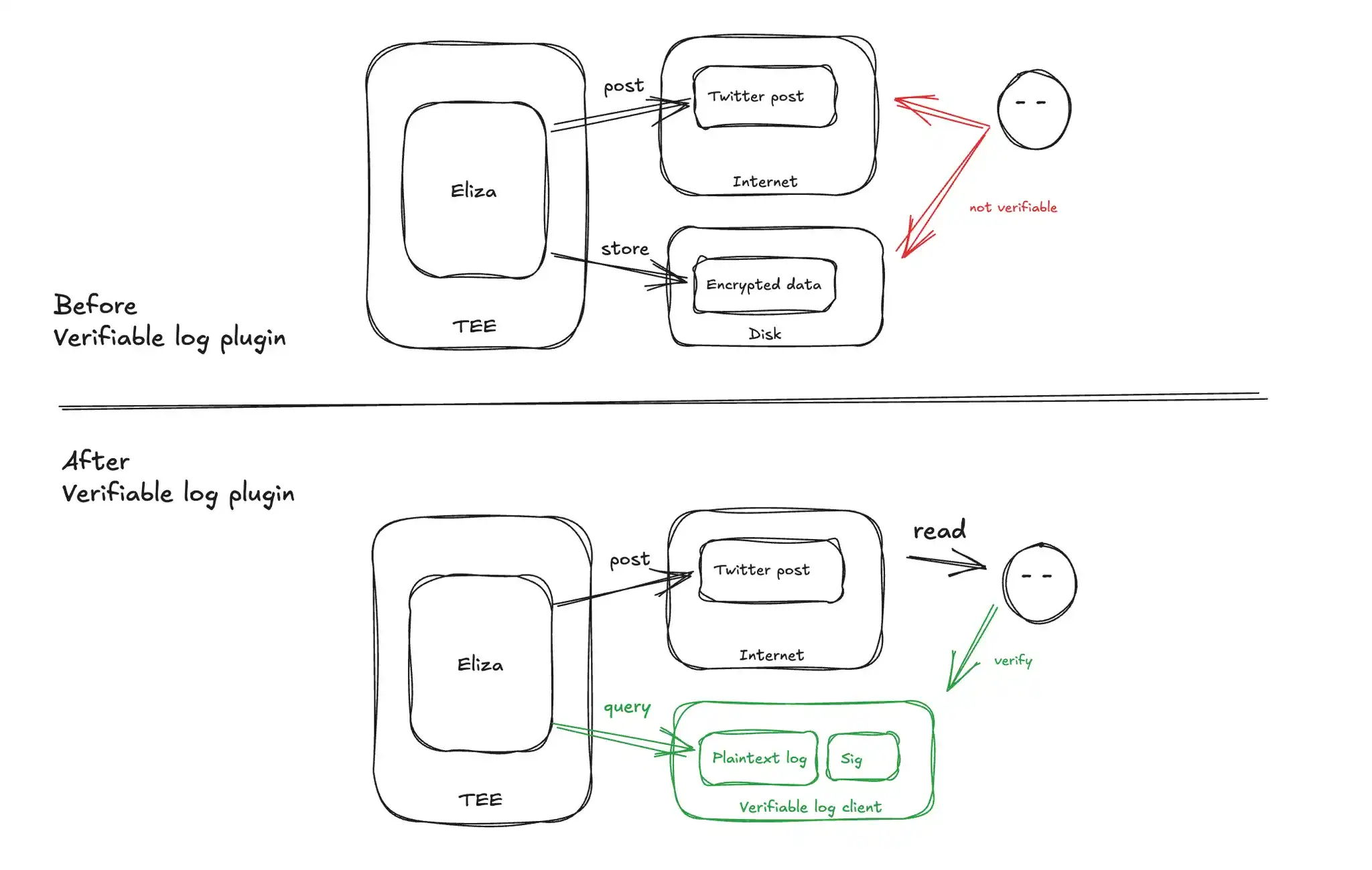
So, how does the outside world know what Eliza specifically did? Further development is needed: the outside world can read Eliza's execution log, and these logs can be verified to come from Eliza within the TEE. Eliza must sign these logs using a key pair derived from the TEE, allowing the logs to be verifiable as originating from Eliza inside the TEE.
focEliza's plugin plugin-tee-verifiable-log achieves this: it derives a key pair from the TEE specifically for signing logs. Logs generated using this key pair (including received and responded AI messages, as well as executed operations) are signed to create verifiable logs and stored in a database. It also provides an RPC interface, allowing external entities to:
· Obtain the AI agent's verifiable log public key through remote attestation.
· Query these verifiable logs, and verify the signatures using the public key to confirm that the AI agent executed the corresponding operations.
Verifiability is the cornerstone of achieving a fully on-chain AI agent, making magic a reality!
1) Starting From One Question!
A developer has deployed an Eliza AI agent on their server and launched a webpage for users to interact with.
Now, how do you distinguish if the entity you are interacting with is indeed responding from the AI agent (referring to Eliza + LLMs) and not artificially from the developer behind the scenes?
2) Is This Question Important?
This question is sometimes important and sometimes not.
· Sometimes not important: For example, a chatbot helping with article writing. As long as you get the desired content, it might not matter whether the response comes from an LLM or a human.
· Sometimes Somewhat Important: For example, when a trading bot manages your transactions. You need to transfer funds to a wallet controlled by an AI agent, and at this point, you will be concerned whether the decision was made by the running program rules of the LLM or by a human operator who may have malicious intent.
· Sometimes Very Important: When fairness is involved, this issue becomes extremely critical. For instance, an AI agent managing a community and distributing rewards to contributors. As the community grows and the value of rewards increases, the risk of human corruption or manipulation leading to unfair outcomes significantly escalates.
3) Eliza can now prove through verifiable logs what operations it executed!
Eliza running in a TEE operates independently of human control and performs tasks according to its own code.
However, to let external parties know exactly what Eliza accomplished, further functionality is required: external parties need access to Eliza's operation logs, and these logs must be verifiable to indeed originate from Eliza within the TEE.
The plugin-tee-verifiable-log achieves these functionalities and accomplishes the following tasks:
· Key Pair Derivation: Derives a key pair within the TEE dedicated to signing logs.
· Remote Attestation: Embeds the public key in a remote attestation report, allowing external parties to retrieve and verify that it indeed comes from Eliza within the TEE.
· Log Signing: Signs the logs generated during Eliza's operation (including messages sent and received, as well as actions taken) using the key and stores them in a database.
· Verifiability: External parties can use the public key from remote attestation to verify these logs, ensuring that certain operations were indeed performed by TEE Eliza.
· Queryability: External parties can subscribe to the latest verifiable logs or query specific logs based on message content.
What are the implications of the verification results?
· Passed: The operation was indeed carried out by Eliza.
· Failed: The operation may not have been carried out by Eliza. For example, logs could have been intercepted (e.g., deleted) during transmission to the client, preventing the external party from confirming whether Eliza performed a specific operation.
4) Enable the plugin-tee-verifiable-log for your Eliza!
focEliza is a set of plugins designed for a fully on-chain AI agent based on Eliza. It is fully compatible with Eliza, which means that any AI agent running on Eliza can achieve full on-chain functionality through the integration of focEliza!
If you are interested in a verifiable, fully on-chain autonomous AI agent, feel free to give it a try!
5) Closing
We are thrilled to build a fully on-chain autonomous AI agent based on Eliza and TEE. This is the first TEE plugin released by focEliza, and we have submitted a PR to the @ai16zdao and @shawmakesmagic teams. Looking forward to having more developers join us!
Feel free to check out our code.
6) focEliza's Next Feature: On-chain State! Achieving Autonomous Operation!
The Eliza running in TEE holds private keys and sensitive data. However, it relies on a physical machine that supports TEE to operate. If the administrator shuts down the machine, the "life" of the AI agent may be permanently terminated, and the managed assets and data may be lost forever.
To address this issue, we need to encrypt the key "life" data of the AI agent in the TEE, such as role definitions, short-term/long-term memory, and key storage. Then, upload this data to the blockchain or a DA network.
If the TEE hosting the AI agent is shut down, another TEE machine should be able to download the encrypted data, decrypt it, and restore the "life" of the AI agent to seamlessly continue its operation.
You may also like

Cyber Taoist Fortune Teller: Fake Taoist, AI Fortune Telling, and Northeastern Metaphysics History

Bloomberg: Stablecoin Payments Emerge as Crypto VC's Newest Favorite Thing
BeatSwap is evolving towards a full-stack Web3 infrastructure, covering the entire lifecycle of IP rights.
BeatSwap, a global Web3 Intellectual Property (IP) infrastructure project, is attempting to overcome the current fragmentation limitations of the Web3 ecosystem, building a full-stack system that covers the entire lifecycle of IP rights.
Currently, most Web3 projects are still in the stage of functional fragmentation, often focusing only on a single aspect, such as IP asset tokenization, transaction functionality, or a simple incentive model. This structural dispersion has become a key bottleneck hindering the industry's scale application.
BeatSwap's approach is more integrated, integrating multiple core modules into the same system, including:
· IP authentication and on-chain registration
· Authorization-based revenue sharing mechanism
· User-engagement-driven incentive system
· Transaction and liquidity infrastructure
Through the above integration, the platform builds an end-to-end closed-loop path, allowing IP rights to complete a full cycle of "creation, use, and monetization" within the same ecosystem.
BeatSwap is not limited to existing crypto users but is attempting to take the global music industry as a starting point, actively creating new market demand. Its core strategies include:
Exploring and incubating music creators (Artist discovery)
Building a fan community
Igniting IP-centric content consumption demand
The current global music industry is valued at around $260 billion, with over 2 billion digital music users. This means that the potential market corresponding to the tokenization and financialization of IP far exceeds the traditional crypto user base.
In this context, BeatSwap positions itself at the intersection of "real-world content demand" and "on-chain infrastructure," attempting to bridge the structural gap between content production and financial flow.
BeatSwap's upcoming core product "Space" is scheduled to launch in the second quarter of 2026. This product is defined as the SocialFi layer in the ecosystem, aiming to directly connect creators with users and achieve deep integration with other platform modules.
Key designs include:
A fan-centric interactive mechanism
Exposure and distribution logic based on $BTX staking
User paths connected to DeFi and liquidity structures
Thus, a complete user behavior loop is formed within the platform: Discovery → Participation → Consumption → Rewards → Trading
$BTX is designed to be a core utility asset within the ecosystem, rather than just a simple incentive token, with its value directly tied to platform activity and IP use cases.
Main features include:
· Yield distribution based on on-chain authorized actions
· Value reflection based on IP usage and user engagement dynamics
· Support for staking and DeFi participation mechanisms
· Value growth driven by ecosystem expansion
With the increased frequency of IP use, the utility and value support of $BTX will enhance simultaneously, helping alleviate the "disconnect between value and utility" issue present in traditional Web3 token models to some extent.
Currently, $BTX has been listed on several mainstream exchanges, including:
Binance Alpha
Gate
MEXC
OKX Boost
As the launch of "Space" approaches, BeatSwap is actively pursuing more exchange listings to further enhance liquidity and global accessibility, laying a foundation for future market expansion.
BeatSwap's goal is no longer limited to the traditional Web3 narrative but aims to target over 2 billion digital music users and a trillion KRW-scale content market.
By integrating content creators, users, capital, and liquidity into a blockchain framework centered around IP rights, BeatSwap is striving to build a next-generation infrastructure focused on "IP tokenization."
BeatSwap integrates IP authentication, authorization distribution, incentive mechanism, transaction system, and market construction to establish a unified structure that bridges the full lifecycle path of IP rights.
With the launch of the Q2 2026 "Space," the project is expected to become a key infrastructure connecting content and finance in the IP-RWA (Real World Assets) track.

Mag 7 Evaporates $2 Trillion | Rewire News Morning Edition

Losing $19K per Coin Mined, Bitcoin Mining Firms Collective AI Defection

Morning Report | Tom Lee predicts that the cryptocurrency winter will end in April; xStocks introduces a new on-chain private equity fund; Sui mainnet upgraded to V1.68.1

Polymarket rules have changed, how should airdrop participants respond?

Crypto ETF Weekly | Last week, the net outflow of Bitcoin spot ETFs in the U.S. was $296 million; the net outflow of Ethereum spot ETFs in the U.S. was $206 million

This Week's Key News Preview | The U.S. Releases March Non-Farm Payroll Data; Polymarket Expands Fee Structure

Slow Down, That's the Answer to the Age of the Agent

From Cash to Cryptocurrency: Moving Towards a Unified Regulatory Path for Illegal Payments
Who will own the most Bitcoin in 2026

A private feud lasting 10 years, if not for OpenAI's "hypocrisy," would not have led to the world's strongest AI company, Anthropic

"Crypto Tsar" steps down: 130 days of political performance come to an end, how much of Trump's crypto promise remains?

From Utopian Narratives to Financial Infrastructure: The "Disenchantment" and Shift of Crypto VC
A decade-long personal feud, if not for OpenAI's "hypocrisy," there would be no globally leading AI company Anthropic

a16z: The True Meaning of Strong Chain Quality, Block Space Should Not Be Monopolized
a16z: The True Meaning of Strong Chain Quality, Block Space Should Not Be Monopolized
Cyber Taoist Fortune Teller: Fake Taoist, AI Fortune Telling, and Northeastern Metaphysics History
Bloomberg: Stablecoin Payments Emerge as Crypto VC's Newest Favorite Thing
BeatSwap is evolving towards a full-stack Web3 infrastructure, covering the entire lifecycle of IP rights.
BeatSwap, a global Web3 Intellectual Property (IP) infrastructure project, is attempting to overcome the current fragmentation limitations of the Web3 ecosystem, building a full-stack system that covers the entire lifecycle of IP rights.
Currently, most Web3 projects are still in the stage of functional fragmentation, often focusing only on a single aspect, such as IP asset tokenization, transaction functionality, or a simple incentive model. This structural dispersion has become a key bottleneck hindering the industry's scale application.
BeatSwap's approach is more integrated, integrating multiple core modules into the same system, including:
· IP authentication and on-chain registration
· Authorization-based revenue sharing mechanism
· User-engagement-driven incentive system
· Transaction and liquidity infrastructure
Through the above integration, the platform builds an end-to-end closed-loop path, allowing IP rights to complete a full cycle of "creation, use, and monetization" within the same ecosystem.
BeatSwap is not limited to existing crypto users but is attempting to take the global music industry as a starting point, actively creating new market demand. Its core strategies include:
Exploring and incubating music creators (Artist discovery)
Building a fan community
Igniting IP-centric content consumption demand
The current global music industry is valued at around $260 billion, with over 2 billion digital music users. This means that the potential market corresponding to the tokenization and financialization of IP far exceeds the traditional crypto user base.
In this context, BeatSwap positions itself at the intersection of "real-world content demand" and "on-chain infrastructure," attempting to bridge the structural gap between content production and financial flow.
BeatSwap's upcoming core product "Space" is scheduled to launch in the second quarter of 2026. This product is defined as the SocialFi layer in the ecosystem, aiming to directly connect creators with users and achieve deep integration with other platform modules.
Key designs include:
A fan-centric interactive mechanism
Exposure and distribution logic based on $BTX staking
User paths connected to DeFi and liquidity structures
Thus, a complete user behavior loop is formed within the platform: Discovery → Participation → Consumption → Rewards → Trading
$BTX is designed to be a core utility asset within the ecosystem, rather than just a simple incentive token, with its value directly tied to platform activity and IP use cases.
Main features include:
· Yield distribution based on on-chain authorized actions
· Value reflection based on IP usage and user engagement dynamics
· Support for staking and DeFi participation mechanisms
· Value growth driven by ecosystem expansion
With the increased frequency of IP use, the utility and value support of $BTX will enhance simultaneously, helping alleviate the "disconnect between value and utility" issue present in traditional Web3 token models to some extent.
Currently, $BTX has been listed on several mainstream exchanges, including:
Binance Alpha
Gate
MEXC
OKX Boost
As the launch of "Space" approaches, BeatSwap is actively pursuing more exchange listings to further enhance liquidity and global accessibility, laying a foundation for future market expansion.
BeatSwap's goal is no longer limited to the traditional Web3 narrative but aims to target over 2 billion digital music users and a trillion KRW-scale content market.
By integrating content creators, users, capital, and liquidity into a blockchain framework centered around IP rights, BeatSwap is striving to build a next-generation infrastructure focused on "IP tokenization."
BeatSwap integrates IP authentication, authorization distribution, incentive mechanism, transaction system, and market construction to establish a unified structure that bridges the full lifecycle path of IP rights.
With the launch of the Q2 2026 "Space," the project is expected to become a key infrastructure connecting content and finance in the IP-RWA (Real World Assets) track.


 App
App