
Exploring BTC On-Chain Data: Initial "Trend Decay" Signal Emerges


Original Author: Murphy, On-chain Data Analyst
Initial Signal of Stage-wise "Trend Decay" Identified for the First Time!
Preface
Looking back at this cycle, it has been very different from the past in many ways. For example, for the first time in a bull market cycle, we experienced a macro contraction combined with a significant election rally, for the first time we broke the previous all-time high before the halving, for the first time a spot ETF was formally recognized by traditional capital, for the first time there is hope of becoming a financial reserve asset in developed countries, bringing us endless expectations for the future...
Against this backdrop, I, like all of you, am extremely excited. However, I am well aware that while belief is essential, fundamentally I am a player. I did not enter the crypto space as a tourist but to make money; I am also a trend investor, not a cross-cycle investor, and everything I do is aimed at increasing the amount of BTC in my wallet, not just increasing its USD value.
I believe that any financial asset, trend, and cycle always objectively exist. It is fundamentally a relationship of supply and demand, a shift in sentiment, capital seeking profit, and above all, human nature! Therefore, I study on-chain data in the hope of analyzing the factors that influence trend and cycle shifts, making rational judgments, guiding trades, and allowing myself to earn money with a higher certainty than opening blind boxes.
That is, to grasp the trend, increase BTC holdings, and better prepare to embrace the boundless opportunities of the crypto market's future!
Main Content
Following BTC's historic high of $73,000 on March 13, 2024, a prolonged 7-month oscillating downtrend began, until a trend reversal occurred after testing the $60,000 psychological support on October 10, ushering in a new uptrend. Over the next 2 months from October to December, the data consistently showed a strong trend without any signs of decay.
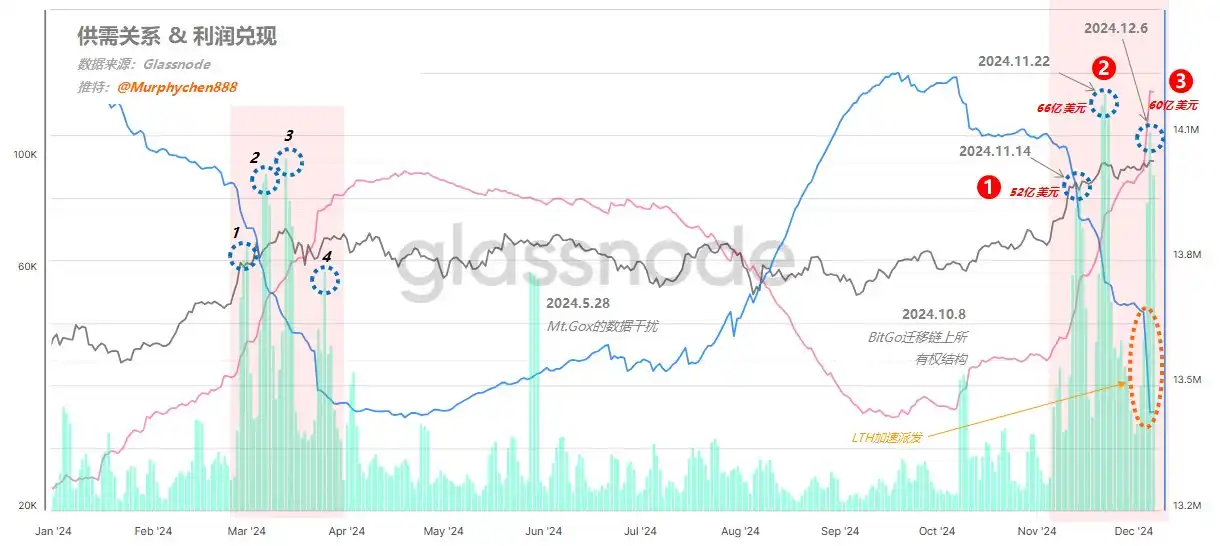
On November 8, I wrote an article titled "Escape the Top Series 6" (link at the end of the article), mainly discussing the application method and underlying logic of data related to "Supply and Demand Relationship & Profit Realization." The final conclusion was that when the following "three elements" appeared simultaneously after BTC broke the previous all-time high, it could be used as a basis to judge a stage-wise peak:
1. Long-Term Holders (LTH) accelerating distribution, possibly nearing completion;
2. Massive profit-taking exits occurring at the same time;
3. As the price rises, the peak of profit-taking exits is decreasing.
(Figure 1)
As shown in Figure 1, long-term holders (LTH) began their second large-scale distribution behavior in this hot cycle starting from October 7th. This indicates an increasing market demand capable of absorbing excess supply. On November 14th, the first wave of massive profit-taking exits occurred, totaling $5.2 billion (labeled 1 in Figure 1), with BTC's price at $87,000 that day. As I have analyzed in a previous tweet, historically, when LTHs start distributing and the first wave of massive profits is realized, it is usually not the relative peak, making it not an ideal selling point.
Indeed, on November 22nd, the second wave of massive profit-taking exits worth $6.6 billion (labeled 2 in Figure 1) appeared, with BTC's price at $98,900. This time, a higher price emerged along with higher profit-taking, showcasing the characteristics of a strong trend. Therefore, on November 24th, I tweeted again: "Don't rush! Patience is needed now more than ever."
On December 6th, the third wave of massive profit-taking exits amounting to $6 billion (labeled 3 in Figure 1) occurred, which was smaller in scale compared to the second wave, with BTC's price at $99,900. This marked the first instance in this trend cycle where all three elements of the "triad of judgment" were met. That is, 1. LTH accelerated distribution, 2. accompanied by massive profit-taking exits, and 3. the price was higher but the peak profit was lower.
When all 3 conditions are met simultaneously, it indicates a sign of attenuation in the current strong trend!
In my data analysis system, I never draw conclusions easily based on the appearance of a single indicator or signal. To confirm the above, I need to integrate and observe several other data points (due to the limit on the number of images in tweets, I will not include the data chart from the previous cycle in the following analysis, only the current one).
1. Capital Inflow Situation
(Figure 2)
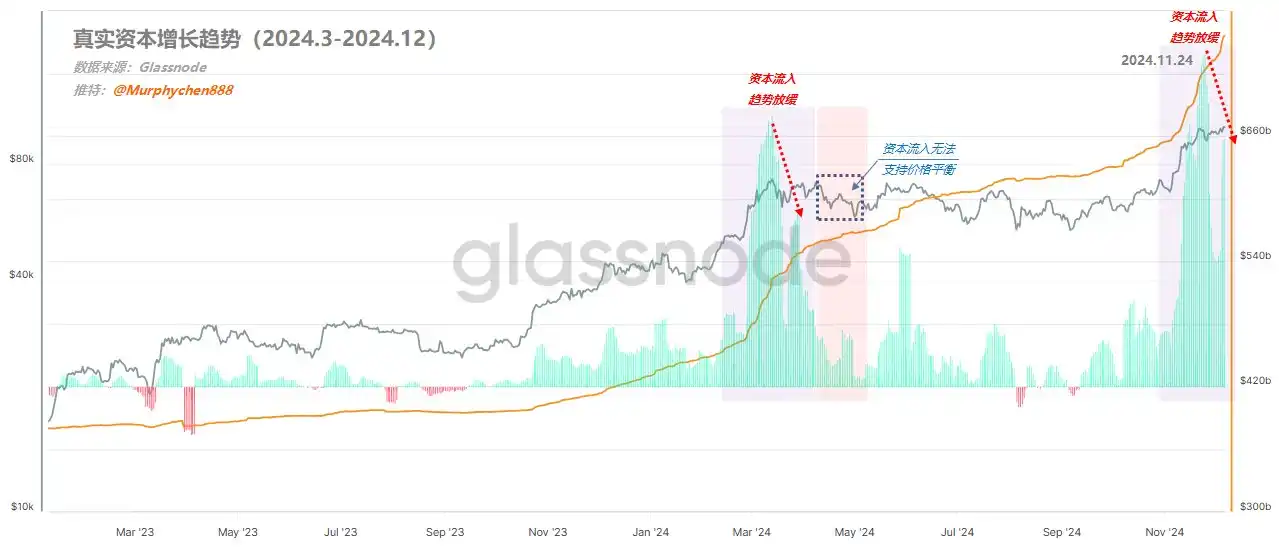
As shown in Figure 2, whenever the trend of incoming real capital begins to slow down, the momentum of BTC price growth will start to weaken. Until the capital inflow cannot sustain the price balance, a retracement will follow as expected. Similar situations have occurred in May 2021, November 2021, and April of this year.
During this trend from November 24th to December 7th, the overall scale of capital inflows is gradually decreasing. Although the price has not experienced a sharp correction, if another peak of capital inflow (higher than the previous high) does not occur in the short term, this downward trend will gradually affect the momentum of BTC price growth.
2. Evaluation of New Demand
(Chart 3)
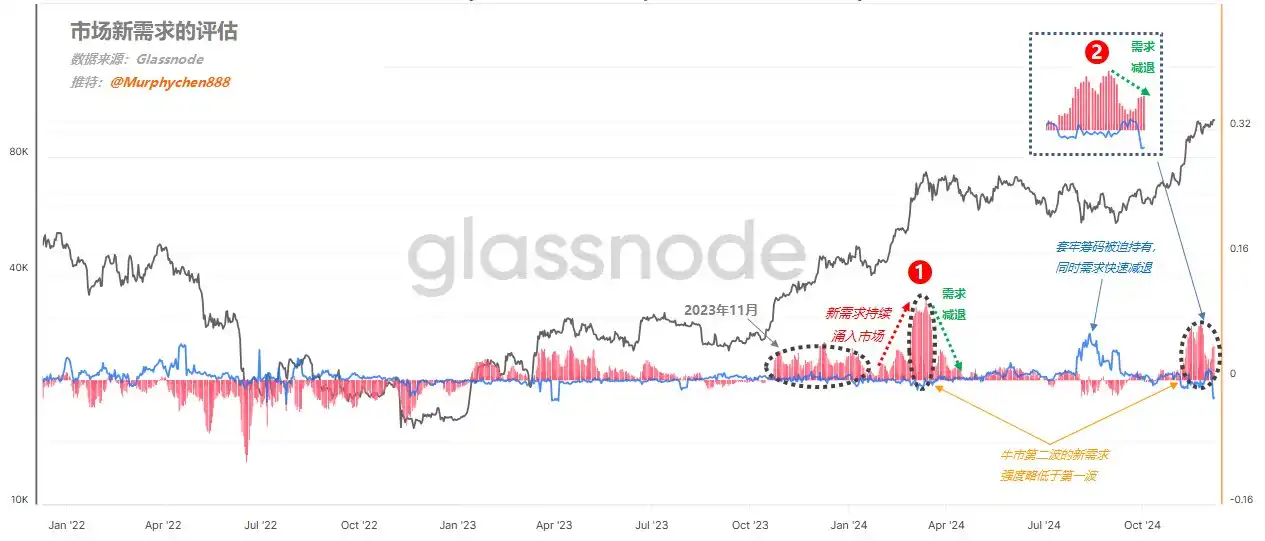
As shown in Chart 3, the sudden surge in the bottom red waveform indicates a large amount of new demand entering the market in the short term. With the continuous influx of demand, BTC usually experiences a strong uptrend; similar situations have occurred in May 2017, November 2020, October 2021, and November 2023.
When the demand begins to wane, BTC will enter a consolidation period; if there is no new demand entering in the short term, the trend will gradually shift, and the market will enter a pullback phase (as indicated in Chart 3).
The sudden rise in the bottom blue line in the chart indicates that the short-term chips trapped at a high level have turned into long-term chips due to passive holding, which will represent the most emotionally unstable long-term holders in the future. Once the price rises again, they will become the primary selling pressure in the market.
Currently, we observe a decrease in market demand (as indicated in Chart 3), and this overall demand scale of this wave is slightly lower than in March of this year, only far surpassing March in sentiment.
3. Market Sentiment Dominance
(Chart 4)
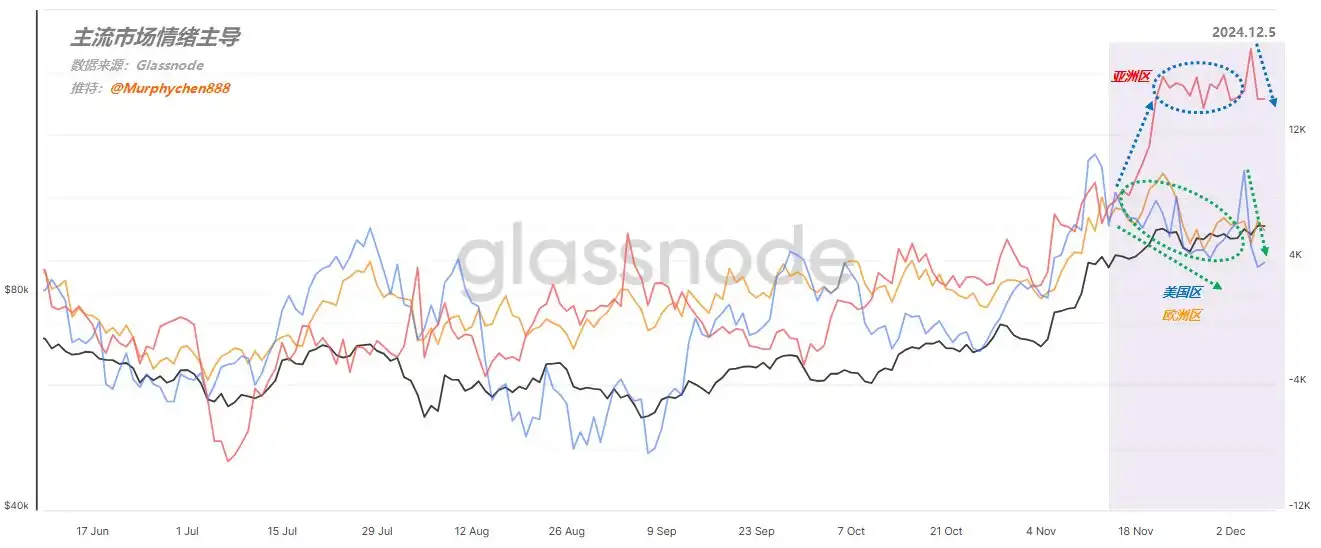
We can clearly see who is dominating the current market from Chart 4. The red line is much higher than the blue and yellow lines, indicating that Asian investors are the main driving force. American investor sentiment only experienced a rapid rebound on December 5th, but unfortunately, it quickly returned to its original level the next day; European sentiment has remained flat throughout. After all, with the Christmas holiday approaching, the gradual withdrawal of sentiment dominance by European and American investors is understandable.
However, what we hope to see is whether the peak of capital inflow can be restored and whether continuous new demand can sustainably enter the market, providing fundamental support for BTC price growth. Ultimately, it still depends on American investors.
Final Thoughts
The shrinking of new demand, slowing capital inflow, accelerated distribution by Long-Term Holders (LTH), and a peak in profit-taking not as high as before... From observations of multiple data points, the conclusion that this round's trend in the "Supply-Demand Relationship & Profit-Taking" data is showing signs of decay is traceable and substantiated.
Seeing a signal does not necessarily mean an immediate pullback; sometimes, there may even be another push higher because market sentiment tends to have inertia.
What will I do? — Of course, I will start executing a phased profit-taking plan. This signal is the "sell point" I have been waiting for. During a bear market cycle, buy orders are phased in at several "buy points" based on indicator signals. Similarly, in a bull market cycle, there cannot be only a single "sell point." The key is to plan well and seize each occurrence of a "sell point."
What if my judgment is wrong? — There is no trading system in the world that is flawless and never makes mistakes. As long as it aligns with one's risk preference and profit expectation, is logical, executable, and can form a closed loop, it is a good system. Understanding goes only this far; money beyond understanding cannot be earned.
However, it is important to note that data cannot predict the future! It is also possible that the comprehensive data mentioned above may suddenly undergo a fundamental reversal due to some event, causing metrics such as capital inflow, new demand, emotion-driven forces, and profit-taking to start turning upwards again. In that case, pause the "phased profit-taking" plan and patiently wait for the next signal indication.
This is just my personal plan, which may not be correct, and certainly does not mean you should do the same. Everyone has different holding amounts, risk preferences, and understandings of the top range. My sharing is for data reference only and not investment advice!!
You may also like

Morning Report | BitMine increased its holdings by 126,971 ETH last week; trader Eugene announced his exit from the crypto market

Wang Chuan: How can one not feel anxious after the neighbor Old Wang made thirty times profit by investing in storage stocks? (Seven) - A quarter-century cycle

Cryptocurrency CEXs are flocking to sell US stocks, and traditional brokerages are facing an "uninvited guest."

$75 billion in foreign capital has fled, and South Korean retail investors have absorbed it all using leverage

Japan’s Three Megabanks Plan Joint Stablecoin Issuance in Fiscal 2026
MUFG, SMBC, and Mizuho reportedly plan to jointly issue fiat-pegged stablecoins in fiscal 2026, signaling Japan’s growing push into bank-led digital payment infrastructure.

Humanity Discloses H Token Dual-Chain Attack Details, With Losses on Ethereum and BSC Exceeding $36 Million
Humanity said the H token attack across Ethereum and BSC caused more than $36 million in losses after leaked ProxyAdmin keys enabled malicious contract upgrades and token minting.
White House Discusses CLARITY Act With Law Enforcement Ahead of Senate Vote
The White House discussed the CLARITY Act with law enforcement ahead of a Senate vote, focusing on illicit finance risks and developer protections.

Bitcoin Trading Guide 2026: Strategies for Experienced Traders

What Is XAUT and PAXG? Why Tokenized Gold Is Booming in 2026

Will the SpaceX IPO Hurt Bitcoin? Here's What Traders Are Watching

Foreign selling in the South Korean stock market accelerates, with cumulative net sales reportedly reaching $75 billion this year
On June 9, The Kobeissi Letter, citing Goldman Sachs data, reported that global investors are selling South Korean stocks at an unusually rapid pace. In the latest trading session, foreign investors sold about $801 million worth of Kospi constituent stocks again; total foreign outflows last week reached about $10 billion, and the market has been in net foreign selling on nearly every trading day over the past month. According to the data cited in the report, foreign investors have sold about $75 billion worth of South Korean stocks so far this year. Meanwhile, South Korean retail and institutional investors together recorded roughly $69 billion in net buying over the same period, suggesting that the market’s main buying support has come from domestic capital rather than returning overseas funds. The information currently disclosed still mainly comes from The Kobeissi Letter’s retelling and Goldman Sachs data summaries, while public details on the statistical period and the specific definition of “selling” remain relatively limited.

Fortune Warns of Strategy’s Financing Structure Risks as Bitcoin Premium Narrows
Fortune warned that Strategy’s Bitcoin treasury model faces growing financing risks as MSTR’s net asset premium narrows and preferred stock dividend pressure increases.

Ferrari Challenge Le Mans: Carl Moon to Dominate in WEEX Livery

Sahara AI Responds to SAHARA’s Sharp Drop: No Contract or Product Security Issues Found, Internal Investigation Underway
Sahara AI responded to SAHARA’s 60% price drop, saying no token contract or product security issues have been found and an internal investigation is underway.

WEEX Deposit/Withdrawal Dynamic Island: Your Asset Status, Always in Sight
Scaling Crypto Derivatives: The Digital Asset Infrastructure Behind High-Volume Trading
In the fast-moving digital asset ecosystem, derivatives platforms face an extreme architectural test. High-leverage futures markets demand more than just standard security—they require absolute operational precision, zero-latency matching engines, and ironclad structural scalability, all while navigating intense market volatility.
As global platforms scale to meet these demands, the industry is shifting away from rigid, monolithic setups toward a more agile, "decoupled" infrastructure philosophy.
The Blueprint for High-Volume Copy TradingFor elite global exchanges like WEEX (founded in 2018), this architectural choice becomes critical when scaling high-volume retail features like social copy trading. When thousands of users automatically mirror the real-time strategies of elite traders simultaneously, it triggers sudden, monumental spikes in concurrent transactional volume.
To prevent execution latency or settlement bottlenecks during these peak volatility events, a platform's primary engine must remain entirely dedicated to risk management, copy-trade synchronization, and order matching.
The Architectural Rule: New-generation platforms must separate front-end user execution engines from heavy backend infrastructural overhead to eliminate operational friction.
By separating these layers, platforms can maintain complete sovereignty over their trading environments and user experiences while strategically aligning with institutional-grade infrastructure ecosystems. This strategic framework allows modern exchanges to leverage advanced Digital Asset Custody infrastructure such as Cobo’s behind the scenes, ensuring that backend wallet management scales elastically alongside trading spikes.
Capitalizing on Market Momentum and 400× LeverageIn a derivatives arena where platforms offer up to 400× leverage on perpetual contracts, capital efficiency and market agility are core business metrics. To capture market momentum, an exchange needs the ability to rapidly expand its asset offerings, supporting everything from legacy crypto assets to sudden, trending altcoins across a massive library of trading pairs.
Adopting a flexible, scalable Wallet-as-a-Service (WaaS) solution such as Cobo’s could completely rewrite the development timeline for high-growth exchanges. Instead of spending months of engineering capital building out custom backend wallet architectures for every new blockchain network, platforms can deploy localized infrastructure in days.
This agility allows platforms to instantly scale their listings to over a thousand trading pairs without compromising security or delaying time-to-market. It mirrors the exact operational advantages seen during high-velocity market events, similar to how advanced wallet infrastructure empowers platforms during sudden asset surges; allowing exchanges to pass that speed and liquidity directly to their global user base.
A Mature Foundation for GrowthThe synergy between trusted infrastructure ecosystems and global trading platforms represents the natural evolution of a maturing crypto market. As WEEX continues to scale its global spot and derivatives offerings for over 6 million users, adopting robust backend paradigms proves that platforms no longer have to compromise between cutting-edge trading velocity and uncompromised structural security.

Get Paid to Onboard? Try WEEX’s New Homepage with Rewards for Registration, Deposit & Trade
WEEX Custom Layout: Build Your Perfect Trading Workspace in Seconds
Morning Report | BitMine increased its holdings by 126,971 ETH last week; trader Eugene announced his exit from the crypto market
Wang Chuan: How can one not feel anxious after the neighbor Old Wang made thirty times profit by investing in storage stocks? (Seven) - A quarter-century cycle
Cryptocurrency CEXs are flocking to sell US stocks, and traditional brokerages are facing an "uninvited guest."
$75 billion in foreign capital has fled, and South Korean retail investors have absorbed it all using leverage
Japan’s Three Megabanks Plan Joint Stablecoin Issuance in Fiscal 2026
MUFG, SMBC, and Mizuho reportedly plan to jointly issue fiat-pegged stablecoins in fiscal 2026, signaling Japan’s growing push into bank-led digital payment infrastructure.
Humanity Discloses H Token Dual-Chain Attack Details, With Losses on Ethereum and BSC Exceeding $36 Million
Humanity said the H token attack across Ethereum and BSC caused more than $36 million in losses after leaked ProxyAdmin keys enabled malicious contract upgrades and token minting.


