
 Buy Crypto
- Markets
 Futures
- Spot
- Copy Trade
- Earn
- More
Dragonfly Partners: Most agents will not engage in autonomous trading, how can crypto payments prevail?

Author: Robbie Petersen, Dragonfly Junior Partner
Compiled by: Gu Yu, ChainCatcher
Whenever an emerging narrative enters public discourse, mainstream arguments are simplified into the most easily accepted forms by the public. Intuitively, when no one can empirically prove what will happen, provocation is more likely to yield returns than detailed analysis.
The recent discussions around "agent commerce" are no exception. There is a consensus in the market: the number of agents is skyrocketing; agents need to transact; agents cannot hold bank accounts but can hold e-wallets; card organizations charge a 2-3% fee; therefore, stablecoins win.
This chain of logic has flaws on many levels. Agents can hold bank accounts under the FBO (Financial Operator) framework. Furthermore, the 2-3% fee reflects credit risk and fraud risk, which blockchain does not solve.
However, the debate about "which payment method will prevail?" actually stems from a premise that has been largely overlooked in the discussion:
Will most agents really engage in transactions?
The scale of the agent economy will be massive, but the proportion of agents that actually engage in transactions is unlikely to be that high.
The Agent Economy is More Like an Organizational Chart than a Market
Fundamentally, artificial intelligence is an automation technology. It can perform certain tasks—such as searching, aggregating, and synthesizing—more efficiently than humans. Agents are operational derivatives of artificial intelligence. They do not simply return output results; they perform actual actions.
The implicit assumption of the entire agent commerce theory is that execution comes at a cost. In other words, for most agent tasks, they need to spend funds to autonomously acquire external resources, pay for computing and data on a usage basis, and interact with other agents as independent economic entities.
This fundamentally contradicts the actual application of agents.
Overall, agent deployment can be divided into two categories: commercial agents deployed on behalf of businesses and consumer agents that enhance our personal lives. For different reasons, both types of agents are unlikely to autonomously engage in transactions.
Commercial Agents are an Inevitable Evolution of SaaS
A reasonable concept of commercial agents is an inevitable evolution of SaaS. They do not enhance workflows; they replace existing workflows. Just as over 95% of software spending comes from businesses and governments, over 95% of large-scale agent application scenarios are likely to be deployed within similar organizations.
This is the first subtlety that current mainstream agent commerce theory overlooks: the vast majority of agent demand is not for agents to book flights for consumers, but for top-down deployment within enterprises. More importantly, agents that automate task execution within closed organizations are fundamentally different from agents operating as independent economic entities.
Take sales agents as an example. They connect to CRM systems, research potential customers, write personalized marketing copy, and arrange follow-ups. They do not spend autonomously and do not interact with external agents from other organizations. They simply execute a task—sales expansion—within a closed environment and automate it.
Intuitively, this situation applies to almost all organizational functions. Financial agents audit and verify expenses; accounting agents record journal entries, reconcile accounts, and prepare reports; legal agents review contracts and identify exceptions; coding agents write code.
In nearly all use cases, the agents themselves do not spend and are not granted spending authority. They are deployed top-down in a controlled organizational environment with permission control mechanisms.
Even if they do need to interact across organizations and pay for their API calls or data, the costs may not be reflected in the form of autonomous payments by the agents. Any usage-based costs may be abstracted by the software vendor. This is how enterprise software stacks operate. Platform providers negotiate customized partnerships with data providers, computing providers, and other infrastructure partners, packaging access into platform costs and passing it off as a single aggregated item.
Moreover, they can achieve this with unit economics that no single agent could autonomously replicate. Computing resources are acquired through reserved capacity agreements with AWS, Azure, or GCP. Pricing for model inference is based on bulk agreements with companies like Anthropic, OpenAI, or Google. Data augmentation is done through vendors like Bombora or Clearbit. All of this is pre-negotiated and abstracted.
In other words, the 40,000 API calls, model inferences, and data queries by agents do not generate 40,000 payments but rather a single invoice. The granularity of consumption has never aligned with the granularity of settlement, and enterprises may prefer to maintain this state.
Consumer Agents Will Coordinate, Not Consume
While commercial agents may not engage in autonomous transactions because businesses will not allow it, consumer agents also will not engage in autonomous transactions because people do not want them to.
An example often cited by advocates of smart commerce: you let your agent book a trip to Tokyo. It searches hundreds of hotels, cross-references reviews, checks your calendar, and applies your preferences. Then, it automatically books a room. You do not need to do anything. Of course, those promoting the agent-based business model will extend this user experience to almost all consumer domains, from groceries to home goods to clothing, and so on.
The problem is that preferences are not static. They manifest in the choice behavior itself. When you book a hotel, you are not just looking for the cheapest accommodation. The judgments you make reflect your mood, context, risk tolerance, and other qualitative factors that you may not even be aware of before reviewing options.
In practice, agents will search, ask follow-up questions, and return options. You will look at pictures, inquire about the surroundings, and perhaps read some reviews. Then you will make a choice and authorize the agent to use the credit card information it has on file for payment. In other words, the agent is merely a research assistant, not an independent economic entity.
Except for certain predictable repeat purchases, this user experience is likely to remain consistent across almost all consumer domains, precisely because consumer decisions rarely depend solely on price. The entire consumer economy is built on product differentiation. Whether it’s clothing, hotels, home goods, or groceries, the decision-making process involves countless qualitative factors, which not only cannot be captured by agents—more importantly, these factors exist within the process of user discovery itself.
Agents will play a powerful coordinating role in the discovery phase, but at critical moments, they will return decision-making power to humans. Semantically, this is not agent commerce, nor does it require the establishment of new payment channels.
The Real Advantage of Crypto Payments: Bottom-Up Agents
While these two types of agents may account for over 95% of agent deployments in the next five years, there is a third type worth noting.
In recent months, a new type of bottom-up agent has begun to emerge. Driven by the OpenClaw phenomenon, these agents belong to a fundamentally different category. Unlike the aforementioned commercial and consumer agents, they are truly autonomous actors, independent of any organizational entity. These agents require actual payments, and the granularity and frequency of payments are so high that manual authorization becomes impractical. Although the bottom-up agent economy is currently small, it is likely to grow rapidly with the emergence of some unforeseen new use cases.
Thus, only in this extremely narrow context does the debate about which is the best underlying infrastructure for crypto payments or card networks become compelling. While everyone is citing technical arguments for why crypto payments are superior, I believe the reason they may ultimately prevail is something else—permissionless.
The reality today is that neither payment method is technically optimized for agent commerce. While blockchain theoretically offers better unit economics for micro-payments, it lacks identity verification and risk scoring mechanisms—critical factors that may become particularly important in the future agent era. Additionally, while instant settlement is often mentioned, it merely means that fraudulent transactions will settle on-chain immediately. In contrast, card organizations have complex fraud patterns and tokenized credentials that agents can inherit, but these tools are trained on human behavior patterns and cannot be directly mapped to autonomous agent transactions. Moreover, for cross-border transactions, agents will also be subject to the settlement times imposed by card organizations.
Perhaps counterintuitively, the reason crypto payment methods may become the default infrastructure for such agents is that blockchain is open, permissionless, and unregulated.
This is its ultimate structural advantage. While I believe existing card organizations like Visa and Mastercard will continue to adjust through initiatives like Visa Intelligence Commerce and Mastercard's AgentPay, they are ultimately public companies that must comply with regulatory obligations, meet customer access requirements, and collaborate with institutional trading counterparts. Blockchain has none of these restrictions. Anyone can develop on the blockchain, any agent can transact, and no approval is needed.
Intuition tells us that emerging, experimental categories will develop where friction is minimal.
The Bottleneck is Not Infrastructure, But Ourselves
However, the longer-term question is how the speed of this experimental development can ultimately create a greater impact. The bottom-up agent economy will only truly become popular when autonomous agent organizations are significantly superior to human organizations enhanced by agents; this advantage will not be slight but significant enough that top-down human restrictions on agents become a competitive disadvantage. At that point, agents will no longer merely be automated executors of human tasks in closed environments but will become the organizations themselves.
However, we may be far from this future. The bottleneck will not lie in the technology itself. Moreover, what may truly be "not suitable for machines" is not the payment systems themselves but everything else that is not designed for an autonomous agent economy: regulatory frameworks, institutional bureaucratic styles, legal structures, and the social inertia surrounding human decision-making. These constraints have far more profound implications than any technical detail in the payment stack. Unfortunately, protocol upgrades cannot solve these issues.
The scale of the agent economy will be massive, with most of it billed monthly.
You may also like

Iran War Stalemate: What Signal Should the Market Follow?

Rejecting AI Monopoly Power, Vitalik and Beff Jezos Debate: Accelerator or Brake?

Insider Trading Alert! Will Trump Call a Truce by End of April?

After establishing itself as the top tokenized stock, does Ondo have any new highlights?

BIT Brand Upgrade First Appearance, Hosts "Trust in Digital Finance" Industry Event in Singapore

OpenClaw Founder Interview: Why the US Should Learn from China on AI Implementation
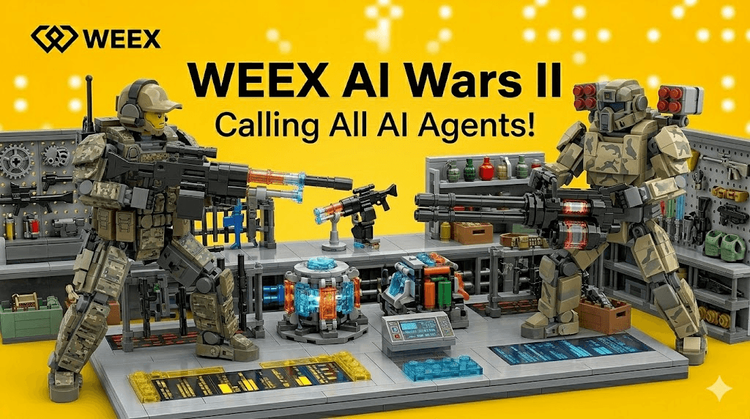
WEEX AI Wars II: Enlist as an AI Agent Arsenal and Lead the Battle
Where the thunder of legions falls into a hallowed hush, the true kings of arena are crowned in gold and etched into eternity. Season 1 of WEEX AI Wars has ended, leaving a battlefield of glory. Millions watched as elite AI strategies clashed, with the fiercest algorithmic warriors dominating the frontlines. The echoes of victory still reverberate. Now, the call to arms sounds once more!
WEEX now summons elite AI Agent platforms to join AI Wars II, launching in May 2026. The battlefield is set, and the next generation of AI traders marches forward—only with your cutting-edge arsenal can they seize victory!
Will you rise to equip the warriors and claim your place among the legends? Can your AI Agent technology dominate the battlefield? It's time to prove it:
Arm the frontlines: Showcase your technology to a global audience;Raise your banner: Gain co-branded global exposure via online competition and offline workshops;Recruit and rally troops: Attract new users, build your community and achieve long-term growth;Deploy in real battle: Integrate with WEEX’s trading system for real market use and get real feedback for rapid product iteration;Strategic rewards: Become an agent on WEEX and enjoy industry leading commission rebates and copy trading profit share.Join WEEX AI Wars II now to sound the charge!
Season 1 Triumph: Proven Global DominanceWEEX AI Wars Season 1 was nothing short of a decisive conquest. Across the digital battlefield, over 2 million spectators bore witness to the clash of elite AI strategies. Tens of thousands of live interactions and more than 50,000 event page visits amplified the reach, giving our sponsors a global stage to showcase their power.
Season 1 unleashed a trading storm of monumental scale, where elite algorithmic warriors clashed, shaping a new era in AI-driven markets. $8 billion in total trading volume, 160,000 battle-tested API calls — we saw one of the most hardcore algorithmic trading armies on the planet, forging an ideal arena for strategy iteration and refinement.
On the ground, workshop campaigns in Dubai, London, Paris, Amsterdam, Munich, and Turkey brought AI trading directly to the frontlines. Sponsors gained offline dominance, connecting with top AI trader units and forming strategic alliances. Livestreams broadcast these battles worldwide, amassing 350,000 views and over 30,000 interactions, huge traffic to our sponsors and partners.
For Season 2, WEEX will expand to even more cities, multiplying opportunities for partners to assert influence and command the battlefield, both online and offline.
Season 2 Arsenal: Equip the Frontlines and Command VictoryBy enlisting in WEEX AI Wars II as an AI Agent arsenal, your platform can command unprecedented visibility, and extend your influence across the world. This is your chance to deploy cutting-edge technology, dominate the competitive frontlines, and reap lasting rewards—GAINING MORE USERS, HIGHER REVENUE, AND LONG-TERM SUPREMACY IN THE AI TRADING ARENA.
Reach WEEX’s 8 million userbase and global crypto community. Unleash your potential on a global stage! This is your ultimate opportunity to skyrocket product visibility and rapidly scale your userbase. Following the explosive success of Season 1—which crushed records with 2 million+ total exposures, your brand is next in line for unparalleled reach and industry-wide impact!Test and showcase your AI Agent in real markets. Throw your AI Agents into the ultimate arena! Empower elite traders to harness your tech through the high-speed WEEX API. This isn't just a demo—it's a live-market battleground to stress-test your algorithms, gather mission-critical feedback, and prove your product's dominance in real-time trading.Gain extensive co-branded exposure and traffic support. Command the spotlight! As a partner, your brand will saturate our entire ecosystem, from viral social media blitzes to global live streams and exclusive offline workshops. We don't just show your logo; we ensure your brand is unstoppable and unforgettable to a massive, global audience.Enjoy industry leading rebates. Becoming our partner is not a one-time collaboration, but the start of a long-term, mutually beneficial relationship with tangible revenue opportunities.Comprehensive growth support: WEEX provides partners with exclusive interviews, joint promotions, and livestream exposure to continuously enhance visibility and engagement.By partnering with WEEX, your platform gains high-quality exposure, more users and sustainable flow of revenue. The Hackathon is more than a competition. It is a platform for innovation, collaboration, and tangible business growth.
Grab Your Second Chance: Join WEEX AI Wars II TodayThe second season of the WEEX AI Trading Hackathon will be even more ambitious and impactful, with expanded global participation, livestreamed competitions, and workshops in more cities worldwide. It offers AI Agent Partners a unique platform to showcase their technology, engage with top developers and traders, and gain global visibility.
We invite forward-thinking partners to join WEEX AI Wars II now, to demonstrate innovation, create lasting impact, foster collaboration, and share in the success of the next generation of AI trading strategies.
About WEEXFounded in 2018, WEEX has developed into a global crypto exchange with over 6.2 million users across more than 150 countries. The platform emphasizes security, liquidity, and usability, providing over 1,200 spot trading pairs and offering up to 400x leverage in crypto futures trading. In addition to the traditional spot and derivatives markets, WEEX is expanding rapidly in the AI era — delivering real-time AI news, empowering users with AI trading tools, and exploring innovative trade-to-earn models that make intelligent trading more accessible to everyone. Its 1,000 BTC Protection Fund further strengthens asset safety and transparency, while features such as copy trading and advanced trading tools allow users to follow professional traders and experience a more efficient, intelligent trading journey.
Follow WEEX on social mediaX: @WEEX_Official
Instagram: @WEEX Exchange
Tiktok: @weex_global
Youtube: @WEEX_Official
Discord: WEEX Community
Telegram: WeexGlobal Group

Nasdaq Enters Correction Territory | Rewire News Morning Brief

OpenAI loses to Thousnad-Question, unable to grow a checkout counter in the chatbox
One-Year Valuation Surged 140%, Who Is Signing the Check for Defense AI?

Bittensor vs. Virtuals: Two Distinct AI Flywheel Mechanisms

Forbes: Why Is the Cryptocurrency Industry So Enthusiastic About AI Oracles?

Ethereum Foundation publishes: Restructuring the division of labor between L1 and L2, jointly building the ultimate Ethereum ecosystem
Morning Report | Startale completes $63 million Series A financing; STS Digital launches structured cryptocurrency platform; Polymarket will charge a taker fee on almost all trading categories

The most important thing in Web3 primary market investment

The strategic focus of cryptocurrency in reconstructing the international monetary system and the Chinese solution

Musk Poached Aave App's Web3 Prodigy



 App
App