
 Buy Crypto
- Markets
 Futures
- Spot
- Copy Trade
- Earn
- More
Deep Dive into BTC On-chain Analysis: Where is the Short-Term Bottom?

Original Author: Murphy, On-chain Data Analyst
Chip Structure Determines the Lower Limit of BTC Price Pullback
Every event that drives market sentiment change is accompanied by a sudden surge in on-chain transaction volume. After data filtering to exclude transfers within the same entity address cluster, the daily on-chain actual transaction volume is usually around 100k BTC (7-day average), with more on weekdays and less on weekends; if it exceeds 150k BTC, it is considered an "abnormal" data point.
For example, the Luna flash crash in May 2022, the FTX flash crash in November 2022, and the collapse of U.S. banks such as Silicon Valley Bank and Signature Bank from March to April 2023 all brought extreme panic and anxiety to the market, with on-chain transaction volume peaking at over 300k BTC (see Figure 1).
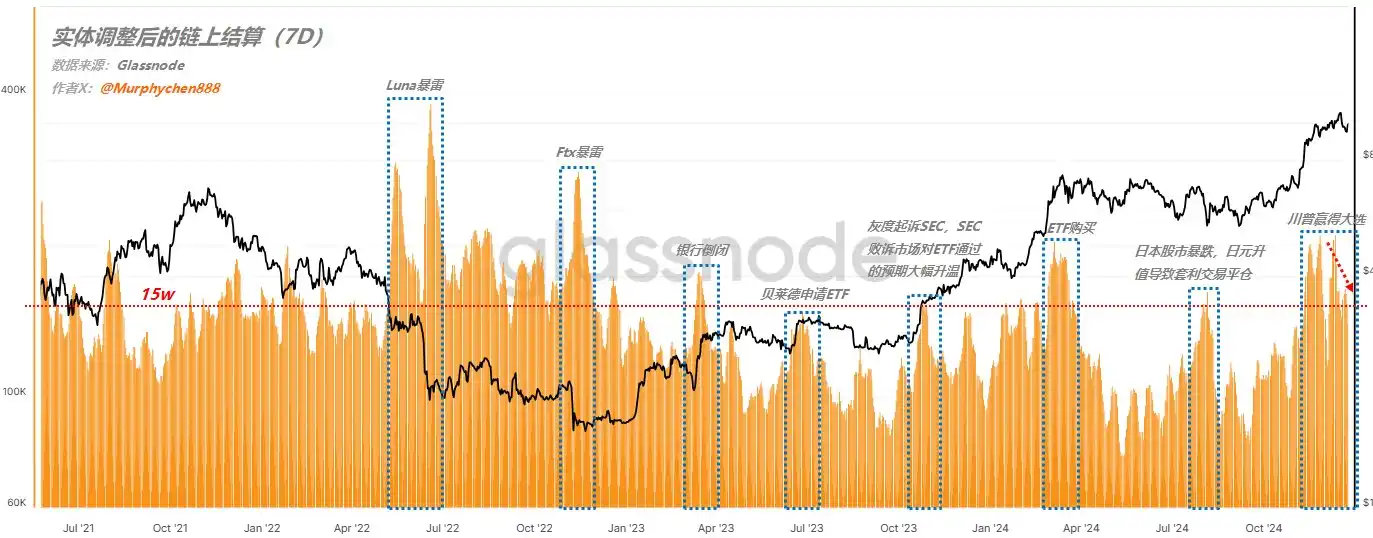
(Figure 1)
From this perspective, we should no longer doubt whether on-chain data can truly reflect "transaction" behavior. It can even be considered that BTC's on-chain settlement is the barometer of the entire crypto market's activity level and a quantified form of macro sentiment.
We can see that after November, as Trump won the presidential election, market sentiment reached a climax, with daily settlement volume reaching 200k. In this round of the cycle, a similar level was only seen in March of this year, indicating a large influx of capital in the short term. However, after December 17, the sentiment began to noticeably cool down, with the average daily settlement volume dropping to around 120k by the 25th. Historically, after experiencing a peak period, the ebb of activity also means that the market enters a period of calm, which is also the most vulnerable time for a pullback to occur.
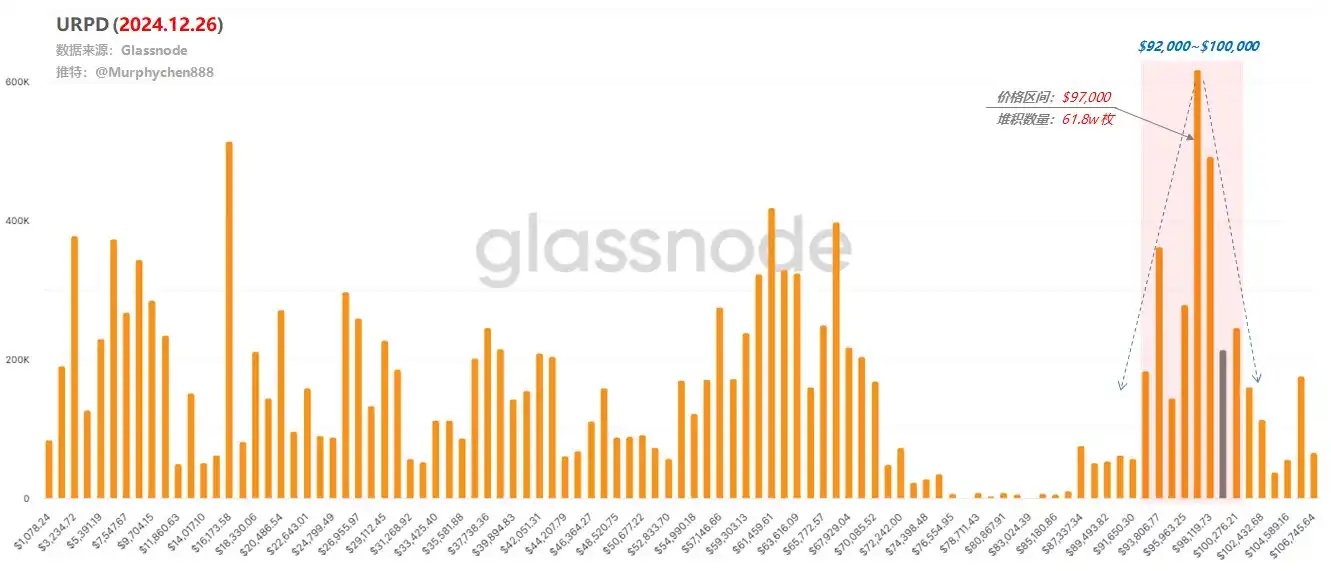
By tracking UTXOs and differentiating on-chain transactions based on different realized prices, we can derive a highly intuitive set of chip structure distribution data, known as URPD (see Figure 2).
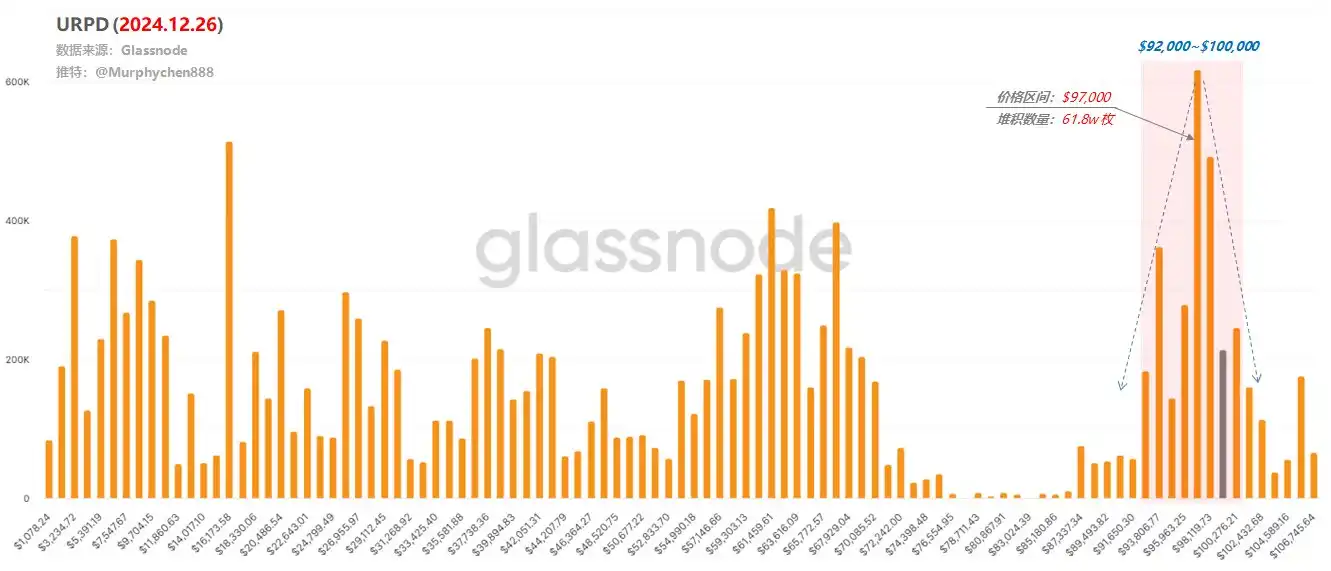
(Figure 2)
From the current data, the on-chain structure is gradually forming a chip accumulation zone in the $92,000 to $100,000 range, with a massive 600k BTC volume column at $97,000 as the peak, decreasing on both sides.
The Appearance of a Massive Volume Candle Indicates 2 Points:
1. The high likelihood that this is not the absolute top price of the bull market cycle.
2. The price range has experienced intense long and short positioning battles, with a large amount of turnover leading to chip stacking.
Where there are sellers, there are buyers. This indicates that some people here believe the price will continue to drop and want to hedge, while others believe the price at this level presents a good buying opportunity. It is precisely because of the significant buying behavior that the $92,000 to $100,000 range has established a strong support effect. This is why we say that the chip stacking zone has a "damping effect" on the price, meaning that the price will face resistance when trying to break through (difficult to penetrate), and there will be gravitational forces pulling the price back when it moves away.
If it is a major cycle top, there usually won't be much dissent, only "consensus." When the majority of participants reach a consensus that the price is "too high," naturally, there will be more selling than buying, and the market will naturally "peak." Therefore, dissent is not necessarily a bad thing; it is a necessary process for the market to self-correct.
If we must provide an example, a similar chip structure also emerged in July-August 2024 (as shown in Figure 3).
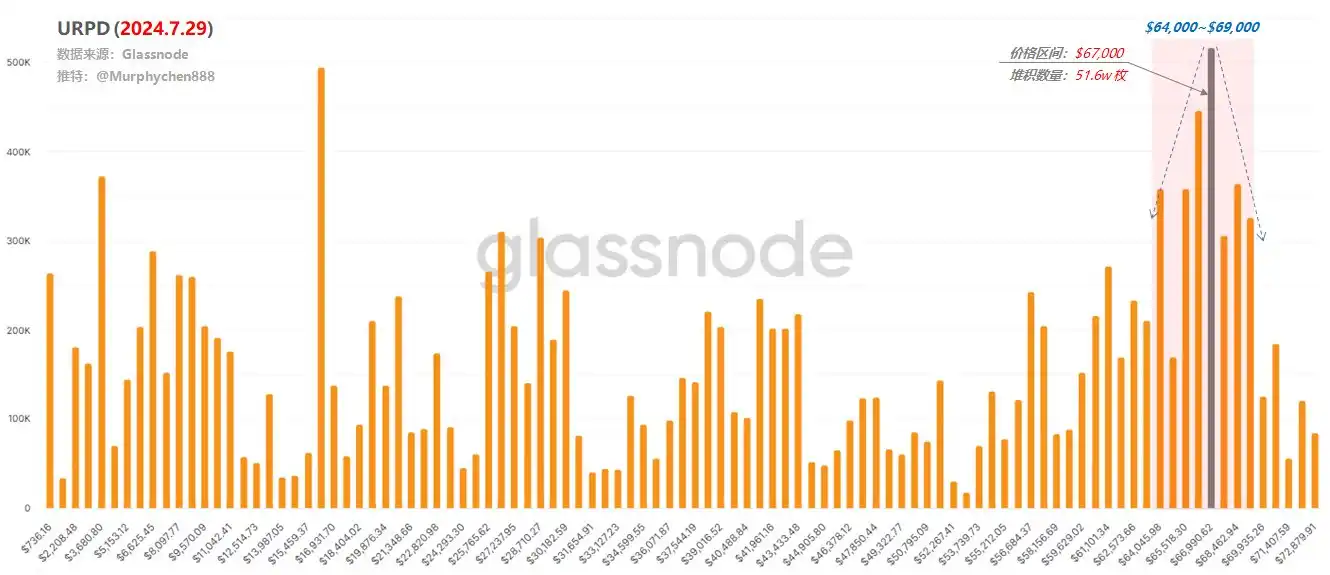
(Figure 3)
At that time, a chip stacking zone was formed in the $64,000 to $69,000 range, with a massive volume candle of 52k BTC created at $67,000 as the peak, gradually decreasing towards both sides, forming a regional price support. I believe everyone still remembers that for a long time after this, the price of BTC did not fall below this price range. Even when it started moving away from this range on August 5 and September 7, the chip structure in this range remained intact. After some time, the price of BTC will return to this range (experiencing gravitational pull).
If we compare the current structure with the horizontal structure in July, the patterns are very similar, but the current one is not as robust yet. Nevertheless, it has already shown a clear support role. Over time, as the turnover becomes more extensive here, the support effect will be stronger. Of course, if the price continues to break upwards, unless it surges quickly away from this price range, it will also be constrained by "gravity" (short-term high-level chips will create massive selling pressure).
We can also observe similar conclusions from CBD data from another perspective (as shown in Figure 4).
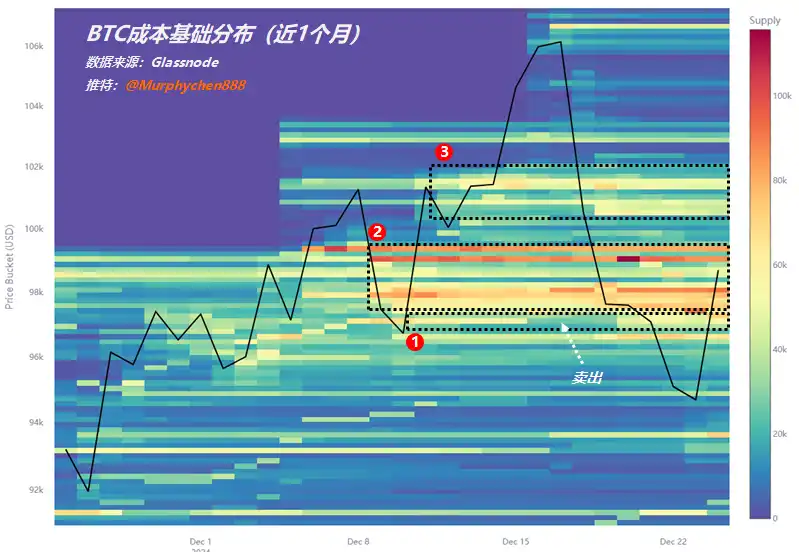
(Figure 4)
Unlike the URPD, which tracks the analysis of the original UTXO, the CBD (BTC Cost Basis Distribution) conducts data calculations per address. It better represents the overall behavior of network participants and can clearly display the trend of cost basis changes over time.
From Figure 4, we can see that as the BTC price retraced to below $100,000 on 12/8, the color changed from green to red, indicating an increase in the money supply (see Point 2). This suggests that a significant amount of bottom-fishing behavior occurred at that time. The chips bought during this period did not show a significant decrease even after the rebound on 12/16 and the subsequent fall on 12/23, with the cost basis remaining around $97,000-$100,000, forming effective support.
Additionally, the chips bought at the low point of $96,000 during the retracement on 12/10 were sold when the price rebounded to $105,000 on 12/16, causing the color to change from red to green (see Point 1). However, when the price retraced again to around $96,000 on 12/21, funds started to buy in. This group is likely engaged in short-term swing trading and represents the main group of on-chain turnover in recent days (STH).
The remaining chips trapped at high prices between $100,000 and $102,000 also account for a significant portion, but they are relatively firm in their positions. Currently, there is no significant decrease in their numbers.
In conclusion, the current market sentiment is gradually calming down, and liquidity is decreasing. However, the chip structure remains "healthy," with the price support formed in the $92,000-$100,000 range proving to be effective. As time passes and turnover increases, the support will strengthen (determining the lower limit). Whether we can see a new all-time high or reverse the trend decline will depend on the market's expectations of macro policies after entering January of the 25th year.
This content is for communication and research purposes only and should not be considered investment advice.
You may also like

Cyber Taoist Fortune Teller: Fake Taoist, AI Fortune Telling, and Northeastern Metaphysics History

Bloomberg: Stablecoin Payments Emerge as Crypto VC's Newest Favorite Thing
BeatSwap is evolving towards a full-stack Web3 infrastructure, covering the entire lifecycle of IP rights.
BeatSwap, a global Web3 Intellectual Property (IP) infrastructure project, is attempting to overcome the current fragmentation limitations of the Web3 ecosystem, building a full-stack system that covers the entire lifecycle of IP rights.
Currently, most Web3 projects are still in the stage of functional fragmentation, often focusing only on a single aspect, such as IP asset tokenization, transaction functionality, or a simple incentive model. This structural dispersion has become a key bottleneck hindering the industry's scale application.
BeatSwap's approach is more integrated, integrating multiple core modules into the same system, including:
· IP authentication and on-chain registration
· Authorization-based revenue sharing mechanism
· User-engagement-driven incentive system
· Transaction and liquidity infrastructure
Through the above integration, the platform builds an end-to-end closed-loop path, allowing IP rights to complete a full cycle of "creation, use, and monetization" within the same ecosystem.
BeatSwap is not limited to existing crypto users but is attempting to take the global music industry as a starting point, actively creating new market demand. Its core strategies include:
Exploring and incubating music creators (Artist discovery)
Building a fan community
Igniting IP-centric content consumption demand
The current global music industry is valued at around $260 billion, with over 2 billion digital music users. This means that the potential market corresponding to the tokenization and financialization of IP far exceeds the traditional crypto user base.
In this context, BeatSwap positions itself at the intersection of "real-world content demand" and "on-chain infrastructure," attempting to bridge the structural gap between content production and financial flow.
BeatSwap's upcoming core product "Space" is scheduled to launch in the second quarter of 2026. This product is defined as the SocialFi layer in the ecosystem, aiming to directly connect creators with users and achieve deep integration with other platform modules.
Key designs include:
A fan-centric interactive mechanism
Exposure and distribution logic based on $BTX staking
User paths connected to DeFi and liquidity structures
Thus, a complete user behavior loop is formed within the platform: Discovery → Participation → Consumption → Rewards → Trading
$BTX is designed to be a core utility asset within the ecosystem, rather than just a simple incentive token, with its value directly tied to platform activity and IP use cases.
Main features include:
· Yield distribution based on on-chain authorized actions
· Value reflection based on IP usage and user engagement dynamics
· Support for staking and DeFi participation mechanisms
· Value growth driven by ecosystem expansion
With the increased frequency of IP use, the utility and value support of $BTX will enhance simultaneously, helping alleviate the "disconnect between value and utility" issue present in traditional Web3 token models to some extent.
Currently, $BTX has been listed on several mainstream exchanges, including:
Binance Alpha
Gate
MEXC
OKX Boost
As the launch of "Space" approaches, BeatSwap is actively pursuing more exchange listings to further enhance liquidity and global accessibility, laying a foundation for future market expansion.
BeatSwap's goal is no longer limited to the traditional Web3 narrative but aims to target over 2 billion digital music users and a trillion KRW-scale content market.
By integrating content creators, users, capital, and liquidity into a blockchain framework centered around IP rights, BeatSwap is striving to build a next-generation infrastructure focused on "IP tokenization."
BeatSwap integrates IP authentication, authorization distribution, incentive mechanism, transaction system, and market construction to establish a unified structure that bridges the full lifecycle path of IP rights.
With the launch of the Q2 2026 "Space," the project is expected to become a key infrastructure connecting content and finance in the IP-RWA (Real World Assets) track.

Mag 7 Evaporates $2 Trillion | Rewire News Morning Edition

Losing $19K per Coin Mined, Bitcoin Mining Firms Collective AI Defection

Morning Report | Tom Lee predicts that the cryptocurrency winter will end in April; xStocks introduces a new on-chain private equity fund; Sui mainnet upgraded to V1.68.1

Polymarket rules have changed, how should airdrop participants respond?

Crypto ETF Weekly | Last week, the net outflow of Bitcoin spot ETFs in the U.S. was $296 million; the net outflow of Ethereum spot ETFs in the U.S. was $206 million

This Week's Key News Preview | The U.S. Releases March Non-Farm Payroll Data; Polymarket Expands Fee Structure

Slow Down, That's the Answer to the Age of the Agent

From Cash to Cryptocurrency: Moving Towards a Unified Regulatory Path for Illegal Payments
Who will own the most Bitcoin in 2026

A private feud lasting 10 years, if not for OpenAI's "hypocrisy," would not have led to the world's strongest AI company, Anthropic

"Crypto Tsar" steps down: 130 days of political performance come to an end, how much of Trump's crypto promise remains?

From Utopian Narratives to Financial Infrastructure: The "Disenchantment" and Shift of Crypto VC
A decade-long personal feud, if not for OpenAI's "hypocrisy," there would be no globally leading AI company Anthropic

a16z: The True Meaning of Strong Chain Quality, Block Space Should Not Be Monopolized
a16z: The True Meaning of Strong Chain Quality, Block Space Should Not Be Monopolized
Cyber Taoist Fortune Teller: Fake Taoist, AI Fortune Telling, and Northeastern Metaphysics History
Bloomberg: Stablecoin Payments Emerge as Crypto VC's Newest Favorite Thing
BeatSwap is evolving towards a full-stack Web3 infrastructure, covering the entire lifecycle of IP rights.
BeatSwap, a global Web3 Intellectual Property (IP) infrastructure project, is attempting to overcome the current fragmentation limitations of the Web3 ecosystem, building a full-stack system that covers the entire lifecycle of IP rights.
Currently, most Web3 projects are still in the stage of functional fragmentation, often focusing only on a single aspect, such as IP asset tokenization, transaction functionality, or a simple incentive model. This structural dispersion has become a key bottleneck hindering the industry's scale application.
BeatSwap's approach is more integrated, integrating multiple core modules into the same system, including:
· IP authentication and on-chain registration
· Authorization-based revenue sharing mechanism
· User-engagement-driven incentive system
· Transaction and liquidity infrastructure
Through the above integration, the platform builds an end-to-end closed-loop path, allowing IP rights to complete a full cycle of "creation, use, and monetization" within the same ecosystem.
BeatSwap is not limited to existing crypto users but is attempting to take the global music industry as a starting point, actively creating new market demand. Its core strategies include:
Exploring and incubating music creators (Artist discovery)
Building a fan community
Igniting IP-centric content consumption demand
The current global music industry is valued at around $260 billion, with over 2 billion digital music users. This means that the potential market corresponding to the tokenization and financialization of IP far exceeds the traditional crypto user base.
In this context, BeatSwap positions itself at the intersection of "real-world content demand" and "on-chain infrastructure," attempting to bridge the structural gap between content production and financial flow.
BeatSwap's upcoming core product "Space" is scheduled to launch in the second quarter of 2026. This product is defined as the SocialFi layer in the ecosystem, aiming to directly connect creators with users and achieve deep integration with other platform modules.
Key designs include:
A fan-centric interactive mechanism
Exposure and distribution logic based on $BTX staking
User paths connected to DeFi and liquidity structures
Thus, a complete user behavior loop is formed within the platform: Discovery → Participation → Consumption → Rewards → Trading
$BTX is designed to be a core utility asset within the ecosystem, rather than just a simple incentive token, with its value directly tied to platform activity and IP use cases.
Main features include:
· Yield distribution based on on-chain authorized actions
· Value reflection based on IP usage and user engagement dynamics
· Support for staking and DeFi participation mechanisms
· Value growth driven by ecosystem expansion
With the increased frequency of IP use, the utility and value support of $BTX will enhance simultaneously, helping alleviate the "disconnect between value and utility" issue present in traditional Web3 token models to some extent.
Currently, $BTX has been listed on several mainstream exchanges, including:
Binance Alpha
Gate
MEXC
OKX Boost
As the launch of "Space" approaches, BeatSwap is actively pursuing more exchange listings to further enhance liquidity and global accessibility, laying a foundation for future market expansion.
BeatSwap's goal is no longer limited to the traditional Web3 narrative but aims to target over 2 billion digital music users and a trillion KRW-scale content market.
By integrating content creators, users, capital, and liquidity into a blockchain framework centered around IP rights, BeatSwap is striving to build a next-generation infrastructure focused on "IP tokenization."
BeatSwap integrates IP authentication, authorization distribution, incentive mechanism, transaction system, and market construction to establish a unified structure that bridges the full lifecycle path of IP rights.
With the launch of the Q2 2026 "Space," the project is expected to become a key infrastructure connecting content and finance in the IP-RWA (Real World Assets) track.


 App
App