
 Buy Crypto
- Markets
 Futures
- Spot
- Copy Trade
- Earn
- More
Building the BNBFi Ecosystem: How Lista DAO Became a BNB Holder Yield Trap

Every year-end, various year-end summaries begin to occupy people's field of vision. 2024 was destined to be an extraordinary year for cryptocurrency, with the year starting off with the Bitcoin ETF approval coinciding with the halving year, and ending with the crazy combination of Trump and Musk going online. In between were various events of all sizes, such as the Ethereum ETF approval, Solana reaching new heights, VC coins "diminishing," and meme coins taking the stage. Every detail reminds us that in 2024, the blockchain industry underwent a dual transformation in technology and the market.
In 2024, the crypto industry finally began to take cash flow seriously, with actual earnings being more important than the fancy numbers on a PowerPoint. PMF became the new first principle, with Bitcoin, stablecoins, DeFi, and meme coins being seen as the four most PMF-rich tracks in the crypto world. Needless to say about Bitcoin, the stablecoin track still has old and new players engaging in fierce competition, meme coins and Solana mutually achieving success, and in the DeFi track, different ecosystems showing different development trends, each with its own strengths.
The DeFi ecosystem saw a resurgence after Trump's reelection, from Binance launching the DEX Thena to investing in the multi-asset liquidity hub Astherus. In the BNB Chain ecosystem, blue-chip DeFi projects continue to emerge in the staking, liquidity, and asset management fields, and the overall liquidity of the ecosystem seems poised for action. This article aims to leverage the project development of Lista DAO, a rising star in the BNB Chain ecosystem, to outline its focus and innovation in staking and liquidity management, exploring why Lista DAO can establish a solid position in the BNB Chain ecosystem.
Lista DAO in 2024
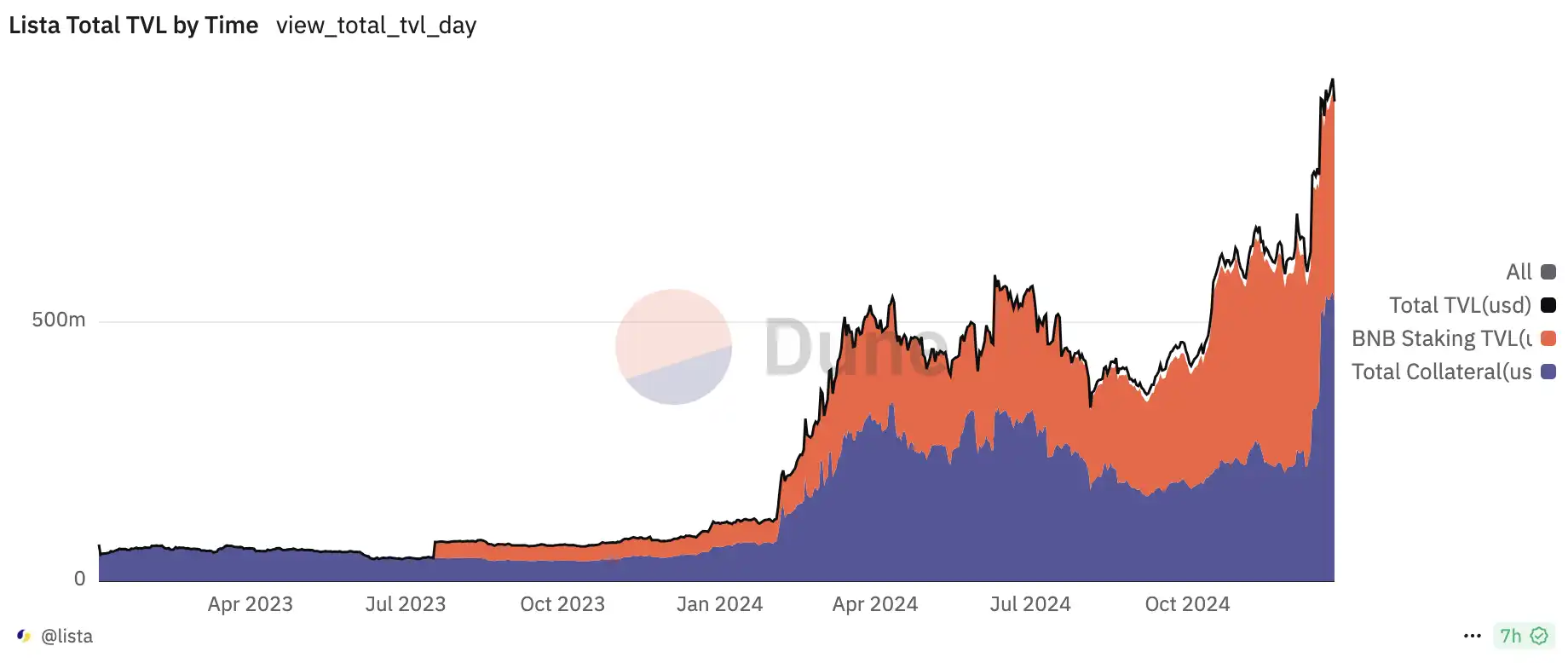
2024 was a year of transformation and breakthrough for Lista DAO, from brand upgrading to ecosystem expansion, and then to product innovation. Every important milestone witnessed Lista DAO's deep cultivation and evolution in the DeFi field. As the staking and liquidity center of the BNB Chain ecosystem, Lista DAO has effectively improved users' capital efficiency and income potential through innovative products, technological upgrades, and governance optimization. At the same time, Lista DAO actively embraced the outbreak wave of the BNB Chain ecosystem, becoming a model of CeFi and DeFi integration. By capturing industry trends and providing core support for ecosystem development, Lista DAO's TVL recently approached $1 billion, reaching a new high, which is the best proof of its success.
Let's first briefly review the key events that have taken place for Lista DAO this year in chronological order.
On February 5th, Helio Protocol officially rebranded to Lista DAO, with the former HAY and SnBNB renamed to lisUSD and slisBNB, respectively. Additionally, Lista DAO introduced airdrop point system - Cosmic Adventure Challenge (CAC).
In March, Lista DAO adjusted its strategy, gradually phasing out its native staking service to focus on the development of its liquidity staking product (BNB/slisBNB) and further deepen its presence in the LSDfi field.
In May, Lista DAO completed several product updates. Firstly, the multi-node delegation upgrade for slisBNB, allocating all deposited BNB to multiple validation nodes, converting existing BNBx, AnkrBNB, and stkBNB to slisBNB, enhancing the security, yield, and withdrawal efficiency of slisBNB, while streamlining the liquidity staking process.
To better meet users' demands for liquidity and new assets, Lista DAO also launched the Innovation Zone this month, introducing weETH, ezETH, and STONE as collateral assets for lisUSD. Concurrently, it formed partnerships with various DeFi projects from different ecosystems, including launching Listpie, and collaborating with Ether.fi, Renzo Protocol, Lynx Finance, Stakestone, and other projects to introduce various collateral assets, providing users with more options.
In June, users participating in the Lista DAO ecosystem reaped the rewards as Lista DAO announced its TGE and commenced an airdrop, with Binance listing Lista on the 20th for trading.
In July, Lista DAO utilized LayerZero's bridging technology to bring slisBNB to Ethereum and introduced the veLISTA and veToken governance models, further promoting DAO governance upgrades.
August marked another significant milestone for Lista DAO and its users. Firstly, the launch of the AMO module optimized the supply-demand balance of lisUSD, significantly enhancing its price stability and market efficiency. Subsequently, it was announced that slisBNB could participate in Binance Launchpool, allowing users to increase potential yields while maintaining liquidity, becoming a model of CeFi+DeFi integration.
In September, Lista DAO successfully lowered the borrowing interest rate of lisUSD through LIP-002 proposal.
In October, Lista DAO introduced a new product, clisBNB, providing more flexibility and functionality for the deposited BNB collateral asset.
In November, Lista DAO released several major updates, including the launch of the lisUSD Anchor Stable Module (PSM), the minting conversion from slisBNB to clisBNB, lisUSD meme fundraising, and other features, maximizing user asset liquidity and yield.
In December, Lista DAO launched the Bribery Market, which not only brings additional income and higher voting participation to veLISTA voters, but also serves as a means of traffic diversion and governance empowerment for projects, thereby strengthening Lista DAO's community governance, transparency, and liquidity overall.
From the initial stablecoin lending business to the current BNBFi ecosystem centered around slisBNB and clisBNB, Lista DAO's development path can be divided into three stages: Phase 1.0 focused on stablecoin business, Phase 2.0 expanded to liquidity staking services, and now Phase 3.0, where Lista DAO is committed to integrating its two core businesses, driven by slisBNB and clisBNB, to build the BNBFi ecosystem.
Lista DAO 1.0: Steadily Advancing CDP Business to Become a Blue Chip in the BNB Ecosystem
Since the election market started, a group of blue-chip decentralized DeFi projects led by AAVE and UNI have embarked on a bullish trend, with the market generally expecting Trump's imminent presidency to be a catalyst for DeFi's next golden age. Against this backdrop, the importance of the three core components of DeFi — stablecoins, AMMs, and lending protocols — has become even more pronounced.
The ability to borrow against specific tokens is one of the most sought-after features in the crypto industry and is often a key criterion for determining whether a project is a "blue-chip" asset. This model is known as a Collateral Debt Position (CDP), where users can borrow leveraged funds at low cost while also allowing asset-rich but illiquid teams to obtain liquidity by collateralizing their treasury and holdings, thus supporting operational funds and earning interest on the collateral in the process.
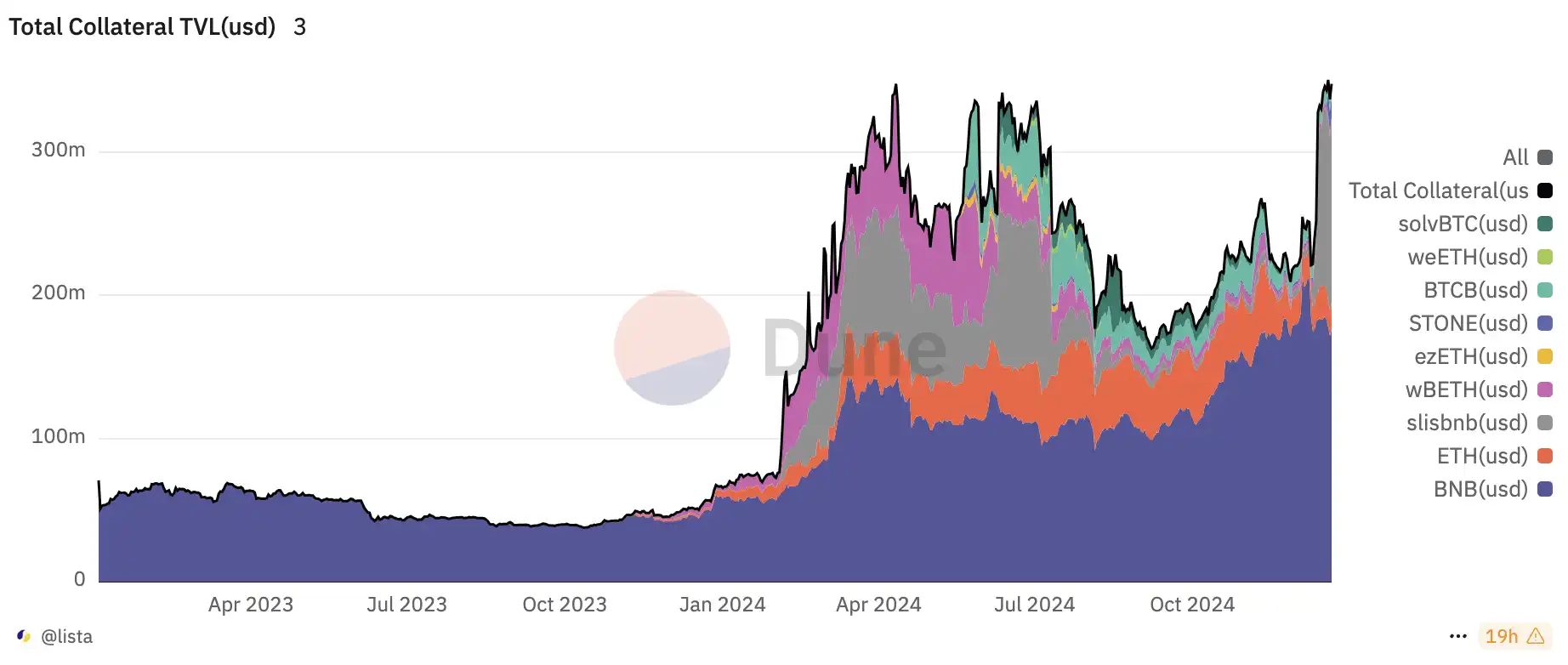
In the BNB Chain ecosystem, Lista DAO has built the stablecoin lisUSD using a CDP system, where users can use assets such as BNB, ETH, slisBNB, wBETH, BTCB, etc., as collateral to obtain lisUSD.
On May 17, Lista DAO launched the Innovation Zone, which for the first time included eligible LST and LRT in the collateral scope, introduced new collateral assets such as weETH, ezETH, and STONE, unlocking greater liquidity and capital efficiency possibilities for users. This not only met users' demand for diversified asset management but also further enhanced the platform's competitiveness in the lending market.
Currently, Lista DAO supports more than a dozen collateral assets, with the total value of assets in the CDP system surpassing $550 million, covering both mainstream and innovative assets. The total lisUSD borrowed amounts to as much as $57 million, with a collateralization ratio of 1046.11%.
On August 9, Lista DAO launched the AMO module (Dynamic Interest Rate System), which employs advanced algorithms to automatically adjust rates in response to market fluctuations. This dynamic approach manages market supply and demand, enhances platform liquidity and transaction efficiency, and maintains price stability of lisUSD.
Lista DAO 2.0: Anchoring on Liquidity Pools to Forge a New De-CeFi Model
From liquidity pooling to rehypothecation, maximizing capital efficiency has always been a continually evolving pursuit in the crypto space. In the new market cycle, the development path of DeFi is experiencing a transition from the traditional decentralized core concept to a new model that combines decentralization with centralization. The market has seen a series of innovative applications emerge, including institutional custody, government bond yields, and CeFi equities.
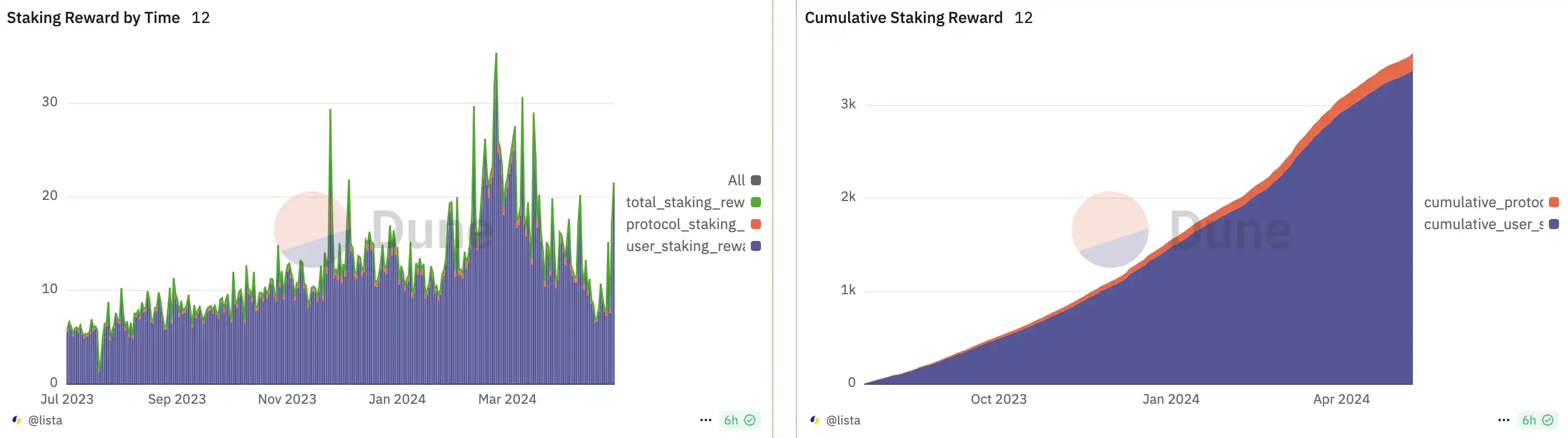
Backed by the Binance platform, Lista DAO, as a native DeFi protocol in the BNB Chain ecosystem, has built a core liquidity pooling business following the CDP system. Users can pledge BNB in Lista DAO to receive slisBNB, and with increasing pledge time and accumulated rewards, the value of slisBNB dynamically grows. Currently, approximately 1 slisBNB is exchangeable for 1.0234 BNB.
As a native collateral product in the BNB ecosystem, slisBNB also possesses multiple practical values. Within the Lista DAO ecosystem, users can use slisBNB as collateral to borrow lisUSD. Additionally, slisBNB supports cross-platform circulation and is currently available on BNB Chain and the Ethereum mainnet, with plans for expansion to more public chains in the future.
slisBNB is also integrated with multiple DeFi protocols, allowing users to not only continue earning staking rewards but also to gain additional returns through platforms like PancakeSwap, Thena Finance, among others. For example, users can utilize slisBNB to participate in lending, liquidity provision, and mining activities on other DeFi platforms. Through integration with the rehypothecation layer Karak, slisBNB further supports rehypothecation, maximizing user's staking rewards.
In July of this year, Binance announced that the DeFi BNB assets in the Binance Web3 Wallet could be included in the Launchpool reward calculation. The first officially announced asset was the liquidity staking token slisBNB launched by Lista DAO. As a result, the multi-yield of slisBNB helps attract more capital into the DeFi market.
As of now, the total BNB staking value of Lista DAO has exceeded $3.89 billion. Combined with Launchpool, liquidity staking, and DeFi activities, the comprehensive annualized staking APY of BNB has surpassed 32.83%, and users can also earn Lista DAO points. It is the liquidity staking protocol with the highest amount of staked BNB in the BNB ecosystem.
Lista DAO 3.0: From slisBNB to clisBNB, the Unique BNBFi Ecosystem
Through the stablecoin lisUSD and the liquidity staking token slisBNB as its two core products, Lista DAO has undoubtedly become the liquidity hub of the BNB Chain ecosystem. However, to further unleash the earning potential of BNB, Lista DAO has introduced clisBNB, allowing users to participate in on-chain token minting while enjoying lending rewards.
clisBNB (Collateralized Lista BNB) is a voucher token directly linked to the collateralized asset. When a user collateralizes BNB in Lista DAO's CDP system, they receive clisBNB at a 1:1 ratio. clisBNB is non-transferable and will be automatically burned when the collateralized asset is redeemed.
One of the key features of clisBNB is its ability to participate in Binance Launchpool activities. Previously, if a user held BNB and wanted to simultaneously earn on-chain and token minting rewards, they could only stake BNB to receive slisBNB and then participate in Launchpool. Now, users can choose to collateralize BNB, earn lisUSD rewards, and participate in Launchpool using clisBNB.
Lista DAO has also introduced a minting feature from slisBNB to clisBNB, supporting the minting of slisBNB into clisBNB at a ratio of 1:0.9709. This allows users to stake BNB while still participating in Binance Launchpool using clisBNB. This innovation not only diversifies the asset's revenue streams for users but also further unleashes the vitality of the BNB ecosystem.
clisBNB is the product of Lista DAO's solid layout in the stablecoin field during Phase 1 and breakthrough in liquidity mining and capital efficiency during Phase 2. In Phase 3, Lista DAO further expanded the user participation dimensions, allowing users to choose based on their actual situations and income levels. This not only unlocked the liquidity of collateral assets in lending but also provided more usability and flexibility to on-chain BNB holders, maximizing BNB's asset efficiency in a way that other native tokens of public chains have never attempted in ecosystem development.
Conclusion
In the current trend of DeFi projects such as Pendle, Ethena, Usual, DeFi is evolving from its initial decentralized concept to a hybrid model combining decentralization and centralization, with DeCeFi becoming the new direction of innovation. In this process, leveraging its position in the BNB Chain ecosystem, ListaDAO, starting from the stablecoin business, successfully maximized BNB asset efficiency through the introduction of slisBNB and clisBNB, utilizing Binance Launchpool, while enhancing platform security and liquidity.
Since the fourth quarter, Lista DAO has successively released product upgrades in these three major areas to further enhance the BNBFi ecosystem.
On November 21, Lista DAO adjusted the AMO module used to maintain lisUSD stability from a fixed parameter (R0) to a dynamic mode, enhancing the platform's adaptability to market changes. At the same time, the lisUSD borrowing limit collateralized by BNB was increased to 50 million, with the total minting limit raised to 60 million, further meeting user liquidity demands.
Over the past year, the stablecoin market competition has become increasingly fierce, and how to enhance user stickiness while maintaining price stability has become the core issue faced by every project. Lista addressed this challenge in a way that is more in line with user needs by introducing the Pegged Stability Module (PSM) and Liquidity Savings Rate (LSR). The launch of PSM allows users to seamlessly convert between USDT and lisUSD, providing strong support for lisUSD's price stability. LSR, by offering stable returns on user deposits, has attracted more long-term participants, further strengthening the ecosystem's capital lock-up.
In terms of mechanism design, Lista DAO has adjusted the platform's Minimum Collateralization Ratio (MCR) and Loan-to-Value ratio (LTV). By lowering the MCR, users can participate in lending with lower asset thresholds, and the increase in LTV allows users to borrow more funds with the same collateral assets. These series of adjustments have significantly enhanced users' capital utilization efficiency, attracted more users to join the lending platform ecosystem, and expanded the market size.
The approach of Lista DAO has been highly profitable. By the end of December, its TVL hit an all-time high, reaching $983,813,645 at the time of writing, making it one of the few projects approaching a $1 billion TVL in the BNB Chain ecosystem.
In addition to the financial aspect, Lista DAO is also continuously exploring governance. The auto-compounding feature launched in October provided users with a more convenient staking management method. Users' rewards can automatically be locked into veLISTA without manual intervention, enabling the automated accumulation of rewards. In December, the bribery market was introduced, bringing additional rewards and higher voting participation to veLISTA voters, while also attracting flow and empowering governance for project teams, thereby strengthening Lista DAO's community governance, transparency, and liquidity overall.
Behind the technological innovation, Lista DAO has not overlooked the importance of community. While introducing new features, Lista has also used meme-based fundraising and a redesigned user interface to bring closer to users, making complex financial tools easier to understand and use, in line with its original intention and mission of "Making DeFi Easier."
By 2025, Lista DAO's goals are clearer. On one hand, it will consolidate its core position in the BNB Chain ecosystem, while also exploring more possibilities of RWA assets and the combination of CeFi and DeFi. From stablecoins to cross-platform liquidity, from yield innovation to user experience upgrades, Lista DAO is redefining the boundaries of DeFi in its unique way, where Lista 3.0 is not only a new starting point but also the core driving force for future growth.
You may also like

Tiger Research: What AI services do cryptocurrency companies offer?

The war not only drives up oil prices but also causes Circle's stock price to soar

When agents become consumers, who will rewrite the underlying logic of internet commerce?

AI Agents in Action Summit: March 31, Hong Kong Cyberport, focusing on the deep waters of AI implementation

29 Days In, What Are America’s Options on Iran?

Flash Crash Down 97%+ with Ongoing Unlocking, WLD Completes $65 Million Off-chain Funding: Who Is Still Buying?

Bitcoin for Real Estate? Fannie Mae Teams Up with Coinbase to Launch Crypto Mortgage
Tether Hires Big Four Auditor, USDT Enters First Attestation Phase

Google AI Paper Destroys $900B Storage Stock, Accused of Faking Experiment
Evaporate $2 Trillion, U.S. Stocks See Worst Start in 4 Years, Why is the Market Bearish?

The speed at which AI discovers vulnerabilities has surpassed the speed at which it patches vulnerabilities.

AI Crypto Trading Bot Explained: Aurora's Multi-Factor Strategy in WEEX Hackathon
Aurora demonstrates how structured, multi-agent AI Trading systems can deliver more adaptive and resilient performance in the WEEX AI Trading Hackathon.

Cyber Taoist Fortune Teller: Fake Taoist, AI Fortune Telling, and Northeastern Metaphysics History

Bloomberg: Stablecoin Payments Emerge as Crypto VC's Newest Favorite Thing
BeatSwap is evolving towards a full-stack Web3 infrastructure, covering the entire lifecycle of IP rights.
BeatSwap, a global Web3 Intellectual Property (IP) infrastructure project, is attempting to overcome the current fragmentation limitations of the Web3 ecosystem, building a full-stack system that covers the entire lifecycle of IP rights.
Currently, most Web3 projects are still in the stage of functional fragmentation, often focusing only on a single aspect, such as IP asset tokenization, transaction functionality, or a simple incentive model. This structural dispersion has become a key bottleneck hindering the industry's scale application.
BeatSwap's approach is more integrated, integrating multiple core modules into the same system, including:
· IP authentication and on-chain registration
· Authorization-based revenue sharing mechanism
· User-engagement-driven incentive system
· Transaction and liquidity infrastructure
Through the above integration, the platform builds an end-to-end closed-loop path, allowing IP rights to complete a full cycle of "creation, use, and monetization" within the same ecosystem.
BeatSwap is not limited to existing crypto users but is attempting to take the global music industry as a starting point, actively creating new market demand. Its core strategies include:
Exploring and incubating music creators (Artist discovery)
Building a fan community
Igniting IP-centric content consumption demand
The current global music industry is valued at around $260 billion, with over 2 billion digital music users. This means that the potential market corresponding to the tokenization and financialization of IP far exceeds the traditional crypto user base.
In this context, BeatSwap positions itself at the intersection of "real-world content demand" and "on-chain infrastructure," attempting to bridge the structural gap between content production and financial flow.
BeatSwap's upcoming core product "Space" is scheduled to launch in the second quarter of 2026. This product is defined as the SocialFi layer in the ecosystem, aiming to directly connect creators with users and achieve deep integration with other platform modules.
Key designs include:
A fan-centric interactive mechanism
Exposure and distribution logic based on $BTX staking
User paths connected to DeFi and liquidity structures
Thus, a complete user behavior loop is formed within the platform: Discovery → Participation → Consumption → Rewards → Trading
$BTX is designed to be a core utility asset within the ecosystem, rather than just a simple incentive token, with its value directly tied to platform activity and IP use cases.
Main features include:
· Yield distribution based on on-chain authorized actions
· Value reflection based on IP usage and user engagement dynamics
· Support for staking and DeFi participation mechanisms
· Value growth driven by ecosystem expansion
With the increased frequency of IP use, the utility and value support of $BTX will enhance simultaneously, helping alleviate the "disconnect between value and utility" issue present in traditional Web3 token models to some extent.
Currently, $BTX has been listed on several mainstream exchanges, including:
Binance Alpha
Gate
MEXC
OKX Boost
As the launch of "Space" approaches, BeatSwap is actively pursuing more exchange listings to further enhance liquidity and global accessibility, laying a foundation for future market expansion.
BeatSwap's goal is no longer limited to the traditional Web3 narrative but aims to target over 2 billion digital music users and a trillion KRW-scale content market.
By integrating content creators, users, capital, and liquidity into a blockchain framework centered around IP rights, BeatSwap is striving to build a next-generation infrastructure focused on "IP tokenization."
BeatSwap integrates IP authentication, authorization distribution, incentive mechanism, transaction system, and market construction to establish a unified structure that bridges the full lifecycle path of IP rights.
With the launch of the Q2 2026 "Space," the project is expected to become a key infrastructure connecting content and finance in the IP-RWA (Real World Assets) track.

Mag 7 Evaporates $2 Trillion | Rewire News Morning Edition

Losing $19K per Coin Mined, Bitcoin Mining Firms Collective AI Defection



 App
App