
 Buy Crypto
- Markets
 Futures
- Spot
- Copy Trade
- Earn
- More
Bitcoin End-of-Year Volatility - What Were the Reasons?

On the last day of 2024, Bitcoin experienced a brief plunge to $92,000, resulting in a total of $277 million in liquidations across the network in the past 24 hours. Of this amount, long positions were liquidated at $185 million, while short positions were liquidated at $92.16 million. Meanwhile, as the U.S. stock market opened, both crypto-related stocks and the "Big Seven" of the U.S. stock market saw a widespread decline, with the Dow Jones falling by 1.04%, the S&P 500 Index dropping by 1.13%, and the Nasdaq declining by 1.33%.
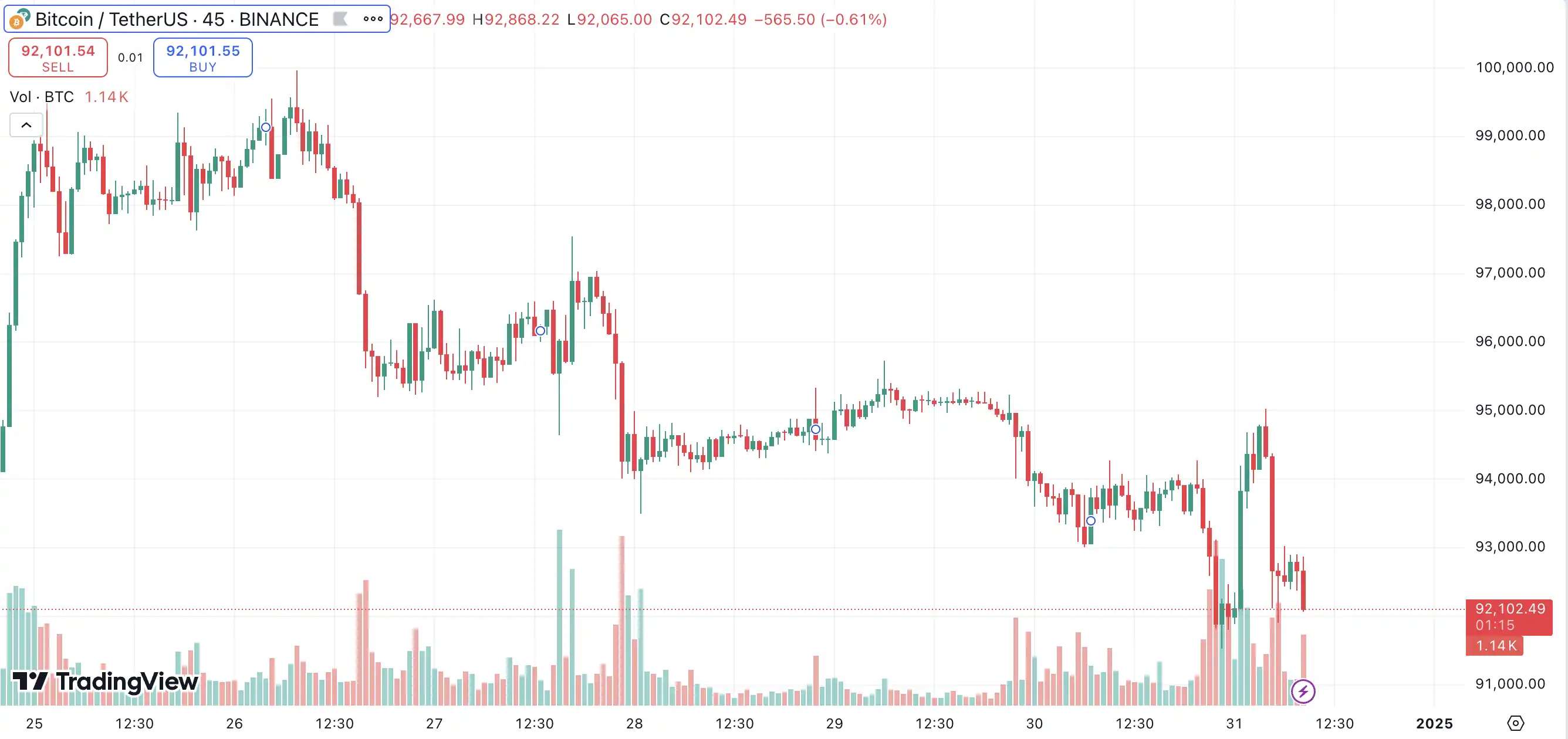
Since entering the Christmas market trend in late December, Bitcoin has experienced multiple sudden plunges. Below are the market reasons for Bitcoin's recent downturn compiled by BlockBeats for reference.
Strength of the U.S. Dollar and Unpopularity of U.S. Stocks and the Crypto Market
According to data from Bank of America, the U.S. stock market saw approximately $35 billion in outflows in the past week, marking the highest weekly outflow since December 2022. In addition, Goldman Sachs' trading desk estimates that U.S. pensions will sell $21 billion worth of U.S. stocks by the end of December this year due to the trends in stocks and bonds, and will purchase an equivalent amount of bonds.
On the past Friday, the yield on the 10-year U.S. Treasury note rose by nearly 1% to 4.629%, nearing a seven-month high. The U.S. stock market may face the risk of massive fund sell-offs. Wall Street analysts believe that in the current absence of major news, data, and light trading, the 10-year U.S. bond yield, as an anchor for asset pricing, will have an impact on the stock market. The higher the yield, the greater the pressure on the stock market.
As the strength of the U.S. dollar has pushed down global currencies and assets, including Bitcoin, dollar-denominated assets become more attractive compared to cryptocurrency in a strengthening dollar environment. Investors prefer traditional investments such as U.S. Treasuries or stocks, which produce returns in a strong dollar environment. Additionally, with declining liquidity and year-end profit-taking by investors, the possibility of further gains in cryptocurrency has been weakened.
Outflows in Bitcoin Spot ETFs
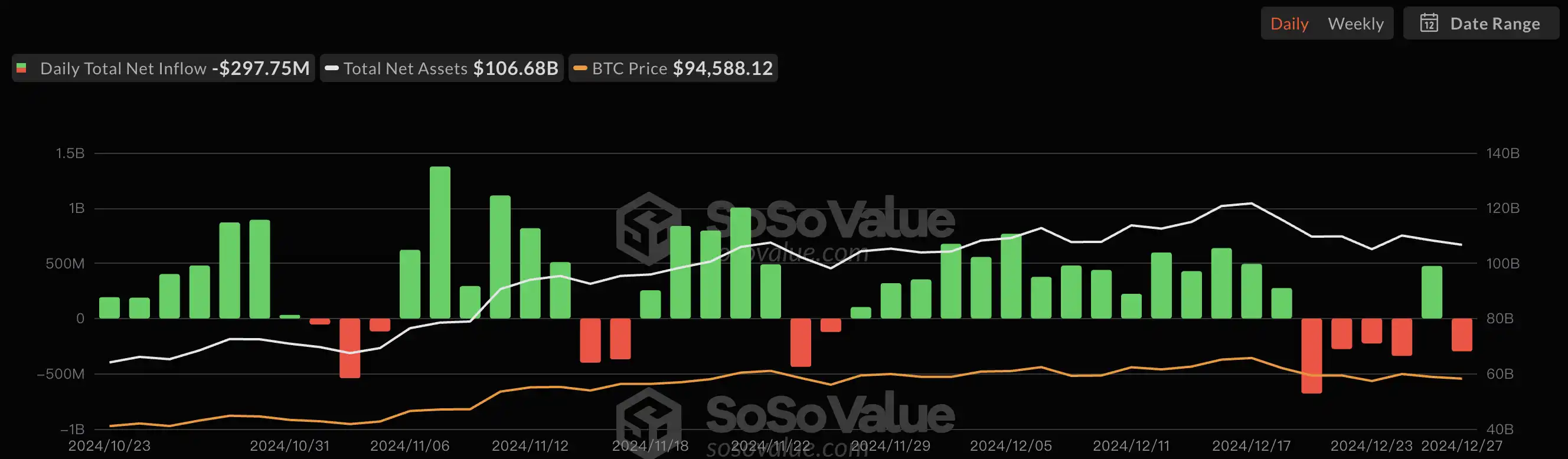
Data from Bitcoin spot ETFs have transitioned from a net inflow status seen during the "Trump Rally" to a net outflow status, with a total net outflow of $377.6 million last week, and a daily net outflow yesterday. On December 27, Fidelity's FBTC saw a net outflow of $208 million, setting a new all-time high for single-day net outflows.
Options Expiration and End-of-Quarter Volatility Sell-off
On December 17, QCP indicated that the options market had sent some cautious signals. Even as the spot price continued to hit new highs, the options market exhibited a persistent skew towards put options relative to call options—perhaps reflecting investors' preference for risk hedging rather than aggressively chasing the uptrend.
On December 28, BTC and ETH options with a notional value of nearly $20 billion were set to expire, almost half of Deribit's total OI. Meanwhile, the Bitcoin price dropped from $97,000 to $94,000 on the same day. QCP believes this was a typical end-of-quarter volatility sell-off, especially considering the continued spot volatility and option sellers continuing to close positions.
Greeks.live analyst Adam also posted on social media, stating that the skew differences between option expiries have widened. Since the bull market at the end of this year, the skew between expiries has been very close, fluctuating around 5%, with most differences not exceeding 1%. However, as recent adjustments have taken place, the differences have started to widen, with the short-term skew experiencing a greater decline. These data indicate a significant decrease in market enthusiasm, with option market participants showing reduced optimism for January.
Stablecoin Minting Volume Declines, USDT FUD Affects Market Confidence
Since December, the minting volume of stablecoins has seen a significant drop. Only on the 13th, Tether minted an additional 1 billion USDT on Ethereum, and USDC's minting volume in December was only 200 million. However, since November 6, Tether has minted 21 billion USDT on Ethereum and Tron blockchains.
Today, the EU's MiCA regulation officially came into effect, but Tether's USDT has not yet received regulatory approval, raising concerns about its future in the EU market. MiCA imposes strict requirements on stablecoin issuers, such as Tether, regarding capital reserves and liquidity, which could lead to their exit from the EU market. Some EU exchanges have already begun taking measures to comply with the new rules, with Coinbase Europe delisting stablecoins like USDT.
Nevertheless, Tether's significant market capitalization and global adoption make it unlikely to suffer an immediate financial shock. Tether's CEO Paolo Ardoino posted on social media, stating, "Don't believe FUD. Competitors are just eager to make you believe in things that don't exist. USDT is safe."
It is worth noting that Tether itself has not faced any financial issues or engaged in any illegal activities. Tether will focus on supporting new stablecoin projects, such as launching stablecoins EURQ and USDQ that comply with MiCA standards. However, given the stablecoin industry's previous history of collapses, short-term USDT FUD can still affect market confidence.
You may also like

Tiger Research: What AI services do cryptocurrency companies offer?

The war not only drives up oil prices but also causes Circle's stock price to soar

When agents become consumers, who will rewrite the underlying logic of internet commerce?

AI Agents in Action Summit: March 31, Hong Kong Cyberport, focusing on the deep waters of AI implementation

29 Days In, What Are America’s Options on Iran?

Flash Crash Down 97%+ with Ongoing Unlocking, WLD Completes $65 Million Off-chain Funding: Who Is Still Buying?

Bitcoin for Real Estate? Fannie Mae Teams Up with Coinbase to Launch Crypto Mortgage
Tether Hires Big Four Auditor, USDT Enters First Attestation Phase

Google AI Paper Destroys $900B Storage Stock, Accused of Faking Experiment
Evaporate $2 Trillion, U.S. Stocks See Worst Start in 4 Years, Why is the Market Bearish?

The speed at which AI discovers vulnerabilities has surpassed the speed at which it patches vulnerabilities.

AI Crypto Trading Bot Explained: Aurora's Multi-Factor Strategy in WEEX Hackathon
Aurora demonstrates how structured, multi-agent AI Trading systems can deliver more adaptive and resilient performance in the WEEX AI Trading Hackathon.

Cyber Taoist Fortune Teller: Fake Taoist, AI Fortune Telling, and Northeastern Metaphysics History

Bloomberg: Stablecoin Payments Emerge as Crypto VC's Newest Favorite Thing
BeatSwap is evolving towards a full-stack Web3 infrastructure, covering the entire lifecycle of IP rights.
BeatSwap, a global Web3 Intellectual Property (IP) infrastructure project, is attempting to overcome the current fragmentation limitations of the Web3 ecosystem, building a full-stack system that covers the entire lifecycle of IP rights.
Currently, most Web3 projects are still in the stage of functional fragmentation, often focusing only on a single aspect, such as IP asset tokenization, transaction functionality, or a simple incentive model. This structural dispersion has become a key bottleneck hindering the industry's scale application.
BeatSwap's approach is more integrated, integrating multiple core modules into the same system, including:
· IP authentication and on-chain registration
· Authorization-based revenue sharing mechanism
· User-engagement-driven incentive system
· Transaction and liquidity infrastructure
Through the above integration, the platform builds an end-to-end closed-loop path, allowing IP rights to complete a full cycle of "creation, use, and monetization" within the same ecosystem.
BeatSwap is not limited to existing crypto users but is attempting to take the global music industry as a starting point, actively creating new market demand. Its core strategies include:
Exploring and incubating music creators (Artist discovery)
Building a fan community
Igniting IP-centric content consumption demand
The current global music industry is valued at around $260 billion, with over 2 billion digital music users. This means that the potential market corresponding to the tokenization and financialization of IP far exceeds the traditional crypto user base.
In this context, BeatSwap positions itself at the intersection of "real-world content demand" and "on-chain infrastructure," attempting to bridge the structural gap between content production and financial flow.
BeatSwap's upcoming core product "Space" is scheduled to launch in the second quarter of 2026. This product is defined as the SocialFi layer in the ecosystem, aiming to directly connect creators with users and achieve deep integration with other platform modules.
Key designs include:
A fan-centric interactive mechanism
Exposure and distribution logic based on $BTX staking
User paths connected to DeFi and liquidity structures
Thus, a complete user behavior loop is formed within the platform: Discovery → Participation → Consumption → Rewards → Trading
$BTX is designed to be a core utility asset within the ecosystem, rather than just a simple incentive token, with its value directly tied to platform activity and IP use cases.
Main features include:
· Yield distribution based on on-chain authorized actions
· Value reflection based on IP usage and user engagement dynamics
· Support for staking and DeFi participation mechanisms
· Value growth driven by ecosystem expansion
With the increased frequency of IP use, the utility and value support of $BTX will enhance simultaneously, helping alleviate the "disconnect between value and utility" issue present in traditional Web3 token models to some extent.
Currently, $BTX has been listed on several mainstream exchanges, including:
Binance Alpha
Gate
MEXC
OKX Boost
As the launch of "Space" approaches, BeatSwap is actively pursuing more exchange listings to further enhance liquidity and global accessibility, laying a foundation for future market expansion.
BeatSwap's goal is no longer limited to the traditional Web3 narrative but aims to target over 2 billion digital music users and a trillion KRW-scale content market.
By integrating content creators, users, capital, and liquidity into a blockchain framework centered around IP rights, BeatSwap is striving to build a next-generation infrastructure focused on "IP tokenization."
BeatSwap integrates IP authentication, authorization distribution, incentive mechanism, transaction system, and market construction to establish a unified structure that bridges the full lifecycle path of IP rights.
With the launch of the Q2 2026 "Space," the project is expected to become a key infrastructure connecting content and finance in the IP-RWA (Real World Assets) track.

Mag 7 Evaporates $2 Trillion | Rewire News Morning Edition

Losing $19K per Coin Mined, Bitcoin Mining Firms Collective AI Defection



 App
App