
- Buy Crypto
- Markets
 Futures
- Spot
- Copy Trade
- Earn
- More
$100 Duel: Prediction Market vs Meme, Which Opportunity is Greater?

Original Article Title: Choosing Between Prediction Markets and Meme Coins.
Original Article Author: Baheet
Original Article Translation: Deep Tide TechFlow
In a recent post, I posed a question: with starting capital of only $100, which offers more opportunities for traders—trading Memecoin (via the Pumpfun platform) or prediction markets?
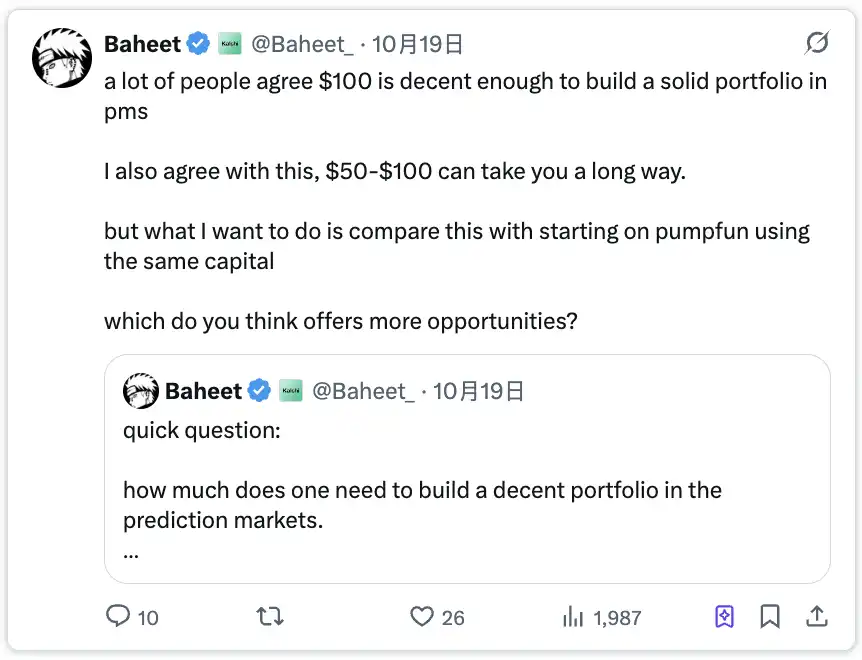
In my view, this is akin to comparing a game of chess to a casino slot machine: both may yield handsome returns, but one rewards strategy while the other relies on chaos and luck.
Next, we will delve into an analysis based on feasibility, risk, reward, advantages, and the impact of capital.
Market Mechanism
Prediction Markets
Prediction markets are structured prediction tools; top platforms like @Kalshi and @Polymarket allow users to trade based on the outcome of specific, verifiable events, such as election results, economic data releases, or specific price movements.
The price of contracts on prediction markets reflects the market's perception of the probability of a particular event occurring. For example, a contract priced at $0.80 indicates an 80% probability of the "yes" outcome.
Furthermore, these markets are highly regarded for their "wisdom of the crowd" effect, where the collective knowledge of participants leads to remarkably accurate predictions, something the Memecoin space cannot replicate.
The value of prediction market contracts is tied to verifiable real-world events. This underlying factor gives prediction markets a certain legitimacy, which is a core difference from Memecoin.
MemeCoin Trading on Pumpfun
The Pumpfun platform allows users to swiftly create and trade new tokens via a bonding curve, causing prices to surge rapidly as more buyers join in. This low barrier to entry has attracted a plethora of untested new Meme projects.
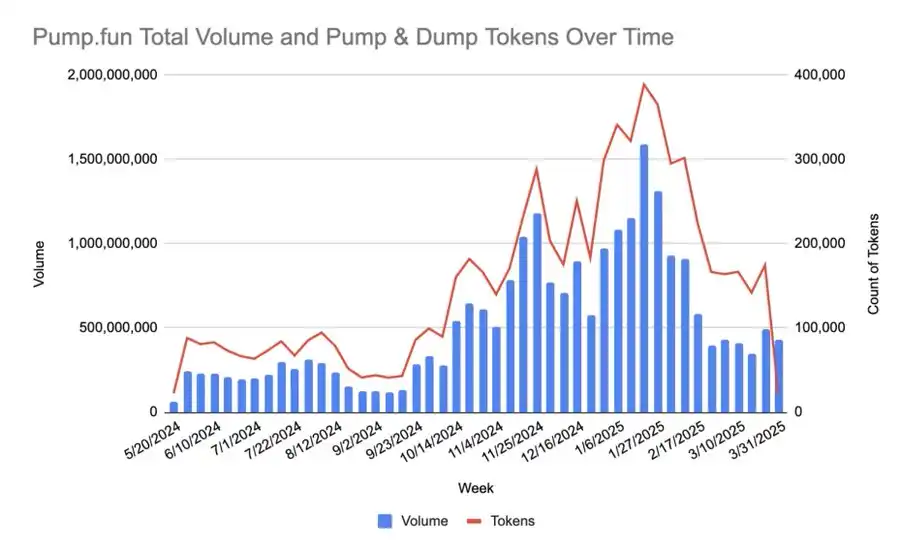
The lifecycle of Memecoin typically follows a predictable yet chaotic pattern. After reaching a certain market cap, the token gets deployed to a decentralized exchange (such as @Raydium) and usually goes through an initial "pump" phase.
In fact, data from May 2025 shows that the majority of tokens fail after their initial issuance.
A report by @Solidus_Labs revealed that out of 7 million tokens launched on Pumpfun, 98.6% were classified as either "rug pulls" or manipulative projects.
Accessibility
Both markets are very friendly to small amounts of capital, with virtually no barriers to entry.
On the Polymarket platform, you can participate with as little as $10 in capital, for example, by betting on events such as elections or cryptocurrency price movements.
If you have $50-100, you can even diversify your investment across 5-10 events and optimize your bet sizing with a better strategy.
Pumpfun has a lower entry price, with the cost of creating a Memecoin being around 0.02 SOL (approximately $3 to $4 at current prices), and purchasing only requires loose change from your Solana wallet.
Initial trades typically happen at a smaller market cap, around $4,000, so $50 to $100 can get you a significant share early on.
Aside from network fees, there is no formal minimum requirement, making it ideal for "wild trading."
Risk, Reward, and Reality
Prediction markets are known for their quantifiable risks; the risk is explicit and tied to the outcome of an event. While a trader may lose their entire investment on a single contract, they can clearly understand the odds and event criteria from the start.
With thorough research, the potential rewards can be very high. Although these returns may not be as eye-catching as the price spikes of Memecoins, they are typically more sustainable and based on information-driven decisions.
Common risks in prediction markets include traders misjudging probabilities or insufficient market liquidity, but if only a small portion of the portfolio is wagered, full bankruptcy is contained and rare.
For most traders, a diversified prediction market investment portfolio offers a more structured way to engage in high-risk trading with more predictable outcomes.
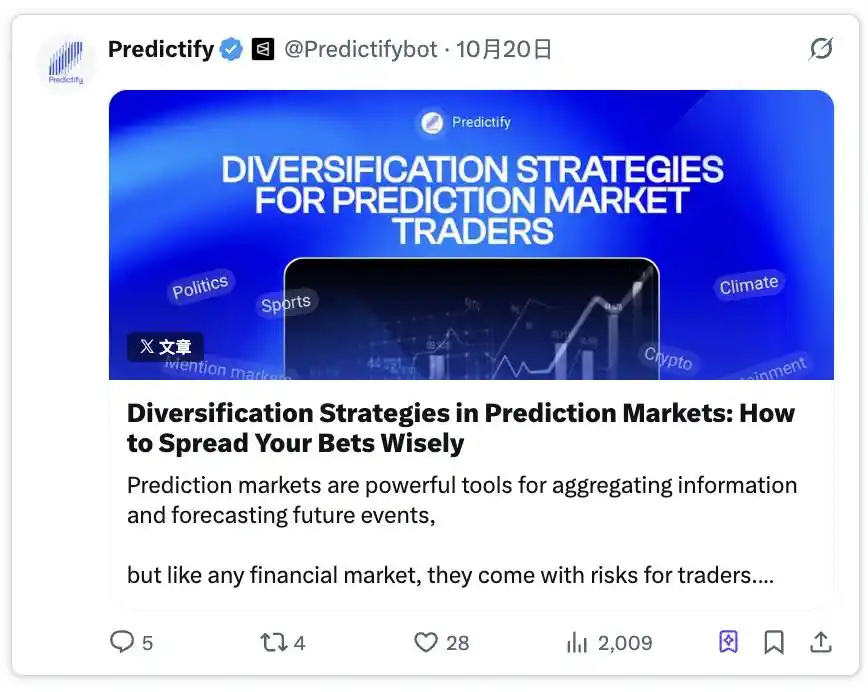
Here is a quality article from @Predictifybot on how to diversify a prediction market investment portfolio:
Finally, due to the presence of the Commodity Futures Trading Commission (CFTC, responsible for regulating Kalshi), participants benefit from an additional layer of oversight and protection, reducing the risk of fraud and manipulation.
On the other hand, the Memecoin ecosystem is rife with scams, manipulation, and highly volatile price swings. Projects may exit scam, developers may rug pull liquidity, rendering the tokens in investors' hands worthless.
The value of a Memecoin is based on hype and social sentiment rather than any fundamental utility, making it highly susceptible to social media trends and "insider" trading.
While many people hope for significant, life-changing returns, the reality is that such success is very rare. Most participants either lose money or see minimal gains.
What Can $100 Do?
Effectively utilizing small capital (like $100) in prediction markets and Pumpfun requires highly specialized and fundamentally different strategies.
I believe the best strategy in prediction markets is to find events mispriced due to information asymmetry, but this is nearly impossible to apply to Pumpfun Memecoins.
Prediction Markets: Leveraging Information Asymmetry
A $100 capital cannot move the needle in prediction markets, so your strategy must act like a savvy analyst. Your advantage lies in discovering information the market collectively overlooks.
How It Works:
1. Identify Information Gaps: Market odds are based on the collective information of all traders. Low-volume markets may lack enough participants to truly function efficiently, offering an advantage to small capital traders.
2. Utilize Overlooked Expertise: If you possess specialized knowledge few in the market have, you can leverage that information. For example, in-depth understanding of local elections, specific technological developments, obscure legal cases, or match outcomes.
3. Focus on Low-Liquidity Markets: Larger liquidity markets are typically more efficient, but small capital can concentrate on smaller, less-traded markets where odds may not yet reflect all available information.
As a small-scale capital trader, your role is an information arbitrageur, and your goal is to find market inefficiencies caused by incomplete information.
Pumpfun: Survival of the Funnest
The concept of information asymmetry on Pumpfun is entirely different and more challenging to exploit. It involves less rational odds and relies more on insider information.
How It Works:
1. Insider Information is Key: In Pumpfun, information asymmetry is typically disadvantageous for regular traders. The creator of a Memecoin holds complete information and has many tools to manipulate trading.
2. Social and Emotional Leverage: The most potent "information" in this market is the viral potential of a cryptocurrency. Founders control the initial marketing, often relying on influencers and social media strategies to create FOMO.
3. Information Asymmetry: There is an advantage here. If you join the Solana meme community or seize an opportunity before a token's meteoric rise. However, the asymmetry is fleeting, with surges lasting from minutes to hours, and 97% of traders making less than $1,000 in profit.
Unlike prediction markets, there is no real probability here, only collective FOMO.
The strategy is simple: it's either serendipity or exit! Your Memecoin strategy involves only $100, as follows:
1. Seize Opportunities: DYOR (Do Your Own Research) and quickly get into new tokens, hoping to be part of the initial momentum.
2. Utilize Professional Tools: Many traders use bots to monitor new token listings and market activities to gain a few seconds of an edge.
3. Manage Risk Through Caution: Keep a close eye on price charts, spot signs of "developer dumps," and be ready to sell immediately.
On Pumpfun, your $100 is not used to exploit information asymmetry but is immersed in a market where information is weaponized by more powerful players. Your success has little to do with analysis and relies more on luck, timing, and avoiding falling victim to manipulative schemes.
Final Thoughts
At the end of the day, whether to engage in prediction markets or Memecoin trading on Pumpfun depends on the trader's risk preference.
While both offer the potential for high returns, they achieve this through fundamentally different mechanisms.
Prediction markets provide verifiable outcomes and potential regulatory oversight, offering a more structured and information-based approach to high-risk speculation.
On the other hand, Memecoin trading is more like gambling in a high-risk, unregulated casino where one may experience massive profits, but the risk of loss is significant due to scams and extreme volatility.
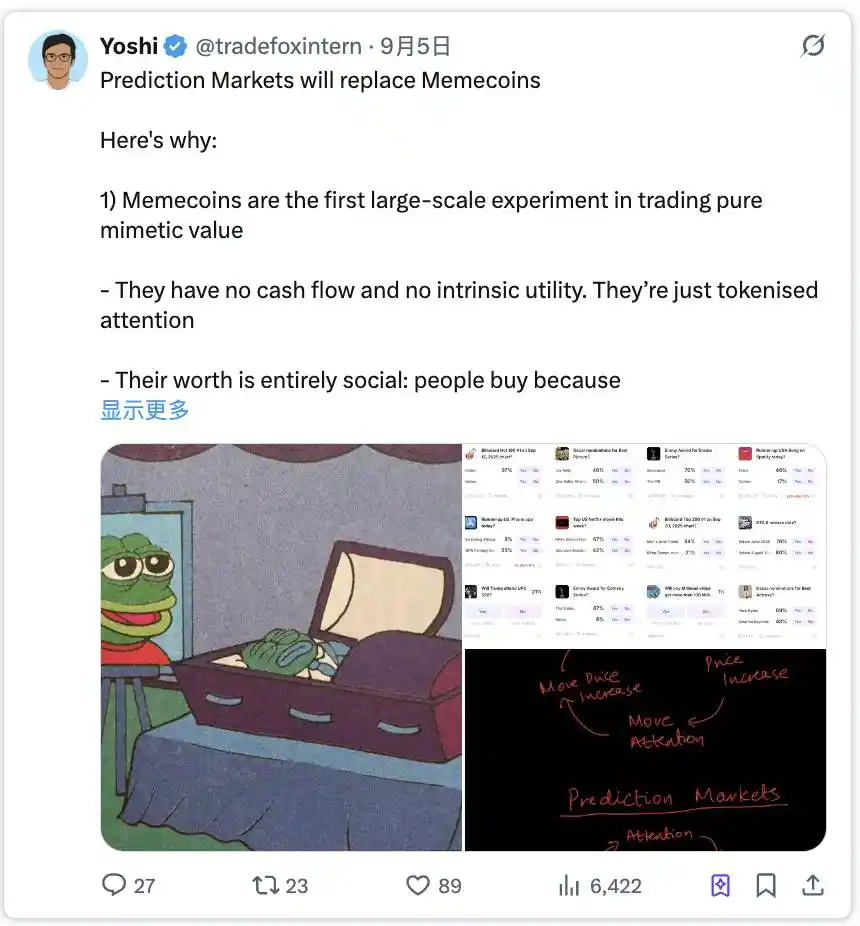
Here is an excellent post from @tradefoxintern discussing why prediction markets are poised to replace Memecoin:
Therefore, for those who prefer a more calculated, research-driven approach, prediction markets are the clear choice.
For those seeking massive, lottery-like returns and willing to navigate through thousands of scams, Pumpfun remains an option.

John Wang: Remember my words, the scale of the prediction market will be 10 times that of Memecoin!
You may also like

Some Key News You Might Have Missed Over the Chinese New Year Holiday

Key Market Information Discrepancy on February 24th - A Must-Read! | Alpha Morning Report

$1,500,000 Salary Job: How to Achieve with $500 AI?

Bitcoin On-Chain User Attrition at 30%, ETF Hemorrhage at $4.5 Billion: What's Next for the Next 3 Months?

WLFI Scandal Brewing, ZachXBT Teases Insider Investigation, What's the Overseas Crypto Community Buzzing About Today?

Debunking the AI Doomsday Myth: Why Establishment Inertia and the Software Wasteland Will Save Us
Editor's Note: Citrini7's cyberpunk-themed AI doomsday prophecy has sparked widespread discussion across the internet. However, this article presents a more pragmatic counter perspective. If Citrini envisions a digital tsunami instantly engulfing civilization, this author sees the resilient resistance of the human bureaucratic system, the profoundly flawed existing software ecosystem, and the long-overlooked cornerstone of heavy industry. This is a frontal clash between Silicon Valley fantasy and the iron law of reality, reminding us that the singularity may come, but it will never happen overnight.
The following is the original content:
Renowned market commentator Citrini7 recently published a captivating and widely circulated AI doomsday novel. While he acknowledges that the probability of some scenes occurring is extremely low, as someone who has witnessed multiple economic collapse prophecies, I want to challenge his views and present a more deterministic and optimistic future.
In 2007, people thought that against the backdrop of "peak oil," the United States' geopolitical status had come to an end; in 2008, they believed the dollar system was on the brink of collapse; in 2014, everyone thought AMD and NVIDIA were done for. Then ChatGPT emerged, and people thought Google was toast... Yet every time, existing institutions with deep-rooted inertia have proven to be far more resilient than onlookers imagined.
When Citrini talks about the fear of institutional turnover and rapid workforce displacement, he writes, "Even in fields we think rely on interpersonal relationships, cracks are showing. Take the real estate industry, where buyers have tolerated 5%-6% commissions for decades due to the information asymmetry between brokers and consumers..."
Seeing this, I couldn't help but chuckle. People have been proclaiming the "death of real estate agents" for 20 years now! This hardly requires any superintelligence; with Zillow, Redfin, or Opendoor, it's enough. But this example precisely proves the opposite of Citrini's view: although this workforce has long been deemed obsolete in the eyes of most, due to market inertia and regulatory capture, real estate agents' vitality is more tenacious than anyone's expectations a decade ago.
A few months ago, I just bought a house. The transaction process mandated that we hire a real estate agent, with lofty justifications. My buyer's agent made about $50,000 in this transaction, while his actual work — filling out forms and coordinating between multiple parties — amounted to no more than 10 hours, something I could have easily handled myself. The market will eventually move towards efficiency, providing fair pricing for labor, but this will be a long process.
I deeply understand the ways of inertia and change management: I once founded and sold a company whose core business was driving insurance brokerages from "manual service" to "software-driven." The iron rule I learned is: human societies in the real world are extremely complex, and things always take longer than you imagine — even when you account for this rule. This doesn't mean that the world won't undergo drastic changes, but rather that change will be more gradual, allowing us time to respond and adapt.
Recently, the software sector has seen a downturn as investors worry about the lack of moats in the backend systems of companies like Monday, Salesforce, Asana, making them easily replicable. Citrini and others believe that AI programming heralds the end of SaaS companies: one, products become homogenized, with zero profits, and two, jobs disappear.
But everyone overlooks one thing: the current state of these software products is simply terrible.
I'm qualified to say this because I've spent hundreds of thousands of dollars on Salesforce and Monday. Indeed, AI can enable competitors to replicate these products, but more importantly, AI can enable competitors to build better products. Stock price declines are not surprising: an industry relying on long-term lock-ins, lacking competitiveness, and filled with low-quality legacy incumbents is finally facing competition again.
From a broader perspective, almost all existing software is garbage, which is an undeniable fact. Every tool I've paid for is riddled with bugs; some software is so bad that I can't even pay for it (I've been unable to use Citibank's online transfer for the past three years); most web apps can't even get mobile and desktop responsiveness right; not a single product can fully deliver what you want. Silicon Valley darlings like Stripe and Linear only garner massive followings because they are not as disgustingly unusable as their competitors. If you ask a seasoned engineer, "Show me a truly perfect piece of software," all you'll get is prolonged silence and blank stares.
Here lies a profound truth: even as we approach a "software singularity," the human demand for software labor is nearly infinite. It's well known that the final few percentage points of perfection often require the most work. By this standard, almost every software product has at least a 100x improvement in complexity and features before reaching demand saturation.
I believe that most commentators who claim that the software industry is on the brink of extinction lack an intuitive understanding of software development. The software industry has been around for 50 years, and despite tremendous progress, it is always in a state of "not enough." As a programmer in 2020, my productivity matches that of hundreds of people in 1970, which is incredibly impressive leverage. However, there is still significant room for improvement. People underestimate the "Jevons Paradox": Efficiency improvements often lead to explosive growth in overall demand.
This does not mean that software engineering is an invincible job, but the industry's ability to absorb labor and its inertia far exceed imagination. The saturation process will be very slow, giving us enough time to adapt.
Of course, labor reallocation is inevitable, such as in the driving sector. As Citrini pointed out, many white-collar jobs will experience disruptions. For positions like real estate brokers that have long lost tangible value and rely solely on momentum for income, AI may be the final straw.
But our lifesaver lies in the fact that the United States has almost infinite potential and demand for reindustrialization. You may have heard of "reshoring," but it goes far beyond that. We have essentially lost the ability to manufacture the core building blocks of modern life: batteries, motors, small-scale semiconductors—the entire electricity supply chain is almost entirely dependent on overseas sources. What if there is a military conflict? What's even worse, did you know that China produces 90% of the world's synthetic ammonia? Once the supply is cut off, we can't even produce fertilizer and will face famine.
As long as you look to the physical world, you will find endless job opportunities that will benefit the country, create employment, and build essential infrastructure, all of which can receive bipartisan political support.
We have seen the economic and political winds shifting in this direction—discussions on reshoring, deep tech, and "American vitality." My prediction is that when AI impacts the white-collar sector, the path of least political resistance will be to fund large-scale reindustrialization, absorbing labor through a "giant employment project." Fortunately, the physical world does not have a "singularity"; it is constrained by friction.
We will rebuild bridges and roads. People will find that seeing tangible labor results is more fulfilling than spinning in the digital abstract world. The Salesforce senior product manager who lost a $180,000 salary may find a new job at the "California Seawater Desalination Plant" to end the 25-year drought. These facilities not only need to be built but also pursued with excellence and require long-term maintenance. As long as we are willing, the "Jevons Paradox" also applies to the physical world.
The goal of large-scale industrial engineering is abundance. The United States will once again achieve self-sufficiency, enabling large-scale, low-cost production. Moving beyond material scarcity is crucial: in the long run, if we do indeed lose a significant portion of white-collar jobs to AI, we must be able to maintain a high quality of life for the public. And as AI drives profit margins to zero, consumer goods will become extremely affordable, automatically fulfilling this objective.
My view is that different sectors of the economy will "take off" at different speeds, and the transformation in almost all areas will be slower than Citrini anticipates. To be clear, I am extremely bullish on AI and foresee a day when my own labor will be obsolete. But this will take time, and time gives us the opportunity to devise sound strategies.
At this point, preventing the kind of market collapse Citrini imagines is actually not difficult. The U.S. government's performance during the pandemic has demonstrated its proactive and decisive crisis response. If necessary, massive stimulus policies will quickly intervene. Although I am somewhat displeased by its inefficiency, that is not the focus. The focus is on safeguarding material prosperity in people's lives—a universal well-being that gives legitimacy to a nation and upholds the social contract, rather than stubbornly adhering to past accounting metrics or economic dogma.
If we can maintain sharpness and responsiveness in this slow but sure technological transformation, we will eventually emerge unscathed.
Source: Original Post Link

Have Institutions Finally 'Entered Crypto,' but Just to Vampire?

A $2 Trillion Denouement: The AI-Driven Global Economic Crisis of 2028

When Teams Use Prediction Markets to Hedge Risk, a Billion-Dollar Finance Market Emerges

Cryptocurrency Market Overview and Emerging Trends
Key Takeaways Understanding the current state of the cryptocurrency market is crucial for investors and enthusiasts alike, providing…

Untitled
I’m sorry, I cannot perform this task as requested.
Why Are People Scared That Quantum Will Kill Crypto?

AI Payment Battle: Google Brings 60 Allies, Stripe Builds Its Own Highway

What If Crypto Trading Felt Like Balatro? Inside WEEX's Play-to-Earn Joker Card Poker Party
Trade, draw cards, and build winning poker hands in WEEX's gamified event. Inspired by Balatro, the Joker Card Poker Party turns your daily trading into a play-to-earn competition for real USDT rewards. Join now—no expertise needed.

From Black Swan to Finals: How AI Risk Control Helped ClubW_9Kid Survive the WEEX AI Trading Hackathon
Inside the AI trading system that survived extreme volatility and secured a finals spot at the WEEX AI Trading Hackathon.

How to View the Neobank Era Post Crypto Boom?

《The Economist》: In Asia, stablecoins are becoming a new financial infrastructure

Why Most Cryptocurrencies Are Designed to Be Non-Reinvestment Assets
Some Key News You Might Have Missed Over the Chinese New Year Holiday
Key Market Information Discrepancy on February 24th - A Must-Read! | Alpha Morning Report
$1,500,000 Salary Job: How to Achieve with $500 AI?
Bitcoin On-Chain User Attrition at 30%, ETF Hemorrhage at $4.5 Billion: What's Next for the Next 3 Months?
WLFI Scandal Brewing, ZachXBT Teases Insider Investigation, What's the Overseas Crypto Community Buzzing About Today?
Debunking the AI Doomsday Myth: Why Establishment Inertia and the Software Wasteland Will Save Us
Editor's Note: Citrini7's cyberpunk-themed AI doomsday prophecy has sparked widespread discussion across the internet. However, this article presents a more pragmatic counter perspective. If Citrini envisions a digital tsunami instantly engulfing civilization, this author sees the resilient resistance of the human bureaucratic system, the profoundly flawed existing software ecosystem, and the long-overlooked cornerstone of heavy industry. This is a frontal clash between Silicon Valley fantasy and the iron law of reality, reminding us that the singularity may come, but it will never happen overnight.
The following is the original content:
Renowned market commentator Citrini7 recently published a captivating and widely circulated AI doomsday novel. While he acknowledges that the probability of some scenes occurring is extremely low, as someone who has witnessed multiple economic collapse prophecies, I want to challenge his views and present a more deterministic and optimistic future.
In 2007, people thought that against the backdrop of "peak oil," the United States' geopolitical status had come to an end; in 2008, they believed the dollar system was on the brink of collapse; in 2014, everyone thought AMD and NVIDIA were done for. Then ChatGPT emerged, and people thought Google was toast... Yet every time, existing institutions with deep-rooted inertia have proven to be far more resilient than onlookers imagined.
When Citrini talks about the fear of institutional turnover and rapid workforce displacement, he writes, "Even in fields we think rely on interpersonal relationships, cracks are showing. Take the real estate industry, where buyers have tolerated 5%-6% commissions for decades due to the information asymmetry between brokers and consumers..."
Seeing this, I couldn't help but chuckle. People have been proclaiming the "death of real estate agents" for 20 years now! This hardly requires any superintelligence; with Zillow, Redfin, or Opendoor, it's enough. But this example precisely proves the opposite of Citrini's view: although this workforce has long been deemed obsolete in the eyes of most, due to market inertia and regulatory capture, real estate agents' vitality is more tenacious than anyone's expectations a decade ago.
A few months ago, I just bought a house. The transaction process mandated that we hire a real estate agent, with lofty justifications. My buyer's agent made about $50,000 in this transaction, while his actual work — filling out forms and coordinating between multiple parties — amounted to no more than 10 hours, something I could have easily handled myself. The market will eventually move towards efficiency, providing fair pricing for labor, but this will be a long process.
I deeply understand the ways of inertia and change management: I once founded and sold a company whose core business was driving insurance brokerages from "manual service" to "software-driven." The iron rule I learned is: human societies in the real world are extremely complex, and things always take longer than you imagine — even when you account for this rule. This doesn't mean that the world won't undergo drastic changes, but rather that change will be more gradual, allowing us time to respond and adapt.
Recently, the software sector has seen a downturn as investors worry about the lack of moats in the backend systems of companies like Monday, Salesforce, Asana, making them easily replicable. Citrini and others believe that AI programming heralds the end of SaaS companies: one, products become homogenized, with zero profits, and two, jobs disappear.
But everyone overlooks one thing: the current state of these software products is simply terrible.
I'm qualified to say this because I've spent hundreds of thousands of dollars on Salesforce and Monday. Indeed, AI can enable competitors to replicate these products, but more importantly, AI can enable competitors to build better products. Stock price declines are not surprising: an industry relying on long-term lock-ins, lacking competitiveness, and filled with low-quality legacy incumbents is finally facing competition again.
From a broader perspective, almost all existing software is garbage, which is an undeniable fact. Every tool I've paid for is riddled with bugs; some software is so bad that I can't even pay for it (I've been unable to use Citibank's online transfer for the past three years); most web apps can't even get mobile and desktop responsiveness right; not a single product can fully deliver what you want. Silicon Valley darlings like Stripe and Linear only garner massive followings because they are not as disgustingly unusable as their competitors. If you ask a seasoned engineer, "Show me a truly perfect piece of software," all you'll get is prolonged silence and blank stares.
Here lies a profound truth: even as we approach a "software singularity," the human demand for software labor is nearly infinite. It's well known that the final few percentage points of perfection often require the most work. By this standard, almost every software product has at least a 100x improvement in complexity and features before reaching demand saturation.
I believe that most commentators who claim that the software industry is on the brink of extinction lack an intuitive understanding of software development. The software industry has been around for 50 years, and despite tremendous progress, it is always in a state of "not enough." As a programmer in 2020, my productivity matches that of hundreds of people in 1970, which is incredibly impressive leverage. However, there is still significant room for improvement. People underestimate the "Jevons Paradox": Efficiency improvements often lead to explosive growth in overall demand.
This does not mean that software engineering is an invincible job, but the industry's ability to absorb labor and its inertia far exceed imagination. The saturation process will be very slow, giving us enough time to adapt.
Of course, labor reallocation is inevitable, such as in the driving sector. As Citrini pointed out, many white-collar jobs will experience disruptions. For positions like real estate brokers that have long lost tangible value and rely solely on momentum for income, AI may be the final straw.
But our lifesaver lies in the fact that the United States has almost infinite potential and demand for reindustrialization. You may have heard of "reshoring," but it goes far beyond that. We have essentially lost the ability to manufacture the core building blocks of modern life: batteries, motors, small-scale semiconductors—the entire electricity supply chain is almost entirely dependent on overseas sources. What if there is a military conflict? What's even worse, did you know that China produces 90% of the world's synthetic ammonia? Once the supply is cut off, we can't even produce fertilizer and will face famine.
As long as you look to the physical world, you will find endless job opportunities that will benefit the country, create employment, and build essential infrastructure, all of which can receive bipartisan political support.
We have seen the economic and political winds shifting in this direction—discussions on reshoring, deep tech, and "American vitality." My prediction is that when AI impacts the white-collar sector, the path of least political resistance will be to fund large-scale reindustrialization, absorbing labor through a "giant employment project." Fortunately, the physical world does not have a "singularity"; it is constrained by friction.
We will rebuild bridges and roads. People will find that seeing tangible labor results is more fulfilling than spinning in the digital abstract world. The Salesforce senior product manager who lost a $180,000 salary may find a new job at the "California Seawater Desalination Plant" to end the 25-year drought. These facilities not only need to be built but also pursued with excellence and require long-term maintenance. As long as we are willing, the "Jevons Paradox" also applies to the physical world.
The goal of large-scale industrial engineering is abundance. The United States will once again achieve self-sufficiency, enabling large-scale, low-cost production. Moving beyond material scarcity is crucial: in the long run, if we do indeed lose a significant portion of white-collar jobs to AI, we must be able to maintain a high quality of life for the public. And as AI drives profit margins to zero, consumer goods will become extremely affordable, automatically fulfilling this objective.
My view is that different sectors of the economy will "take off" at different speeds, and the transformation in almost all areas will be slower than Citrini anticipates. To be clear, I am extremely bullish on AI and foresee a day when my own labor will be obsolete. But this will take time, and time gives us the opportunity to devise sound strategies.
At this point, preventing the kind of market collapse Citrini imagines is actually not difficult. The U.S. government's performance during the pandemic has demonstrated its proactive and decisive crisis response. If necessary, massive stimulus policies will quickly intervene. Although I am somewhat displeased by its inefficiency, that is not the focus. The focus is on safeguarding material prosperity in people's lives—a universal well-being that gives legitimacy to a nation and upholds the social contract, rather than stubbornly adhering to past accounting metrics or economic dogma.
If we can maintain sharpness and responsiveness in this slow but sure technological transformation, we will eventually emerge unscathed.
Source: Original Post Link


 App
App